My Daughter-in-Law Tried to Steal the House While I Was Still Living in It, Certain I Was Too Old to Fight Back—She Never Knew My Late Husband Had Left Behind One Final Trap That Turned Her Perfect Plan Into the Biggest Mistake of Her Life.
The moment my son said, “Sarah told me the house would belong to us soon anyway,” I stopped hearing the rain tapping against the porch roof.
Everything inside me went still.
David stood on my front step looking like the frightened twelve-year-old boy who used to come home after breaking a neighbor’s window, except he was thirty-eight now, married, and admitting that his wife had forged my signature to borrow $280,000 against the house his father and I had spent decades paying off.
“What does ‘soon’ mean?” I asked.
David’s lips trembled.
“Mom…”
“Say it.”
He looked past me into the house.
The oak staircase.
Robert’s photograph on the hall table.
The brass clock we had received for our twenty-fifth anniversary.
Finally, David whispered, “Sarah said you wouldn’t be living here much longer.”
For one horrible second, I thought he meant death.
Then he added, “She was going to move you.”
I stared at him.
“Move me where?”
He reached into his jacket and produced another folded document.
An assisted-living brochure.
I almost laughed.
Not because it was funny.
Because sometimes humiliation becomes so complete that your mind refuses to process it normally.
Across the glossy cover, smiling silver-haired couples walked through landscaped gardens beneath the words:
A NEW CHAPTER BEGINS HERE.
Sarah had circled a facility forty miles outside Columbus.
Below the brochure was a handwritten note.
Melinda transfer after loan approval.
My name.
Written like an appointment.
Like furniture delivery.
I looked at David.
“You knew?”
“I knew she was looking at places.”
“You knew?”
His eyes filled.
“I thought she meant eventually.”
That answer hurt more than if he had shouted at me.
Because David wasn’t claiming innocence.
He was claiming cowardice.
And cowardice had lived under my roof for three years.
I opened the door wider.
“Come inside.”
He hesitated.
“Where’s Sarah?”
“With Brooke.”
“Good.”
He stepped inside.
I locked the door.
For the first time since Robert died, I felt as though I was about to defend not only my home, but the life we had built inside it.
David sat at the kitchen table.
The same table where Sarah had announced that I would sleep on the couch.
I remained standing.
“Start at the beginning.”
He rubbed his palms together.
“Sarah met Brooke about a year ago. Brooke flips houses.”
“Using whose money?”
David winced.
“Investors.”
“And mine was supposed to be next?”
He looked down.
That was answer enough.
He explained that Brooke had found a distressed property outside Dublin, Ohio, supposedly worth nearly half a million dollars after renovation.
The problem was financing.
Brooke had bad credit.
Sarah had little savings.
David had debts I knew nothing about.
So Sarah devised another solution.
Me.
My fully paid home.
My excellent credit.
My identity.
The loan application I had found beneath Sarah’s chair was intended to extract enough equity from my house to fund Brooke’s property purchase.
“And after that?” I asked.
David swallowed.
“Sarah wanted you in assisted living.”
“So she and Brooke could move in here?”
“No.”
His voice became softer.
“So we could sell it.”
I gripped the back of a chair.
The house suddenly felt unfamiliar.
Every room carried memories.
Robert teaching David to shave upstairs.
Christmas mornings.
My daughter Emily’s piano lessons before she moved to Seattle.
Robert lying on the living room floor with our grandchildren, pretending to be a dragon.
And Sarah had reduced all of it to numbers.
I asked the question I had been avoiding.
“Did you forge my signature?”
“No.”
He answered quickly.
Too quickly.
“Then who did?”
“Sarah.”
“You watched her?”
He said nothing.
I felt my heart sink.
“You watched her.”
“She said you’d eventually agree.”
“And when I didn’t?”
“She said we’d deal with it.”
I studied my son.
“You didn’t stop her.”
“No.”
“You didn’t warn me.”
“No.”
“You were going to let your wife steal my house.”
His face crumpled.
“I’m sorry.”
I had imagined many versions of betrayal before that day.
None were as pathetic as a grown man apologizing only after the plan failed.
I walked to the counter.
Then I slid an envelope toward him.
“What’s that?”
“A notice from my attorney.”
His face drained.
“Mom—”
“You and Sarah are no longer residents here. Your belongings are in storage for sixty days. After that, storage becomes your responsibility.”
He stared at me.
“And the bank?”
“My attorney is contacting them.”
David stood.
“You can’t.”
I almost smiled.
“There it is.”
“What?”
“Your first instinct wasn’t to ask whether I’m all right.”
He froze.
“It was to protect yourself.”
“Mom, if the bank investigates—”
“They should.”
“I could lose my job.”
David worked in commercial insurance.
Fraud allegations could destroy him.
For one moment, the old mother inside me surfaced.
The one who cleaned scraped knees.
The one who stayed awake waiting for him after prom.
The one who had quietly fixed every financial mistake he made.
Then I remembered the assisted-living brochure.
I opened the front door.
“Go.”
He looked at me desperately.
“Please don’t do this.”
I met his eyes.
“You already did.”
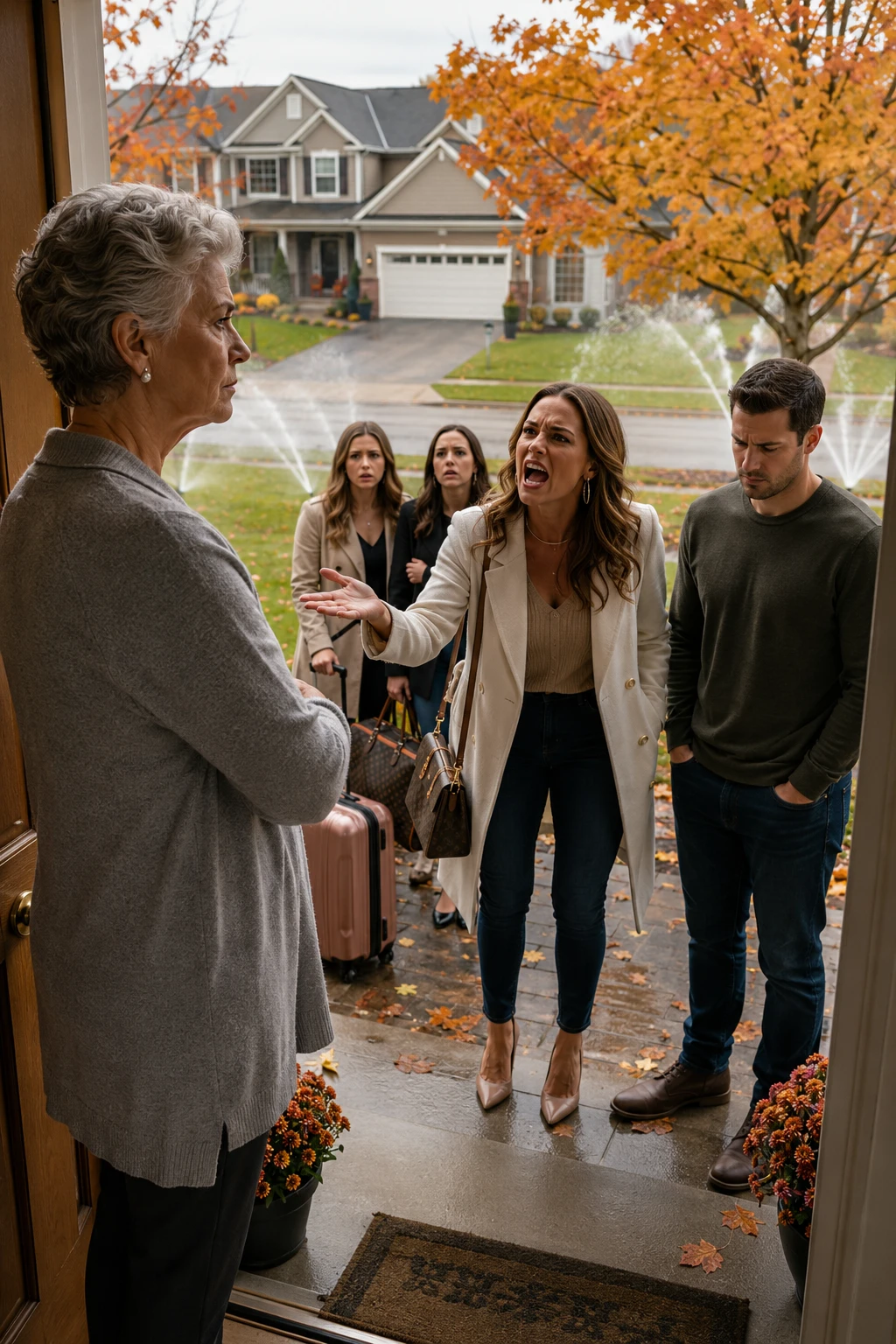
The next morning, Sarah arrived at 7:12.
She didn’t knock.
She slammed both fists against my door.
“Melinda!”
I watched through the security monitor.
Brooke stood near the driveway, arms crossed.
David was nowhere to be seen.
Sarah shouted, “We need to talk!”
I used the intercom.
“My attorney will speak with you.”
“You are destroying your own son!”
“No, Sarah. I’m finally refusing to rescue him.”
Her face hardened.
“You think you’re clever because you found one application?”
One application.
The phrase made my blood run cold.
I opened the recording app on my phone.
“What does that mean?”
She smiled.
“You don’t even know what Robert left behind.”
My breath caught.
“What did you say?”
“Your husband wasn’t the saint you think he was.”
Then she walked away.
For the first time since this began, fear replaced anger.
Sarah had invoked Robert.
And Robert had been dead four years.
I called my lawyer, Margaret Ellis, immediately.
Margaret had handled Robert’s estate.
She was seventy-two, sharp-eyed, silver-haired, and impossible to intimidate.
When I repeated Sarah’s words, Margaret went quiet.
Then she said, “Melinda, come to my office.”
Something in her voice frightened me more than Sarah had.
Margaret closed her office door after I arrived.
“There’s something Robert asked me not to disclose unless a specific condition occurred.”
I stared at her.
“What condition?”
“If anyone attempted to borrow against, transfer, or fraudulently sell the house.”
My skin prickled.
“Why would Robert expect that?”
Margaret opened a safe.
From it she removed a thick sealed envelope.
Across the front, in Robert’s handwriting, were five words.
For Melinda, if they try.
My hands shook.
“They?”
Margaret pushed the envelope toward me.
“I don’t know.”
Inside was a letter.
My husband’s handwriting tilted slightly to the right, just as it had on every birthday card he had ever given me.
Mel,
If you are reading this, someone has tried to take the house.
First: trust Margaret.
Second: do not blame yourself.
Third: the house is not what David believes it is.
I stopped.
“What does that mean?”
Margaret nodded toward the page.
I continued.
Twenty-two years ago, after my mother died, she left me more money than anyone knew. I never told David or Emily because I wanted them to build their own lives.
With part of that inheritance, I created the Hawthorne Family Property Trust.
Your home was placed inside that trust twelve years ago.
Legally, you have lifetime possession and full authority, but the property cannot be mortgaged, pledged, transferred, or sold without approval from all three trustees.
I looked up.
“All three?”
Margaret nodded.
“You’re one.”
“Who are the other two?”
“Keep reading.”
My heart pounded.
The second trustee is Margaret Ellis.
The third is our daughter, Emily.
I covered my mouth.
Emily knew?
Margaret said softly, “Since Robert’s funeral.”
I kept reading.
David does not know because I discovered something years ago that frightened me.
In 2018, David tried to use my identity to guarantee a business loan.
I felt the room tilt.
“No.”
Margaret reached across the desk.
“Keep reading.”
The loan never completed. I confronted him privately. He cried. He promised it would never happen again. I believed fathers should give sons another chance.
But I also protected you.
If David ever tries again, do not save him from the consequences.
Melinda, love is not the same as surrender.
Robert.
I sat motionless.
David had done this before Sarah.
Sarah hadn’t corrupted my son.
She had simply discovered who he already was.
That afternoon I called Emily.
She answered on the second ring.
“Mom?”
“You knew.”
Silence.
Then she exhaled.
“Dad made me promise.”
I started crying.
Not loudly.
Just the quiet tears that come when grief finds a new doorway.
“Why didn’t you tell me?”
“Because Dad thought knowing would make you treat David differently.”
“I should have treated him differently.”
“No,” Emily said. “You treated him like your son.”
I closed my eyes.
“Emily, did Sarah know about the trust?”
“No.”
“Then why did she mention Robert?”
Emily went quiet.
“I don’t know.”
That answer bothered me.
Sarah knew something.
But not enough.
Two days later, the bank’s fraud department contacted Margaret.
The home-equity application wasn’t the only problem.
There had been three previous attempts to verify ownership.
Two online.
One by phone.
All traced to an IP address associated with Sarah and David.
Then came something stranger.
The bank representative told us the application listed an alternate contact.
A man named Michael Trent.
I had never heard the name.
Margaret had.
Her expression changed immediately.
“Robert worked with a Michael Trent.”
My stomach dropped.
“Doing what?”
“Private investments.”
We searched old estate records.
Nothing.
Then Emily remembered a locked filing cabinet in Robert’s workshop.
The locksmith opened it that evening.
Inside were tax statements, insurance records, photographs—
and one small black notebook.
Robert’s handwriting filled the pages.
Dates.
Payments.
Names.
One name appeared repeatedly.
Michael Trent.
Beside the final entry, written seven years earlier, Robert had added:
D. must never know.
D.
David?
The notebook led Margaret to an old LLC registered in Delaware.
The company owned one asset.
The very property Brooke intended to buy.
The distressed house outside Dublin.
Except it wasn’t distressed.
And Brooke wasn’t buying it from a stranger.
The owner was the Hawthorne Investment LLC.
Robert’s company.
I stared at Margaret.
“This is impossible.”
“Robert retained it through the trust.”
“Then why would Brooke need $280,000 to buy a property my family already owns?”
Margaret slowly leaned back.
“Because she wasn’t buying it.”
The truth arrived piece by piece.
Brooke and Sarah had discovered that the LLC owned the property, but they believed David was the beneficiary.
They planned to borrow against my house, transfer the $280,000 through Brooke’s renovation company, and then claim the investment property through David.
It was money laundering disguised as a house flip.
But one question remained.
How did they know about Robert’s secret LLC?
David.
Margaret arranged a meeting.
Sarah arrived with an attorney.
David arrived alone.
Brooke didn’t come.
We sat around a conference table.
Sarah crossed her legs confidently.
“This whole thing has been exaggerated.”
Margaret placed the forged loan application on the table.
Sarah’s smile faded.
Then Margaret placed the trust documents beside it.
Sarah stared.
“What is that?”
“The deed structure for Melinda’s home.”
Sarah read the first page.
Her face went pale.
“You can’t mortgage it,” Margaret said. “You never could.”
Sarah turned toward David.
“You told me she owned it outright.”
David looked stunned.
“I thought she did.”
Margaret added another document.
“And the property you intended to purchase through Brooke?”
Sarah stopped breathing.
Margaret slid forward the ownership record.
Hawthorne Investment LLC.
Sarah whispered, “No.”
David stared at me.
“What is this?”
I said nothing.
Margaret answered.
“Your father’s trust owns that property too.”
David pushed back from the table.
“You’re lying.”
Then something extraordinary happened.
Sarah laughed.
Not nervously.
Not hysterically.
Coldly.
She looked at David with contempt.
“You idiot.”
Everyone turned toward her.
David blinked.
“What?”
Sarah reached into her handbag.
She pulled out her phone.
“You told me you inherited that property.”
David’s face changed.
I looked at him.
“What?”
Sarah continued.
“You told me your father secretly left it to you.”
David shook his head.
“Sarah—”
“You said your mother was too stupid to know what she owned.”
My stomach twisted.
David stood.
“Shut up.”
Sarah stood too.
“No. You shut up.”
Then she turned to me.
“Your precious son came to me with this plan.”
The room went silent.
“Sarah,” David warned.
She ignored him.
“He told me about the Dublin property. He said Robert had hidden investments and that once you were out of the house, he could get control of everything.”
I stared at David.
He looked trapped.
Sarah kept talking.
“The loan was his idea.”
David shouted, “You forged her name!”
“Because you gave me copies of her signature!”
My heart stopped.
David’s face collapsed.
Sarah pulled up messages.
Hundreds of them.
Plans.
Photos of my financial documents.
Discussions about moving me into assisted living.
Messages from David.
Not Sarah.
Once Mom’s out, we sell fast.
She won’t fight me.
She always forgives me.
I could barely breathe.
Then Sarah said the cruelest thing of all.
“He told me Robert wanted him to have everything.”
David whispered, “Dad did.”
Margaret looked at him.
“No.”
David turned.
“My father told me—”
“No,” Margaret repeated.
She opened Robert’s sealed file.
“There is one final document.”
She placed an envelope before David.
His name was written across it.
For David.
My son stared at his father’s handwriting.
His hands began to shake.
He opened it.
Inside was one page.
David,
If you are reading this, then you tried again.
I hoped I was wrong about you.
The Dublin property was never your inheritance.
It was a test.
Years ago, when you attempted to use my identity for that business loan, I told you about the property deliberately. I told you enough to make you believe it might someday be yours.
But I never transferred it.
If greed ever brought you back to it, Margaret would know exactly what you were trying to do.
I loved you.
But I stopped trusting you long before I died.
Dad.
No one moved.
David read the letter again.
Then again.
His face seemed to age ten years.
Robert had known.
My husband had seen something in our son that I had refused to see.
And from beyond the grave, he had built a trap around the very thing David believed he could steal.
David looked at me.
“Mom…”
I stood.
For once, I didn’t feel like rescuing him.
I felt free.
Sarah eventually accepted a plea agreement related to forgery and attempted financial fraud.
Brooke cooperated with investigators and provided records proving David had orchestrated much of the scheme.
David lost his job.
He also lost his marriage.
Sarah filed for divorce three months later.
But the biggest surprise came when Margaret finished reviewing Robert’s trust.
The Dublin property was sold legally the following spring.
After taxes and expenses, it produced just over $640,000.
I assumed the money would remain in the trust.
Instead, Margaret handed me another instruction from Robert.
Use the proceeds for the person in our family who understood what home actually means.
I looked at Emily.
She smiled.
“Nope.”
The money wasn’t for her.
Robert had directed it toward a nonprofit housing fund for widows over sixty who had been financially exploited by relatives.
I laughed through tears.
“That man.”
Margaret smiled.
“He planned everything.”
A year after Sarah tried to move me onto my couch, the first three women moved into newly purchased homes through the Robert Hawthorne Home Again Fund.
I attended every closing.
At the third one, a seventy-one-year-old woman named June hugged me and whispered, “My grandson told me I’d end up with nothing.”
I held her hands.
“So did mine.”
That evening, I returned home.
My home.
The oak table was still scratched.
Robert’s photograph still stood near the door.
And upstairs, the master bedroom remained exactly where it had always been.
Sometimes I still wake expecting to hear Robert breathing beside me.
Sometimes grief is a room you never truly leave.
But now I understand something he tried to teach me for years.
Love does not require blindness.
Forgiveness does not require access.
And family does not earn the right to destroy you simply because they share your blood.
David writes occasionally.
I read the letters.
I haven’t invited him back.
Maybe one day that will change.
Maybe it won’t.
But the last letter he sent contained only one sentence.
Dad knew me better than I knew myself.
I placed it inside Robert’s old fireproof box.
Beside the forged loan application.
Beside the assisted-living brochure.
Beside Robert’s final letter to me.
Then I closed the lid.
Locked it.
And walked upstairs.
Not to the couch.
Not to some facility chosen by people waiting for me to disappear.
I walked into the bedroom Robert and I had shared for thirty-seven years, opened the curtains, and watched evening sunlight pour across the floor.
For most of my life, I had believed keeping peace meant keeping quiet.
I know better now.
Sometimes the most loving thing you can finally say is no.
And sometimes the dead leave behind more than memories.
Sometimes they leave the truth exactly where greed will eventually find it.