My Husband Walked Into Divorce Court Smiling, Certain the Prenup Would Leave Me With Absolutely Nothing—Until the Judge Turned to Article Twelve, and One Forgotten Clause Stripped Away Everything He Thought He Had Protected.
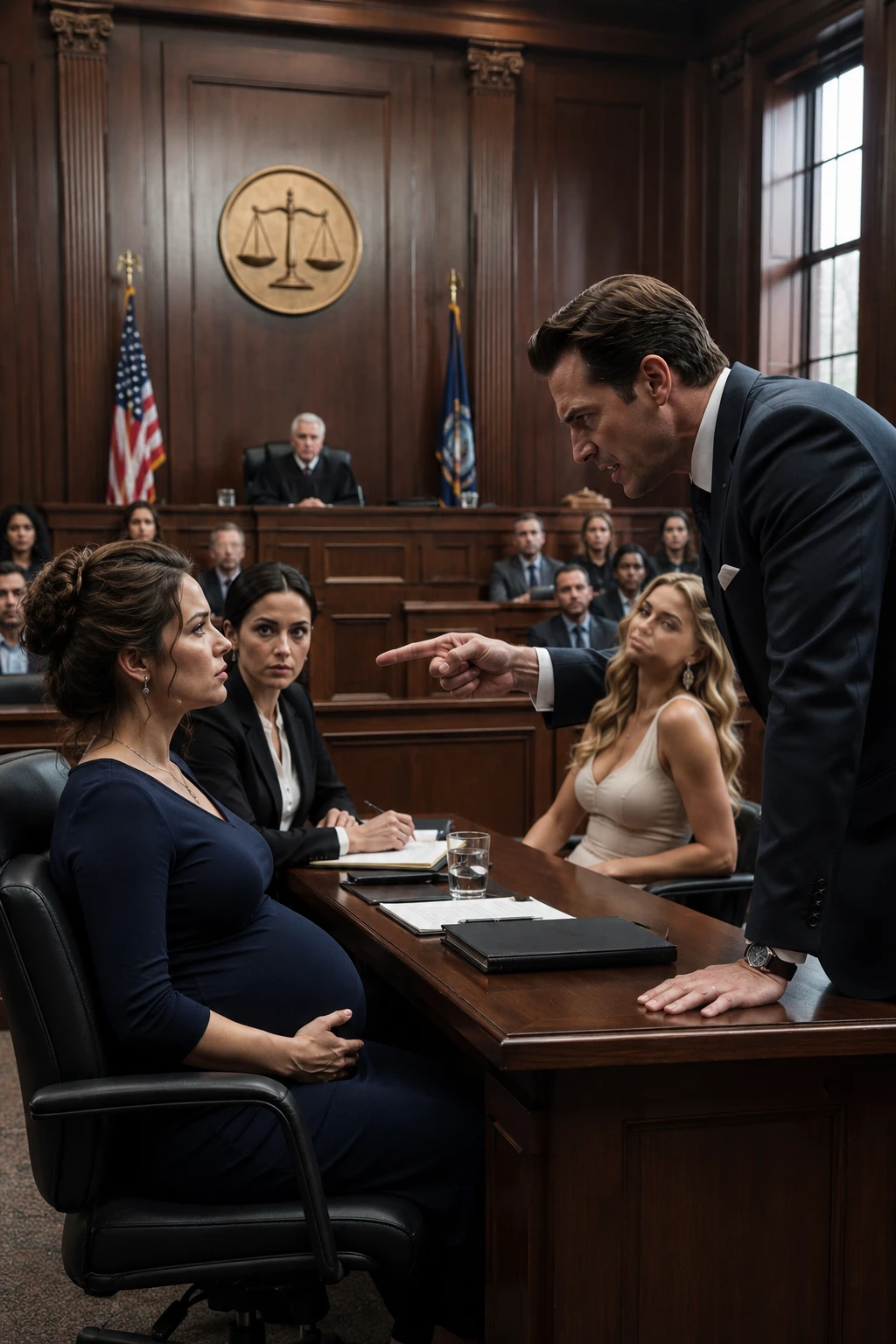
The man who had promised I would leave our divorce with nothing looked at my eight-month-pregnant belly in open court—and laughed.
Not nervously.
Not awkwardly.
He laughed like a man watching someone walk willingly toward her own execution.
Richard Sterling sat across from me in a charcoal designer suit, one ankle resting casually over his knee, the silver face of his watch catching the courtroom lights.
Behind him sat Ava Monroe, his twenty-three-year-old girlfriend, wearing my grandmother’s sapphire earrings.
The earrings that had vanished from my jewelry box three months earlier.
Richard followed my gaze and smiled.
“Don’t worry, Caroline,” he whispered. “She wears them better.”
My fingers tightened over my stomach.
Our son moved beneath my navy dress.
I felt his tiny heel press against my ribs.
For him, I stayed calm.
For him, I didn’t scream.
My attorney, Miriam Cole, leaned closer.
“Almost there,” she murmured.
Richard had always mistaken my silence for surrender.
That morning, he was about to learn the difference.
For nearly nine years, I had been Mrs. Richard Sterling.
To the public, that meant penthouses, charity galas, private jets, magazine covers, summer houses, and black-tie dinners where Richard shook hands with senators and CEOs.
People called me lucky.
They never saw me sitting awake at two in the morning helping Richard rewrite investor presentations.
They never saw the spreadsheets I built when Sterling Global was still drowning in debt.
They never knew that when banks refused Richard credit after his father’s disastrous expansion, I used the inheritance my grandmother left me to keep his company alive.
Richard promised he would never forget.
Eventually, he did.
Success changed him slowly.
Then all at once.
At first came the late meetings.
Then the locked phone.
Then perfume I didn’t wear.
When I was six months pregnant, I found a hotel invoice tucked inside a folder marked “Logistics.”
Presidential suite.
Two guests.
Three nights.
There were more.
Chicago.
Miami.
Aspen.
Paris.
Then hidden accounts.
Jewelry purchases.
Private transfers.
A beach villa rented in Ava’s name.
Thousands of deleted messages recovered from an old synced tablet Richard had forgotten existed.
When I confronted him, I expected denial.
Instead he poured himself bourbon.
“You went through my private records?”
“You’re sleeping with someone.”
He took a drink.
“You’re pregnant and emotional.”
I stared at him.
“Who is she?”
Richard sighed as if I had inconvenienced him.
“Ava understands what my life requires.”
Something inside me went still.
“What about our son?”
His eyes flicked toward my stomach.
“You wanted the baby more than I did.”
Those words hurt worse than the affair.
Then came his final threat.
“You signed a prenup, Caroline. If you make this ugly, you leave with exactly what you brought into this marriage. Nothing more.”
He smiled.
“And I’ll make sure everyone knows why.”
Within two weeks, stories began appearing online.
Sources close to Richard Sterling claimed his pregnant wife had become unstable.
Then greedy.
Then vindictive.
His attorneys accused me of using our unborn child as leverage.
His publicist suggested I was demanding hundreds of millions.
None of it was true.
But Richard understood something about power.
If you tell a lie loudly enough, people begin asking the victim to prove the truth.
So I stopped defending myself publicly.
I hired Miriam.
And I started collecting evidence.
We discovered money routed through shell companies, luxury purchases disguised as consulting costs, offshore transfers, and corporate funds used to finance Richard’s relationship with Ava.
But the prenup was brutal.
Richard’s attorneys had designed it that way.
I had waived claims to most marital appreciation, investment growth, corporate ownership, and real estate.
Then, three weeks before our hearing, Miriam and I visited an old Sterling family records office in Connecticut.
We were looking for a business valuation.
Instead, I found a dusty box containing the original prenup.
“Same document,” Miriam said.
I almost closed it.
Then I noticed handwritten initials beside Article Twelve.
Mine.
Richard’s.
And those of his late father, George Sterling.
I read it.
Then read it again.
“Miriam?”
She looked over.
Her expression changed.
“Oh my God.”
Article Twelve was called the Integrity Preservation Provision.
George Sterling had insisted upon it after Richard’s uncle nearly destroyed the family company through hidden debts.
The clause stated that if either spouse intentionally concealed marital property, fraudulently transferred protected assets, misused family corporate funds for undisclosed personal purposes, or attempted to hide assets during dissolution, the prenup’s protections could be suspended against the offending spouse.
Richard hadn’t merely cheated.
He had potentially activated the one provision capable of opening everything he believed protected.
But Miriam warned me not to celebrate.
“We still have to prove intent.”
That was why we came prepared.
Now, inside the courtroom, Richard’s attorney finished praising the prenup as “unambiguous.”
Ava smirked.
“That’s more than she deserves,” she whispered.
Judge Harrison looked up.
Miriam stood.
“Your Honor, before enforcement, we ask the court to review Article Twelve.”
For the first time, Richard moved.
Only slightly.
But I saw it.
His smile died.
His attorney flipped rapidly through the agreement.
“What is she talking about?” Ava whispered.
Richard didn’t answer.
Judge Harrison found the section.
He read silently.
The courtroom became so quiet I could hear the air-conditioning vent above us.
Finally he said, “Counsel, proceed.”
Miriam opened her first folder.
“Sterling Global funds were used to pay for personal travel involving Mr. Sterling and Ms. Monroe.”
Richard’s lawyer stood.
“Those expenditures were authorized executive expenses.”
Miriam nodded.
“That was our assumption too.”
She produced emails.
“Until we obtained internal correspondence instructing accounting staff to classify romantic travel as acquisition meetings for companies that do not exist.”
Richard’s jaw tightened.
Miriam continued.
A villa in St. Barts.
A Manhattan apartment leased through a shell corporation.
Designer jewelry.
Ava’s car.
Payments to a public-relations firm used to spread false claims about me.
Then Miriam placed a photograph of my grandmother’s sapphire earrings before the judge.
“These are Mrs. Sterling’s separate inherited property.”
Every eye turned toward Ava.
Her hand immediately touched her ear.
Richard hissed, “Take those off.”
Ava looked at him.
“You said they were yours.”
“Take them off.”
The first crack appeared.
Then Miriam lifted a sealed envelope.
“This, Your Honor, is why we requested emergency financial review.”
Richard stood.
“What document?”
His attorney grabbed his sleeve.
“Sit down.”
Judge Harrison opened the envelope.
His eyes moved across the first page.
Then the second.
His expression hardened.
“Mr. Sterling,” he said, “is Sterling Global currently solvent?”
Richard blinked.
“Of course.”
“Answer carefully.”
Richard glanced at his lawyer.
“Yes.”
Judge Harrison turned to Miriam.
She nodded.
“Your Honor, the forensic accounting report indicates Mr. Sterling has been borrowing against protected family holdings while publicly representing those assets as unencumbered.”
A murmur moved through the gallery.
Richard’s face went pale.
“That’s false.”
Miriam didn’t look at him.
“The report estimates undisclosed liabilities exceeding $640 million.”
Ava gasped.
Richard shot to his feet.
“That is confidential corporate information!”
Judge Harrison’s voice cracked through the room.
“Sit down, Mr. Sterling.”
Richard sat.
Barely.
I stared at Miriam.
I knew about irregular loans.
I had not known the number.
She had kept that final figure from me until the forensic report was complete.
Richard’s fortune wasn’t nearly as solid as the world believed.
But the next revelation shocked even me.
Miriam produced a second file.
“There is another issue.”
Richard’s lawyer whispered, “No.”
That single word made my skin prickle.
Miriam turned toward me.
“Caroline, do you remember the eighteen-million-dollar trust distribution from your grandmother?”
“Yes.”
“You invested eleven million of that into Sterling Global during its restructuring eight years ago.”
Richard laughed suddenly.
“A loan that was repaid.”
Miriam faced him.
“No.”
She lifted the original investment agreement.
“It was never a loan.”
Richard froze.
My heart began pounding.
I had signed so many papers during those desperate early years that I barely remembered them.
Miriam continued.
“George Sterling structured Caroline’s contribution as preferred founding equity in the reorganized holding company.”
My mouth went dry.
“What?”
Richard whispered.
“No.”
His lawyer closed his eyes.
Miriam looked directly at Richard.
“Your father converted her investment into equity because the bank required new capital to remain in the business.”
“That was temporary.”
“Apparently not.”
Richard shook his head violently.
“My father transferred it.”
“He tried.”
Miriam held up another document.
“But under the company charter, preferred founding shares could only be transferred with the shareholder’s notarized consent.”
She turned toward me.
“Caroline never signed one.”
The room seemed to tilt.
I whispered, “What does that mean?”
Miriam smiled for the first time that day.
“It means you still own twenty-six percent of Sterling Global’s controlling holding company.”
Richard slammed both hands on the table.
“That is impossible!”
Judge Harrison immediately warned him.
Ava stared at Richard.
“You told me you owned everything.”
“Shut up.”
Her face changed.
“What did you just say?”
“Not now, Ava.”
Miriam wasn’t finished.
“Because Caroline’s ownership predates several later restructurings, her consent was legally required for substantial borrowing against core assets.”
Richard’s attorney looked sick.
Judge Harrison glanced back at the forensic report.
“Were these loans approved by Mrs. Sterling?”
“No,” Miriam said.
Richard looked at me as if seeing me for the first time.
I remembered all those years.
All the dinners.
All the speeches.
All the times Richard thanked investors while I stood smiling beside him.
I remembered him calling me predictable.
Useless.
Lucky.
He had built his empire on money I brought into the marriage—and then forgotten I still owned part of the foundation.
Judge Harrison ordered an immediate freeze on several disputed assets pending investigation.
Richard began arguing.
His attorney begged him to stop.
Then Ava suddenly stood.
“I’m leaving.”
Richard spun toward her.
“Sit down.”
“No.”
She removed my grandmother’s earrings and dropped them onto the table.
“You said Caroline was crazy. You said the company had billions in cash.”
Richard’s face twisted.
“You knew I was married.”
“Yes, but I didn’t know you were broke!”
Gasps erupted.
Ava grabbed her purse.
Richard caught her wrist.
Judge Harrison stood.
“Mr. Sterling!”
A deputy moved forward.
Richard released her.
Ava stumbled backward.
And something fell from her purse.
A small black flash drive.
Miriam’s eyes locked onto it.
Ava went white.
Richard did too.
I felt a strange chill.
“Ava,” I said quietly. “What is that?”
“N-nothing.”
Richard barked, “Give it to me.”
That was the moment everything changed.
Ava grabbed the drive first.
“No.”
Richard lunged.
The deputy stepped between them.
Judge Harrison ordered everyone still.
Ava began crying.
“I didn’t know what it was at first.”
Richard stared at her with naked panic.
“Don’t.”
She looked at the judge.
“He gave me files to keep at my apartment because he said Caroline was searching his office.”
Richard shouted, “She stole them!”
Ava flinched.
“You told me they were backups.”
Miriam asked, “Backups of what?”
Ava swallowed.
“Accounts.”
Richard closed his eyes.
“And recordings.”
The room went silent again.
Judge Harrison ordered the drive secured.
Because it involved possible corporate fraud, the court recessed while officers contacted financial investigators.
Richard was no longer smiling.
He was sweating.
For twenty minutes we waited.
Then Miriam came back from the hallway looking stunned.
“What?”
I asked.
She sat beside me.
“They previewed one audio file.”
My heart climbed into my throat.
“What does it say?”
She lowered her voice.
“Richard talking to his CFO.”
“And?”
“He says once the divorce is final, he’s moving the remaining liquid reserves offshore before creditors discover the liabilities.”
I looked across the room.
Richard had spent months calling me greedy.
He had been preparing to loot his own company.
But Miriam looked shaken for another reason.
“There’s more.”
“What?”
“Your name.”
Before she could explain, the doors opened.
Two federal agents entered.
Richard’s attorney stood so fast his chair tipped backward.
One agent approached Richard.
“Richard Sterling?”
His face turned gray.
“Yes?”
“We need to speak with you regarding allegations of securities fraud, fraudulent conveyance, and obstruction.”
Ava began sobbing.
Richard looked at me.
For the first time in nine years, there was no arrogance in his face.
Only fear.
“This is your fault.”
I almost answered.
Then another voice came from the back of the courtroom.
“No, son.”
Everyone turned.
An elderly man stood near the doors, leaning on a cane.
I stopped breathing.
Richard looked as if he had seen a ghost.
“Dad?”
George Sterling had supposedly died eighteen months earlier.
I had attended his funeral.
I had watched Richard scatter his ashes.
Yet George Sterling was standing ten yards away.
Alive.
Richard whispered, “That’s not possible.”
George slowly entered the courtroom.
His shoulders were thinner.
His hair completely white.
But it was him.
Miriam stared at me.
I could barely speak.
“George?”
He looked at me with tears in his eyes.
“I’m sorry, Caroline.”
Richard backed away.
“You died.”
“No.”
“You—”
“I disappeared.”
The entire room seemed suspended.
George explained.
Eighteen months earlier, he had discovered Richard using hidden debt to inflate Sterling Global’s apparent value.
When George confronted him, Richard threatened to have him declared mentally incompetent and remove him from the board.
George feared Richard had already bribed people around him.
So with help from his longtime attorney and a federal investigator, George staged his death while secretly cooperating with authorities.
The funeral had contained cremated remains from a legally donated anonymous source.
Only three people had known.
He had been building the case ever since.
Richard stared at his father.
“You destroyed me.”
George’s expression broke.
“No, Richard. I spent my life protecting you from consequences.”
He looked toward me.
“And I nearly let you destroy the one person who helped build everything.”
Then George revealed the final truth.
The most shocking truth of all.
When he discovered the scale of Richard’s fraud, he reviewed the holding company’s succession documents.
Because my twenty-six percent preferred equity had never been transferred, and because Richard had violated the company’s integrity provisions, a dormant emergency-control clause had automatically activated months earlier.
George looked directly at me.
“Caroline, your shares carry enhanced voting rights when a controlling executive commits documented fraud.”
I stared at him.
“What are you saying?”
He smiled sadly.
“I’m saying Richard stopped controlling Sterling Global the moment his fraud was verified.”
Richard shook his head.
“No.”
George continued.
“The next largest legitimate voting block is mine.”
Richard whispered, “Dad…”
“And this morning, before I came here, I signed my voting proxy.”
He walked to my table.
Then he placed a document in front of me.
My hands trembled as I read it.
George Sterling had given me voting authority over his shares.
Combined with mine—
I controlled fifty-one percent.
Richard looked at the paper.
Then at me.
His mouth opened.
Nothing came out.
“You said I would leave with nothing,” I whispered.
He stared.
I placed one hand over my son.
“I’m leaving with my child, my grandmother’s property, my name, my dignity…”
I slid the proxy toward Miriam.
“And apparently your company.”
A laugh escaped someone in the gallery.
Richard’s face collapsed.
The federal agents stepped closer.
Ava moved away from him.
George lowered himself into the chair behind me.
Judge Harrison reviewed the documents and ordered further proceedings on Article Twelve.
Two weeks later, the family court ruled that Richard’s intentional concealment and fraudulent transfers triggered the prenup’s penalty provision.
I received restitution for misused marital assets.
My inherited property was returned.
The smear campaign became evidence against him.
And the criminal investigation expanded.
Three months later, I gave birth to a healthy baby boy.
I named him George, not because the older George had been perfect, but because he had finally chosen truth over blood.
Richard was indicted on multiple federal charges.
Ava cooperated with prosecutors in exchange for immunity on lesser financial offenses.
The billionaire magazines stopped calling him a genius.
They began calling him a defendant.
As for Sterling Global, the debt was enormous.
I could have sold my controlling interest and disappeared.
Instead, I walked into the boardroom where Richard had once told everyone I “didn’t understand business.”
I replaced the executives who helped hide his fraud.
We sold unnecessary assets.
Settled legitimate obligations.
Protected employee pensions.
And rebuilt.
Two years later, the company posted its strongest honest quarter in a decade.
At the annual shareholder meeting, I stood backstage before walking out to speak.
My son was in George’s arms.
The old man smiled.
“Nervous?”
“A little.”
He nodded toward the stage.
“You saved the company.”
I shook my head.
“No.”
I looked at the audience waiting beyond the curtain.
“I stopped saving the man who was destroying it.”
That was the real difference.
Richard had always believed power meant controlling everyone around him.
He believed money could rewrite truth.
He believed a contract could make betrayal consequence-free.
And he believed the quiet pregnant woman sitting across from him in court was the weakest person in the room.
But the prenup he trusted most contained the clause he forgot.
The fortune he claimed to build alone began with money he forgot was mine.
The mistress he flaunted carried the evidence he tried to hide.
The father he thought was dead had been documenting his crimes.
And the wife he planned to leave with nothing became the person holding the deciding vote over everything he had spent his life trying to own.
Before walking onto the stage, I glanced at the sapphire earrings now resting safely in a small velvet box inside my purse.
I never wore them again.
Instead, when my son turned eighteen, I planned to tell him the story behind them.
Not the story of a rich family.
Not the story of revenge.
The story of a woman who finally understood that silence is not always surrender.
Sometimes, silence is preparation.
Sometimes, the person saying the least is simply waiting until the truth becomes impossible to ignore.
And sometimes the weapon someone carefully designs to destroy you…
becomes the very thing that hands you the key to their kingdom.