Part 3 – The Daughter Who Never Wrote Back
Richard Hail did not reach into the red leather folio immediately. He glanced first at Gerald, then at the guests gathered around the nearest tables, as though calculating how many people would need to be convinced before the evening could be brought back under control. The ballroom had grown so quiet that I could hear the faint hiss of the ventilation above the chandeliers and the uneven clink of ice settling in someone’s abandoned glass. Beyond the windows, the country club grounds lay black beneath the October sky, but inside, two hundred and fifty people were waiting for my father to explain why he had kept fifteen years of my life from his younger daughter.
Richard unfastened the brass clasp.
“Before we turn this into something it isn’t,” he began, his voice carrying the practiced patience of a man accustomed to explaining unfavorable terms to people who had already agreed to sign them, “I want everyone to understand that Gerald has been extraordinarily generous with both his daughters. He’s supported Clare financially, provided her with every opportunity, and made considerable sacrifices to preserve the family through some difficult years.”
“Richard,” Clare said, still holding the microphone, “I asked for a letter.”
“And a letter is precisely what you’re going to see.” He slid a thin sheet of paper from an inner pocket of the folio, its edges protected by a transparent sleeve. “But context matters. Especially when accusations are being made in front of two hundred and fifty guests.”
He handed the paper to Gerald.
My father accepted it without looking down. He seemed to enjoy the small ceremony of possession, the way the room waited while he held a document that supposedly contained the answer to everything. His wedding suit fit perfectly, his silver cuff links caught the chandelier light, and his expression had settled into the grave, wounded dignity he wore whenever he wanted other people to mistake control for suffering.
“Clare,” he said, “you wanted proof. Here it is.”
He offered the letter to her.
She did not take it.
“Read it,” she said.
Gerald’s mouth tightened. For a moment, I thought he might refuse, but the audience mattered too much to him. He unfolded the sheet with deliberate care, smoothing a crease with his thumb before lifting it high enough for those nearest the head table to see. The paper was ordinary white stock, the sort that came in boxes of five hundred, and the text had been typed in a plain black font without a letterhead or an address.
He began reading.
“Evelyn, I have had enough time to understand that you made your choice and that our lives no longer have anything in common. You left this family because you wanted to, and I do not intend to spend the rest of my life being reminded of that decision.”
My fingers tightened around the stem of my wineglass.
Gerald continued, his voice steady and almost tender, as though he were reading a difficult passage from a family Bible.
“Please stop writing to me and stop trying to contact me through other people. I don’t want you involved in my life, and I don’t want you contacting me again. You made it clear where your priorities were when you walked away. I have mine now. Respect my wishes and leave me alone.”
He lowered the paper.
At the bottom, beneath the typed paragraphs, was a handwritten signature.
Clare.
For one terrible instant, the ballroom seemed to tilt. I recognized the name, of course. I had written it thousands of times in birthday cards, on envelopes, on the little notes I used to slip under her bedroom door when our father was in one of his moods. But the sight of it at the bottom of those words brought back a feeling I had spent years teaching myself to live without: the sick, helpless certainty that the person you loved most had decided you were no longer worth the trouble.
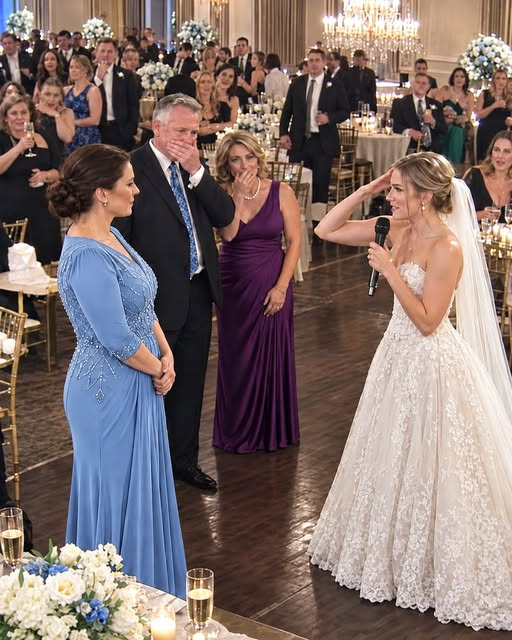
Clare stared at the sheet in Gerald’s hand. Her face had gone pale beneath her makeup, and the fingers wrapped around the microphone were trembling so badly that its metal body tapped against her wedding ring.
“I never wrote that,” she said.
My father looked at her with an expression of exhausted disappointment.
“Of course you would say that now.”
“I never wrote it.”
“You were a teenager when Evelyn left. You were angry, confused, and frightened. You told me repeatedly that you didn’t want her coming back and disrupting your life.”
“I told you I wanted my sister.”
A murmur moved through the ballroom, passing from table to table like a draft beneath a closed door. Somewhere near the bar, a chair scraped against the floor, and a guest who had been holding a champagne flute lowered it without drinking. Richard’s eyes moved toward the guests, measuring the damage, but Gerald remained focused on Clare.
“You were fifteen,” he said. “You were dependent on me. I had to make decisions you weren’t old enough to understand.”
“And that means you can put words in my mouth?”
“It means I had to protect you from a situation you could not possibly comprehend.”
I looked at the letter again, trying to separate the words from the memory they had awakened. Fifteen years earlier, after I arrived at my first duty station, I had called home whenever I could. Some calls went unanswered. Others ended with Gerald picking up, his voice clipped and impatient, telling me Clare was busy with school or that she had no interest in speaking to me. I had believed him because I had no reason to imagine that my own father would deliberately manufacture my sister’s rejection.
Then, one evening, he had reached me before I could call again.
I remembered the room where I had taken the call, the harsh fluorescent lights and the smell of floor polish, the fatigue that had settled into my bones after a day of training. Gerald had spoken with the cool certainty of a man delivering a decision that had already been made.
“Clare doesn’t want you contacting her anymore,” he had said. “She’s asked me to make that clear.”
I had asked to hear it from her.
He told me she had already said everything she needed to say.
I had asked him to let me speak to her for five minutes, just five, but he had refused. Then he had warned me that if I kept calling, I would make things worse for everyone, especially Clare. I had spent that night sitting on the edge of my narrow bed, staring at the telephone, trying to decide whether loving my sister meant respecting a boundary she had never spoken to me directly.
I had never seen the original letter Gerald was now holding.
At the time, I had accepted his account because it fit the cruelest explanation for my own departure. I had chosen the Air Force. I had walked out of the family business. I had left Clare behind, and perhaps, I had told myself, she had decided that the price of loving me was too high.
I had carried that belief through deployments, promotions, funerals, and homecomings. I had carried it into rooms where people trusted me with decisions that could determine whether dozens of lives would be saved or lost. I had learned to make choices under pressure without allowing doubt to paralyze me, but I had never found a way to make peace with the possibility that my little sister had wanted me gone.
Now she stood in a wedding dress beneath a chandelier, looking at a letter she swore she had never written, while our father used it as a weapon.
“May I see it?” I asked.
Gerald’s gaze snapped toward me.
“No.”
“Then why bring it out?”
“Because Clare demanded proof, and I have provided it.”
“You’ve provided a sheet of paper with a signature at the bottom. That’s not the same thing as proving who wrote it.”
Richard slipped a hand into the pocket of his jacket. “Evelyn, with respect, you’re not a handwriting examiner. Neither are we. The document is consistent with what Gerald has told us for years, and there is no reason to turn this into an investigation.”
“Then you shouldn’t be afraid of anyone examining it.”
His expression hardened.
I watched my father fold the paper along its original crease. He did it carefully, protecting the signature from the edge of his thumbnail, and tucked it back into the transparent sleeve. The gesture struck me as more revealing than his words. He was not handling a painful family memory. He was protecting an exhibit.
Clare lowered the microphone slightly.
“Let me read it myself.”
Gerald held the letter against his chest. “You’ve read enough.”
“No, Dad. I haven’t. You read it to the room, but you won’t let me hold it.”
“Because you’re upset.”
“I’m upset because you just showed me a letter in my own name that I never wrote.”
“Your memory is not infallible, Clare.”
“And yours is?”
The question landed harder than its volume suggested. Gerald’s jaw shifted, and for the first time that evening, the guests were not looking at me as the embarrassing daughter at the last table. They were watching him struggle to keep his younger daughter from asking a question he could not answer without changing the shape of the family story.
He glanced toward David.
“Perhaps your husband can explain to you that this is not the appropriate way to handle a private disagreement.”
David had been standing beside the head table, one hand resting on the back of Clare’s chair. He wore a dark suit and a pale tie, and his expression was composed in the way of someone who had spent a long time listening before deciding that listening was no longer enough.
“Clare is asking about her own correspondence,” he said. “I don’t see how that becomes inappropriate simply because other people can hear her.”
“You’re a newly married man,” Gerald replied. “I would advise you to be careful about involving yourself in matters that existed long before you arrived.”
David’s hand remained on the chair.
“I’m already involved. I married her.”
Margaret drew a sharp breath behind my father. Her red dress glittered whenever she moved beneath the lights, and the pearls around her throat seemed almost too bright against her skin. She looked from David to Clare, then toward the guests, where several people had stopped pretending not to listen.
“Gerald, perhaps we should take this somewhere private,” she said. “This is a wedding reception, not a courtroom.”
“An excellent suggestion,” Richard added quickly. “We can review the relevant documents with Clare tomorrow, when everyone has had time to calm down. There’s no need to make decisions in front of a room full of people who have no understanding of the circumstances.”
Clare looked at him.
“You brought the letter into the room.”
Richard’s mouth opened, then closed.
“You brought it out,” she continued, “and Dad read it into a microphone. You don’t get to call it private after that.”
A flush crept up Richard’s neck. He had built a career around making complicated transactions sound inevitable, and I suspected that being contradicted by a bride in front of his business associates was an unfamiliar experience. His attention shifted to the folio, which he held close against his side, and his fingers curled around the leather edge.
Gerald noticed the movement.
“Enough,” he said, with the flat authority that had once ended every argument in our house. “Clare, you have had a beautiful wedding. David is a good man. You have a future to look forward to, and I will not allow an old grievance to poison it.”
“An old grievance?” Clare repeated. “You hid letters from my sister.”
“I protected you.”
“From what?”
He gave a short, humorless laugh. “From the consequences of her choices.”
My father’s eyes settled on me, and I felt the old instinct to brace myself before he spoke. I had been out of his house for fifteen years, but there were moments when my body remembered him faster than my mind could remind it that I was no longer the frightened twenty-two-year-old on his porch. I kept my shoulders level and my hands still, refusing to let the room see the effort it took.
“You want to talk about choices, Evelyn?” he asked. “Fine. You chose to leave. You chose a career that took you away from everyone who cared about you. You chose not to come home when your sister needed you. And now you’ve returned, wearing a uniform in all but name, expecting everyone to applaud you for what you’ve become.”
“I’m not wearing a uniform,” I said. “I’m wearing a dress Clare chose for me to feel comfortable in.”
A few people near the dance floor looked down at their plates, but no one laughed. My father had never understood that humiliation depended on an audience’s cooperation. For years, people had given him what he wanted because it was easier to smile at his jokes than risk becoming the next subject of them.
He leaned toward me.
“Do not confuse your rank with authority in this family.”
“I don’t.”
“Good. Because whatever you’ve achieved in the military, it doesn’t entitle you to dictate how I manage my household.”
“Then stop using your household as an excuse to dictate what everyone else remembers.”
The silence that followed was different from the one before. It was no longer the silence of people waiting for a spectacle; it was the silence of people realizing the spectacle had begun to expose something they might have preferred not to know.
Gerald straightened his jacket.
“Clare, I am going to say this once. Your trust distributions are not an unconditional right to be used however you please. There are provisions in place for circumstances exactly like this, and I can suspend distributions while the trustees review whether you remain capable of managing your affairs responsibly.”
Clare stared at him.
“You would take away my inheritance because I asked about my sister?”
“I would protect the assets I have worked my entire life to preserve from impulsive decisions.”
“Those assets are supposed to provide for me.”
“They provide for you because I allow them to.”
The words escaped him with the ease of long practice. I watched Clare absorb them, and I saw something change in her expression. The shock did not disappear, but it settled into a harder shape, like water turning to ice beneath a winter sky.
Richard moved in before anyone could respond.
“Gerald is speaking about the practical realities of trust administration,” he said. “Not punishment. There are fiduciary obligations that don’t disappear because a family conversation has become emotional.”
He lifted the red folio slightly, the brass clasp catching a bright flash from the chandelier. Until that moment, it had seemed like an accessory he had carried because it belonged to the evening’s business. Now I noticed the way he kept it turned away from Clare, his forearm pressed across its cover as though the documents inside might try to escape.
“Actually,” Richard continued, “there is something else we should settle before the reception ends. I brought the revised trust amendment we discussed. It is a routine administrative measure, and with the wedding complete, it would be sensible for Clare to sign it while all the relevant parties are present.”
Clare’s eyes moved from the folio to Gerald.
“What amendment?”
“The one we discussed last month,” Richard replied. “The update to the trust arrangements. It clarifies certain responsibilities and allows us to complete the transition without unnecessary delay.”
“I don’t remember agreeing to sign anything tonight.”
“No one is asking you to make a new decision,” he said, wearing the patient smile again. “We’re simply formalizing what has already been agreed in principle.”
“I agreed to review the paperwork. I did not agree to sign it at my wedding.”
Richard’s smile weakened, and he turned to Gerald as if expecting him to restore the conversation to its proper order. My father responded with a small movement of his chin, the same signal he had used at business dinners when a subordinate needed to be reminded of the person who paid his salary.
“Clare,” Gerald said, “you know what this family has done for you. The house you grew up in, the education you received, the wedding you’re standing in now. None of it happened by accident. I have spent decades making sure you would never have to worry about the things other people worry about.”
“And now I’m supposed to sign something because you remind me what you paid for?”
“You’re supposed to honor your responsibilities.”
“To whom?”
“To your family.”
She looked at the folio again.
“Or to your company?”
For the first time, Richard’s composure slipped completely. His hand tightened around the leather, and his eyes darted toward my father with a speed that would have escaped most people. I had spent enough years watching senior officers conceal bad news behind calm expressions to recognize the movement. It was the reflex of a man who had just heard a question he had not prepared an answer for.
Gerald stepped between them.
“The business is none of your concern, Clare.”
“Then why does its paperwork need my signature?”
“Because the trust must be administered responsibly.”
“That isn’t an answer.”
“It is the only answer you’re getting tonight.”
The bandleader, still standing near the musicians, made a discreet motion toward his players. The first few notes of a soft instrumental piece floated into the ballroom, then faltered when nobody moved toward the dance floor. A waiter approached the head table with a silver tray of coffee cups, saw the expressions gathered there, and retreated so quickly that the cups rattled against one another.
Clare turned away from Gerald and looked directly at Richard.
“I’m not signing anything tonight.”
“Then we will have to postpone the settlement,” he replied, a little too quickly. “That could complicate the distribution schedule.”
“Postpone it.”
“You may not understand the consequences.”
“Then explain them to me in writing, with enough time for someone independent to review them.”
His face reddened.
“That is an unnecessarily adversarial position.”
“No. It’s a reasonable one. If the amendment is routine, it can survive a review.”
Richard closed his mouth. Gerald looked at his daughter as if she had suddenly begun speaking a language he had never permitted her to learn.
I watched the two men standing on either side of that red folio. Gerald’s wealth had always been described as the foundation of the family, the solid ground beneath our feet. But now, as Richard guarded a stack of papers that could apparently not wait until morning, I wondered whether the foundation was less secure than my father wanted people to believe.
The thought brought me no satisfaction. If the company was in trouble, then there were likely employees whose livelihoods depended on it, people who had never met me and had no idea that the family name on their paychecks was being used as a weapon at a wedding. I had no desire to see innocent people hurt simply because Gerald could not distinguish his authority from his right to control everyone around him.
But I had even less desire to watch Clare surrender her independence because she had been taught to fear what would happen if she disappointed him.
Margaret moved closer to her husband, her fingers closing around his sleeve.
“You’re making this worse,” she whispered.
He turned his head sharply. “You should have thought of that before encouraging her.”
“I didn’t encourage—”
“Not now, Margaret.”
The words were quiet, but she recoiled as though he had slapped her. Her eyes flickered toward me, and something like resentment crossed her face before being replaced by the brittle smile she had worn all evening. I recognized the expression. It was the look of someone who had spent years convincing herself that obedience was the same thing as innocence.
Clare saw it too.
“Margaret,” she said, “you knew about the letters.”
Margaret’s fingers tightened around Gerald’s sleeve.
“I knew your father was handling the correspondence.”
“That isn’t what I asked.”
“Clare, darling, this is not the moment to make accusations you cannot take back.”
“Then help me understand. Did you know Evelyn had been writing to me?”
The room seemed to draw inward around Margaret. She glanced at the guests, at Richard, at the paper Gerald still held, and finally at me. For a moment, I thought she would deny everything. She had been practicing denial for fifteen years, and the habit sat on her as comfortably as the pearls at her throat.
“I knew she had tried to contact you,” she said at last.
Clare’s face changed.
“How many times?”
“I can’t remember every occasion.”
“Was it once? Five times? A dozen?”
“Clare, there were reasons.”
“How many?”
Margaret swallowed. The light caught the fine lines around her mouth, and I saw how carefully she had arranged herself for this evening: the dress, the jewelry, the smooth hair, the expression of serene concern. Every detail had been chosen to suggest a life in which nothing unpleasant happened unless someone brought it in from outside.
“I helped intercept some of her calls,” she admitted. “And I put several letters aside rather than giving them to you.”
The words seemed to remove the air from the ballroom. Clare’s hand dropped from the microphone, and for several seconds she did not speak. Gerald turned toward Margaret with an expression so cold that even Richard took a small step away from him.
“You were not supposed to discuss that,” Gerald said.
Margaret flinched, then lifted her chin.
“You asked me to help.”
“I asked you to maintain order.”
“You asked me to keep her away.”
“Because I was protecting Clare.”
Margaret’s gaze shifted to her stepdaughter. “That’s what he told me. He said Evelyn had become unpredictable, that her military career was changing her, that she was being trained to live with violence and would eventually bring that way of thinking home with her. He said Clare was still young, still impressionable, and that she needed stability more than she needed a sister who had chosen to abandon her.”
I felt something cold move through my chest.
“Did you believe that?” I asked.
Margaret looked at me, and her expression hardened with the defensive urgency of someone who had just been forced to see her own choices described aloud.
“You were very different from the girl who left. You were angry, and you were determined to prove your father wrong. You called at strange hours. You spoke about your training and your plans, and Gerald said you wanted to turn Clare against him.”
“I wanted to speak to my sister.”
“You wanted to take her away from everything she knew.”
“I wanted her to know she could call me if she ever needed me.”
“Gerald said you were making promises you couldn’t keep. He said the Air Force would always come first, that you would encourage Clare to depend on you and then disappear again whenever your duties called.”
I stared at her. I remembered the calls she described, the hours I had spent searching for a quiet corner where I could hear Clare’s voice. I remembered asking Margaret to put her on the phone, hearing the receiver shift in her hand, and being told that Clare was busy. At the time, I had assumed Margaret was simply obeying Gerald’s wishes. I had never imagined she was helping make the absence look like my decision.
“Did you ever let Clare hear me?” I asked.
Margaret’s mouth opened, but no answer came.
“Did you tell her I was calling?”
“I told her you had made your choice.”
“You told her I had abandoned her.”
“I told her what Gerald believed was best.”
“No,” Clare said. Her voice was quiet, but the microphone caught it. “You told me what he wanted me to believe.”
Margaret turned to her, alarm breaking through the composure she had managed to recover.
“I thought I was protecting you.”
“From my own sister?”
“From a future that could have hurt you.”
Clare shook her head slowly. The veil at the back of her hair shifted against the beaded bodice of her dress, and I saw a tear gather at the edge of one eye before she blinked it away.
“You were my stepmother,” she said. “You were the person who stayed in the house with me when Dad was angry. You knew how much I missed Evelyn, and you let me believe she didn’t care enough to come back.”
Margaret’s lips trembled.
“I didn’t know how to challenge him.”
“Neither did I,” Clare replied. “But I was fifteen. You were an adult.”
For the first time, Margaret had no polished phrase ready to cover the damage. She looked toward Gerald as if waiting for him to intervene, to turn the confession into a misunderstanding, to give her a version of events she could repeat until it sounded harmless. He did not help her. His attention had shifted to the guests, where faces that had been politely blank now carried unmistakable questions.
My father could tolerate almost any private sin, provided it remained private. What he could not tolerate was a room full of people discovering that the man who lectured everyone about loyalty had built his own family on deliberate deception.
He pointed toward the microphone.
“Clare, put that down.”
She looked at it, then back at him.
“No.”
“You have made your point.”
“I haven’t even started asking the questions I came here to ask.”
“This is my family.”
“I’m your daughter,” she said. “That doesn’t mean I belong to you.”
His face darkened.
“Be very careful.”
David moved beside Clare, not in front of her, and rested his hand lightly against her back. He did not attempt to take the microphone or speak for her. Instead, he leaned close enough that only she and I could hear his next words.
“Do you want to leave?” he asked.
Clare turned toward him. His expression was gentle, but there was nothing uncertain about it. He had already made his decision: if she wanted to walk out, he would go with her, and he would not ask her to justify it.
“We can be out of here in five minutes,” he continued softly. “I’ll get your coat, and we can have the car brought around. You don’t have to finish this tonight.”
Clare looked past him toward the ballroom doors. The reception decorations gleamed beneath the chandeliers, the flowers arranged in white and pale green, the place settings aligned with the precision of a military inspection. Every detail had been paid for, approved, and supervised by Gerald, who had made sure the room reflected the image of a family that had never suffered a fracture it could not conceal.
“If I leave now,” she whispered, “he’ll tell everyone I was too emotional to understand what happened.”
“Let him.”
“He’ll say Evelyn came back to cause trouble. He’ll say I ruined my own wedding by choosing her over him.”
David’s hand remained steady against her back.
“Then stay because you want to stay. Not because you have to prove anything to him.”
Clare looked at him for a long moment. The fear in her face did not vanish, but I watched her straighten her shoulders, gathering herself beneath the weight of her wedding dress.
“I want to stay,” she said. “And I’m not signing anything.”
“All right.”
“Even if he suspends the money.”
David nodded. “We’ll work out our lives without his permission.”
She closed her eyes briefly, then leaned her forehead against his for a moment that belonged only to them. When she stepped away, her fingers found his and squeezed once. He kissed her temple and released her hand, allowing her to turn back toward the room on her own.
I looked away before they could see me watching. Their quiet exchange had opened a space inside me that I had not expected to feel that evening, something painful and almost unfamiliar. For fifteen years, I had imagined Clare growing up in our father’s house with no one who could tell her she was allowed to disagree with him. I had worried that she would mistake his financial support for love and his anger for authority, as I once had.
But David had not asked her to choose him over her family. He had offered her a way out and trusted her to decide whether she needed it.
That, I realized, was what Gerald had never been able to do.
He needed every choice to be proof of loyalty, every gift to become a debt, every disagreement to be evidence of betrayal. He could not imagine a relationship in which someone stayed because they wanted to rather than because they feared the cost of leaving.
Clare returned to the center of the small gathering around the head table. She raised the microphone again, and the bandleader quietly signaled his musicians to stop playing.
“Thank you for staying,” she told the guests, her voice still shaky but clearer than before. “I know this is not what anyone expected at my wedding. I know some of you would rather we took this conversation somewhere private, and I understand why. But the decisions being discussed tonight have affected my life, my sister’s life, and the way this family has treated people for fifteen years. I don’t think we can fix that by pretending it isn’t happening.”
A woman at the nearest table lowered her napkin into her lap. An older man beside her nodded almost imperceptibly, then looked down when Gerald’s eyes passed over him. The room was still full of people who wanted the evening to return to its original shape, but they were no longer willing to pretend they had not heard what had been said.
Clare turned toward me.
“Evelyn, I need to ask you something, and I need you to answer honestly.”
“I will.”
“Did you ever stop trying to contact me?”
The question struck me more deeply than the letter had. There was no accusation in her voice, only a desperate need to know whether the sister she had mourned had ever truly given up on her. I could have softened the answer, offered her a version of the truth that would spare us both the worst of it, but she had asked for honesty, and I had spent too many years living inside a lie to give her anything else.
“I stopped calling when Dad told me you had asked me to stop,” I said. “I believed him because I thought respecting your wishes was the only thing I could do for you from a distance. But I kept writing.”
Clare’s lips parted.
“How many letters?”
“I don’t know exactly. For a while, I wrote whenever I had something I thought you might want to hear. Later, I wrote on your birthday and at Christmas. I told you where I was stationed, what I was doing, and that I hoped you were happy. I never asked you to answer.”
“Why didn’t you keep calling?”
“Because I thought you were asking me to leave you alone. I thought if I kept pushing, I would turn your life into something you had to defend against me.”
Her eyes filled, and she pressed the microphone against her chest.
“I waited for you.”
The words were so soft that I almost missed them.
I took one step toward her, then stopped. I wanted to cross the remaining distance, to pull her into my arms as I had done when she was fifteen and came crying to my bedroom because Gerald had taken away something she loved. But she was thirty years old, standing in front of a room full of people, and I would not turn her grief into another decision made for her.
“I waited for you, too,” I said.
Gerald made a disgusted sound.
“This is precisely the problem. Sentiment has replaced judgment, and now everyone is expected to pretend that feelings are evidence.”
I turned toward him.
“I don’t want your money, Dad.”
He gave me a thin smile. “You say that now.”
“I didn’t come here for the trust. I didn’t come here to ask for a share of your company, and I don’t want a place in your business. I built a life without any of those things, and I have no intention of trading my independence for them now.”
“Then why are you here?”
“Because Clare invited me.”
“She invited you because she doesn’t understand the consequences of her actions.”
“No,” I said. “She invited me because she’s my sister.”
He looked as though I had deliberately insulted him. In his world, the distinction between those two statements was impossible to understand. He believed Clare’s invitation should have been subject to his approval, that her desire to see me was an indulgence he could permit or withdraw depending on how well she behaved.
I turned back to her.
“Listen to me, Clare. I don’t need an apology from you. I don’t need you to explain why you didn’t answer letters you never received. I don’t need you to defend me to anyone in this room, and I don’t need you to prove that you love me by giving up anything you’ve worked for. I only need to know the truth about what happened. Even if the truth means we have to face things neither of us wants to hear.”
Clare’s chin trembled.
“I want that, too.”
“I know.”
I wished I could tell her that knowing the truth would make everything easier. It would not. Fifteen years could not be returned to us, and the years we had spent apart had shaped us in ways neither of us could undo. There would be questions we could not answer in a single evening, memories we remembered differently, and wounds that might reopen when we finally understood how they had been made.
But we could begin with the truth.
Margaret stood near the head table, twisting her wedding-band-free fingers together. She had been watching us with an expression that seemed to shift between fear and resentment, and I suspected she was beginning to understand that Gerald’s carefully constructed story had no place for her once the deception came into the open.
“I didn’t know he would take it this far,” she said.
Clare turned toward her.
“You helped him hide the letters.”
“Yes.”
“You let me believe Evelyn didn’t want me.”
Margaret swallowed. “Yes.”
“And you knew I was miserable.”
“I knew you missed her. I thought it would pass.”
Clare stared at her, and the disappointment in her face was almost harder to watch than the anger.
“You thought I would stop loving my sister if you kept me away from her long enough?”
Margaret shook her head, but her answer came out too quickly to sound convincing.
“I thought you would learn to live with it.”
The admission settled over the group. For years, Margaret had benefited from the empty space Evelyn’s absence left behind: fewer questions about the family’s past, fewer reminders that Gerald had a daughter who refused to follow his plans, fewer challenges to the version of the Ulette family she had helped present to the world. Now, standing beneath the chandeliers, she looked like a woman who had discovered that the silence she had protected was not the same thing as peace.
“I told myself it was for your own good,” she said, her voice becoming defensive. “Gerald believed Evelyn was becoming someone who could hurt you. He said the military would change her, that she would come back expecting you to choose sides. He said it was better if you learned to build your life without her.”
“And you believed him,” Clare said.
“I wanted to believe him.”
“Why?”
Margaret’s gaze dropped to the floor. For the first time, she seemed unable to find a way to make her answer sound reasonable.
“Because it was easier.”
Gerald stepped forward, his face flushed with anger.
“That is enough. Margaret, you will not make yourself the victim here. You did what was necessary to protect this family.”
“No,” she said, so quietly that he almost talked over her. Then she lifted her head. “I did what you asked me to do.”
He stared at her.
“You agreed with me.”
“I agreed with you because I was afraid of what would happen if I didn’t.”
The words appeared to surprise her as much as they surprised him. Her hand rose to her throat, touching the pearls as though they might help her recover the composure she had lost. She looked at Clare, and for an instant I saw something resembling genuine regret beneath the layers of self-preservation.
“I should have given you the letters,” she said. “I should have let you speak to her. I should never have told you that she didn’t care.”
Clare did not answer. She had spent the evening hearing people offer explanations for decisions that had shaped her life, and I could see that she no longer wanted explanations without consequences.
Gerald recovered first.
“Margaret, you’re tired. You’ve had too much champagne, and you’re allowing an emotional situation to distort your judgment.”
“I’ve had one glass.”
“Then perhaps you should have stopped at one.”
She flinched, and his attention shifted back to Clare as if Margaret had become an inconvenience he could dismiss.
“Now, Clare, we are going to settle this sensibly. Richard will put the amendment aside until tomorrow, provided you agree not to interfere with the trust administration in the meantime. You will return to the head table, the band will play, and the guests will enjoy the rest of the evening. We can discuss your sister privately after everyone has gone home.”
Clare regarded him for several seconds.
“And if I don’t agree?”
“Then I will have no choice but to reconsider the financial arrangements I have made for you.”
“You’re threatening me again.”
“I’m explaining reality.”
“No,” she said. “You’re explaining what happens when I don’t obey you.”
Gerald’s nostrils flared.
“Everything you have is because of me.”
“My life is not a bill you can send me.”
A faint gasp came from one of the nearby tables. Richard looked down at the folio, and the bandleader, who had been watching with the rigid concentration of a man trying to decide whether the next song might be inappropriate, quietly stepped away from the musicians.
My father had spent the entire evening trying to make me feel small. He had called me a charity case, dismissed my service, and announced to the room that I had abandoned my family. But Clare’s refusal to surrender had unsettled him more than any insult I could have returned. He knew how to punish someone who wanted his approval. He did not know what to do with a daughter who had begun to question whether his approval was worth having.
Richard cleared his throat and opened the folio again.
“If we’re not signing tonight, I suggest we at least establish a date for reviewing the amendment. There are timing considerations, and I would prefer not to leave the administration in uncertainty.”
Clare looked at him without moving.
“Send it to me and my independent adviser. I’ll review it when I’m ready.”
“That could take weeks.”
“Then it will take weeks.”
“Clare, the document is not nearly as complicated as you’re making it.”
“Then you won’t mind giving me time to read it.”
Richard’s eyes flickered toward Gerald, who was now standing so rigidly that the seams of his jacket pulled across his shoulders. For years, I had seen people mistake my father’s stillness for strength. They never noticed how much effort it took him to remain motionless when he could no longer control a conversation.
“Fine,” Richard said at last. “I’ll arrange for the documents to be sent over.”
He closed the folio, but his hand remained on the clasp.
Clare looked once more at the letter inside its sleeve.
“I want a copy of that, too.”
Gerald’s answer came immediately.
“No.”
“Why not?”
“Because it is a private family document.”
“You just read it aloud to our entire wedding.”
“I am not required to surrender personal correspondence because you have decided to challenge my recollection of events.”
“Then let me see the original.”
“No.”
“Why?”
“Because I said so.”
The old command echoed through the ballroom, carrying with it every locked door, every confiscated privilege, every childhood argument that had ended with my father reminding us who paid the bills. Clare’s shoulders tightened, and I saw the effort it took her not to look toward David for reassurance.
Then she turned back to Gerald.
“You’re not going to make me stop asking.”
He stared at her, and for a moment I thought he might finally lose his temper completely. His mouth worked around a response, but he seemed unable to find one that would restore the room to its former arrangement. He could threaten her inheritance, criticize her judgment, and invoke the family name, but none of those things could make her unhear the confession Margaret had just made.
Clare stepped closer to the table where Richard had set the folio. She did not reach for it, and Richard did not offer it. Instead, she looked at the letter Gerald had returned to its sleeve, the white page visible through the transparent plastic, its typed paragraphs neat and impersonal beneath the signature that supposedly belonged to her.
“Let me look at the signature again,” she said.
Gerald hesitated.
“Why?”
“Because I want to.”
He gave a contemptuous shake of his head, but after a moment he drew the sleeve from the folio and held it out. Perhaps he believed the gesture would make him appear reasonable. Perhaps he thought Clare would look at the paper, see her own name, and finally accept the explanation he had spent fifteen years constructing.
Clare took the sleeve carefully, supporting its edges with both hands so that the paper would not bend. Her eyes moved across the typed words without stopping, then descended to the signature at the bottom. I watched her face, searching for some sign of recognition, some indication that she might remember writing the letter and simply have forgotten the circumstances.
Instead, her expression became strangely distant.
She tilted the sleeve toward the light, then brought it closer. One finger hovered above the signature without touching the plastic, tracing the shape of the first letter and the small upward flourish at the end of her name. Her breathing slowed, and the color that had begun to return to her cheeks drained away again.
“What is it?” David asked softly.
Clare did not answer him. She looked at the signature once more, then glanced toward Gerald, whose face had grown rigid with a new and unmistakable tension. Something had caught her attention, something small enough that everyone else in the room might have overlooked it, but familiar enough to make the past shift beneath her feet.
I watched her thumb press against the edge of the sleeve.
“This signature,” she whispered.
Gerald reached for the paper. “Clare, give it back.”
She pulled it away before he could touch it, her eyes still fixed on the handwritten name. Then she looked at him with an expression I had never seen on her face before—not fear, not grief, but the dawning certainty of someone who had just recognized a detail that made an impossible story begin to unravel.
“I’ve seen this before,” she said.
Gerald’s voice sharpened. “You have signed your name thousands of times.”
“Not like this.”
She studied the signature again, following the unusual curve of the capital C, the cramped space between the letters, and the small flourish beneath the final stroke. I could see her searching her memory, moving through old papers and forgotten occasions until the pieces settled into place.
Then her gaze lifted from the page to my father.
The signature was copied from a birthday card she had given Gerald years ago—a card he should never have needed to use as evidence.
Part 4 – The Price of Keeping a Family
“Then tell me why you kept it.”
Clare’s voice carried farther than she intended, cutting through the subdued music and the rustle of expensive clothes. She held the plastic sleeve between both hands, her thumb pressed against the copied signature, while Gerald stood on the other side of the table with his mouth slightly open. For the first time that evening, he looked less like a man preparing to deliver a verdict and more like someone who had heard a lock click behind him.
“Clare, you’re making an extraordinary accusation over a piece of stationery,” he said, smoothing the cuff of his jacket. “I suggest you put that document away and remember where you are.”
“I remember exactly where I am. I’m at my wedding, surrounded by people you’ve spent thirty years teaching to believe whatever you say.” She raised the sleeve, holding the signature toward him. “You told Evelyn that I wanted nothing to do with her. You told me Evelyn had abandoned us. And now you’re standing here pretending you have proof that I wrote this letter.”
Gerald’s expression hardened. “You did write it.”
“No,” Clare replied. “I wrote you a birthday card.”
The distinction fell between them with the weight of something finally given its proper name. I watched Margaret’s fingers tighten around the little silver clutch she had carried all evening, her wedding pearls trembling against her throat as she swallowed. Richard Hail, who had been standing close enough to intervene whenever Gerald wanted an audience, shifted his attention toward the red leather folio resting on the chair beside him.
I knew that movement. Richard was calculating how much of the room’s attention had wandered away from the business he had come to conduct.
Clare noticed him, too, but she kept her eyes on our father. “I was eighteen when I gave you that card. I wrote it at the kitchen table, and I remember making the C too large because the pen kept catching on the paper. The signature on this letter has the same crooked curve. The same little flourish underneath my name.”
Gerald gave a small, dismissive laugh that never reached his eyes. “You’re describing your own handwriting. Naturally, it resembles your handwriting.”
“Except I didn’t write this.”
“You’ve just admitted the signature resembles yours.”
“Because someone copied it.”
A chair scraped against the ballroom floor. One of the guests at the nearest table began folding his napkin, then stopped halfway through, apparently uncertain whether pretending not to listen had become more embarrassing than listening openly. Beyond the windows, the dark grounds of Greenfield Country Club reflected the chandeliers, leaving the ballroom suspended in its own golden light.
Gerald surveyed the surrounding faces and seemed to remember that a hundred conversations had stopped waiting for him to resume speaking. His shoulders settled into the posture he used in boardrooms, where silence usually meant that everyone else was preparing to agree with him.
“Enough,” he said. “You’re upset. You’ve had a long day, and someone has encouraged you to turn a private family matter into a spectacle. We will discuss this at home.”
“I’m not going home with you.”
The words came from Clare without a tremor. David, standing beside her in his dark suit, did not touch her or attempt to answer on her behalf. He simply moved half a step closer, placing himself where she could reach for him if she wanted to, while leaving the space in front of her entirely hers.
Gerald looked at David as though his new son-in-law had tracked mud across a polished floor. “This has nothing to do with you.”
“It became my concern when you started threatening my wife at her own wedding,” David said. His voice remained even, but his jaw tightened. “And it became everyone’s concern when you presented a letter as evidence that she wrote something she says she never wrote.”
“I have known Clare for thirty years.”
“Then you should know whether she means what she says.”
A flush climbed Gerald’s neck. He turned back to Clare, apparently deciding that David could be dealt with later, after the more familiar machinery of fatherhood had restored order. “I gave you everything you have. Your education, this wedding, the security you’ve enjoyed all these years. I will not stand here while you accuse me of conspiring against my own family.”
Clare glanced down at the ring on her finger. The diamond caught the light as she rotated her hand, and for a moment I wondered whether she was looking at the ring itself or at the life everyone had expected it to represent.
“You keep saying you gave me everything,” she said. “You say it whenever I disagree with you. You say it whenever I make a decision you didn’t choose. Did you ever wonder what it would mean if I stopped accepting gifts that come with conditions?”
Gerald’s eyes narrowed. “You have no idea how much of your life depends on the arrangements I’ve made.”
“Then perhaps it’s time I understood them.”
Something changed in his face. It was brief, a tightening around the mouth, but I saw it clearly because I had spent fifteen years remembering the expression he wore whenever one of his children asked a question he could not safely answer. He looked toward Margaret, who immediately lowered her gaze, then toward Richard, whose hand had settled protectively over the red leather folio.
I felt the old reflex stir inside me: the instinct to step backward, lower my voice, and make myself smaller until the danger passed. My body remembered the porch where I had stood with a suitcase at twenty-two, waiting for my father to reconsider. It remembered the empty spaces where family photographs had been removed, the telephone calls that went unanswered, and the humiliating realization that a person could be erased from a house long before anyone bothered to change the locks.
But I was not standing on that porch anymore.
“Clare is asking you a question,” I said. “You could try answering it.”
Gerald turned toward me with the familiar look of contempt he had used to silence me since childhood. “You have been out of this family for fifteen years, Evelyn. You don’t get to return for one evening and appoint yourself its judge.”
“I haven’t appointed myself anything.”
“You’ve spent the evening encouraging this performance.”
“I’ve spent the evening listening to you explain why no one should have invited me. You were quite clear about my place in the family until Clare picked up that microphone.”
His nostrils flared. “You walked away.”
“I left because you told me to leave.”
“You chose the military over your family.”
“I chose a career. You chose to change the locks.”
A few guests shifted in their seats. The band had stopped playing altogether, leaving the room filled with the low mechanical hum of the ventilation system and the faint clinking of glasses from the bar. My father glanced around, searching for someone willing to laugh, object, or otherwise help him turn the conversation back into a story he controlled.
Nobody volunteered.
Margaret finally spoke. “Gerald, perhaps we should take this somewhere private. There are guests here who have nothing to do with—”
“Don’t,” Clare said.
Margaret stopped with her lips parted.
“Don’t make this about the guests,” Clare continued. “You were happy to have an audience when Dad called Evelyn a charity case. You were happy to introduce her as someone who did something with planes. You didn’t seem concerned about privacy then.”
“I was trying to keep the evening pleasant.”
“You told people she abandoned us.”
Margaret’s face tightened, and she looked toward Gerald as if he might rescue her from the sentence she had just been forced to hear. He gave her no such assistance. Instead, he stared at the signature in Clare’s hand, his attention fixed on that small imitation of handwriting as though the ink itself had become capable of testifying against him.
“Did you know?” Clare asked her stepmother. “Did you know this letter was false?”
Margaret’s fingers worked against the clasp of her clutch. Her manicure was flawless, each nail painted a deep, glossy red, but one thumb had rubbed the skin beside its nail until the edge was pink.
“I knew your father had received correspondence,” she said.
“That isn’t what I asked.”
“Clare, please. This is not as simple as you think.”
“Then make it simple. Did you know someone had copied my signature onto a letter saying I never wanted Evelyn to contact me again?”
Margaret looked at me, and I saw a flicker of something that might once have been shame before she buried it beneath indignation. “You don’t understand the circumstances we were dealing with.”
“What circumstances could justify pretending I hated my sister?”
Her voice had risen, and she drew a breath as though the words had surprised even her. David’s hand hovered near her elbow, but he waited until she looked at him before allowing his fingers to rest lightly against her arm. Clare took one breath, then another, and faced Margaret again.
“Did you type it?”
Margaret’s eyes closed.
It was not a dramatic gesture. She did not collapse or cry or reach for a chair. She simply shut her eyes for one second too long, and when she opened them, the carefully arranged expression she had worn throughout the reception was no longer holding together.
“Yes,” she whispered.
The word seemed to travel across the room more slowly than any shout could have done. I heard it distinctly, but for a moment my mind refused to attach meaning to it. I had spent fifteen years wondering how a message from Clare had found its way into my life, why it had sounded so final, and why the letter I sent in reply had returned to me unopened. I had imagined anger, embarrassment, youthful impatience, even the possibility that my sister had grown to despise the memory of me.
I had never imagined Margaret sitting at a desk and typing the words herself.
Clare lowered the sleeve a fraction. “You typed it.”
“Yes.”
“Why?”
Margaret glanced at Gerald. “Your father asked me to.”
Gerald’s face darkened. “That is enough, Margaret.”
“No,” she said, so quietly that he almost spoke over her. She lifted her chin, although her eyes remained frightened. “You told me that Evelyn’s letters were upsetting you, that she was trying to pull Clare away from the family. You said she had become unpredictable, that the military had changed her, that she would eventually come back demanding money or making trouble for the business.”
“I never said she was dangerous,” I replied.
Margaret looked at me with an expression that was almost pleading. “You don’t know what he told me.”
“I know what I wrote. I asked Clare whether she was happy. I asked about school. I told her I missed her. I sent birthday cards, Christmas cards, letters about places I’d been stationed, and little things I thought might make her laugh. I never asked for a cent.”
My voice remained level, but I could feel my fingers pressing into my palm beneath the tablecloth. There were things I had not allowed myself to remember in detail for years because the memories seemed to lead nowhere. A letter about a storm that had shaken the windows of my quarters. A postcard with a photograph of mountains on the front. A note in which I had carefully avoided mentioning how much I missed the sound of Clare arguing with me over the television remote.
I had sent all of them believing that silence was the answer.
Margaret’s mouth trembled. “Gerald said if you kept writing, Clare would begin questioning everything. He said you were angry because you had been cut off, and that you would use her affection to turn her against him. He told me we needed to make the separation final before you could do any more damage.”
“So you forged my sister’s rejection,” I said.
“I typed what he dictated.”
“And that made it acceptable?”
“No.” Margaret’s answer came too quickly, as if she had been waiting years for someone to ask the question in precisely those words. She looked down at her clutch, her shoulders drawn inward beneath the red silk of her dress. “No, it didn’t. I told myself it was a temporary measure. I told myself Clare was young and that Evelyn would eventually stop writing. Then the years passed, and every year it became harder to admit what we’d done.”
Clare stared at her stepmother. “You helped him hide the letters, too.”
Margaret’s silence supplied the answer before she did.
“I answered the telephone when Evelyn called,” she said at last. “Sometimes I told her you were busy. Sometimes I said you didn’t want to speak to her. Gerald told me to stop putting calls through. Later, he said there was no reason for you to see the letters because they would only reopen old wounds.”
“Whose wounds?” Clare asked. “Mine? Evelyn’s? Or yours?”
Margaret pressed her lips together. “I thought I was protecting this family.”
“You were protecting your place in it,” I said.
She flinched, and for once I did not feel the satisfaction I had imagined would come from seeing her lose her composure. She looked smaller without her certainty, but she was still the woman who had watched me leave with a suitcase and then helped remove me from the photographs on the mantel. Whatever fear she had felt, she had used it as a reason to cooperate.
“I won’t pretend I wasn’t afraid of him,” Margaret said. “I was. I still am, sometimes. But that doesn’t excuse what I did.”
Gerald made a sharp, impatient sound. “You are both being absurd. Margaret is confused, and Clare has chosen to interpret an unfortunate family misunderstanding as some elaborate conspiracy. There was no conspiracy. There were difficult decisions made by people who understood the consequences.”
“Then explain the signature,” Clare said.
“I’ve explained it.”
“No. You’ve talked around it. Margaret has admitted typing the letter, and you still haven’t told me why you needed a letter from me at all.”
Gerald’s eyes moved toward the crowd. I could almost see him weighing the damage of each possible answer, measuring the room in terms of who mattered, who might repeat what they heard, and whose opinion could still be purchased. He had built his life on the assumption that every problem had a price, every witness had a weakness, and every relationship could be made dependent on something he controlled.
He was discovering that a wedding reception contained too many people to manage individually.
I reached for the small navy handbag hanging from the back of my chair. My fingers found the worn edge of an envelope inside, and I held it through the fabric for a moment before drawing it out. The paper had softened over the years, its corners rounded from being handled and returned to hiding. Across the front, in faded block letters, were the words RETURN TO SENDER.
Clare saw it immediately.
“What is that?”
I looked at her face and felt the room recede around us. There were still two hundred and fifty people in the ballroom, still a red leather folio on a chair beside Richard, still a father who had spent half his life making sure neither of us could speak without asking permission. But for the first time that evening, none of those things seemed as important as the envelope resting between my hands.
“Something I should have shown you a long time ago,” I said.
Gerald moved so quickly that his chair struck the table behind him. “Evelyn, don’t.”
His reaction told Clare more than my words had. She turned toward him, then back to me, and held out her hand.
I placed the envelope in her palm.
The postmark was still legible beneath the faded ink. It was dated fifteen years earlier, in the week around Clare’s eighteenth birthday, when I had been stationed far enough away that a telephone call required planning and a letter was the only thing I could send with any certainty of reaching her. The return address belonged to the small apartment I had rented near the base, and the handwritten name on the front was unmistakably mine.
Clare’s fingers closed around the edges. “You sent this to me?”
“On your eighteenth birthday.”
“Why was it returned?”
“I don’t know. It came back unopened.”
She stared at the envelope, her lips parting slightly as she read the words again. I could see the memory assembling behind her eyes: a birthday cake, a card she had written to Gerald, the years in which she had waited for news of me and been told that no news meant no interest. Her gaze lifted to our father, and the hurt in it was so naked that he looked away.
“I thought you stopped trying,” she whispered.
“I didn’t.”
“You never received anything I sent you?”
“No. Not after I left. I kept writing for a while, even when I didn’t hear back. I thought you needed time. Then I received a message that made me believe you’d decided you didn’t want me in your life.” I glanced at the typed letter in the plastic sleeve. “I didn’t know that message had been fabricated. I thought it was yours.”
Clare held the envelope as though the paper might dissolve if she gripped it too tightly. “What did you write?”
I could have told her. I could have repeated the words from memory, the ones I had written at a narrow desk after a long day, carefully crossing out anything that sounded like a plea. But the message had survived fifteen years inside that envelope, and it belonged to the letter, not to my recollection of it.
“Open it,” I said.
She slid one finger beneath the flap, which had been loosened by the postal service before it was returned, and carefully drew out the folded sheet. The paper was yellowed at the creases. My handwriting ran across it in dark blue ink, the letters slanted forward as though even then I had been trying to move toward her faster than circumstances allowed.
Clare began reading silently.
Her eyes stopped halfway down the first paragraph. She pressed her lips together, swallowed, and started again from the top, this time moving her mouth faintly around the words. I watched her face change as she reached the end, watched the years between us become something more painful than an unanswered question because the answer was now sitting in her hands.
The letter was simple. I had wished her a happy eighteenth birthday and told her I hoped she was finding things that made her feel capable and free. I had written that I missed our conversations, her terrible jokes, and the way she used to steal the crispiest pieces of roasted potato from my plate while pretending she had no idea what I meant. I had told her that I would always be willing to rebuild our relationship if she ever wanted me back in her life, and that she never needed to choose between loving me and loving the rest of the family.
At the bottom, I had written, You don’t have to answer now, or next week, or even this year. I’ll be here when you’re ready. You’re my sister, Clare. That doesn’t expire.
Her breath caught on the final line.
“Evelyn,” she whispered.
I reached across the table, but stopped before touching her hand. I did not know whether she needed comfort or space, and I had learned that love could not be measured by how quickly someone reached for another person. For fifteen years, we had been deprived of the chance to make those choices ourselves.
Clare looked at me through eyes that had begun to shine. “I never saw this.”
“I know.”
“I would have answered you.”
“I know that, too.”
She shook her head, a small, disbelieving motion. “I used to check the mail on my birthday. I used to think maybe you would send something, even if it was only a card. Dad told me you had stopped trying, and I believed him because I thought you must have had a reason.”
I looked toward Gerald. He stood rigidly beside the table, his face drained of color except for the dark flush at his temples. His eyes had settled on the returned envelope, and I recognized the expression of a man confronting evidence he had believed would never survive him.
“The postmark proves when I sent it,” I said. “The letter proves what I wanted. And that typed rejection proves someone went to considerable trouble to make both of us believe something that wasn’t true.”
Gerald’s voice dropped into a register meant for private negotiations. “You cannot know what would have happened if those letters had reached her.”
“Neither can you,” I replied. “That’s the point.”
He opened his mouth, but Richard stepped forward before he could speak. The movement was deliberate, accompanied by a smoothing gesture over the front of his suit, and for an instant I thought he intended to defend Gerald. Instead, he positioned himself beside the red leather folio and addressed the room with the patient, professional tone of a man trying to move a meeting past an inconvenient interruption.
“Ladies and gentlemen, I appreciate that emotions are running high. We are dealing with personal matters that have been misunderstood over many years, and I think everyone would benefit from a little perspective. Whatever happened between Evelyn and her family, Clare’s future is what matters tonight. Gerald and I have spent years making arrangements to ensure that she is financially secure.”
Clare folded my letter carefully, aligning its edges before sliding it back into the envelope. “Why are you bringing up my finances?”
“Because your father has made considerable sacrifices to provide for you.”
“There it is again,” she said. “Another gift.”
Richard ignored the remark and reached for the folio. Its leather was a deep oxblood red, polished enough to reflect the chandelier light along its rounded spine. I had noticed it earlier, tucked close to his chair as though it were more valuable than the watch on his wrist, and now I understood that whatever lay inside it had survived the evening’s changing atmosphere because Richard had been guarding it.
“The trust arrangements are straightforward,” he said. “Your father and I are co-trustees. There are administrative matters that need to be completed now that you are married, and we had hoped to settle them tonight so you could begin your married life without unnecessary complications.”
David’s expression changed. “What administrative matters?”
“Routine amendments. Clarifications concerning the management of certain assets and the continuation of existing protections.”
“Then why does it need to happen tonight?” Clare asked.
“Because the documents are ready, and your father has been kind enough to arrange for everything to be completed at once. It saves everyone the inconvenience of another meeting.”
Clare looked at the folio, then at Gerald. “You brought paperwork for me to sign at my wedding?”
Gerald’s composure returned by degrees, as if the familiar territory of money had begun to steady him. “It is not unusual for families to settle financial arrangements around major life events. Your marriage changes certain circumstances, and we need to make sure the trust continues to operate properly.”
“You told me there was nothing I needed to worry about.”
“And there isn’t, provided you stop allowing this evening to become a public confrontation.”
Richard opened the folio and removed a thick packet of documents secured by a dark clip. He set it on the table, turned it so the signature lines faced Clare, and tapped the top page with one finger. The paper made a dry, expensive sound against the linen, almost comically ordinary after the revelations that had just torn through the room.
“Here,” he said. “This is the amendment. Your signature is required in a few places, and then the revised arrangements can take effect. We have highlighted the relevant sections.”
David leaned forward, but Richard drew the packet slightly toward himself.
“I’d like to read it first,” David said.
“You are welcome to review it after Clare has signed the necessary acknowledgments.”
“No,” Clare said. “He can read it now.”
Richard paused, then offered a thin smile. “Of course. I only meant that some of the language is technical, and I wouldn’t want you to feel overwhelmed by unnecessary detail on a day that should be about celebrating your marriage.”
“I have a university degree, Richard. I can manage a few paragraphs.”
He released the packet.
David began reading the first page, his eyes moving steadily from one clause to the next. I watched his expression shift as he turned a page, then another, until the restrained concern he had worn all evening hardened into something more focused. He looked at the heading again, flipped back to the first page, and traced a line with his finger without touching the ink.
“What does this clause mean?” he asked.
Richard glanced down. “Which one?”
“Section seven. The trust assets may be pledged as collateral for obligations incurred by designated affiliated entities. What obligations?”
“That is standard protective language.”
“Protective of whom?”
“Of the trust’s long-term interests.”
David turned the page around so Clare could see it. “This amendment doesn’t just change the administrative arrangements. It permits trust assets to secure debts owed by the insurance business.”
For the first time, Richard looked genuinely irritated. “That is an oversimplification.”
“Then explain it properly.”
Richard adjusted his cuff. “The trust has always maintained a relationship with the family enterprise. This language merely allows for flexibility in managing assets when circumstances require it. There is no immediate danger to Clare’s inheritance.”
“Then why is the company named in the clause?” David asked. “Why does it refer to existing and future obligations, rather than a specific transaction? And why are Gerald and you retaining control over the assets while gaining permission to use them as security?”
The questions came without theatrics, one after another, and Richard’s expression became more guarded with each one. He glanced toward Gerald, who had moved close enough to read over his shoulder, then toward the guests who were now watching the documents rather than the people holding them. The red folio lay open between them, its contents exposed beneath the ballroom lights.
“This is not the appropriate venue for a detailed financial discussion,” Richard said.
“Then you shouldn’t have brought it here,” Clare replied.
Gerald’s voice cracked through the room. “I brought it here because I wanted to spare you another burden after the wedding. I thought we could take care of a few signatures and let you enjoy the evening. Apparently, even that is too much to ask.”
“Did you know the amendment would let the business use my inheritance as collateral?” Clare asked.
“It’s a technical provision.”
“Did you know?”
“I knew what the documents said.”
“Then answer the question.”
Gerald looked at Richard, and the glance lasted only a fraction of a second. It was enough. I saw Richard’s shoulders stiffen, and I saw Clare register the exchange with the same sharp attention she had given the signature on the forged letter. Her father had spent the evening relying on his ability to overwhelm questions with indignation, but the documents did not care how offended he felt.
David lifted the packet. “If the company is healthy, there’s no reason to put Clare’s inheritance at risk. If it isn’t healthy, this amendment gives you a way to make her assets responsible for debts she didn’t incur.”
Richard’s mouth tightened. “You are making assumptions about the company’s financial position.”
“Then correct them.”
The room held its breath.
Richard looked down at the open folio. For a moment, he seemed to consider gathering the papers and closing the leather cover, as though the simple act of removing the documents from sight could restore the balance of the evening. Instead, he rubbed a hand across his forehead and let out a long breath through his nose.
“The company is experiencing a difficult period,” he said.
Gerald turned sharply. “Richard.”
“I am not going to pretend otherwise. We have several significant obligations coming due, and the financing we expected has not materialized. The amendment would give us additional security while we work through the shortfall.”
“How significant?” Clare asked.
“Significant enough that we need to be prudent.”
“That’s a word people use when they don’t want to give a number.”
Richard’s jaw moved. “The business is under pressure. There are debts that need to be refinanced, and certain lenders have become less patient than we anticipated. But this is not a collapse. We have options, and the trust amendment would provide flexibility while we execute them.”
“You mean my money would provide flexibility,” Clare said.
“Your assets would be helping protect the family enterprise that has supported you for your entire life.”
“An enterprise I don’t own.”
“An enterprise that has helped make your inheritance possible.”
“Then why are you asking me to sign something that lets it take that inheritance away?”
Richard spread his hands, the gesture almost apologetic. “Because this is how responsible financial planning works. Wealth has to be managed. It cannot simply sit in an account untouched while the world changes around it.”
David looked at him steadily. “You could have sent these documents to Clare weeks ago. You could have asked her to have an independent lawyer review them. Instead, you brought them to her wedding and expected her to sign before she had time to understand the consequences.”
“We were trying to simplify the process.”
“You were trying to get her signature while everyone was celebrating.”
Richard’s expression sharpened. “I will not be accused of exploiting a family occasion. Clare is an adult, and she is perfectly capable of deciding whether she wishes to sign a document.”
“Then she can decide after reading it,” David said.
Clare took the packet from him. Her wedding dress whispered against the table as she leaned forward, the beadwork at her bodice catching the light. She read the relevant clause once, then again, moving her finger beneath the lines that described the assets the trust could pledge and the obligations it could secure. Her face became very still.
“Did you plan to tell me about the company’s debts?” she asked Gerald.
“Of course.”
“When?”
“When the time was appropriate.”
“Before or after I signed?”
Gerald’s silence was brief, but it was no longer empty. It was full of all the answers he had tried to avoid.
Clare straightened. “You brought this amendment to my wedding because you knew I would be surrounded by people, because you knew I wouldn’t want to create a scene, and because you expected me to trust you enough not to read it carefully.”
“That is an insulting interpretation.”
“Is it inaccurate?”
“You have no idea how much effort goes into preserving what this family has built.”
“And you have no idea how little I care about preserving it if the price is losing control over my own life.”
The sentence seemed to strike him harder than the accusation about the letters. Gerald had always understood rebellion as a temporary condition, something a daughter might grow out of when she encountered the practical difficulties of independence. He had never truly considered that Clare might examine the cost of his protection and decide she preferred the uncertainty of living without it.
Richard stepped between them verbally, if not physically. “Clare, I understand that this is upsetting. But the amendment is not a punishment, and no one is suggesting you should lose your inheritance. We are trying to prevent a difficult situation from becoming worse. If you refuse to cooperate, we will have to reconsider certain distributions, and there may be consequences for the timing of funds you have been counting on.”
Clare looked at him. “Are you threatening to withhold my own money?”
“I am explaining that the trust has conditions.”
“Conditions you and my father control.”
“Conditions established to protect the beneficiaries.”
“Then why does protecting me require giving the company permission to borrow against my assets?”
Richard opened his mouth, but no answer came quickly enough. His eyes moved to the folio again, and I understood that the packet was more than a convenient administrative measure. It was a lifeline for a business whose problems had become too large to conceal behind the Ulette name. Gerald had brought it to the wedding because he believed his daughter’s happiness would make her compliant, and Richard had guarded it because their financial future might depend on a signature obtained before she understood what she was surrendering.
Clare set the documents on the table.
“I won’t sign this.”
Gerald stared at her. “You cannot make that decision without understanding the consequences.”
“I understand the consequences of signing it. You get to decide what happens to my inheritance, you get to use it to protect your business, and I get to hope that you will someday give it back.”
“That is not what the amendment says.”
“It’s what it allows you to do.”
“You are being manipulated by people who have no interest in your future.”
Clare’s gaze flicked toward me, then David, and returned to her father. “You keep saying that as though the only possible reason to disagree with you is that someone has tricked me. Evelyn didn’t tell me what to think. David didn’t tell me what to think. You are the one who brought a false letter to my wedding and expected me to accept it as the truth.”
Gerald’s face had gone rigid again, but his eyes were moving. He looked toward the guests, toward the silent band, toward the tables where people sat with untouched desserts and cooling coffee. I could see him trying to calculate whether a softer voice might help, whether a threat would frighten Clare into retreat, or whether he could still turn the evening into a misunderstanding that everyone would politely forget by morning.
“Clare,” he said, lowering his voice, “you have been upset by a series of unfortunate revelations. I understand that. But you need to separate your feelings about Evelyn from your financial future. These are different matters.”
“They are different matters,” Clare agreed. “Which is why I’m not going to let you use one to control the other.”
She lifted the packet and placed it inside the open red folio. Then she closed the cover, slowly enough that Richard could have stopped her if he had wanted to, and slid it across the table toward him.
“I will not sign the amendment. I will not allow my inheritance to be used to secure the company’s debts, and I will not accept financial support as a reason to surrender my right to make decisions about my own life.”
A murmur moved through the ballroom, growing and then dying as people realized no one was going to interrupt her. Clare’s voice had steadied, and the pallor in her face had given way to a flush that reached the tops of her cheeks. She looked frightened, but she did not look uncertain.
Richard pulled the folio toward himself. “You may regret making such a definitive decision before you have had the opportunity to consider all the implications.”
“Then I’ll consider them without signing anything tonight.”
“Your father has every right to be concerned about what happens to the wealth he has spent his life building.”
“He can be concerned about it. He can even be disappointed in me. But he cannot use my inheritance to keep his business afloat without my informed consent.”
Gerald’s hand came down on the table hard enough to make the wineglasses tremble. A red ribbon from the wedding decorations slipped off the edge and fell to the carpet, where nobody bent to retrieve it.
“Do you have any idea what I have done for you?” he demanded. “Do you know what it takes to keep a family like this together? To protect its reputation, to provide security, to make sure that the next generation doesn’t have to start from nothing?”
Clare flinched at the sudden volume, but she held her ground. “You keep describing a family as though it were a company you own.”
“Because someone has to make the difficult decisions.”
“You decided Evelyn didn’t belong. You decided what I was allowed to know about her. You decided what I should believe when she tried to contact me. And now you’ve decided that my inheritance belongs at the service of your business. At what point was I supposed to get a say?”
“When you were old enough to understand what was at stake!”
“I was eighteen when you told me my sister didn’t want me. I was old enough to understand that.”
His expression twisted. “You have no idea what that separation cost me.”
I felt the words land in my chest before I could stop them. Not because I believed he was telling the truth, but because he had finally used the word cost without attaching it to a balance sheet. He had spent fifteen years insisting that I had made the choice, that I had abandoned the family, that his anger was the unavoidable consequence of my disobedience. Now, cornered by his own daughter’s questions, he had begun to speak as if the separation had been something done to him.
“What did it cost you?” I asked.
He turned on me. “Everything I had to do to keep this family from falling apart.”
“You could have answered my letters.”
“You were not supposed to keep writing.”
The words escaped him before he could dress them up.
For one suspended second, nobody moved. Richard looked sharply at Gerald, Margaret’s hand rose to her mouth, and Clare’s fingers tightened around the edge of the table. I felt a strange, cold clarity settle over me, the kind that had sometimes arrived in dangerous situations when all the noise dropped away and the essential fact became impossible to miss.
My father had not merely failed to receive my letters.
He had wanted them to stop.
Clare took a step toward him. “You knew Evelyn was writing?”
Gerald’s jaw worked, but he did not answer.
“You knew she was trying to reach me, and you made sure I never saw any of it.”
“I was trying to protect you from a situation you were too young to understand.”
“I was eighteen.”
“You were a child.”
“I was your daughter.”
“And I was responsible for you!”
His voice struck the ballroom walls and came back to us, louder in the silence. He stood with both hands planted on the table, his shoulders raised, his expensive suit suddenly too tight across his back. For the first time that evening, I saw the fear beneath his anger without the usual veil of superiority. He was not afraid of losing an argument. He was afraid of losing the ability to decide what the argument meant.
Clare’s eyes filled, but she did not look away. “Did you forge the letter?”
Gerald glanced at Margaret. She had gone so still that the pearls at her throat seemed to have become part of her skin.
“Gerald,” she whispered, “you need to tell her.”
He rounded on her. “You have said enough.”
“No,” Margaret replied, and her voice broke on the word. “I’ve said too little for too long. You asked me to type it. You gave me the wording. You told me to make it sound final so Evelyn would stop writing and Clare would stop asking questions. I did it because I was afraid of what would happen if I refused, and because I wanted to keep the life I had. But I cannot keep standing here while you pretend it was an innocent misunderstanding.”
Gerald stared at her as if he had never seen her before. Then he looked back at Clare, and something in his expression seemed to buckle under the accumulated weight of all the explanations that had failed him.
“Yes,” he said.
Clare did not blink. “Yes, what?”
“Yes, I had the letter written. I arranged for it to be sent. I wanted Evelyn to believe you had rejected her so she would stop trying to contact you.”
The admission was quiet, almost conversational, and that made it worse. There was no sudden collapse, no theatrical display of remorse, only the flat statement of a man who had run out of ways to make his actions sound like something else. I felt Clare’s pain before I saw it in her face, because the truth did not merely restore the sister she had lost. It revealed that the loss had been manufactured by someone who had watched her grieve and allowed her to believe the grief was her own fault.
“Why?” she asked.
Gerald straightened, pulling his shoulders back as if he could recover his authority through posture alone. “Because you were becoming too attached to a person who had chosen to leave. Evelyn was angry, ambitious, and determined to build a life that had nothing to do with this family. She would have kept pulling you toward her until you began to question everything I had worked to provide.”
“You mean everything you had worked to control.”
“I mean the stability you took for granted. I had a business to run, employees to protect, obligations to meet. I had a family whose future depended on decisions that could not be made by sentiment.”
“So you decided we couldn’t love each other.”
“I decided that one daughter was not going to destroy what I had built by turning the other against me.”
I stared at him, searching for any sign that he understood what he had just admitted. He spoke as though he had chosen a course of action in a difficult negotiation, as though separating two sisters had been an unfortunate but necessary expense. There was no recognition that he had taken our trust, our memories, and our affection and turned them into tools, using each of us to reinforce the lie he had told the other.
“You didn’t protect Clare from me,” I said. “You protected yourself from the possibility that she might choose me.”
His eyes snapped toward mine. “You don’t know what I was protecting.”
“Then tell us.”
He looked at the room again, but the room no longer offered him refuge. The guests who had once smiled politely at his remarks were watching him with the uncomfortable attention people gave a man whose private conduct had become impossible to separate from his public reputation. Richard had closed the red folio, but his hand remained on it, as though he could keep the business from being dragged into the family scandal by holding the leather tightly enough.
Gerald’s voice dropped. “You think this is about a letter. You think it’s about a few years of silence and a financial document you don’t like. You have no idea what I was trying to preserve.”
“Then explain it,” Clare said. “All of it. No more threats, no more stories about sacrifice, no more pretending you did everything for our own good. Tell me why you needed us separated, and tell me why my inheritance is suddenly so important that you would bring a contract to my wedding and threaten to withhold it if I refused to sign.”
He looked at his younger daughter for a long time. Beneath the chandeliers, his face had aged in a way I had never noticed before, the lines around his mouth deeper, the skin beneath his eyes slack with exhaustion. Yet when he finally spoke, the words carried none of the humility that might have made his confession easier to hear.
“The trust was never simply a way to provide for you, Clare,” he said. “It was the last instrument I had left to keep both my daughters dependent on me.”
Part 5 – The Family She Chooses
For several seconds, nobody moved.
The orchestra had fallen silent, leaving only the faint hum of the ballroom’s ventilation and the occasional clink of ice against glass. Gerald stood beneath the chandeliers with his confession hanging between us, his shoulders rigid inside his expensive suit, as if he could force the words back into his mouth by refusing to acknowledge that he had spoken them. Across from him, Clare held the edge of the head table with one hand and stared at our father as though she were seeing the architecture of her childhood collapse, stone by stone.
I had imagined confronting Gerald more times than I could count. In some versions, I shouted until he finally understood what he had taken from me; in others, I walked away before he could wound me again. Never, in fifteen years of imagining, had I pictured him admitting the truth in front of two hundred and fifty people while my sister stood beside her new husband in a wedding dress that caught the light whenever she breathed.
Clare slowly released the table.
“So that’s what I was to you,” she said. Her voice was quieter than it had been at the microphone, but the sound carried farther than a shout. “Not your daughter. Not a person who could decide whom she loved. An instrument you could use to keep Evelyn away.”
Gerald’s jaw tightened. “That is not what I said.”
“You said my inheritance was the last instrument you had left.” Clare looked at the red leather folio beneath Richard Hail’s hand. “And you’ve already shown me what you planned to do with it. I don’t need you to explain the difference between your words and your intentions anymore.”
“Clare, you’re upset. You’re standing in the middle of your wedding reception, surrounded by people who have no understanding of the pressures this family has faced.” Gerald’s voice recovered some of its familiar smoothness, the reassuring cadence he used when persuading business associates to accept terms they had not originally wanted. “We can discuss this privately tomorrow, when you’ve had time to think.”
She looked down at the diamond on her left hand, turning it once with her thumb. David stood beside her, close enough that their sleeves touched, but he did not interrupt. When Clare raised her eyes again, the softness had not left her face entirely; it had simply stopped being available for our father’s use.
“No,” she said. “Tomorrow is how you made sure nothing ever happened today.”
Gerald glanced at the guests, searching for a sympathetic expression, a familiar face, somebody willing to help him transform this into a misunderstanding between a father and an emotional daughter. A few people lowered their eyes. Others watched him with the careful stillness of people realizing that their silence had been part of the machinery, even if they had never known what it was building.
He turned back to Clare. “You have no idea what you’re risking.”
“I know exactly what you’re asking me to risk. My security, my independence, my relationship with my sister, and apparently the right to decide what happens to my own money.” She took a breath, and I saw the small tremor in her fingers before she curled them into her palm. “You’ve spent my entire life telling me that everything you gave me was proof of how much you loved me. Now I understand that you were also keeping a record of everything I owed you.”
For the first time that evening, Gerald looked genuinely uncertain about what to say.
Richard shifted beside the table, and the red leather folio made a soft scraping sound against the linen. It was a small noise, but my attention went to it immediately. The folio had followed him through the reception like a shadow, from the cocktail tables to the head table and finally to the confrontation that had stripped our father of his preferred disguise. Richard’s hand remained on its cover, his fingers spread possessively across the leather.
“Perhaps,” he said, clearing his throat, “we should all remember that there are practical matters to consider. The family has financial obligations, Clare. The trust exists within a larger structure, and changing its administration isn’t as simple as making an emotional declaration at a wedding.”
He spoke like a man trying to move a conversation back into a conference room, where every uncomfortable truth could be buried beneath terminology and a carefully arranged stack of papers.
Clare turned toward him. “Then let’s be practical. What happens if I refuse to sign your amendment?”
Richard’s eyes flickered toward Gerald before returning to her. “The existing arrangements remain in place, subject to their terms.”
“And who controls those arrangements?”
“I do, alongside your father, under the current co-trusteeship.”
“And what does your amendment change?”
“It would extend certain administrative authorities and provide additional flexibility in the management of the trust’s assets.”
“Would it allow those assets to secure debts belonging to the insurance business?”
Richard’s lips parted, but he did not answer immediately.
“That is a technical question,” he said at last. “The proposed language would need to be interpreted in the context of the company’s existing obligations.”
“Then answer the question technically.”
David’s hand settled lightly against Clare’s back. He did not look at Richard; he watched his wife with an expression of quiet confidence that made me understand why she had chosen him. He had given her room to make this decision without making the decision for her.
Richard opened the folio, though he seemed to have forgotten what he intended to retrieve from it. Inside lay several documents secured by a black clip, their edges perfectly aligned. The top sheet bore the heading of the trust, followed by dense paragraphs of legal language and a signature line marked with Clare’s name.
“The company is facing a difficult period,” he admitted. “There are outstanding obligations that require us to consider every legitimate source of financial support. The amendment would make it possible to manage those obligations more efficiently.”
“By using my inheritance,” Clare said.
“Potentially, yes, depending on the final structure.”
“Without asking me whether I wanted my money used that way.”
“You would be authorizing it.”
“After you and Dad threatened to withhold my distributions if I didn’t sign.”
Richard’s expression hardened. “Your father has supported you for thirty years. He has paid for your education, your living expenses, and much of this wedding. There is a difference between being controlled and being asked to recognize the obligations that come with being part of a family.”
I felt something cold settle beneath my ribs, not because the argument surprised me, but because I knew its shape. Gerald had used the same reasoning when I was twenty-two, standing on his porch with a suitcase and the decision to join the Air Force already made. Every act of care had become a debt the moment I wanted something he had not chosen for me.
I stepped closer to Clare, leaving enough room between us that she would not mistake my presence for an attempt to direct her.
“An obligation freely accepted is one thing,” I said. “A debt invented to prevent someone from leaving is another.”
Richard gave me a thin smile. “With respect, Major General, this isn’t a military operation. Civilian finances are considerably more complicated than following a chain of command.”
“I’m aware of that.” I met his gaze without raising my voice. “I’m also aware that a document can be complicated without being honest. You can use every word in the legal dictionary, Richard. It won’t change who benefits from this amendment or who bears the risk.”
His smile disappeared.
Clare reached for the folio. Richard instinctively pulled it toward himself, then stopped when he noticed the guests watching his hand. The hesitation lasted less than a second, but it told the room more than another paragraph of explanation could have.
“Give it to me,” Clare said.
He looked at Gerald.
Our father did not speak. His silence had once been enough to make other people move, but Richard’s fingers loosened, and the folio slid across the table.
Clare opened it fully and read the amendment. She moved slowly, stopping at the clauses that Richard had described as routine, her finger tracking the lines while David leaned close enough to read over her shoulder. The ballroom smelled of extinguished candles, wine, and the fading sweetness of the flowers arranged around the head table. Somewhere near the windows, a chair creaked as a guest shifted his weight, but nobody attempted to restart the evening.
When Clare reached the relevant section, she stopped.
“This doesn’t merely extend your authority,” she said to Richard. “It permits trust assets to be pledged against liabilities connected to the company.”
“Under specified conditions.”
“Conditions you and Dad would have substantial power to determine.”
“The provision is designed to preserve flexibility.”
“For whom?”
Richard looked away first.
Clare closed the document without signing it. “I won’t authorize this. I won’t authorize a revised version tomorrow, and I won’t discuss another version with either of you while you have a financial interest in persuading me to surrender control.”
Gerald stepped forward. “You cannot make a decision of this magnitude because you’re angry with me.”
“I’m making it because I’ve read the document.”
“You’ve read one page.”
“I’ve read enough to know what you want.”
“Your inheritance has been managed responsibly for years.”
“Then an independent administrator can continue managing it responsibly.”
Gerald’s face changed at that. Until then, he had behaved as though Clare’s refusal were a temporary rebellion that could be corrected with enough pressure. The possibility of an arrangement in which his opinion carried no authority seemed to strike him more deeply than the rejection of his amendment itself.
“You would put strangers in charge of your family’s affairs?” he demanded.
“I would put an independent fiduciary in charge of my inheritance. Someone who has no stake in the insurance business, no reason to protect your reputation, and no ability to threaten me into signing documents I don’t understand.”
“You don’t even know what that would cost you.”
“Then I’ll pay the cost.”
The words came without drama. Clare did not raise her chin or look around to see who had heard her. She simply stood beside David, her wedding dress pooling around her feet, and refused to make her future conditional on our father’s approval.
I watched her for a moment and felt the peculiar ache of recognizing someone I had missed while discovering that she had grown into a person I had never been allowed to know. I had left her as a frightened teenager crying behind a bedroom window, and for fifteen years I had carried the belief that she had eventually chosen the silence between us. Now she was the one standing in front of Gerald, refusing to let him dictate what happened next.
Gerald turned toward me as though I were responsible for the ground disappearing beneath him.
“You’re pleased with yourself,” he said. “You come back after fifteen years, and in a single evening you have my daughter questioning everything I’ve done for her.”
“Clare was questioning you before I came back,” I replied. “You just assumed she would never be allowed to finish asking.”
“You have no idea what it takes to keep a family together.”
“I know what it takes to keep two sisters apart.”
His mouth tightened. He looked toward Margaret, who had been standing several feet behind him, her hands clasped in front of her red dress. The pearls at her throat gleamed beneath the ballroom lights, but her expression had lost the polished assurance she had worn throughout the reception. She looked smaller somehow, although her posture remained perfectly straight.
“Margaret,” Gerald said. “Tell them.”
She did not answer.
“Tell them what we discussed. Tell them why we made those decisions. You know perfectly well that Evelyn was never a stable influence on Clare’s future.”
Margaret’s fingers tightened around one another. For a moment I thought she might obey him, that she would reach for the familiar story and smooth its edges until the truth became something the room could tolerate. I had watched her do it when she described my military career as a youthful fixation, when she explained my absence from family photographs, and when she introduced me as the daughter who had left because she wanted something more important than family.
Instead, she looked at Clare.
“I helped him,” she said.
The words were so quiet that Gerald turned sharply toward her.
“What did you say?”
Margaret swallowed. “I helped intercept Evelyn’s letters. I answered some of her calls before they could reach Clare, and I made sure the letters she sent never reached the people they were meant for.”
Clare’s face went still. “You told me she never wrote.”
“I know.”
“You watched me wait for her birthday calls. You watched me ask Dad whether Evelyn had sent anything, and you told me I needed to stop living in the past.”
Margaret’s eyes filled, but she did not reach for Clare. “Yes.”
“And you helped erase her from the photographs.”
“I did.”
Clare took a small step backward, as though the admission had changed the distance between them without either of them moving very far. Margaret’s red dress rustled when she lifted a hand, then lowered it again, unable to find a gesture that would make the confession easier to hear.
“Why?” Clare asked.
Margaret looked toward Gerald, and I saw the last of her old reflexes fighting against the truth. Even now, she wanted permission to speak, some signal that he would absorb the consequences if she admitted too much. Gerald stared at her with an expression of disbelief sharpened by fury, and whatever answer she might once have given him died behind her teeth.
“He told me you were vulnerable,” Margaret said at last. “He said Evelyn’s decision to join the military had made her reckless, that she had rejected the life your father had built, and that she would eventually try to persuade you to reject it too. He said keeping the correspondence from you was temporary, that when you were older and settled, you could make your own decision.”
Clare’s voice trembled. “And when I was older?”
Margaret closed her eyes.
“He said it was too late to undo what had been done. Then he said telling you would only hurt you.”
“So you kept lying.”
“Yes.”
The admission seemed to leave Margaret with nothing to hold on to. She looked down at her hands, where her wedding bracelet caught against the cuff of her dress, and for the first time that evening she seemed unable to arrange herself into the person she wanted the guests to see.
“I was afraid of losing my place in this family,” she said. “I convinced myself that your father knew what was best, and that if I kept the peace, there would be less pain for everyone. I knew what I was doing was wrong. I simply kept finding reasons to do it again.”
Gerald’s face darkened. “That is enough.”
“No,” Margaret said, and the single word seemed to surprise her as much as it surprised him. She straightened, though her hands continued to shake. “It isn’t enough. I’ve spent years letting you decide what everyone else was allowed to know. I helped you do it, and I won’t pretend otherwise simply because you don’t want these people hearing it.”
For several seconds, Gerald stared at his wife as if she had spoken in a language he could not understand. Then he turned away from her and looked toward the guests, searching again for the room that had once responded to his smallest gestures.
Nobody stepped forward.
The realization appeared to reach him gradually. He had built a life in which people accepted his account because challenging him carried a price, and he had mistaken their caution for belief. Now, with the documents unsigned and the letters no longer hidden, he could not force the people around him to unhear what they had learned.
Clare moved toward Margaret, stopping just outside arm’s reach.
“I can’t tell you that I forgive you,” she said. “I don’t even know what our relationship is supposed to look like after tonight. But I need you to understand that you don’t get to apologize and then ask me to make this easier for you.”
Margaret nodded, tears slipping down her cheeks. “I understand.”
“And you don’t get to ask me to forgive Dad because you were both involved.”
“I won’t.”
“Then that’s all I can give you tonight.”
Margaret pressed her lips together, accepting the boundary without attempting to bargain. It was the first honest thing I had seen her do without attaching a request to it, and although it did not undo the years she had helped take from us, I recognized the difference between a beginning and a conclusion.
Gerald was not ready to accept either.
“This is absurd,” he said. His voice had grown louder, carrying toward the far tables. “You are all behaving as though I invented some elaborate conspiracy when I was trying to protect what belongs to this family. The company employs people. The trust supports Clare. Our reputation affects every decision we make, and none of you seems to understand the consequences of tearing everything apart over a misunderstanding.”
“It wasn’t a misunderstanding,” Clare said.
“You think I wanted this?”
“I think you wanted control. I think you wanted Evelyn gone because she made a choice you couldn’t dictate, and you wanted me dependent because you were afraid I’d make one you couldn’t dictate either.”
“I gave you everything.”
“You gave me things. Then you used them to make sure I couldn’t say no.”
Gerald’s expression hardened into something almost unrecognizable. “After everything I’ve done, you would throw away your inheritance to make a point?”
“No,” Clare said. “I would give up your control over it to make my own life possible.”
He shook his head slowly, as if she were a child who had disappointed him by refusing a perfectly reasonable instruction. “You have no idea what independence costs.”
“Perhaps not. But I know what dependence has cost me.”
Clare looked at the folio again, then turned to Richard. Her voice became measured, the uncertainty she might once have felt giving way to a clarity that needed no audience.
“I want the proposed amendment withdrawn. I want your resignation as co-trustee in writing, and I want all trust records made available for independent review. No company debts are to be secured against my inheritance under any new agreement, and neither you nor Dad is to negotiate on my behalf.”
Richard’s face had taken on a grayish cast beneath the warm lights. He looked at the amendment, then at Gerald, and I could see the calculations moving behind his eyes. The company was in trouble; he had admitted as much. He had come to the wedding expecting Clare’s signature to provide the flexibility they needed, and now the room knew exactly what he had hoped to secure.
“You should be careful about making demands you may not be able to enforce tonight,” he said. “The existing trust has legal terms. A resignation doesn’t automatically resolve every question concerning its administration.”
“I understand that,” Clare replied. “I’m not asking you to perform a legal miracle in a ballroom. I’m telling you what I will authorize, what I will refuse, and what I expect you to put in writing. The remaining legal work can be handled properly, without either of you controlling the process.”
Richard studied her for a long moment. Then he looked at David, who had remained silent through the discussion, and seemed to realize that there was no longer a private conversation waiting in which he could persuade Clare to reconsider.
“What if I withdraw the amendment?” he asked.
“Then you will have withdrawn the amendment.”
“And if I resign?”
“Your position as co-trustee will need to be transferred according to the trust’s governing terms. An independent administrator can oversee that process.”
Richard gave a short, humorless laugh. “You make it sound simple.”
“No,” Clare said. “I make it sound possible.”
He opened the folio again and removed the amendment. For a moment, he held the document in both hands, his thumbs resting on either side of Clare’s unsigned name. Then he tore the signature page away from the rest of the packet, not violently, but with the deliberate motion of a man trying to preserve some small measure of dignity while abandoning a plan he could no longer defend.
“This amendment will not be presented for signature,” he said. He turned toward the guests, his voice acquiring the formal tone he used in board meetings. “I am withdrawing it, effective immediately. I will also submit my resignation as co-trustee and cooperate with an independent review of the trust’s administration.”
Gerald stared at him. “Richard, you cannot be serious.”
Richard placed the separated pages on the table. “I am serious about the company’s position. We cannot afford to have the trust arrangement examined under these circumstances, particularly with the questions now being raised about the proposed use of its assets.”
The honesty of the remark was almost startling. Richard had not suddenly become Clare’s ally, and he had not offered an apology for bringing the amendment to her wedding. He was choosing the course that left him least exposed, withdrawing from a transaction that had become too dangerous to pursue.
Gerald’s voice dropped to a furious whisper. “You said we had an understanding.”
“We did,” Richard replied. “But an understanding is not a signature, and tonight we have neither.”
“You brought those documents here.”
“At your request.”
“You assured me she would sign.”
“I assured you the amendment was prepared. I could not guarantee her decision.”
The exchange revealed another crack in the structure Gerald had built. Even Richard, who had helped him carry out the plan, was now distinguishing his own responsibility from our father’s intentions. The red leather folio lay open between them, its carefully arranged documents suddenly looking less like instruments of authority than evidence waiting to be examined.
Clare held out her hand. “The remaining documents, please.”
Richard hesitated, then removed the unsigned amendment and the supporting papers, placing them in a neat stack before her. She passed them to David, who gathered them carefully without making a show of possession. When Richard tried to close the folio, Clare stopped him.
“I want copies of the trust records and a complete accounting of its assets and obligations. Not just the pages you’ve chosen to show me. Everything relevant to its administration.”
“You’ll receive the records required under the trust’s terms,” Richard said.
“I expect that to include all records necessary for an independent review.”
He gave her a stiff nod. “I will cooperate.”
“And the company’s debts remain the company’s responsibility.”
Richard’s gaze moved briefly to Gerald. “The company will have to address its financial position through its own arrangements.”
“Without my inheritance.”
“Without your inheritance.”
Clare lowered her hand. “Then we understand each other.”
For the first time since I had entered the ballroom, I saw her take a full, unhurried breath. It was not relief exactly; the problem had not disappeared, and the legal work ahead would not become easy simply because she had spoken clearly. But she had removed the most immediate threat, and she had done so without asking Gerald for permission to protect herself.
Richard slid the papers back into the folio and closed its cover. He looked at Gerald as though he expected one last instruction, but our father had turned toward the windows, his hands clasped behind his back. The familiar authority in his posture remained, yet it had become a costume worn by a man who could no longer make the room obey him.
“I’ll leave the resignation with the appropriate documentation,” Richard told Clare. “You will have the records for review.”
“Thank you for confirming that.”
He looked as though he wanted to say something else, perhaps a defense of his conduct or a reminder that the business had been important to the family for decades. Instead, he picked up the red leather folio and tucked it beneath his arm.
As he passed Gerald, he paused. “We will have to deal with the company’s debts without this arrangement.”
Gerald did not turn around.
Richard left the ballroom carrying the unsigned documents, and the soft sound of his shoes faded into the corridor beyond the reception doors. No one followed him. The folio, which had commanded so much attention throughout the evening, disappeared with him, leaving only the empty space on the table where it had rested.
Clare watched the doorway until he was gone. Then she looked at David, and the tension around her mouth eased slightly.
“Are you all right?” he asked.
She considered the question rather than answering automatically. “I think I will be. I don’t think I knew how much I was afraid of until I stopped agreeing to be afraid.”
David took her hand and brushed his thumb across her wedding ring. “You don’t have to figure out the rest tonight.”
“I know.” She glanced at the table, where the flowers had begun to wilt at their edges beneath the heat of the lights. “But I need to finish one thing.”
Her gaze returned to Gerald.
He had not moved from the windows. His reflection appeared faintly in the dark glass, superimposed over the lights of the country club grounds. For years, I had imagined what it might feel like to see him powerless, and I had assumed the moment would satisfy something in me. Instead, I felt a complicated mixture of grief and exhaustion, as if the person I had spent fifteen years fighting in my memory had finally become small enough for me to see how little he had understood.
Clare approached him first.
“Dad.”
He turned slowly. “I hope you’re satisfied.”
“No. I’m hurt, and I’m angry, and I wish I had known the truth years ago. Satisfaction has nothing to do with it.”
He looked at her wedding dress, perhaps noticing for the first time that the celebration had continued around a confrontation he could not control. A few guests had begun speaking in hushed voices near the bar, but the majority remained quiet, uncertain whether the evening had reached its end or whether another revelation was coming.
“You could have handled this privately,” he said.
“I tried to understand you privately for years. I asked why Evelyn never called. I asked why her photographs disappeared. I asked why every time I mentioned her, you acted as though I’d insulted you. You told me she had chosen to leave us, and I believed you because you were my father.”
His expression shifted at the word believed.
“I never wanted you to suffer.”
“Then why did you let me?”
He opened his mouth, but no answer emerged quickly enough to satisfy even him. Clare waited, her hand resting against the skirt of her dress, while the silence stretched beyond the point where he could fill it with a speech about duty or sacrifice.
“I thought I was protecting you,” he said finally.
“You thought you were protecting your place in my life.”
“That isn’t fair.”
“Neither was making me believe my sister didn’t want me.”
Gerald looked past her toward me. “You have to understand, Evelyn was determined to do things her own way. She rejected the future I offered her. She made it clear that what I valued meant nothing to her.”
“I rejected your business,” I said. “I never rejected my family.”
“You left.”
“You threw me out.”
“You had made your choice.”
“I had chosen a career. You decided that meant I no longer deserved a home.”
The words were familiar, but they no longer carried the helplessness I had felt on his porch. I remembered the suitcase at my feet, the cold night air on my face, and the certainty with which he had told me that the consequences were mine to bear. I had believed, for years afterward, that some part of me must have deserved the punishment because I had been the one who chose to leave his plans behind.
Now I could see the choice more clearly. I had walked away from a life he had designed for me, and he had made certain that the price would be the people I loved.
Gerald looked down at the floor. “I did what I thought I had to do.”
“No,” Clare said. “You did what you wanted to do, and then you taught us to call it necessity.”
His face tightened, but he did not interrupt her.
Clare took another breath. “I am not going to pretend that you can fix this by giving me a check, releasing a payment, or signing a document. My inheritance will be placed under independent administration, and the process will be handled according to the trust’s terms. You will not control it, and Richard will not control it. The company will have to face its financial problems without using my assets as collateral.”
“You would put your own father through that?”
“I would stop you from putting me through it.”
“I built this family.”
“You built a family where everyone had to agree with you to remain safe.”
Gerald flinched, almost imperceptibly. Clare’s eyes filled with tears, but she did not look away.
“I don’t know whether I can have a relationship with you after tonight,” she continued. “I don’t know whether I will want one next month, or next year, or ever. That decision belongs to me. If you want to be part of my life, you will have to earn that place through honesty, and you will have to accept that I may decide not to give it to you.”
He stared at her as though he had never considered the possibility that love could exist without a guarantee of access.
“And what about Evelyn?” he asked.
Clare’s expression hardened. “She is my sister. You don’t get to decide what she means to me.”
He turned toward me again, and for a moment I saw the old expectation in his eyes: the assumption that I would either seize the opportunity to punish him or soften the consequences because I had finally received the recognition I had wanted. He could understand revenge. He could understand obedience. What he seemed unable to understand was that I no longer needed him to decide what my life meant.
“I am not asking you for anything, Dad,” I said. “Not your money, not your approval, and not a place in your business. I didn’t come here to take anything from you. I came because Clare asked me to stay.”
His gaze dropped to the space between us.
“You could have contacted her yourself,” he said, but the accusation lacked its former force.
“I tried.”
“I know.”
The words came out so quietly that I almost missed them.
Clare went still. “What do you mean, you know?”
Gerald closed his eyes briefly, then opened them again. When he looked at us, the calculation had finally begun to give way to something more difficult, though not necessarily more generous.
“I intercepted the letters,” he said. “I had them kept in my study. I told myself I would return them when the situation had settled, but I never did. I knew Evelyn had continued trying to reach you.”
Clare’s face drained of color. “And you told me she never wrote.”
“Yes.”
“You told her I wanted nothing to do with her.”
He looked at me. “Yes.”
The ballroom seemed to contract around those two answers. For fifteen years, I had carried the conviction that my sister had read my words and decided she no longer wanted me in her life. Clare had carried the opposite conviction, believing that I had disappeared because she had not mattered enough to keep. Our father had taken two young women who loved each other and given each of them a story designed to make the other seem responsible for the silence.
He reached inside his jacket and drew out a thick envelope. Its edges were worn, the flap softened by handling, and the sight of it made my heart beat faster before I could stop it. The return address was mine, written in my own hand, and the bundle beneath it contained the correspondence I had sent over the years.
“I kept them,” Gerald said. “All of them. I told myself I might need to prove what happened if either of you ever challenged my account. I suppose I wanted to keep control of the evidence as well as the story.”
He held the letters out to Clare.
She did not take them immediately. Her gaze moved over the envelopes, recognizing my handwriting, the dates, the stamps from places where I had been stationed. One bore a holiday greeting. Another was addressed to her school. Several carried the familiar marks of ordinary correspondence: a small correction where I had written the wrong apartment number, a folded corner, the faint impression of a pen pressed too hard against the paper.
“I want you to understand something,” Gerald said, his voice rougher now. “I knew you loved each other. I knew that if the letters reached you, you might decide that your sister’s choices were not the abandonment I had described. I was afraid that if you had each other, you would stop needing me.”
Clare slowly accepted the bundle.
“You were afraid of being unnecessary,” she whispered.
“Yes.”
The admission did not make him look noble or tragic. It made him look like a man who had spent years treating his fear as a justification for everyone else’s suffering. His eyes moved toward the guests, and for the first time he seemed aware that the room had heard him confess not to one isolated act, but to the deliberate construction of an entire family history.
He turned to face them.
“I need to correct something I said earlier,” Gerald announced. His voice carried through the ballroom, although he had to clear his throat before he could continue. “Evelyn did not abandon Clare. She wrote to her repeatedly over the years, and I intercepted those letters. I also allowed Clare to believe that Evelyn had chosen to end their relationship. That was not true.”
No one applauded. Nobody offered the polite murmur that usually followed one of his speeches. The silence was more complete than the one that had greeted my rank, my career, or Clare’s first revelation, because there was nothing impressive to admire in what he had finally admitted.
Gerald looked toward me. “I was wrong.”
I let the words settle. Fifteen years ago, I would have given almost anything to hear them. I had imagined them in the dark of lonely apartments, in the quiet after dangerous flights, and during holidays when I told myself that my absence had become a fact too old to hurt. Now that they had arrived, they could not reach backward through time and change the girl standing on his porch with a suitcase.
“I hear you,” I said.
His eyes searched mine. “Is that all?”
“It’s what I can give you tonight.”
Something in his face crumpled, then hardened again as he struggled to recover the expression he had worn for so long. He seemed to want the apology to function like a transaction: an admission offered, forgiveness received, the account balanced before the evening ended. I could not give him that, and I would not pretend that a single sentence had restored the trust he had spent fifteen years destroying.
“You have to understand why I did it,” he said.
“I understand why you did it. You were afraid we would choose our own lives, and you decided to make those lives more painful than obedience.” I looked at the letters in Clare’s arms. “Understanding isn’t the same as accepting it.”
He fell silent.
Margaret moved toward him, then stopped when she saw his shoulders tense. She did not reach for his arm or whisper an excuse into his ear. Instead, she remained beside him, her face wet with tears, accepting the uncomfortable truth that she had helped create the life they were now standing in.
“I am sorry,” she said to me. “I helped him erase you because I thought keeping his confidence would protect my place in this family. I told myself you were strong enough to survive without us, and that made it easier to justify what I did. It was a cruel thing to tell myself.”
I studied her face. I remembered her standing in my childhood bedroom doorway, deciding which photographs should remain on the walls, and her pleasant smile when she introduced me as the daughter who had chosen airplanes over family. The years between those memories and this moment had not softened them; they had simply given me enough distance to see how carefully she had participated.
“Thank you for admitting it,” I said. “I don’t know what forgiveness looks like yet.”
Margaret nodded, wiping her cheek with the edge of a tissue. “You don’t owe it to me tonight.”
It was not absolution, and I did not offer it. But she did not ask for more, and that mattered.
Clare turned toward me, the bundle of letters held against her chest. “There’s something else I need to tell you.”
I felt the familiar tightening in my stomach, the instinctive readiness for another revelation that might alter the ground beneath my feet. Yet Clare’s expression held none of the guardedness she had worn when our father was still directing the conversation. She looked frightened, hopeful, and exhausted all at once.
“When I found the letters in Dad’s study, I found something else too,” she said. “The rejection letter he showed you. The one that supposedly came from me.”
I nodded. “I remember it.”
“I recognized the handwriting because it wasn’t mine. The signature was copied from a birthday card I gave Dad when I was younger.” She swallowed, and her fingers tightened around the envelopes. “I wrote that card because I loved him. I never imagined he would use it to make you believe I hated you.”
Gerald lowered his eyes.
Clare looked at him, but she did not wait for another explanation. “I know you forged it. Margaret has admitted her part, and you’ve admitted yours. I don’t need you to explain it again.”
Then she turned back to me. “I need you to know that I never asked you to leave my life. I never wrote that letter. I never wanted you gone.”
The words struck a place in me that had remained untouched by rank, achievement, and every award I had ever received. I had spent years teaching myself to live with the belief that Clare had made a choice I could not change. I had built a life in which I could command aircraft, lead personnel, and make decisions under pressure, yet I had never quite managed to stop wondering what I might have done differently to make my little sister want me back.
“You were fifteen when I left,” I said. “You were a child.”
“So were you, in a way,” she replied. “You were only twenty-two. I always thought you must have decided that we weren’t worth coming back for.”
“I thought you didn’t want me to.”
Clare’s mouth trembled. “I waited for you.”
“I waited for you too.”
We stood facing each other, the distance between us only a few feet, and fifteen years seemed to gather in that narrow space. I wanted to cross it immediately, to put my arms around her and hold on until every year of silence had been accounted for. But I could see the strain in her face, and I knew that if I rushed to fill the emptiness, I might ask her to move faster than she was ready to move.
So I held out my hand.
She looked at it for a moment, then stepped into my arms.
The bundle of letters pressed between us, their edges crinkling against the front of her wedding dress. Clare buried her face against my shoulder, and I felt the first shudder of a sob move through her. When I wrapped my arms around her, the familiar scent of her perfume rose above the flowers and candle wax, and for one impossible second I remembered a little girl sitting cross-legged on my bedroom floor, asking me to braid her hair before school.
“I thought you had forgotten me,” she whispered.
“Never.”
“I thought maybe you were happier without us.”
“I was building a life, Clare. I wasn’t building one without you on purpose.”
She pulled back enough to look at me. Tears had left faint tracks beneath her eyes, and a strand of hair had loosened beside her cheek. “I don’t know how to get those years back.”
“Neither do I.”
“I want us to be sisters again.”
My throat tightened. “Then we start there.”
“But I don’t want to pretend we can fix everything tonight. I don’t want to say that one hug makes all of this disappear, because it doesn’t. There are so many things I need to ask you, and things I need to tell you, and I don’t know how to fit fifteen years into one conversation.”
“You don’t have to.” I brushed a tear from her cheek with my thumb. “We can take as long as we need. You can call me when you’re ready. You can ask me anything, even if the answer hurts. I won’t ask you to make up for the time we lost, and I won’t ask you to be the sister you were when you were fifteen.”
Clare nodded, crying harder now that she no longer had to keep her voice steady for the room. “And you won’t disappear?”
“I won’t disappear because someone tells me to. And I won’t expect you to prove that you want me in your life every time we speak.”
She pressed her forehead against mine. “I can do that.”
I held her a little longer, listening to her breathing gradually settle. The guests remained around us, but their presence had become less important than the quiet space we were making between ourselves. For once, there was no audience whose approval mattered, no father waiting to judge our words, and no false letter telling either of us what the other had chosen.
When Clare finally stepped back, she kept one hand in mine.
“There’s something I want to ask you,” she said, glancing toward the envelope in the bundle of letters. “Is there anything else? Anything you never got to tell me?”
My fingers moved instinctively toward the inside pocket of my jacket.
The worn envelope was still there, its folded edges pressing against the fabric. I had carried it through moves, deployments, promotions, and years when I could not decide whether keeping it was an act of hope or a refusal to accept what had happened. The words RETURN TO SENDER were faded across the front, and the postmark dated it to the time of Clare’s eighteenth birthday.
For years, I had imagined giving it to her as proof that I had tried. I had imagined placing it in her hands and watching her read the message I had written when I was still young enough to believe that love could wait indefinitely without changing. But tonight was not about proving which of us had suffered more, or presenting a collection of wounds for judgment.
It was about letting her know that I had never stopped wanting her in my life.
I drew out the envelope and held it between us.
“This is the last letter I sent you before I stopped writing,” I said. “It was for your eighteenth birthday. I sent it to the address I had, and it came back unopened.”
Clare stared at the return stamp. Her fingers rose toward it, then stopped just short of touching the paper.
“You kept it all this time?”
“I didn’t know what else to do with it. I thought you had received it, read it, and decided you didn’t want to answer. When it came back, I thought perhaps you had moved on and no longer wanted anything from me. I didn’t know what I was supposed to do after that.”
“I never saw it.”
“I know that now.”
She looked at the handwriting on the front, then at my face. “Can I read it?”
“Of course.”
I handed it to her, and she eased the flap open with careful fingers. The paper inside had softened along the folds, but the ink remained clear. She unfolded it beneath the light from the nearest chandelier, and I watched her eyes move over the words I had written fifteen years earlier.
*Happy eighteenth birthday, Clare.*
*I wish I could be there to see you blow out your candles. I wish I could take you out for dinner and listen to you tell me everything that’s happened since I left. I know you may be angry with me for going, and I know you may not understand why I couldn’t stay, but I need you to know that leaving Dad’s house was never the same thing as leaving you.*
*You are my little sister, and nothing about the life I choose can change that. I will always be willing to rebuild our relationship if you ever want me back in yours. You don’t have to agree with every decision I’ve made, and you don’t have to apologize for anything. You only have to let me know when you’re ready.*
*I’ll be here, Clare. No matter how much time passes, I’ll be here.*
*All my love,*
*Evelyn.*
Clare’s lips moved silently over the final lines. When she finished, she folded the paper along its original creases and held it against her chest beside the bundle of letters our father had hidden.
“I would have answered,” she whispered.
“I know.”
“I would have written back immediately.”
“I know, sweetheart.”
The endearment came out before I could think about it, and the moment I heard it, I remembered how often I had used it when we were children. Clare closed her eyes, and a fresh tear slid down her cheek.
“I spent so long thinking I had missed my chance,” she said. “I thought that if I ever found you again, you might not want anything to do with me.”
I took her hand again. “I spent fifteen years thinking the same thing about you.”
She let out a small, broken laugh. “We were both waiting for a door that someone had locked from the other side.”
“Yes.”
“And Dad knew.”
“Yes.”
Clare looked toward him. Gerald stood several feet away, his face drawn, while Margaret remained beside him without touching him or attempting to interrupt. The truth had not transformed either of them into different people; it had simply removed the stories they had used to disguise their choices. Whatever happened next would have to begin from that reality.
“I don’t know what to say to him,” Clare admitted.
“You don’t have to say anything else tonight.”
“I want him to understand that he can’t buy his way back into our lives.”
“He understands that he has lost the power to make us obey him. Whether he understands anything beyond that is his responsibility.”
She considered my answer, then nodded slowly. “I don’t want to spend the rest of my life hating him.”
“You don’t have to decide what you feel about him tonight, either.”
“What if I never forgive him?”
“Then you will have made your decision honestly. You don’t owe him a relationship because he is our father, and you don’t have to punish yourself for what you cannot give him.”
Clare squeezed my hand. “You sound so certain.”
“I’ve had fifteen years to learn that you can love someone and still refuse to let them decide what happens to you.”
For the first time since the microphone, she smiled without forcing it. It was small and tired, but it belonged to her rather than to the bride she had been expected to play for the guests. She slipped the birthday letter into the envelope again and tucked it carefully into the bundle, where it would no longer be mistaken for evidence of rejection.
David approached us, his tie slightly loosened and his expression warm with relief. “I hate to interrupt, but I think the band is waiting to find out whether the reception is officially over.”
Clare laughed through her tears. “I think we’ve given them enough reason to play something cheerful.”
“I was hoping you’d say that.” David glanced at the letters in her arms, then at me. “I also wanted to thank you for staying.”
“She asked me to,” I said.
“I know.” His gaze returned to Clare. “And I’m glad she did.”
Clare leaned against him briefly, then looked at me with a sudden uncertainty that reminded me of the girl who used to ask whether I could stay up a little longer before lights out.
“Will you stay for the rest of the reception?” she asked. “I know tonight has been awful in a lot of ways, but I don’t want it to end with all of us standing here talking about Dad. I want to have at least some of the wedding I thought I was going to have.”
I looked toward the ballroom. The candles still burned on the tables, the flowers remained beautiful despite their curling edges, and the chandeliers scattered light across the polished floor. The evening had changed beyond anything Clare could have planned, but the room was still hers to claim.
“Of course I’ll stay.”
Her face brightened, and she gave my hand a grateful squeeze. “Good. Because I have something else I want to do.”
She turned toward the musicians and lifted her free hand, catching the attention of the bandleader. He nodded, speaking briefly to the others, and the first notes of a slow song drifted into the room. Conversations quieted as guests began to turn toward the dance floor, uncertain whether they were witnessing another formal part of the wedding or something more personal.
Clare faced me.
“Dance with me?”
I looked at her wedding dress, the carefully arranged train, and the small bouquet David had retrieved from the head table. Then I looked at her face, where the last traces of the evening’s tears still shone beneath her eyes.
“I’d be honored.”
She handed David her bouquet, gathered the skirt of her dress, and offered me both hands. I took them, feeling the warmth of her fingers against mine, and stepped with her onto the polished floor. Around us, the guests made room without being asked, opening a circle beneath the chandeliers that felt nothing like the space Gerald had commanded earlier.
He stood at the edge of the ballroom, watching us. His hands hung at his sides, and for once he did not signal the musicians, call Clare back, or attempt to turn the moment into a statement about the family. Margaret moved to stand beside him, leaving a small distance between their shoulders. She did not reach for his arm, and he did not ask her to explain what had happened.
The music rose gently, and Clare began to sway.
“I don’t know how to dance with a general,” she whispered, trying to smile.
“You’re dancing with your sister.”
“Right. I keep forgetting.”
“Then let’s make it easy.”
She laughed, and the sound loosened something in my chest that I had carried for years. I followed her lead for a few steps, allowing her to guide us across the floor in the way she wanted, until the rhythm settled between us and we no longer had to think about where to place our feet.
“I wish I had known you were doing all those things,” she said after a moment. “The evacuations, the people you helped, the places you’ve been. I wish I had been able to call you when I was proud of you.”
“You can call me now.”
“I know. I just wish we hadn’t lost so much time.”
I looked at her, at the woman she had become, and felt the familiar ache of all the ordinary moments we had been denied. There were birthdays I had missed, decisions I had made without her advice, and years in which she had learned how to live without a sister she believed had chosen to disappear. No dance could restore those years, and I would not insult either of us by pretending otherwise.
“We can’t get the time back,” I said. “But we can decide what to do with the time we have.”
Clare nodded, resting her forehead briefly against mine as we turned beneath the lights. “Then I want to start with Sunday breakfast. Just us, if you’re free.”
“I can make Sunday breakfast.”
“And I want to hear everything. Not the official version, not the stories you tell at ceremonies. I want to know what you were afraid of, what made you laugh, what you missed, and whether you ever wanted to come home.”
“I can tell you all of that.”
“Even the difficult parts?”
“Especially those.”
She smiled again, and this time the expression reached her eyes. “Then we’ll start there.”
We continued dancing, slowly enough that the conversation could come and go without disturbing the music. David watched from beside the head table, his face relaxed, while the guests gradually returned to their conversations and the reception found a quieter rhythm. No one attempted to deliver another speech about loyalty, and nobody asked us to pose for a photograph that would make the family look whole.
At the edge of the room, Gerald remained alone in the space he had once occupied so confidently. The trust would no longer serve as a leash around Clare’s future. Richard had taken the unsigned amendment away and would relinquish his position as co-trustee, leaving the company to confront its debts without access to her inheritance. The letters had been returned to the people whose lives they belonged to, and the lie that had separated us for fifteen years had finally been spoken aloud in the room where it could no longer be denied.
None of that made Gerald’s loss a victory I wanted to celebrate. I did not feel triumphant watching him stand without the authority he had mistaken for love. I felt relieved that his decisions no longer determined what my sister and I could say to each other, and grateful that Clare had chosen to make room for me even after learning how much our separation had cost her.
When the song reached its final passage, Clare lifted her head and looked at me. Her eyes were tired, her cheeks were still damp, and the smile she gave me carried the uncertainty of a person beginning something she could not yet know how to finish.
“I’m glad you came,” she said.
“I’m glad you asked me to stay.”
She squeezed both my hands, and I squeezed hers in return. We did not promise that everything would be easy, that the years between us would disappear, or that our father would become the man we had once needed him to be. We promised only to keep the door open between us, to tell each other the truth, and to let the relationship we had been denied become something we could choose for ourselves.
The music faded, but neither of us let go.
For fifteen years, I had carried a letter marked RETURN TO SENDER, believing it was the final answer my sister had ever given me. Now Clare stood in front of me with that letter’s truth in her hands, and the future no longer depended on what Gerald wanted us to believe. We finished our dance holding each other’s hands, no longer separated by a forged rejection, a hidden inheritance, or our father’s approval.
At the edge of the ballroom, Gerald watched his daughters choose one another without asking him for permission, while Richard’s unsigned documents left with him and Margaret sat beside her husband without offering another excuse. The man who had spent fifteen years trying to control every door in his family could no longer decide who walked through them.
Clare and I left the dance floor together, still holding hands, and for the first time in fifteen years, neither of us had to wonder whether the other would be waiting on the other side.