The brass tag drawer at Gate Six was three short before I signed the morning clipboard. Private Dewitt counted them twice and got the same number both times.
Nine tags on the board, twelve hooks. The three empty hooks sat in a row above the drawer.
“Maybe maintenance borrowed them,” Dewitt said. He shifted his boots on the gravel.
“Maintenance signs for brass.” I checked the clipboard chain, then the board again. “Who had the drawer open before shift?”
“Sergeant Salas had it at six. Then headquarters called about the vehicle count.” Dewitt looked at the empty hooks. “I never saw anyone take tags.”
I flipped the top sheet on the clipboard. Two carbon copies were still clipped under it. Same vehicle number, 0610 and 0614, no stamp beside either line.
“Did you run this vehicle twice?”
“No, Sergeant. The first line was already there when I came on.”
The brass clip bit into my thumb. “Every entry on this clipboard needs a matching stamp or the barrier stays down. You understand that?”
“Yes, Sergeant.”
“Then who at headquarters benefits from a quiet gate?”
Dewitt did not answer. He looked back toward the road, where a dust cloud was settling behind a supply truck. I put the carbons in the red hardbound binder and wrote the tag count on the inside cover.
At eleven I walked to the guardhouse office with the clipboard under my arm. Private Salas had the week’s duty rosters spread across the metal desk. He stood when I came in.
“Sergeant, they moved three names off Gate Six for the week. No annex, no signature.” Salas tapped a pencil line. “The duty clerk wrote it in pencil at 0645. Garrison headquarters called it in.”
“Who called?”
“The clerk did not take a name.”
I looked at the sheet. My own name had been moved from Thursday afternoons to Wednesday mornings. Dewitt and Salas were split onto different shifts.
“Was there a signed order behind it?”
Salas shook his head. “Nothing in the binder, Sergeant.”
“Then we treat it as an unofficial change.” I set the clipboard down. “Find the duty clerk’s pencil note and put it in a folder. If headquarters wants this roster, they can put a signature on it.”
Salas glanced at his boots. “Sergeant, the clerk said the change came from the commander’s office.”
“Which commander?”
“She would not say.”
A warm breeze pushed the office door against its stop. I adjusted the brass buckle on my duty belt. “Then we keep our own copy. Every hour on the hour.”
At a quarter past one I was in the commissary parking lot with a paper sack against my hip. The receipt said eighty four dollars and seventeen cents. Three boxes of cereal sat on top, one for each of my kids. I had the trunk open when the white Mercedes pulled in close enough to shade my bumper.
Vivian Harmon stepped out with a white silk scarf tied at her throat. She wore dark glasses and held her purse against her chest like a shield she did not need.
“Sergeant Conroy. I need two priority access tags for the weekend.”
I set the sack in the trunk. “Priority tags require a written request from the sponsor’s commander, ma’am.”
“My husband is the sponsor.”
“Then Colonel Harmon can sign the request.”
Vivian twisted the thin gold chain around her left wrist. “Bruce is at the airfield all week. I am not driving out there for a form.”
“The form takes ten minutes at the pass office.”
“I do not stand in lines.” She looked at my cart, at the cereal, at the trunk of my car. “This base runs on courtesy, Sergeant.”
“Yes, ma’am. And on regulation.”
Her mouth tightened. “The white Mercedes will be through Gate Six Friday at six.”
“Then it needs a tag.”
“I expect two tags by Thursday.” She got back in the car and pulled away without checking her mirror. The white scarf lifted once behind her neck.
I put the grocery sack in the back seat and sat there with the engine off. A priority tag request was a one page form. Vivian Harmon had been on this base long enough to know that.
At two I was back at Gate Six with Dewitt. The asphalt read ninety six degrees. Dust coated the toe of my boot, and the guard shack fan moved hot air from one side of the door to the other.
I pulled the printed airfield bypass roster from the clip on the wall. The sheet listed ten names. It should have listed twelve.
“Who printed this?” I asked.
Dewitt leaned over. “HQ runner dropped it at noon. Said it was the updated copy.”
The two missing names were Colonel Bruce Harmon and Garrison Commander Miller. Both men signed the bypass list. Both men were supposed to be on it.
“Did the runner say why it changed?”
“No, Sergeant. He said the airfield lockdown moved up.”
I checked the print line at the bottom. The roster had been reprinted that morning at 1130. The old sheet was still in the binder, and the two names had been crossed out in blue ink.
“Do not let anyone through on a name they give you,” I said. “If it is not printed here, the barrier stays down.”
Dewitt shifted his boots. “Even if it is the colonel’s car?”
“Especially then.”
I clipped the old roster behind the new one and placed the clipped log sheet back into the red hardbound binder. Dust settled on the road beyond the barrier. I ran my thumb along the inside cover and stopped on a blue thumbprint, fresh enough to shine.
The ink was still tacky.
Salas had the daily ledger open before I got my coffee down.
“Top of the page, Sergeant. Ninth through the fifteenth.” He turned the book on the counter. “Every garrison stamp on this sheet is the same blue. Except that one.”
The mark sat in the third row, boxy, an eagle inside a border, and the ink had a green cast to it. One edge was soft where the rubber had rocked.
I put my thumb beside it and left it there.
“Supply issues one ink,” Salas said. “One. The formula card is taped inside the cabinet. I checked it against the last two pages before you came in.”
I pulled the card and held it under the desk lamp next to the entry. Navy, flat, no green. Under that light the difference was not small.
“Where’s the tag board?”
He slid the drawer out. Three hooks at the top were bare, the brass tags gone, the steel rings still hanging on their screws.
“Missing since Monday.”
I counted the hooks twice.
“Three tags buys three free entries,” I said. “No tag on the board, no name on the sheet, no stamp required.”
Salas looked down at his boots. “Nobody pulls brass for a joke, Sergeant. Somebody wanted cars through this gate that don’t get written down.”
That was the thing about Salas. Twenty years old and he could say a hard sentence without dressing it up.
I took the garrison stamp out of the drawer and inked it on the supply pad. The impression came up navy on the scrap paper, flat as a coin, and I set the two marks side by side.
“They don’t match because they were never made with the same pad,” I said. “Whoever pressed this one brought his own ink through the gate.”
Salas rubbed the back of his neck. “There’s a drawer over at quartermaster. Slips in there with signatures already on them. I saw it when I went for toner.”
I did not ask him about it. Not yet.
The lamp over the counter hummed, and Salas stood with his hands behind his back, waiting to be told what came next.
The bypass roster hung in a plastic sleeve on the wall binder. I pulled it down. The page was dated the first of August, and the bottom four lines had been retyped on a fresh sheet laid over the old one. I could see the corner of the older page underneath, yellow at the edge.
I copied the ledger line, the time, and the color onto my own pad, tore the sheet, and put it in my breast pocket.
At 1030 I walked the administrative hallway with the log page in a folder and my buckle squared to the middle of my belt.
Colonel Bruce Harmon’s door stood open. He waved me in with two fingers and pointed at the chair.
“Sergeant Conroy. Sit. You look like a woman carrying a problem.”
He poured iced tea from a glass pitcher into a sweating tumbler and set it in front of me without asking. The office smelled of lemon polish and old paper.
I laid the log page on his blotter. There was a green smear at the top edge of the leather, faint as a thumbprint, and I kept my eyes off it.
“One entry stamp on the daily ledger does not match the garrison ink formula. The tag board is short three brass tags. I need to know who authorized the transfer.”
Harmon leaned back and picked up a silver fountain pen. He tapped the cap on the corner of the blotter, four soft clicks, then set the pen down.
“Clerical,” he said. “A pad dries out, a clerk re-inks it wrong, and it comes out green. You have seen the supply room. Half those boys can’t spell their own names on a requisition.”
“The garrison does not stock that color, Colonel.”
“Then some clerk brought his own.” He folded his hands. “Sergeant, you have three children and a gate. The board convenes on the fourteenth. I would rather my provost sergeant spend her hours on readiness than on a stamp pad.”
“Whose pen made the mark, sir?”
“You are asking the wrong man, and you are asking him at the wrong hour.”
He pulled a memo off the stack, signed it with the silver pen, and slid it across the desk. The ink looked green going down.
“Run that to the armory. And stop overthinking minor paperwork. It is a habit that follows people.”
I picked up the memo by its corner. The signature was still wet, and it was green against the page.
I held it long enough for him to notice.
He capped the pen. “Something else, Sergeant?”
“No, sir.”
“How is Michael liking the eighth grade?”
The question came out easy, the way a man asks about the weather. I told him fine. I did not tell him my son had come home on Monday with a knot in his shoelace and no explanation for it.
In the hallway I stopped under the window and let the light come up through the paper.
At 1400 I had Dewitt in the record room pulling gate logs. The bottom drawer of the second cabinet caught on its rail and he had to lift it with both hands.
“July and August, Sergeant. Anything older went to the warehouse when they painted the ceiling.”
I set the memo on the reading desk and switched on the metal lamp.
Dewitt brought the August folder over and stopped.
“That’s the same green.”
“Put the log page under the light.”
He did. I laid the memo beside it, signature end down, and we both stood with our hands flat on the desk. The stamp and the signature were the same ink. Not close. Same.
“A missing stamp might be a mistake,” I said. “But this one was pressed with fresh ink today, and the only pen laying that color sits on the colonel’s blotter.”
Dewitt shifted his boots on the concrete. “Sergeant. There’s something I should show you.”
He dug in his cargo pocket and came out with a small green notebook, the kind the shoppette sells for two dollars.
“I keep my own tally. Every car through without a stamp. Plate, time, driver, and who waved them on.” He held it against his chest. “My girlfriend picked it out. It was supposed to be for grocery lists.”
I opened it. His handwriting was small and square and it went on for pages.
The fifth line down stopped me. A white Mercedes, four in the afternoon, no tag on the bumper, no stamp on the sheet, and a corporal’s initials in Dewitt’s careful pencil.
“Does anyone else know you keep this?”
“No, Sergeant.”
“Keep it that way.”
He put it back in his pocket and stood there a moment with his hand still on it.
“Sergeant, if this goes upstairs, do I lose my stripe?”
“You keep it in your pocket and you answer when I ask. That is all you do.”
He nodded, and then he said the other thing.
“A major from headquarters asked me twice this week who put you on afternoons.”
I squared my buckle under my thumb. “Twice.”
“Tuesday. And again this morning.”
I turned the cabinet key, pulled the drawer handle to make sure it had caught, and walked out with Dewitt behind me.
At 1730 I cut down the housing lane with my cap under my arm.
The white Mercedes came up behind me slow and stopped at the curb with the passenger window down.
“Sergeant Conroy.”
Vivian Harmon had her sunglasses pushed up on her head. The engine idled.
“Mrs. Harmon.”
“You have been asking after permits.” She let her hand rest on the wheel. “So let me save you the walk. Base rules are for people who need them. I do not.”
“The bypass roster is a regulation, ma’am. Not a preference.”
Her jaw moved. Her fingers found a thin gold chain at her wrist and turned it once, twice.
“Have you ever seen a permit in my windshield, Sergeant? In all the times you have leaned in at that gate?”
I had not. Not once.
“You should ask yourself who decides what goes on that roster,” she said. “Then go home and make your children supper. Michael has a spelling test Thursday, doesn’t he.”
The window went up. The Mercedes pulled away toward the officer quarters without signaling.
I stood in the lane with my cap in my hand until the car turned the corner by the water tower. She had used my son’s name without ever having met him.
Dewitt’s notebook was in his pocket. The memo with the green signature was in my folder. I did not tell her about either one.
Dewitt had the patrol gear laid out in two rows on the table, and he had counted the flashlights twice before I finished my coffee.
“One short,” he said. “The aluminum one off the north post.”
“Write it in the ledger.”
He did, with the blue pen, slow and square. His boots scraped the gravel outside the door, back and forth.
“Sergeant, a man from garrison came by the shack on Wednesday.”
I set the cup down. “A man with a name?”
“A lieutenant. He had a clipboard. He asked me who put you on the afternoon shift at Gate Six.” Dewitt’s hand went to his shirt pocket and stopped there. “He asked it twice.”
“What did you tell him?”
“That the schedule comes down from headquarters and I don’t read it, I just work it.”
“Good.” I put my thumb on the brass buckle of my belt and left it there a second. “What’s in the pocket?”
“Just the little book.” He looked at the floor.
“Then it stays in the pocket.”
“Yes, Sergeant.”
“How’s your girl?”
“She picked a name. She won’t tell me what it is till the baby comes.”
“That’s a smart girl.”
I signed the gear sheet and slid it into the red hardbound binder. One flashlight short, and a lieutenant up at garrison counting my shifts on a clipboard.
I called the quartermaster from the desk phone and got a busy signal three times.
At nine thirty I walked over there myself.
The counter smelled like toner and wet cardboard. Salas had the replacement logbooks stacked and counted before I had my gloves off.
“Twenty-four,” he said. “They shorted us the green ones again.”
“Then we use blue and we don’t complain.” I set the clipboard down. “What’s on the tray?”
A rubber band held a stack of blue forms, and the top one carried a heavy signature in a blue ink I had seen that week on a morning log sheet.
Salas leaned over. “Clerk said those came up from the back for a reorder.”
I turned the stack sideways. Gate override slips. Blank date lines, signed at the bottom.
“Run me a copy of the top three,” I said. “Then put them back exactly where he left them.”
“Sergeant, those are command forms.”
“I know what they are.”
He fed them through the machine by the window and the copies came out warm. Then he tapped the line at the bottom of the sheet.
“Sign-out says these come out of the commander’s transfer drawer. That stays locked. Only his clerk carries the key.”
I folded the copies into my jacket. “You didn’t see me do that.”
“I don’t see anything before noon.”
He pulled the lower drawer open for the green ledgers, and the drawer caught on its rail halfway.
A folder had been laid flat under the stock and left there.
“That’s not mine,” Salas said.
It was a copy of the official Gate Six bypass roster. One name had a single black line drawn through it, and beside the line, in the margin, somebody had written four words and a date.
Omit per GCM. 12 Aug.
The name under the line was Vivian Harmon. Her white Mercedes did not appear anywhere else on the sheet, not in the officer section, not at the bottom.
Salas read over my shoulder and said nothing, which was the most useful thing he could have done.
At noon I ate a sandwich standing up at the sink and then walked the copies across the parade ground to garrison headquarters.
Garrison Commander Miller ate at the same table every day, the corner by the window, with a paper napkin folded under his coffee cup.
“Sergeant Conroy.” He moved the napkin an inch. “Sit down, since you’re standing there.”
I laid the copies beside his tray and turned them so the signature read right side up.
He chewed, looked at them, and chewed again.
“Where did these come from?”
“A tray at the quartermaster’s, sir. Pre-signed, blank date. Anybody with a pen could wave a car through Gate Six and the file would look perfect afterward.”
“Anybody,” he said. “You mean the colonel.”
“I mean the forms.”
He wiped his mouth and set the napkin down on the papers. “How old are your children?”
“Fourteen, eleven and eight.”
“School here?”
“Up on Custer.”
He nodded slowly, the way a man does when he has found the handle he wanted. “If you want your kids to stay in base housing through May, you will drop this clipboard matter.”
I did not reach for the copies. I did not put them away either.
“A car came to my gate that wasn’t on the roster, sir.”
“That could not have surprised you.” He said it flat. “That name came off the bypass roster by my order, and I would sign the same order tomorrow.”
He picked up his coffee and drank and did not offer me a chair.
“Now. The duty roster for the twelfth of August.”
“Sir.”
“That roster did not leave this building by accident. Let it be.” He folded his napkin once, along the crease. “Let it be, Sergeant.”
I left two of the copies on his tray so he would think he had all of them.
The third one stayed folded inside my jacket, against my ribs.
At three I walked the fence line with the clipboard and the binder, because the afternoon inspection does not care what kind of day a sergeant is having.
Behind me the post was quiet. Ahead of me the white Mercedes came down the access road too fast for the gravel and stopped with the engine running.
Vivian Harmon, the colonel’s wife, rolled her window down two inches and looked at me over the top of her sunglasses. The thin gold chain on her wrist was wound twice around her finger.
“Sergeant. I hear you’ve been visiting offices.”
“I go where my duty takes me, ma’am.”
“You’ll find that questions get expensive.” She smiled. “Three children, isn’t it? In quarters up on Custer.”
“Yes, ma’am.”
“Then ask yourself how you’d like to explain a housing transfer in the middle of a school year.”
She put the car in gear and the engine note changed.
“Friday,” she said. “One o’clock. I’ll be coming through this gate and I won’t be stopping to chat.”
“Ma’am, without a permit the barrier stays down.”
The window went up.
The Mercedes pulled off the gravel and swung toward the officer quarters, and the dust rolled after it down the road.
My radio clicked at my shoulder before the dust settled.
“Sergeant Conroy.” Salas, breathing hard. “That drawer’s got a second padlock on it now, and I never saw a soul come through this counter.”
Ahead of me the white car turned at the officer quarters and was gone.
I keyed the radio and told him to write down the time and speak to nobody.
The airfield list came off the fax at twelve forty, still warm in my hand. Three names had been struck through with black marker and not replaced.
I carried it out to the barrier and clipped it to the board. Dewitt had his sleeve pressed to his forehead. Salas was pouring water over the back of his neck and watching the road.
“Restricted list,” I said. “No unlisted vehicles today. Not even the chaplain’s golf cart.”
Dewitt laughed once and put his cap back on. A photograph of his girlfriend showed at the corner of his ID card, her hair pulled back and one hand flat on her belly.
“She has another appointment Thursday,” he said. “I put in for the morning.”
“Put it in again,” I said. “In writing.”
Salas screwed the cap back on his water bottle. “Sergeant, the list is missing two garrison names. The airfield office sent it over that way.”
I checked the page again. The brass clip was hot enough to sting my thumb. Two names I had seen on last week’s roster were gone, and no correction line had been drawn through them.
“Note the time,” I told him. “Both of you.”
Dewitt wrote it in his pocket notebook. Salas wrote it on the back of his hand.
A black truck with government plates came up the access road, slowed at the fuel point, and turned around at the dead end. No gate tag on the bumper.
“That is twice,” Salas said.
I opened the red hardbound logbook and wrote the plate number in the margin. The ink took a second to dry in the heat.
“Sergeant,” Salas said. “About August twelfth. Miller moved me and Dewitt to this gate. No written notice. I asked at headquarters and the clerk told me it came down verbal.”
“I saw the roster,” I said.
He looked at his boots. “He wanted kids on the gate. Kids who would not argue with an officer’s wife.”
Dewitt’s ears went red. I closed the logbook and adjusted the brass buckle on my duty belt.
“Then he picked the wrong kids,” I said. “Keep your eyes on the road.”
At thirteen fifteen the white Mercedes came up the access road fast enough to lift dust against the fence. The driver’s window came down before the car stopped rolling.
Vivian Harmon had her sunglasses on and her gold chain twisted around two fingers. “I am expected at the airfield.”
“I need a permit tag, ma’am.”
“I do not carry a permit tag. I am Colonel Harmon’s wife.”
“Without a permit,” I said, “I cannot raise the barrier.”
She took her glasses off. “You are not listening to me.”
“I am listening, ma’am. No permit, no entry.”
“That is twice now, Sergeant.”
“It is three times before I finish. I need a current airfield permit or a garrison bypass tag.”
She looked at the clipboard in my hand. The brass clip caught the sun. “Move the barrier.”
“No, ma’am.”
The engine went quiet. She got out and shut the door with both hands, slow, like she wanted me to hear every part of it.
Dewitt and Salas came up behind me. I heard Salas swallow. I did not turn around.
Vivian stopped close enough that I could see the thread in her collar and the small gold clasp on her chain. “You have no idea who you are dealing with.”
“I know you need a permit,” I said.
Her mouth tightened. “You are military trash, a cheap little disgrace wearing a uniform.”
I kept my eyes level. I did not raise my hand to my face. I did not take a step back.
Her open hand came across my left cheek. The sound was flat and quick. My cap went off my head and rolled once on the gravel.
Dewitt made a noise behind me. Salas said, “Ma’am, please.”
Vivian did not look at them. “Arrest her. Disobedience at the gate. I want her in the guardhouse.”
Neither soldier moved. The sun sat on the asphalt and made the white car too bright to look at.
“Do it now,” Vivian said. “That is an order.”
Dewitt stepped forward. His boots shifted on the gravel. He was crying before he touched me. I could hear it in his breathing.
“Sergeant,” he said. “I am sorry.”
I kept my eyes on the fence line. I did not move. I did not tell him to stop.
His fingers touched my sleeve. A heavy engine rumbled in the distance.
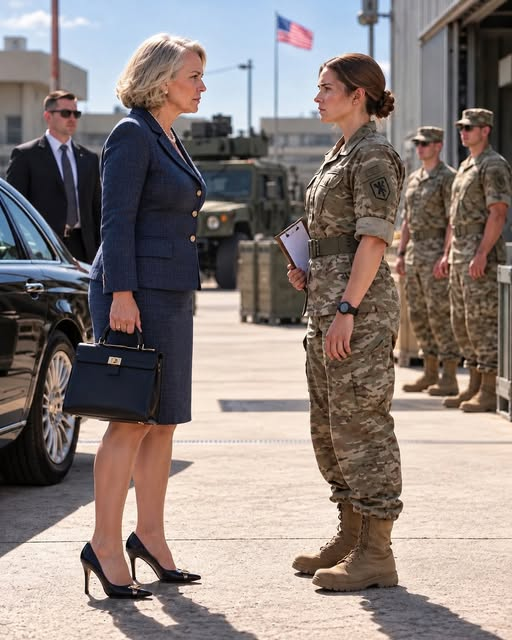
The engine died, and a woman with four stars on her collar came around the hood of the black truck at a walk that ate the gravel. I had seen her face once before, in a briefing packet at the MP station.
Dewitt’s hand came off my sleeve. Salas stepped back two paces and set his arms flat against his sides, and then he put one hand up over his mouth.
“Sergeant Conroy,” General Vance said. “Order your men to stand easy.”
“Sir.” I turned my head. “Dewitt, Salas. Hands down. Eyes on me.”
Both of them looked at me and not at her, and that was its own kind of report.
Vivian had her mouth open already. “General, thank God. This sergeant refuses a lawful pass on a personal vehicle, and I have been standing in this sun for ten minutes.”
Vance turned her head the way you turn toward a radio playing in somebody else’s yard.
“Mrs. Harmon. Stand still and stand silent.”
“I am the wife of the brigade commander. I do not answer to a gate sergeant.”
“You answer to me,” Vance said. “Whatever you say next goes into my report in your own words, and I write them down exactly.”
Vivian’s fingers found the thin gold chain at her left wrist and twisted it once around.
Vance put her hand out in my direction without looking away from Vivian. “Clipboard, Sergeant Conroy.”
I gave it to her. Then I followed her into the shade of the shack, because a sergeant does not stand in the road while a four star reads her paper.
She laid the board flat on the table and put one finger on the fourth line. “Who wrote these entries?”
“Private Dewitt, sir. I initialed each one as he wrote it.”
“And this stamp.”
“That is not garrison ink.” She said it flat, the way a person reads a tire pressure.
“No, sir. I flagged it this morning.” My hand went to the brass buckle on my belt and I made myself drop it.
She looked at me one beat longer than the sentence needed. “Bring me the full logbook. The red hardbound one, not the top sheet.”
The bottom drawer of that shack held the only paper I could prove a thing with, and she was asking me to carry it out into the open.
“Sir, may I ask what it is for?”
“You may not. Fetch it.”
I went inside, worked the drawer past the rail it catches on, and lifted the red book up from under the clipboard where the brass clip still bit the board.
I set it on the table and stepped back with my hands at my sides.
Vance opened a black leather binder, wide as a folded newspaper and pale at the corners, and wrote across the first ruled page in longhand. She wrote the date, the hour, the name of the book, then tore the page out along its perforation and held it toward me.
“Receipt. Sign at the bottom.”
I signed. She took the page back, read my name, and handed it over again.
“One red hardbound gate logbook, in the custody of an inspector general, thirteen thirty eight hours. Keep that in your pocket, Sergeant, and not in a drawer.”
“Sir, I did not call you.”
“I know you did not,” Vance said, and turned a page.
Behind me, a car door opened.
“Mrs. Harmon. Your vehicle stays off the blacktop. Back it onto the shoulder, lock it, and walk to garrison headquarters.”
“Walk.”
“You will walk alone, and you will sit in the outer office until I come for you.” Vance did not look up from the binder.
Vivian pulled the white silk scarf loose from her throat, wound it twice around her knuckles, and got in behind the wheel.
The Mercedes rolled backward onto the gravel and stopped. She came out from behind it with her jaw set and the scarf back at her neck.
She stood by the front fender with one hand on the door and did not go anywhere.
“Private Dewitt. Private Salas.” Vance walked over to them and stopped close enough that they had to raise their eyes.
“Sir,” they said, together.
“You put hands on your sergeant under an unlawful order. You stopped the moment you understood what it was.” She let that sit in the heat. “Nothing goes on your records. Nothing goes in a letter. Do you understand me?”
Dewitt’s chin was going. “Yes, sir.”
“Then get in the shade and drink water, both of you.”
Salas pulled the jug off the shelf inside the shack and poured two cups, and his hands were steady enough by the second one.
Vance came back to the table. “How many children, Sergeant?”
“Three, sir.”
“Then you will eat supper with them tonight. That is not a suggestion.”
“Sir.” My voice came out wrong on the word, so I straightened my cap instead of saying anything else.
She turned a page of the binder and read something she had written herself.
“The brick building behind supply. The quartermaster archive room.”
“I know the building, sir.”
“Tomorrow at eight. Nineteen ninety six, Fort Hood, every box with an administrative transfer stamp coming out of the MP school. Bring gloves, they will be filthy.”
Twenty eight years. That was longer than the whole of my career in uniform.
“May I ask what I am looking for?”
“You will know it by what is not in the box,” Vance said.
She read down the page, then further, and stopped with her thumb holding a line open.
“Your name came up in a stack of garrison paperwork this morning. Nothing for you to worry about yet.”
I did not ask which stack. I stood there with the receipt folded in my breast pocket and let the diesel smell come off the truck.
Behind her, the white Mercedes ticked as its engine cooled, and Vivian had not moved off the fender.
“Eight o’clock,” Vance said. “Wear your ribbons.”
The black leather binder closed with a snap that carried all the way to the fence line.
Vivian was still standing there.
Colonel Bruce Harmon had the iced tea poured before I got the door shut behind me.
“Sergeant Conroy. Sit down, please.”
I sat. The glass sweated a ring onto a square coaster, and his silver fountain pen tapped the blotter twice and went still. My hand found the brass buckle on my belt and centered it.
“I have been unfair to you,” he said. “A sergeant with three children at home should not be standing out in ninety six degrees arguing with an officer’s wife over a clipboard.”
“Sir, the roster was altered before I ever walked out to that gate.”
“I know what the roster said.” His voice dropped at the end, the way it always did. “I also know what the board will say on the fourteenth about a shouting match at Gate Six.”
“Nobody shouted, Colonel.”
“Somebody slapped.” He said it easily, the way he’d say a supply count. “That is what goes in the minutes unless we give them a better minute.”
“Whose minute, sir?”
“Mine.” He turned a folder around and pushed it across the desk with two fingers. “Read it before you answer.”
Promotion to Master Sergeant, immediate. Preferred reassignment, Naval Air Station Pensacola. Family housing guaranteed, four bedrooms, a school district noted in the margin in somebody’s neat hand.
Fourteen thousand more a year. I did the arithmetic before I decided to.
“Four bedrooms,” I said.
“Your oldest is at the middle school on Ridgeway. The twins are at the elementary.” He folded his hands. “I know what a school year costs a woman raising three by herself. This promotion solves all your family needs, Sergeant, provided we close this gate file today.”
“Close it how?”
“Sign the acknowledgment on the back. The discrepancy was clerical, nobody’s fault, I take the write-up on my own record.” He nudged the pen an inch. “You take the rank. You take Florida. This post goes back to being boring and your kids get a yard with a fence.”
“What happens to Private Dewitt and Private Salas?”
“Nothing. They followed an order from a civilian. I already told personnel no action goes in their files.”
“Then you know her order was unlawful.”
Harmon picked up his tea and did not drink it. Half under the phone sat a pink routing slip, QM ARCHIVE, BLDG 4, with a date in the upper corner older than most of the clerks in this building.
“You keep a lot of old paper in this office, Colonel.”
“Old paper is how the army remembers things.” He set the glass down. “General Vance has asked for readiness binders going back five years. I have two clerks pulling them as we speak.”
“Five years.”
“She can read binders until Christmas. Our house is in order.” The pen slid another inch toward my hand. “Take the folder home. Read it tonight. Bring me your name on the bottom in the morning.”
I picked up the folder. I left the pen where it was.
Vivian Harmon was waiting at the water fountain in the headquarters hallway, a white silk scarf knotted at her throat, working her thin gold chain around her wrist.
“Sergeant Conroy. Two minutes.”
“I have a duty log to file, ma’am.”
“This is the two minutes.” She stepped into my lane of the hallway. “I behaved badly on Tuesday. The heat, the drive, that gravel lot. I would like to put it behind us.”
She held out one page.
“Read it.”
The page said the exchange at Gate Six was a misunderstanding about a parking pass, that no physical contact occurred, and that Sergeant Conroy considered the matter closed.
“There was no misunderstanding, ma’am. You struck me in front of two of my soldiers.”
“And I am apologizing for it.” Her voice came up half a step. “That is more than most wives on this post would offer a sergeant with a clipboard.”
“Who typed this?”
“Post legal. A clerk in legal.” The chain went tight around her wrist and stayed there. “Does it matter who typed it?”
“It matters if the word misunderstanding goes into my record while the logbook says otherwise.”
“You’re holding a promotion and arguing about a word.” She looked at the folder under my arm. “Bruce is handing you a life. Don’t be the woman who hands it back.”
“Ma’am, did you read the effective date on it?”
Her chin came up. The chain loosened, and she started over with it, once around, twice around.
“Effective dates are for clerks,” she said, and went down the stairs without looking back at me.
The garrison breakroom smelled of burnt coffee and floor wax. Private Dewitt sat at the corner table with a sandwich from the machine and a photograph he kept standing upright against his paper cup.
“Her name is going to be Daisy,” he said. “The baby. We think.”
“You think?”
“He wants Daisy. She wants Ruth. I’m staying out of it.” He grinned, then saw the folder. “Is that the promotion, Sergeant?”
“Page two. Bottom line. Read it out loud.”
He wiped his fingers on his trousers first. Dewitt always wiped his fingers before he touched paper.
“Effective date of transfer, nine August.” He stopped. “But you were on the gate the twelfth.”
“Say it again.”
“Nine August, Sergeant. That’s three days before.” He turned the page into the window light. “Routing block says cut on the seventh. Typed the eighth. Colonel signed on the ninth. How does a transfer off this post get signed before the thing that transfers you?”
“Somebody built the paper first and went looking for a story to hang on it.”
“Ma’am?”
“Nothing. Turn it over.”
The back page was the acknowledgment. Two lines, saying the discrepancy was clerical and that Sergeant K. Conroy had no further statement to make to the readiness board. Underneath, a witness line, already stamped with the legal office seal and dated the eleventh of August.
The day before the gate.
“Somebody had this ready to sign before I ever told her no,” I said.
Dewitt set the folder down flat and put both hands on the table. “The clerk who carried it up to personnel asked me this morning if you’d signed yet. I said I didn’t know. She told me to tell you to read the whole page.”
“What’s her name?”
“Ruiz. She’s been there eleven years, she said.” He looked down at his boots and shifted his weight, left, right, left. “Sergeant, if you sign that, you weren’t there.”
“If I sign it, the twelfth never happened. No slap, no gravel, no two privates with their hands on my sleeve.”
“They told me nothing goes in my file.”
“They told me the same thing an hour ago. I want it in writing for you before I believe a word of it.”
“Would asking for writing cost you the promotion?”
“It might cost me the pen.”
Dewitt picked up his sandwich and set it back down without eating any of it. “My grandmother says never sign anything the same day somebody’s nice to you.”
Through the window, past the dumpster and the chain link, a black sedan idled in the slot marked INSPECTOR GENERAL with two cardboard file boxes balanced on its trunk lid. Both boxes had a year inked on the end in black marker.
1996.
I folded the promotion document in half and put it in my jacket pocket without signing it. Harmon could keep his pen.
The stairwell smelled like wet brick and old paper. Vance was already inside the archive room with her black leather binder open on the reading desk.
“Sergeant Conroy. Shut the door.”
I shut it.
She tore the corner off a duty pad, wrote six digits on it in blue ink, and slid it across the desk. “Fort Hood transfers. 1996. I want the box that carries this service serial on the label.”
I read the number twice. “General, that serial is older than my oldest child.”
“It belonged to an enlisted clerk. A typist.” She set her wire rim glasses down on the desk. “This room is the only place on this post that does not lie to me. Bring the box here, not to my office.”
“Whose serial is it, ma’am?”
“You may ask.” She picked the glasses back up.
The stacks ran to the ceiling and the aisle lights buzzed over my head. The Fort Hood row sat behind a rolling ladder that had not moved in a long time.
Dust came off the lids in sheets. I worked the labels with my thumb until the numbers showed.
The fourth box carried the six digits. The label had been typed, not printed, and the paper had gone the color of weak tea.
The drawer caught on its rail. I had to lift the whole box to get it free, and something inside slid and settled hard against the lid.
At 1130 I set it on the reading desk and opened it.
Forty or fifty pages, sorted into manila folders and held with a bent wire clip. The folders smelled like cedar and somebody’s basement.
The third tab read Cole, Vivian J. E-3. Clerk typist.
I knew every name on the Gate Six roster and every name on the MP duty sheet. There was no Vivian Cole at Fort Ansel.
Under the name, a clerk had typed one line and stopped. Transfer authorized pending administrative review.
No review board stamp. No date of action. The page under it was blank.
Boots came down the aisle at 1215. Vance set her glasses on the desk and stood at my shoulder.
“Read it to me.”
“Cole, Vivian J. Clerk typist. Transfer authorized pending administrative review.” I turned the folder toward her. “There is no stamp, General. No board, no date.”
“Keep going.”
The next sheet was heavier stock. The seal at the top was embossed, and the words beneath it were set in a font nobody used anymore.
Court martial. Misappropriation of unit funds. Nine thousand two hundred dollars. Forged allotment forms. Dishonorable discharge.
I read it twice. The third time I put my finger under the date of discharge. 11 April 1996.
“She was never an officer wife back then, Sergeant. She was a clerk facing formal discharge.”
Vance said it without lifting her eyes from the paper.
The signature block at the bottom had gone pale in the copying. Captain’s bars, a line of ink, and a name I could not read.
“General, whose signature is that?”
“Keep going,” she said again.
Behind the discharge order sat one more page, and this one carried no seal at all.
Transfer override, Fort Ansel receiving. It ordered the personnel record of Vivian J. Cole sealed and reissued under a dependent spouse number within thirty days.
At the bottom, in blue black ink, Lieutenant B. Harmon. The H looped like a piece of wire.
I had seen that H on forty pre-signed slips in the quartermaster drawer.
“General.” I turned the page flat.
“I know what it says.” She took her glasses off and held them. “I have known for four years.”
“Four years.” The number sat in the room between us. “Then why am I the one holding it?”
“Because a sergeant’s initials on a chain of custody form mean something in a hearing room that a general’s argument does not.” She held out her hand. “May I?”
I gave it to her. She slid the page into the black leather binder and closed it with a snap.
Then it came to me at once, standing in that brick room with dust on my sleeve. She never came here for a gate violation. She came with a four year file and a 1996 serial, and my red binder was the last link she needed.
My gate stand had been evidence before it was ever a scandal.
I put both hands flat on the desk and read the sign-out card taped inside the box lid.
Two lines. Lieutenant B. Harmon, 14 March 1996. And R. Miller, the previous Thursday.
The garrison commander had signed this box out of the archive a week before a white Mercedes pulled up to my gate.
The administrative corridor at 1300 smelled like floor wax. Salas stood by the water fountain holding two paper sacks.
“Sergeant. I got you a sandwich. They threw out the good bread at noon, so it’s the other bread.”
“Thank you, Salas.”
He walked beside me. “Commander Miller’s clerk came by the MP office twice this morning. He asked what time you clocked in and whether you signed anything out of the archive.”
“What did you tell him?”
“That I’m a private, and privates don’t keep a sergeant’s hours.” He glanced down at his boots. “Then he asked me a second time.”
“And?”
“And I told him I’d find out.”
We stopped where the tile turned to concrete.
“Salas, that box I brought up. Did anybody else ask about the Fort Hood transfers?”
“A sergeant from personnel came by the desk while you were in the stacks. He said the archive key has to be signed back in person to Commander Miller by end of shift.” He shifted his boots on the concrete. “I told him you’d do it. Was that wrong?”
“No. That was right.”
It was not right. Miller had not asked for an archive key at the end of a shift in the three years I had worn this badge.
I folded the sack back into his hand. “Eat this. I have one more page to look at.”
“Sergeant.” He did not move. “My grandmother asks about you. She wants to know if you’re eating.”
“Tell her I ate.”
“She can tell when I lie.”
I almost smiled at that.
Then he said the other thing.
“The clerk said the commander wants you at zero seven thirty tomorrow. He said to bring your badge and your clipboard, Sergeant. He said it twice.”
I went back up the stairs. The box was where I had left it, lid open, the yellowed pages fanned under the lamp.
I held the last sheet flat until the ink showed black instead of brown.
Lieutenant B. Harmon. 1996.
I turned the lamp down and left the box unsigned.
I ran the archive copier four times before the page came out clean, then put the original back in its box and squared the lid.
Vance folded the copy once and slid it inside the black leather binder.
“Not a word of this to your soldiers,” she said. “Not yet.”
That was Tuesday.
Wednesday at 0725, Garrison Commander Miller stood at the MP guardhouse counter with a folder he did not open until I was standing in front of him.
“Sergeant Conroy. Effective 0730 you are suspended from duty.” He turned the folder around. “No duty pay. No access to post logs.”
“On what finding, sir?”
“Insubordination. Duty breach.” He tapped the page twice. “Both endorsed at brigade.”
I read it down to the bottom. Under his signature sat the little typed box that tells a clerk where the authority came from.
By direction of the brigade commander.
“Who typed the endorsement?”
“It came down signed.” He closed the folder and held it against his chest. “You have a hearing the second week of September. Bring a lawyer.”
Behind him the two clerks in the back room had stopped typing. Neither of them looked up.
“He’s your commander,” I said. “You could walk down the hall and ask him what it’s for.”
Miller looked over my shoulder at the duty board. “Hand over your badge and vacate these quarters by the end of the month, Sergeant.”
“My badge stays on my belt until thirteen hundred. It belongs to the post, sir, not to a desk.”
“Your squad goes to another platoon at noon,” he said. “That’s not my decision either.”
“Whose is it?”
“You know whose it is.” He put his cap on. “Read your form.”
He left with the folder under his arm and did not look at the duty board again.
I adjusted the brass buckle on my belt and kept my hand on it until the door swung shut.
The housing office at 1000 smelled like toner and floor wax.
The clerk took one sheet from a tray and set it in front of me, then turned it right side up with two fingers.
“Fourteen days, Sergeant. Quarter rights revoked contingent on duty status.” She smoothed the corner flat. “I don’t write them. I hand them out.”
“Who writes them?”
“Brigade sends the status change. We act on what brigade sends.”
She glanced at the door behind me, then back at my face. “There’s a family on the waiting list asking about your unit. They’ve asked twice this week.”
“What did you tell them?”
“The number of the quarters.” She looked at her screen. “They asked whether the school bus stops on that corner.”
Fourteen days put the end of my quarters on the morning of the fourteenth, the same morning the garrison board convened.
“Can I appeal it?”
“You can file. It goes to brigade.” She pushed a pen across the counter. “Most people don’t win.”
“Copy it first,” she said. “The machine in the back is free. Nobody counts.”
I copied it front and back and put the original in her tray. Then I signed the receipt and not the notice, and she let me have that.
At 1300 the thermometer over the Gate Six door read ninety-six.
Dewitt had the red hardbound logbook open on the counter and a pen in his hand he was not writing with.
Salas stood out at the barrier arm with his back to the post, which was how I knew he had been wiping his face.
“Sergeant.” Dewitt’s voice came out thin. “Housing called the MP desk this morning. They said end of the month.”
“They told me the same thing at ten o’clock.”
I unhooked the badge from my duty belt and set it on the counter. The brass made a flat sound on the metal.
“I don’t want to log this in.”
“You don’t have to want to. You have to write it down. Time, item, your initials.”
He wrote it. His letters were rounder than mine.
Then he lifted the clipboard off its hook and held it against his chest a second before he signed for it.
“Sergeant, I still have the little book.” He said it low, watching the road. “The one you told me to keep in my cargo pocket.”
“Keep it in the pocket. Not a locker, not a desk, and not in anybody else’s hands.”
“Not even Salas?”
“Salas already knows more than he wanted to.”
Dewitt capped the pen. “What happens to us now?”
“Nothing happens to you. You wrote an entry when you were told to write one.”
“That’s not what I asked.”
Salas came in from the barrier with his mouth working before he got a word out. “They can’t do this. She hit you. You never raised a hand, not once.”
“She did. And I’m still standing.” I squared my cap. “You two hold this post the way I taught you. Every tag checked. Every line written twice.”
“Why would Harmon promote you and then throw you out the gate?” Dewitt asked.
“He never promoted me. He tried to buy me.” I kept my voice level. “The transfer date on that paper was the eighth of August, four days before the white Mercedes stopped at my barrier.”
“Sign it and I was never at Gate Six that afternoon. I never existed.”
Salas pulled something from his cargo pocket and set it on the counter, a small brass clip with the screw still in it.
“Came loose off the old clipboard this morning. I didn’t want it getting lost.”
“Then put it where it won’t get lost,” I said.
“Will you be at the board?” Dewitt asked.
“I’ll be there.”
I walked out past them into the afternoon heat. Behind me I heard the pen start again on a fresh sheet.
The kitchen at 1600 held three lunchboxes on the counter where the kids had left them, lids flipped open, one crust of bread in each.
I opened the banking app and let it load, then read the number twice.
Four hundred twelve dollars.
Fourteen days.
The youngest had folded a paper into her lunchbox, a drawing of the gate with a stick figure in a cap and a sun with too many rays coming off it.
I put it on the fridge under the magnet from Fort Ansel Elementary.
My son came through with his backpack still on and asked whether the bus still stopped on our corner in October.
“It stops on the corner,” I said. “Go hang that bag up.”
“You always say that when something’s wrong.”
I got the peanut butter down and made him a sandwich, and he ate it standing at the counter watching me, and neither of us said anything else about it.
When he went to the front room I took the two papers out of my jacket and laid them side by side where the lunchboxes had been.
The promotion form, creased in half, its effective date typed as the eighth of August.
The quarter notice, folded in quarters, its last day landing on the fourteenth, square on the board date.
Vance’s card came out of the inside pocket, soft at one corner from the heat.
I turned it over twice. A number ran along the back in blue ink, small and careful.
The fridge hummed. Somebody had left the radio on in the front room.
I thought about four hundred twelve dollars, and a family I had never met asking twice about a school bus, and a hearing in September with a lawyer I could not afford.
Then I picked up the phone and dialed the number on the back of the card.
She picked up on the second ring.
Dewitt came up the walk at six with two coffees in a cardboard tray and a notebook pressed flat against his chest.
“Gate opens in thirty minutes,” I said.
“I know, Sergeant. I wanted you to have it before the shift changed.” He held out the tray and I took the cup with the sleeve already slid up.
He set the notebook on the porch rail and opened it to August first. Dates down the left margin in pencil. Tag numbers on the right in blue ink. Times to the minute.
“Every unlisted vehicle,” he said. “Both copies.”
“Say it the way I said it.”
He almost smiled. “Every entry on the clipboard needs a matching stamp or the barrier stays down.”
“And the second page.”
“The second page is the one that lasts.” He said it like a line out of a manual, which is where he got it. I told him that my first week with him at the gate, standing in the shade with a clipboard in his hands and his boots shifting on the gravel.
I picked my youngest’s sneaker off the step and set it inside the door, where she steps over it every morning.
We went through the notebook page by page. Twenty two entries. Fourteen of them white cars, one gray pickup, the rest contractor vans.
Near the back, four pages were blank.
Not blank the way a clean page is blank. The paper was dented. Hold it to the porch light and you could see the ghosts of numbers pressed through from a sheet written on top of it.
“I filled those in,” Dewitt said. “Last four days of August. I wrote them on the clipboard same as always.”
“Then somebody laid a fresh sheet over yours and walked off with the one you signed.”
His boots went back and forth on the boards. “Sergeant, I don’t want to be the one who brings this.”
“You’re not bringing it. You’re carrying it.”
He looked down the street and then back at me. “The baby’s due second week of November. If they send me home early, I don’t have the money for the hospital paperwork.”
“Nobody’s sending you home.”
“Will you write the letter for my reenlistment packet? The one from the post sergeant.”
“Sunday. After church.”
He left at twenty past six and cut across the lawn instead of using the sidewalk, so nobody on the duty roster would see him come off my walk.
Salas had a shoebox on the diner table at nine, and my coffee already waiting.
“You didn’t have to buy,” I said, sitting down across from him.
“It’s two dollars, Sergeant. I’m not going to starve.”
He lifted the lid. On top, folded in a paper napkin, was the brass clip.
I turned it over. Twenty years of spring in that hinge, the jaw still biting. Along the inside jaw a thin crust of dried ink had gone the color of an old bruise.
The same blue black I had put a cotton swab to in the record room in August.
“Where did these come from?” I asked.
“I printed the pink duplicates off the pad,” Salas said. “There’s forty of them. They come out of the machine whether anybody asks or not.” He shrugged. “I just didn’t throw them away.”
“Where did you keep them?”
“In my wall locker. Inside a boot. Nobody looks in a boot.”
We spread the pink slips out and matched them against Dewitt’s notebook, line for line, tag for tag. Then I stopped on one.
August twelfth. Times filled in. The gate stamp square in the corner. And beside it a second impression, smaller, the garrison clerk’s receiving stamp with the initials R. M. set in the circle.
“You didn’t do this.”
“That’s what I’m saying, Sergeant. It’s the only one of the forty that has it.”
I held it closer. Under the receiving stamp, where the carbon had pressed through from the sheet above, the tag number had been written a second time in a slant I did not recognize.
I folded that slip into my own notebook and closed the clasp.
“Your grandmother’s bus ticket still going up in December?” I asked.
“Eleven dollars.” He drank his coffee. “I’m still going.”
I paid for both cups on the way out and he let me.
The county library opens at ten, and the second floor has a long table by the periodicals where nobody sits once the summer reading program ends.
I brought a ruler, a black pen, and a pad of twelve column paper.
Forty eight pages. I numbered every one in the lower right corner and initialed every third page.
Date across the top. Tag number. Time in. Time out. Which guard signed. Which clipboard page it matched. Which pink slip contradicted it.
The white Mercedes came up fourteen times in Dewitt’s hand. Two of those days had a matching line in the main gate logbook.
Every one of the fourteen fell on a day Commander Miller had Dewitt and Salas paired together at Gate Six. Nineteen and twenty years old, on the hottest post on the installation.
At one o’clock the copier jammed and I fed it four dollars in quarters. Then I paid the meter and did the arithmetic on the back of a receipt.
Copies, eighteen dollars sixty. A binder, six forty nine. The meter, three dollars. Three hundred eighty three dollars left of my last paycheck, and a quarter tank of gas.
I sat in the car with the binder on my knees and the engine off.
Then I squared the stack with the ruler, laid Dewitt’s notebook in the back pocket of the binder, and drove out the north road to the boundary fence.
General Vance’s car sat on the county road at half past three, off the installation, where a four star could stand with a sergeant and not pass in front of a gate camera.
She was out of the car with her wire rim glasses in her hand.
“You look like a woman who’s been in a library since breakfast,” she said.
“County library, ma’am. Second floor.”
“Give it to me.”
I laid the binder on the hood and opened it to the cover sheet. She read the first column with one finger on the paper, then turned a page, then another. Her black leather binder lay open on the trunk lid with tabs down one side. One tab had a year inked at the top, 1996, and I did not look at it twice.
“How many pages,” she said.
“Forty nine with the cover. Twenty two notebook lines. Forty pink slips. One garrison receiving stamp that has no business on a gate receipt.”
“The brass clip.”
“In the envelope, ma’am.”
“Take it out. Give it to me loose.”
She turned it over once, looked at the ink in the jaw, and set it back in my palm. “Keep it in your pocket Thursday. Not a folder. A pocket.”
“Thursday.”
“Nine o’clock, garrison headquarters. Class A’s. Ribbons. The whole uniform.” She closed her binder and the clasp snapped.
“The post sergeant usually speaks first at a readiness board,” I said. “After the commander’s summary.”
“Not this one. He speaks first. Let him say everything he came to say, and don’t correct a word of it.”
“Ma’am.”
She started to turn, then stopped. “He’ll have something folded in his breast pocket. Three folds, always the same three.”
“How do you know what’s in his pocket, ma’am?”
She put her glasses on and did not answer.
The stenographer’s keys clicked once and went quiet. General Vance set the manila folder in the middle of the table and left it shut.
“You asked to be heard first, Colonel,” she said. “The board is yours.”
Colonel Bruce Harmon stood and squared his ribbon rack with two fingers. He tapped the silver fountain pen against the blotter before he spoke.
“On August twelfth, Sergeant Conroy refused a lawful instruction at Gate Six.” His voice dropped at the ends of sentences, the way it always did. “She embarrassed a spouse in front of two junior enlisted men. She has spent six weeks building a paper case against this command.”
Kate kept her hands folded in her lap. The brass buckle of her duty belt pressed into her forearm.
“Paper case,” Vance said. “You want that phrase in the transcript?”
“I want the transcript to show she altered documents to cover her own insubordination.”
Vance removed her wire-rim glasses and laid them on the folder. “Then let’s look at documents.”
Harmon slid a page across the table. “The August twelfth duty roster, signed by Commander Miller. Sergeant Conroy was not assigned to Gate Six that afternoon. She placed herself there.”
Kate had a copy of that roster in a shoebox under her bed.
“Commander Miller,” Vance said. “You signed it?”
“I sign a great many duty rosters.” Miller’s voice came out thin as paper.
“This one carries your initials in the margin, in pencil.” Vance turned the page around. “Who told you to put junior guards on that shift?”
Miller looked at Harmon. Harmon looked at the wall clock, which ran eleven minutes fast.
“I reassigned the shift,” Miller said. “That is my prerogative.”
The stenographer kept typing, steady, unhurried, and nobody said anything else for a while.
At the recess, a young specialist carried in a pitcher and poured water too full into Kate’s cup. She caught the overflow in her palm and thanked her anyway.
Vance leaned in close enough that only Kate could hear. “Don’t get comfortable at Gate Six.”
Kate turned that over and had no place to put it.
When the board came back, Vance opened her black leather binder.
“This is a certified copy,” she said, “pulled from the Fort Hood administrative archive. Nineteen ninety-six. Discharge order for an enlisted clerk named Vivian Cole.”
Vivian Harmon’s fingers found the thin gold chain at her wrist and stopped moving.
“That name has no bearing here,” Harmon said.
“It has every bearing.” Vance turned the page toward the board, and the yellowed paper caught the overhead light. “The signature at the bottom is mine. I was a captain then. I wrote it.”
Vivian spoke from her chair without standing. “That was a different life, General.”
“It was the same clerk who signed for three thousand dollars in unit funds that never reached a vault.” Vance set the page flat. “And it was the same woman at Gate Six on August twelfth.”
Harmon started to talk over her, and Vance raised one hand, and he stopped.
“The board will not take up the personal matter of the twelfth,” she said. “That belongs elsewhere.”
Kate filed that away with everything else she could not ask about yet.
“Sergeant Conroy,” Vance said. “The floor is yours.”
Kate stood and set the brass clipboard clip on the table first, so the board could see what held the paper together. Then she walked them through it, one page at a time.
“These are duplicate carbons from the red hardbound gate logbook, kept by Private Dewitt under my standing order from his first week of patrol.” She laid the sheets in a fan. “Every entry on this clipboard needs a matching stamp or the barrier stays down. These three did not have one.”
Harmon’s pen came up and then went back down.
“August ninth,” Kate said. “August eleventh. August twelfth. All three stamps came off a desk set, not off the gate press. The post lab compared the ink. Only one set on this installation mixes fresh water into the blue.”
Miller’s chair scraped the floor.
“Commander,” Vance said, “the locked drawer in your transfer cabinet. What’s in it?”
Miller’s hands came off the table and settled in his lap. “Pre-signed override slips. For the Harmon vehicle.”
“Who signed them?”
“Colonel Harmon did.”
“And who put them in a locked drawer instead of a logbook?”
Miller’s mouth worked twice before anything came out. “I did.”
Kate sat down. Her knees felt like they belonged to somebody else.
Harmon was on his feet now, and this time his voice did not drop at the end of anything. “General, I want it noted that this board has been steered by a sergeant under suspension.”
“It’s noted,” Vance said. “The suspension is lifted as of nine this morning, and your signature is on it, Colonel, which makes it awkward.”
Kate’s hand went to her jacket pocket without her telling it to. Dewitt’s promotion recommendation was folded in there, blank at the top and waiting for a signature she had not been allowed to give for two weeks.
Vance closed the binder and stood.
“Colonel Bruce Harmon, this board finds probable cause on document forgery, false official statement, and misuse of command authority across two decades. You will be referred for court-martial.”
The side door opened. Two military police sergeants came in quietly and stopped in front of Harmon’s chair.
Harmon did not move. He held his arms at his sides and looked at a spot on the wall above the clock while they took the eagles off his shoulders and set them on the table.
Vance picked up her glasses. “Sergeant Conroy. Thirteen hundred hours. Base Legal.”
Vivian caught me at the water fountain outside the legal office before I reached the stairwell.
Her white silk scarf was knotted too tight at her throat. She kept twisting the thin gold chain around her left wrist.
“Sergeant Conroy. Please.”
I stopped with my hand on the fountain button. Water ran over my fingers.
“I can pay for the cheek,” she said. “The medical. The time. I can write you a check today.”
“The Army has a process.”
“The Army has a process for everything except what I need.”
She reached into her purse and pulled out a bank envelope. The paper was soft at the corners.
“Eleven thousand four hundred dollars. Cash. I brought it with me.”
I did not take it. My hand moved to my belt out of habit and found the empty loop where my badge had been.
“Your children could use it,” she said. “That is all I am saying.”
I looked past her toward the stairwell door. “You should put that away.”
“Not until you tell me you will not file.”
The envelope stayed open in her hand. I could see the band of the bills inside.
“I am not going to talk about money in a hallway,” I said.
Vivian’s chin trembled. “Then talk to me in the office. Five minutes.”
“Five minutes is not going to fix this.”
“Nothing fixes this,” she said. “I know that.”
She stepped back and let me pass. The envelope went back into her purse.
“I have never hit anyone before,” she said behind me.
I kept walking. “You hit me.”
General Vance had the yellowed 1996 personnel file open on the desk when I walked in. Her black leather binder sat beside it, closed.
She removed her wire rim glasses and set them on the file.
“Sit down, Sergeant.”
I sat. The chair was cold through my trousers.
“Colonel Harmon will face court martial for document forgery and fraud,” she said. “Commander Miller submitted his retirement papers at noon.”
My mouth was dry. “And my rank?”
“Restored as of eleven hundred hours. Your quarters are yours again. The revocation is void.”
I looked at the yellowed page under her glasses. I did not ask what I already knew.
“The promotion Colonel Harmon offered you is void,” Vance said. “If you want Master Sergeant, you will earn it before a board, not in a hallway.”
“Yes, ma’am.”
“What about my soldiers?” I asked. “Dewitt and Salas.”
Vance put her glasses back on, then took them off again. “No charges. They stopped when I arrived. That is the correct end to an unlawful order.”
“Dewitt was crying.”
“That is not a crime.”
“What about Mrs. Harmon?” I asked.
“Her discharge status is a separate matter. The Army will decide whether she misrepresented it on any federal form.”
“She has been on this base for years.”
“Yes. That is the part I am still untangling.”
She closed the yellowed file. “There is a desk at headquarters with your name on it. I will not ask for an answer until Monday.”
“Monday.”
“Monday.” She set her glasses in her lap. “Your children are in school here. That is a real cost. Think about it.”
I stood. “Ma’am, I need to get back to Gate Six.”
“Then get back to Gate Six.”
The legal office smelled like copy toner and old carpet. A clerk handed me a blue folder with a sticky tab that said civil damages.
Vivian sat in the chair by the wall, weeping into her white silk scarf. Her mascara had run.
The legal officer, a young captain with a name tape that said Ortiz, opened the folder.
“This is the packet,” he said. “Assault, medical, lost wages. You can file today.”
I read the first page. It had a blank line for the amount. Vivian’s envelope sat on the desk between us.
“She has offered cash,” Captain Ortiz said. “You can accept it and still file.”
I turned the page. “I need to check something at Gate Six first.”
Vivian’s head came up. “You are not signing?”
“I will be back at five.”
Captain Ortiz tapped the folder. “The offer does not expire today, Sergeant. The waiver does not either.”
I closed the folder and took it with me. Vivian said my name once, quiet, as I reached the door.
Gate Six was quiet at four o’clock. The asphalt still gave off heat through my soles.
Private Dewitt stood at the barrier with his cap squared. Private Salas was at the clipboard.
Dewitt saw me first. His boots shifted on the gravel. “Sergeant. Your badge.”
“It came back.”
Salas let out a breath. “Ma’am.”
The red hardbound logbook sat on the counter with a white evidence receipt taped inside the cover. The original brass clip was back on the clipboard. Salas had found it in the supply drawer.
I pulled the promotion recommendation from my jacket. “Dewitt. This goes to the board. It is a recommendation for Corporal, not a promotion.”
He stared at the paper. “Corporal.”
“You have to sign it,” Salas said. “Right here.”
Dewitt took the pen. His hand was steady. “My girlfriend is going to frame this.”
“Frame the certificate,” I said. “Not the recommendation.”
He laughed once, short and surprised. Salas laughed with him.
“Did you keep the log clean while I was out?” I asked.
Dewitt nodded. “Every line. I double checked the tags.”
“Good.”
Salas tapped the counter. “He has been practicing saying Corporal on duty all week.”
“I have not,” Dewitt said.
“You have too.”
A cardboard box sat at the end of the counter. The packing slip said digital access scanner, parts, and a Monday delivery date.
I clipped the recommendation under the brass clip. “Nothing goes through this gate without a stamped tag. Not one.”
“Yes, Sergeant,” Dewitt said.
Salas looked at the box. “Monday.”
“Monday,” I said.
Captain Ortiz had the blue folder open on the desk again when I came back at five. Vivian was still in the chair. Her white silk scarf was crumpled in her lap.
“You understand this waives civil damages,” Ortiz said. “Assault, medical, lost wages. All of it.”
“I understand.”
“You are leaving eleven thousand four hundred dollars on the table.”
“I am leaving it where it is.”
I took the pen. The line for the amount was blank. I drew a line through it, then signed my name at the bottom.
Vivian watched my hand. “Why?”
I set the pen down. “I came here to serve my country and protect my family, not to destroy what little you have left.”
She put her face in the scarf.
I handed the signed waiver across the desk. Vivian sat weeping on the chair.
The fridge door swung shut on the yellow suspension notice, still pinned under the pizza magnet, and my youngest hauled her lunch bag across the counter like it weighed forty pounds.
“Two sandwiches is too many,” she said.
“One is for after school.” I put the second one in and snapped the latch.
The brass clipboard clip sat by the salt shaker where I had left it the night before, and my son picked it up and squeezed it open and shut twice.
“Does this go on the guns?”
“It goes on the paper.” I took it back and slid it into my jacket pocket.
My oldest stood at the screen door with her backpack on one shoulder, watching the street instead of me.
“Are we moving?”
“No.”
“Marisol’s mom said the army takes houses back from people who get written up.”
I set the apple in the bag and folded the paper over twice. “The trouble left in August. Marisol’s mom can call me and I’ll explain it to her myself.”
The bus came around the corner with its brakes hissing, and my middle one went down the steps without the toast she had asked for.
My oldest still had not moved. “You’d tell us if something was happening.”
“I’d tell you.” I handed her the bag. “That has been the deal since the day I put this uniform on.”
She went down the steps two at a time. The bus door folded shut and the street went quiet.
I stood on the porch with the screen door handle in my hand until the bus turned at the corner and the dust settled back down on the road.
At nine I had my cap on and Gate Six gravel under my boots.
Corporal Dewitt had the tablet propped against the barrier housing, and he read off it the way he used to read the red logbook.
“Forty one tags since six. Two rejects.” He turned the screen toward me. “Both expired stickers. Dental clinic, and a contractor who backed out and came back at eight with a new one.”
“Anything else hold you up?”
“Two cars with out of state plates. I called the number on the form both times.” He said it without waiting for me to ask, which was new.
The new scanner was bolted to a steel plate at the end of the barricade, with a camera mounted above it and a green light that swept the lane from left to right.
“Six seconds it holds the number,” Dewitt said. “Long enough for me to read it and long enough for the camera to catch it.”
I took the brass clip out of my jacket and clipped the paper backup sheet to the tablet frame.
“Scanner goes down, this goes up. Keep them together.”
“Every shift?”
“Every shift.” I stepped back into the sun. “And keep the barrier down until every tag checks out, Corporal.”
A bread truck came up the lane, and the green light swept its front plate and went amber. Dewitt was out of the shack before I could open my mouth, clipboard against his chest, and he had the driver’s tag up and the number read out loud in a voice that carried to the fence.
The driver reached for the paper and Dewitt pulled it back a half inch. “Not until I write it down, sir.”
I stood on the asphalt and watched him do it. He did not look over at me once for approval.
The red hardbound logbook from August sat in a box on the shelf behind the barrier, closed and squared away under a rubber band. I had put my hand flat on its cover that morning and left it there.
“General Vance’s aide called the office at seven,” Dewitt said, back inside, entering the truck number with his tongue a little between his teeth.
“What did the aide want?”
“She asked what day to put on your orders. She said Monday.”
I let that sit on the gravel between us. “She’s optimistic.”
He laughed, then got quiet the way he did when he had more. “Denise has her appointment Thursday. Doctor says January, right on the day.”
“You’ll want a yard.”
“She’s already picked the house. It has a fence and a lemon tree in back.”
“Then the fence is the first thing we check when you sign for it.”
At eleven thirty Private Salas had his elbow into the quarterly reviews and the bottom drawer of the file cabinet stuck halfway out.
He pulled, lifted, pulled again, and it came with a scrape of metal on metal.
“Third drawer this week, Sergeant.”
“Take the whole cabinet apart Friday and grease the rail. Put the grease on my charge account.”
He set the reviews in and slid the drawer shut harder than he needed to. “The money order window closes at two. If I want my grandmother’s September and October in the same envelope, I need to walk over at one.”
“Go at one. Take the long way back so nobody thinks you’re hiding.”
Vance filled the doorway with her cap under her arm and her glasses already off her face.
“Private,” she said, and Salas was gone before the word finished landing.
She sat down without being asked, set the wire rim glasses on my desk, and folded her hands on top of them.
“I will say this once, Sergeant. I want you in the operations section at headquarters. A desk, a phone, and a major who owes me a favor. Monday.”
“No, General.”
She did not move. “Give me one reason I can put in writing.”
“My kids are settled in school here. The house is ours through May. And I know this gate.”
“That is three reasons. I asked for one.”
“Take the one you like best.”
She picked up her glasses, turned them once in her hand, and set them down again.
“There is a sergeant in the provost marshal’s training shop with a file that says she is ready for more than a desk,” I said. “Ask for her by name and she will report Monday.”
“I have someone in mind.” Vance stood and put her glasses back on. “I wanted to hear you say no out loud, in this room, so nobody could claim I pushed you.”
“Now you have it.”
“Commander Miller’s retirement papers take effect the first of November. Colonel Harmon’s case stays with the justice division and it stays there.” She paused at the door. “None of that belongs to you anymore, Sergeant. You are going to have to get used to the quiet.”
“The gate’s yours to keep dull,” I said.
She almost smiled. “Then keep it dull.”
At three I walked the fence line the way I did most afternoons, out along the wire and back to the paint mark where the barrier arm comes down.
The heat had gone out of the day. The gravel threw up dust with every step and the sky over the motor pool was a flat, bright blue with nothing moving in it.
Halfway back, the scanner in the shack gave a short buzz, and Dewitt leaned out the window.
“Sergeant. Third tag today printed with a blank line where the number goes.”
“Then it does not clear.”
“It already cleared. The camera caught the picture fine.”
“Reset the unit and run the tag again. Log the reset on the backup sheet.”
He ducked back inside. I could hear him talking to the scanner under his breath, the way he used to talk to the old clipboard.
Then the printer coughed out a strip and he held it up in the window with two fingers.
“Number’s on it now, Sergeant. Camera matches.”
“Write it down.”
He wrote it down with the brass clip within reach and the pen cap in his teeth.
I walked back to the paint mark and set my heels on it, and I adjusted my cap until the brim sat level over my eyes and the sun came in under it warm instead of hot.
The road running out of Fort Ansel went straight to a line of mesquite and then out of sight, and the barrier arm rested at the top of its arc where everybody could see it.
“The gate is clear, Sergeant,” Dewitt said as the barrier lifted smoothly.