Part 1 — The Envelope in Hazel’s Backpack
**I raised my granddaughter on my own after my daughter died — 11 years later, when her father went to court to take her away, she said, “Your Honor, I know why he really wants custody.”**
My only daughter died when her daughter, Hazel, was just a few months old.
God, I still remember holding that tiny baby at my daughter’s funeral and thinking, *How are we supposed to live without her now?*
Hazel’s father, Brandon, didn’t want to take responsibility.
“I’m still too young for this,” he told me. “I have my whole life ahead of me. A baby would only be a burden.”
Then he handed Hazel to me, left a bag with a couple of bottles and a small pack of diapers, and simply disappeared.
So yes, at sixty-four, I became a mother again.
Only this time, to my granddaughter.
I took every odd job I could find, cleaned other people’s houses, skipped vacations, and wore the same winter coat for years just to make sure there was food on the table and the lights stayed on.
Eleven years passed.
It never became easy.
But not once did I regret choosing Hazel.
She became my whole world.
Then, one Saturday morning, someone knocked on the door while I was making pancakes.
I opened it and almost dropped the spatula.
Brandon stood on the porch.
I barely recognized him.
He wore an expensive suit, had arrived in a luxury car, and told me that he had married a wealthy woman.
Then he smiled.
“Well, I’m taking Hazel to live with me. I’m her father, so I have every right to.”
I stared at him.
“I’m sorry, but Hazel isn’t a toy you can throw away and come back for whenever you feel like it. She doesn’t even know you.”
Hazel came out of her room.
Brandon hugged her before she understood who he was.
“Sweetheart, I’m your dad. I’m going to take you home soon. You’ll live in a much better house instead of this dump.”
Hazel looked over his shoulder at me.
She didn’t say anything.
But I knew that look.
She was frightened.
A few weeks later, the court papers arrived.
Brandon wanted my guardianship terminated.
Hazel cried every night for three days.
Brandon did not ask to take her to lunch.
He did not come to her school play.
He did not ask what books she liked, what frightened her, whether she still slept with the stuffed rabbit she’d had since she was two, or why she refused to eat tomatoes unless they were chopped so finely she couldn’t see them.
He simply insisted that he wanted his daughter.
At the hearing, his attorney showed photographs of Brandon’s house.
It was enormous.
Stone pillars. Tall windows. A swimming pool.
There was even a photograph of a bedroom Brandon claimed would belong to Hazel, with pale yellow walls and shelves filled with brand-new books.
Then his lawyer showed photographs of my house.
Peeling paint.
A crooked porch railing.
Furniture older than Hazel.
I felt myself shrinking in my chair.
When the judge asked me to speak, my voice trembled.
“Your Honor, I’ve been there for every birthday, every time she was sick, every time she scraped her knees. She is my whole world. Please don’t take her away from me.”
I squeezed Hazel’s hand.
Then she gently pulled hers away.
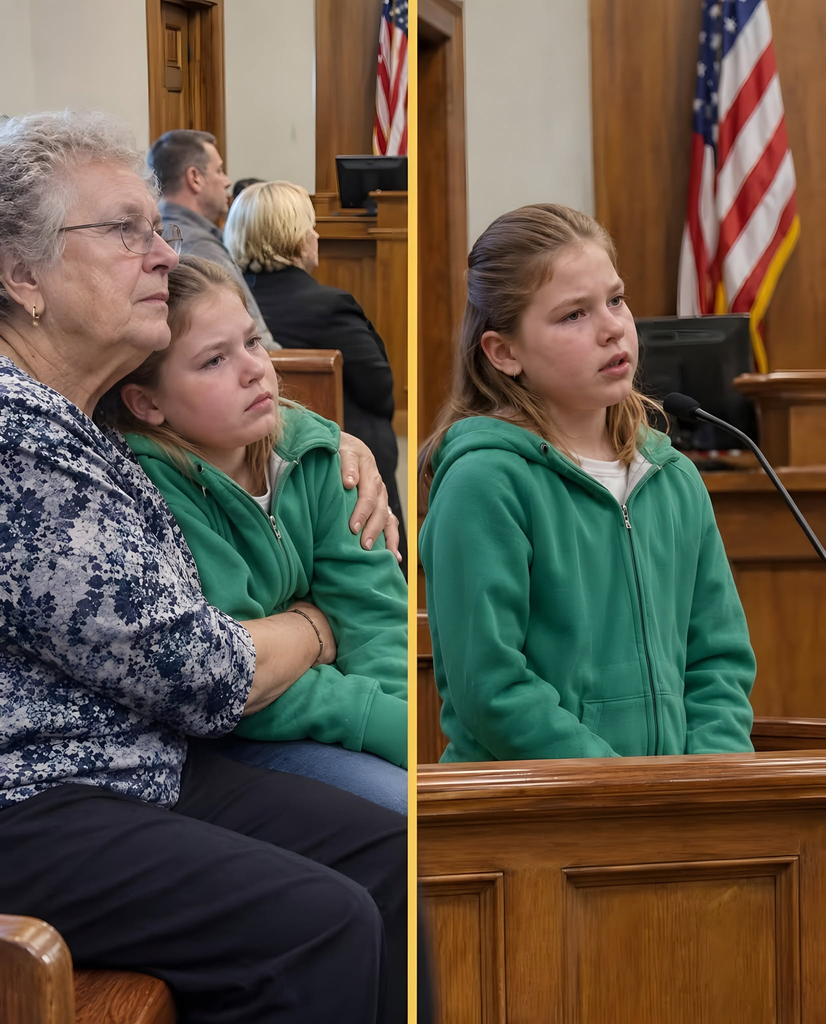
She stood.
“Your Honor, may I say something?”
The judge looked at her kindly.
“Of course. But first, you need to promise to tell the truth, young lady. Do you promise?”
“I promise.”
Hazel walked to the witness stand.
She took one breath.
Then another.
“Your Honor, a few days ago, I overheard my father talking to his attorney on the phone. I know why he really wants custody of me.”
She reached into her backpack.
And when she pulled something out, Brandon’s face turned pale.
The judge covered her mouth with one hand.
It was not money.
It was not a photograph.
It was a letter.
An old letter.
The paper was yellowed around the folds, and across the front was handwriting I had not seen in eleven years.
My daughter’s handwriting.
My heart stopped.
I knew every curve of those letters.
**For Hazel, when she is old enough.**
I stood so quickly that my chair scraped backward.
“Where did you get that?”
Hazel looked at me.
“In the attic.”
The judge lowered her hand.
“Hazel, did you read this letter?”
“Yes, ma’am.”
Brandon’s attorney rose.
“Your Honor, we have no idea what that document is or whether—”
“Sit down, Mr. Keaton.”
The judge’s voice was not loud.
It did not need to be.
Brandon’s lawyer sat.
Judge Alvarez turned back to Hazel.
“What does this letter have to do with your father seeking custody?”
Hazel swallowed.
“There was another paper with it.”
She reached into her backpack again.
This time she produced a folded photocopy.
Brandon closed his eyes.
I looked at him.
That frightened me more than his anger would have.
Hazel unfolded the page.
“My mom wrote that if anything ever happened to her, Grandma should raise me.”
I pressed my hand over my mouth.
I had never known.
Hazel continued.
“But that’s not the part my father cares about.”
The courtroom seemed to become impossibly still.
“What part does he care about?” the judge asked.
Hazel glanced at Brandon.
For the first time since he had returned, I saw something in his face other than confidence.
Shame.
“My mom wrote that when I turn twelve, something that belonged to her becomes mine.”
Brandon’s attorney stood again.
“Your Honor—”
Judge Alvarez raised a hand.
“Mr. Keaton.”
He sat.
“What becomes yours?” the judge asked Hazel.
“I don’t know exactly.”
Hazel held up the second paper.
“But my mom called it the Bellweather property.”
My stomach tightened.
Bellweather.
I knew that word.
I had not heard it in years.
Judge Alvarez looked at me.
“Mrs. Marlow?”
I barely managed to answer.
“My daughter’s grandfather owned some land outside town. There used to be an orchard on it.”
“Used to be?” the judge asked.
“I thought it was sold.”
Brandon finally spoke.
“It practically was.”
Every head turned toward him.
His lawyer whispered sharply, “Brandon.”
But the damage had been done.
Judge Alvarez leaned forward.
“Mr. Cole, what does ‘practically’ mean?”
Brandon glanced toward his attorney.
“I meant that the property isn’t worth much.”
Hazel looked straight at him.
“That’s not what you said on the phone.”
His face tightened.
Judge Alvarez regarded Hazel carefully.
“What did you hear?”
Hazel’s fingers trembled around the letter.
I wanted to run to her.
I wanted to tell every adult in that courtroom to stop making an eleven-year-old carry something this heavy.
But Hazel lifted her chin.
“He said, ‘Once she’s legally living with me, I can handle everything until she’s eighteen.’”
Brandon’s lawyer leaned toward him.
Hazel continued.
“And then he said, ‘By then the development deal will already be finished.’”
I looked at Brandon.
“What development deal?”
He said nothing.
Judge Alvarez turned toward his attorney.
“Mr. Keaton?”
The lawyer exhaled slowly.
“I believe a recess would be appropriate.”
“I agree.”
The judge looked directly at Brandon.
“And I would strongly advise your client not to leave the building.”
The gavel fell.
The room exploded into whispers.
I reached Hazel before anyone else could.
I wrapped both arms around her.
“You should have told me.”
“I wanted to.”
“Why didn’t you?”
Her face disappeared against my shoulder.
“Because I thought you’d make me give the letter back.”
“Back to whom?”
She pulled away.
“To Dad.”
My stomach dropped.
“Hazel, the letter was in our attic.”
She shook her head.
“No.”
“What?”
“It wasn’t.”
She looked toward Brandon.
“He put it there.”
I stared at her.
“What are you talking about?”
“A few days after he came to our house, I heard something upstairs at night. I thought it was you, but you were asleep.”
The courtroom around us blurred.
Hazel lowered her voice.
“I saw him climbing down from the attic window onto the porch roof.”
I felt cold all over.
“Brandon was inside our house?”
Hazel nodded.
“I didn’t tell you because I thought maybe I imagined it. But the next day I went into the attic.”
“And found the letter.”
“And a box.”
“What box?”
“A wooden one.”
“Where is it?”
Hazel hesitated.
“I hid it.”
Before I could ask another question, someone approached.
Not Brandon.
A woman.
She was perhaps forty, elegantly dressed but pale with worry. I recognized her immediately from the photographs Brandon’s attorney had submitted.
His wife.
Claire.
She stopped several feet away.
“Mrs. Marlow?”
I instinctively moved Hazel behind me.
Claire noticed.
Pain crossed her face.
“I understand why you don’t trust me.”
“Do you?”
“Yes.”
Brandon saw her from across the courtroom.
“Claire.”
She ignored him.
“Mrs. Marlow, I need to tell you something before this hearing continues.”
Her hands were shaking.
“What?”
She glanced toward Brandon.
“He lied to me too.”
Brandon crossed the room.
“Claire, don’t.”
She turned on him.
“For eleven years?”
His face changed.
“You don’t understand.”
“I understand perfectly.”
People nearby fell silent.
Claire looked back at me.
“When Brandon told me about Hazel, he said you had kept his daughter from him.”
I stared at him.
Claire continued.
“He told me he had tried for years to see her.”
“That’s a lie.”
“I know that now.”
Brandon stepped closer.
“Claire.”
She ignored him again.
“There’s something else.”
“What?”
“The Bellweather land.”
My chest tightened.
Claire took a breath.
“My family’s company is involved in the proposed development.”
Hazel stepped from behind me.
“What development?”
Claire looked at her.
Her expression softened.
“A medical center.”
Brandon scoffed.
“As if that makes me some monster.”
Claire turned.
“No one called you a monster.”
“You’re all acting like—”
“You told me Hazel’s trust was yours.”
His mouth closed.
Claire’s voice broke slightly.
“You told me your late girlfriend had left the property to you.”
I looked at Brandon.
“My daughter was not your late girlfriend when she died. She was the mother of your child.”
His gaze dropped.
Judge Alvarez’s clerk appeared at the courtroom doors.
“The hearing will resume in ten minutes.”
Claire touched my sleeve.
“There’s one more thing you need to know.”
I wanted to tell her I had heard enough.
But something in her expression stopped me.
“What?”
“The development cannot proceed unless the owner signs.”
“And the owner is Hazel?”
Claire nodded.
“According to the documents my attorneys uncovered, yes.”
I looked toward my granddaughter.
Eleven years old.
Pink sneakers.
A frayed backpack.
She still needed me to cut the crusts off grilled cheese sandwiches.
Yet somewhere on paper, she owned land powerful adults were fighting over.
“Why does Brandon need custody?” I asked.
Claire answered quietly.
“Because the guardian controlling Hazel’s financial affairs can petition the court for approval to sell property on her behalf.”
The room tilted.
I gripped the back of a chair.
Hazel took my hand.
For years, I had believed poverty was my greatest weakness.
Suddenly I understood something far more frightening.
Someone else believed Hazel’s money was theirs to control.
When court resumed, Judge Alvarez did not make a custody decision.
Instead, she appointed an independent attorney to represent Hazel’s interests and ordered an investigation into the Bellweather property.
Brandon’s request to change custody was temporarily suspended.
I should have felt relief.
I did, for perhaps five minutes.
Then the judge asked to examine my daughter’s letter.
And one sentence near the bottom caught her attention.
She read it twice.
Then she looked at me.
“Mrs. Marlow, were you aware your daughter had created a trust?”
“No.”
Judge Alvarez turned the letter toward me.
My daughter had written:
*Mom, if you are reading this, then I am probably not there to explain what I did. I need you to know that Bellweather is not the inheritance I am worried about.*
My knees weakened.
Below that was another sentence.
*The important thing is what I hid there.*
Judge Alvarez looked at Hazel.
“You said you found a wooden box in the attic.”
“Yes.”
“Was there anything else inside?”
Hazel nodded.
“A key.”
Brandon stood so abruptly that his chair struck the table.
His attorney grabbed his arm.
The judge stared at him.
And I understood, with a certainty that chilled me to my bones, that Brandon had not returned merely because of land.
He knew about the key.
Hazel looked at me.
“Grandma?”
“Yes?”
“I think I know what it opens.”
The entire courtroom seemed to disappear around us.
“What?”
Hazel took my hand.
“There’s a little stone building at Bellweather.”
I stared at her.
“How do you know that?”
She looked toward Brandon.
“Because I found a picture of Dad standing in front of it.”
Then she whispered:
“The picture was taken three days before Mom died.”
Part 2 — The House Beneath the Orchard
Three days before my daughter died.
That sentence followed me home.
It followed me through the kitchen while I heated soup neither Hazel nor I ate.
It followed me upstairs while I checked the locks twice.
It followed me into bed, where I lay awake listening to the old pipes knock inside the walls.
My daughter’s name was Emily.
For eleven years, I had taught myself to remember her in safe pieces.
Emily at seven, racing through sprinklers.
Emily at seventeen, painting her bedroom without asking permission and getting blue fingerprints on the ceiling.
Emily at twenty-five, placing newborn Hazel into my arms and saying, “Look at her, Mom. Isn’t she perfect?”
I avoided remembering the last months.
Grief makes strange bargains.
You tell yourself that if you stay away from certain memories, they cannot hurt you again.
But memories are patient.
That night, every locked door inside me seemed to open.
The next morning, Hazel came downstairs carrying the wooden box.
It was smaller than I expected.
Dark walnut.
Scratched.
There was no lock.
Inside were three things: the old photograph, a brass key, and a notebook.
The photograph showed Brandon outside a small stone cottage.
Behind him stood rows of apple trees.
Bellweather Orchard.
He looked younger.
Nervous.
And unmistakably angry.
On the back, Emily had written a date.
Three days before the accident.
I turned the photograph over.
“Where’s the notebook?”
Hazel handed it to me.
Most of the pages were blank.
Only the first contained writing.
Emily’s.
*If Hazel is reading this someday, I hope someone loved you enough to keep this safe.*
I stopped.
Hazel leaned against me.
“Keep going.”
I swallowed.
*The key belongs to the records room at Bellweather. Grandpa kept copies of everything because he trusted paper more than people.*
The next line had been underlined.
*Do not assume the person who comes looking for these records is the person who deserves them.*
That afternoon, Hazel’s court-appointed attorney came to see us.
Her name was Maya Chen.
She was thirty-something, wore practical shoes, and spoke to Hazel rather than around her.
That alone made me like her.
“I represent you,” she told Hazel. “Not your grandmother. Not your father. You.”
Hazel frowned.
“What if what I want is to stay with Grandma?”
“Then I make sure the court hears that.”
“What if everybody starts talking about money?”
“Then I remind them that you are a person, not an account.”
Hazel considered this.
Then she smiled slightly.
“Okay. I like you.”
Maya smiled back.
“So do I.”
I showed Maya the box.
Her expression grew serious.
“You should not go to Bellweather alone.”
“I wasn’t planning to.”
Hazel raised her hand.
“I was.”
“No,” Maya and I said together.
Hazel folded her arms.
“It belongs to me.”
“That does not mean you’re marching into an abandoned orchard looking for mysterious records.”
“It sounds cooler when you say it that way.”
Maya laughed.
Despite everything, so did I.
It was the first time I had laughed since Brandon returned.
Two days later, with Maya beside us and a court-approved property representative meeting us there, we drove to Bellweather.
The orchard sat twenty miles outside town.
I had not visited since Emily was a teenager.
Time had changed it.
Trees once carefully spaced in straight green rows had grown wild.
Branches tangled together.
Weeds rose around our knees.
The farmhouse had collapsed on one side.
But the stone building remained.
Hazel stopped in front of it.
“That’s it.”
The door was narrow.
The key fit.
Inside smelled of dust and damp stone.
Shelves lined the walls.
Boxes had been stacked beneath canvas covers.
Maya switched on a flashlight.
“Everybody stays together.”
Hazel whispered, “This is amazing.”
“It is moldy,” I said.
“It can be both.”
The records room contained decades of ordinary papers.
Tax statements.
Old orchard invoices.
Equipment receipts.
Handwritten harvest records.
Then Maya found a steel cabinet.
“Mrs. Marlow?”
I came over.
Inside were folders labeled with family names.
One read:
**EMILY MARLOW / HAZEL COLE**
My hands went numb.
Maya opened it carefully.
There was a trust document.
A property deed.
Several letters.
And a sealed envelope marked:
**For Brandon.**
Hazel looked at me.
I looked at Maya.
“Do we open it?”
Maya shook her head.
“Not yet.”
“But it’s about him.”
“And it was addressed to him. We need to handle this properly.”
Hazel sighed.
“Lawyers make mysteries less fun.”
“That,” Maya said, “is secretly our mission.”
Then I noticed another folder.
My own name was written across it.
**RUTH MARLOW.**
For some reason, seeing my name frightened me more than seeing Brandon’s.
I opened it.
Inside was a document signed by Emily.
A nomination of guardian.
Me.
Below it was a letter.
*Mom,*
*You are going to be furious that I didn’t tell you.*
I almost laughed.
That was Emily.
Even from eleven years away, she knew me.
*Grandpa left Bellweather to me because he believed one day it would be valuable. I never cared about that. But after Hazel was born, I started thinking differently.*
*I want the land protected until she is old enough to decide what should happen to it.*
I looked at Hazel.
She was reading over my arm.
*Brandon thinks we should sell. He says money would solve everything. Maybe he’s right that money could make life easier. But lately he’s become obsessed with it.*
My breath caught.
*He has debts I didn’t know about.*
Hazel looked up.
“Debts?”
Maya made a note.
I kept reading.
*He borrowed against things that were never his.*
Then the letter changed.
The writing became shakier.
*Mom, I am scared—not of Brandon hurting me. I don’t believe he would. I am scared of what desperation is turning him into.*
That distinction mattered.
Even frightened, Emily had been fair.
*Yesterday, he asked me to sign papers giving him authority over Bellweather.*
*I said no.*
*He left angry.*
The last paragraph was short.
*If something happens to me, please don’t tell Hazel her father was a bad man. Tell her he was a frightened young man who made bad choices. But do not let those choices become hers.*
I had to sit down.
Hazel sat beside me.
For a while, nobody spoke.
Then Hazel said softly, “Mom didn’t hate him.”
“No.”
“Do you?”
The question pierced me.
I wanted to say yes.
For eleven years I had hated Brandon whenever money was short.
I hated him during fevers.
During parent-teacher conferences.
During birthdays when Hazel asked why other children had fathers.
But looking at my daughter’s words, hatred felt too simple.
“I hated what he did.”
“That wasn’t my question.”
Maya quietly moved away, giving us privacy.
I looked at Hazel.
“I don’t know anymore.”
She nodded.
That seemed enough.
A noise came from outside.
Footsteps.
Maya immediately turned.
The property representative called, “Hello?”
A figure appeared in the doorway.
Claire.
She raised both hands.
“I’m sorry. I should have called.”
Maya’s expression hardened.
“How did you know we were here?”
“My attorney.”
“That information should have been confidential.”
Claire looked embarrassed.
“My company owns the neighboring parcel. Someone saw cars.”
That explanation was plausible.
Still, Maya did not relax.
Claire looked around.
“So this is the records room.”
“You knew about it?” I asked.
“I knew there was an old storage building.”
She glanced at the cabinet.
“Brandon told me everything important had been destroyed years ago.”
Hazel watched her.
“Why are you helping us?”
Claire looked at her.
“Because I believed your father when he told me he wanted a relationship with you.”
“And now?”
Claire took a long time to answer.
“Now I think he wants several things, and I don’t know which one matters most to him.”
That was the first thing anyone had said about Brandon that felt entirely true.
People were rarely driven by one reason.
Love and greed could exist inside the same person.
So could regret and selfishness.
“So what happens now?” I asked Maya.
“We inventory everything. We determine what’s legally relevant. And no one removes documents.”
Hazel looked disappointed.
“Not even Mom’s letter?”
“Especially not the important documents.”
Hazel wandered toward the back wall.
I returned Emily’s letter to its folder.
Then Hazel said, “Grandma?”
Something in her voice made me turn.
“What?”
“There’s a door.”
At first I thought she meant the entrance.
Then I saw it.
Behind one of the shelving units was a narrow wooden panel.
The property representative helped move the shelf.
There was indeed a door.
The brass key did not fit.
But the door was unlocked.
Inside was a tiny room containing a desk.
Nothing else.
Hazel stepped closer.
On the desk sat an old answering machine.
Claire frowned.
“Does that thing even work?”
Maya examined it.
A power cord ran through the wall.
The property representative found an outlet.
For several seconds, nothing happened.
Then a red light flickered.
**1 MESSAGE.**
Hazel’s hand found mine.
Maya pressed the button.
Static filled the room.
Then a woman’s voice spoke.
My daughter.
“Mom?”
I stopped breathing.
Emily sounded frightened.
Not panicked.
Just tired.
“If you’re hearing this, I guess I finally found a way to make you clean out Grandpa’s horrible old office.”
A tiny laugh.
Hazel covered her mouth.
It was the first time she had ever heard her mother’s adult voice.
Then Emily continued.
“I need to record this because Brandon is coming over tonight.”
Claire slowly turned toward me.
The date on the machine appeared.
Three days before Emily died.
Emily’s voice continued.
“He says he wants to apologize.”
There was a pause.
Then:
“But I think somebody else sent him.”
Maya leaned closer to the machine.
Emily took a breath.
“If I’m right, then Bellweather was never just about Brandon’s debts.”
A sound came through the recording.
A knock.
Emily whispered:
“He’s here.”
Another voice followed faintly from somewhere beyond the recorder.
A man.
But not Brandon.
“Emily?”
I knew that voice.
Even after twenty years.
My legs nearly gave way.
Hazel looked at me.
“Grandma?”
I could barely answer.
Because the man on the recording had been dead for six years.
My former husband.
Hazel’s grandfather.
Thomas.
And according to everything I had believed, Thomas had not spoken to our daughter for nearly a decade before she died.
Part 3 — The Things Families Leave Unsaid
For most of my adult life, I believed silence could protect a family.
If you did not mention the divorce, children would eventually stop asking why their father never came for Christmas.
If you did not discuss old arguments, perhaps time would turn them into misunderstandings.
If you carefully placed grief in boxes and pushed those boxes into the attic, perhaps the house would remain standing.
I had been wrong.
Silence did not erase anything.
It simply left the truth for someone younger to discover.
Hazel heard her grandfather’s voice three times.
Each time she pressed the button again, I wanted to stop her.
I didn’t.
Thomas said only a few words on the recording.
Emily apparently walked away from the answering machine soon after he entered.
Their voices became indistinct.
But certain fragments were clear.
Thomas: “You don’t understand what’s happening.”
Emily: “Then explain it.”
Thomas: “Brandon owes people.”
Emily: “I know.”
Thomas: “Not the kind of people you ignore.”
Then static.
A chair scraping.
Emily saying, “No.”
Thomas speaking more softly.
And finally Emily:
“Hazel is not paying for his mistakes.”
The message ended.
On the drive home, Hazel stared out the window.
“Grandpa Thomas was alive when Mom died?”
“Yes.”
“Why didn’t I know him?”
I gripped the steering wheel.
“He and I divorced when your mother was young.”
“That doesn’t answer me.”
Eleven-year-olds can be merciless in their clarity.
“No.”
I breathed out.
“It doesn’t.”
I pulled into a roadside rest area.
Maya, driving behind us, pulled in too but remained in her car.
I turned toward Hazel.
“Thomas and I had a difficult marriage.”
“Did he hurt you?”
“No.”
I wanted to make that clear.
“He was not violent. He was not cruel. But he was restless. He always believed something better was waiting somewhere else.”
“Like Dad?”
The resemblance hurt.
“Yes.”
Thomas started businesses.
Lost money.
Started again.
Eventually, he moved away.
Emily blamed him for leaving.
For years, they barely spoke.
“I thought they never fixed things,” I said.
“But they did.”
“Apparently.”
“Why didn’t Mom tell you?”
“That is what I don’t understand.”
Hazel thought about this.
“Maybe she thought you’d be mad.”
“I probably would have been.”
“That might be why.”
I laughed despite myself.
“You’re becoming dangerously wise.”
“Eleven.”
“Terrifying age.”
She smiled.
But it faded quickly.
“Grandma?”
“Yes?”
“Do grown-ups ever know what they’re doing?”
I looked through the windshield.
“Almost never.”
That made her laugh.
The investigation unfolded slowly over the following weeks.
Not dramatically.
There were no midnight chases.
No threatening strangers.
Instead, there were documents.
Phone calls.
Depositions.
Bank records.
And the much less cinematic but remarkably effective persistence of lawyers.
Maya discovered that Thomas had quietly paid several of Brandon’s debts shortly before Emily died.
Some were ordinary.
Credit cards.
A failed business.
A car loan.
Others were stranger.
Loans connected to a real estate venture that had collapsed.
Brandon had borrowed money believing Bellweather would eventually be sold.
Emily refused.
That refusal left him trapped.
But the biggest surprise came from Claire.
She arrived at my house one rainy Thursday carrying a folder.
Brandon had moved out of their home.
“I’m sorry,” she said.
“For what?”
“For taking this long to understand what kind of situation I married into.”
I put on coffee.
Hazel sat at the table doing homework while pretending not to listen.
Claire placed the folder between us.
“My company first became interested in Bellweather eight years ago.”
“That long?”
“Yes. We wanted to build a rehabilitation clinic there.”
“Why Bellweather?”
“The county planned a road expansion. The land became much more valuable.”
“How much more?”
Claire hesitated.
“Several million.”
My spoon slipped from my fingers.
Hazel looked up.
“Several?”
Claire nodded.
Hazel returned to her homework.
“Okay.”
I stared at her.
“You’re not surprised?”
“I already own more money than I understand. Making the number bigger doesn’t help.”
Claire smiled.
“She may be the wisest person in this family.”
“I’ve been telling Grandma.”
I pointed toward the worksheet.
“Fractions.”
Hazel sighed.
Claire became serious again.
“Brandon learned about the development six years ago.”
“Then why wait until now?”
“The trust.”
She opened the folder.
“Emily structured it unusually. Bellweather belongs to Hazel, but until Hazel turns twelve, the property cannot be sold except under extraordinary circumstances approved by the court.”
Hazel’s birthday was four months away.
I understood.
“He needed custody before then.”
“Probably.”
“Why?”
Claire pointed to a clause.
“At twelve, Hazel gains additional rights. She doesn’t control everything, but her wishes become legally significant.”
Maya later confirmed Claire’s interpretation.
That night, I found Hazel sitting on the porch steps.
I brought her a blanket.
She wrapped it around both of us.
“Grandma?”
“Yes?”
“What would you do with the land?”
“It isn’t mine.”
“What if it was?”
I looked toward the dark street.
“I’d probably be terrified of making the wrong decision.”
“Same.”
She rested her head against my shoulder.
“I don’t want Dad to get it.”
“That is understandable.”
“But I don’t want to keep it just because he wants it.”
I turned toward her.
“That is a very important difference.”
“What did Mom want?”
“I think she wanted you to decide.”
Hazel frowned.
“That’s annoying.”
“Why?”
“Because dead people are supposed to leave instructions.”
I laughed softly.
“Your mother hated instructions.”
“Really?”
“She once assembled a bookcase without reading the manual.”
“What happened?”
“It became a table.”
Hazel laughed so hard the blanket fell off.
For the next half hour, I told her stories about Emily.
Not the saint I had accidentally turned her into after death.
The real Emily.
The girl who cheated at Monopoly.
The teenager who sneaked a stray cat into her bedroom.
The college student who called me at two in the morning because she could not figure out how to cook rice.
Hazel listened greedily.
Finally she said, “I wish I remembered her.”
“Oh, sweetheart.”
“I know she loved me.”
“She did.”
“But I wish I remembered what it felt like.”
I pulled her close.
For years I had thought the greatest gift I could give Hazel was security.
Now I understood there was another.
Memory.
Not perfect memory.
Not polished memory.
Truthful memory.
The custody hearing resumed three weeks later.
Brandon looked different.
No expensive suit.
No confident smile.
Just a tired man sitting beside his attorney.
Maya presented the court with the trust documents and evidence of Brandon’s financial interest.
His attorney did not contest most of it.
Then Brandon asked to speak.
Judge Alvarez warned him that he was not required to testify.
“I know.”
He took the witness stand.
Maya questioned him first.
“Mr. Cole, did you seek custody partly because you believed it would give you influence over Bellweather?”
“Yes.”
I had expected denial.
The honesty startled me.
“Was that your only reason?”
“No.”
“What other reason?”
Brandon looked at Hazel.
She did not look away.
“I saw her picture.”
Maya waited.
“Where?”
“Online. Her school posted pictures after a science fair. She looked like Emily.”
His voice broke on her name.
“I hadn’t seen Hazel since she was a baby.”
“Why not?”
“Because I was a coward.”
Silence filled the courtroom.
“I kept telling myself I’d come back when I had money. Then when I had a decent job. Then when I wasn’t ashamed. Every year I waited made coming back harder.”
“And Bellweather?”
“When Claire’s company became interested, I saw a way to solve everything at once.”
“You mean financially?”
“Yes.”
“And personally?”
Brandon nodded.
“I thought if Hazel came to live with me, I could pretend the eleven years in between hadn’t happened.”
Hazel looked down.
Maya’s voice softened.
“Can they?”
“No.”
“Can what?”
“The years.”
Brandon wiped his eyes.
“No. They can’t.”
His confession did not excuse him.
But something changed in the room.
He stopped being the villain in the story I had told myself.
He became something harder to understand.
A man who had failed.
A man whose failure had lasted eleven years.
Judge Alvarez eventually denied his request to terminate my guardianship.
The words reached me slowly.
Hazel would remain with me.
I closed my eyes.
Hazel grabbed my arm.
“We won.”
I whispered, “You’re staying home.”
Brandon stared at the table.
But Judge Alvarez was not finished.
She ordered supervised visits if Hazel wanted them.
Not because Brandon had earned them.
Because Hazel deserved the opportunity to decide whether a relationship with him was possible.
Outside the courthouse, Brandon approached us.
He stopped several feet away.
“Hazel.”
She looked at him.
“I’m sorry.”
Hazel’s face remained unreadable.
“For which part?”
He almost smiled.
“All of it.”
She considered this.
Then:
“I don’t forgive you yet.”
He nodded.
“Okay.”
“But maybe I’ll have lunch with you.”
His eyes filled.
“Okay.”
“Not somewhere fancy.”
“Okay.”
“And Grandma comes.”
He looked at me.
That was harder.
Finally he said, “Okay.”
Hazel walked toward our car.
I followed.
Brandon called my name.
“Ruth.”
I turned.
“There’s something about Thomas you need to know.”
I felt the old dread return.
“What?”
“The night I went to Bellweather…”
He swallowed.
“Thomas wasn’t trying to help me take the land.”
“What was he doing?”
“Trying to stop me.”
I stared at him.
“Then why was he there?”
“Because Emily called him.”
That made no sense.
“She hadn’t spoken to him in years.”
“She had.”
Brandon looked toward Hazel.
“For months.”
“Why?”
“Because Thomas discovered something about Bellweather.”
“What?”
Brandon shook his head.
“I don’t know. Emily wouldn’t tell me.”
“Then why mention it?”
“Because the night before Emily died, she told me she had finally decided what to do.”
“With the land?”
“No.”
He looked at me.
“With whatever Thomas had found.”
A cold wind moved across the courthouse steps.
“What did she decide?”
Brandon reached into his coat.
He took out an envelope.
Unlike Emily’s old letters, this one was clean and new.
“My lawyer found this among documents Thomas left in storage after he died.”
My name was written on the front.
Brandon handed it to me.
“I never opened it.”
“Why?”
“For once,” he said quietly, “I thought maybe something wasn’t mine.”
Then he left.
That night, Hazel and I opened the envelope together.
Inside was a letter from Thomas.
Only four sentences.
*Ruth,*
*Emily was right not to sell Bellweather.*
*Her grandfather did not buy that orchard for the trees.*
*Ask the county what was buried beneath the east field in 1978.*
And the final sentence:
*Whatever you do, do not sign anything until you know why six families left this town that summer.*
Part 4 — What Was Buried at Bellweather
The county clerk stared at me over her glasses.
“1978?”
“Yes.”
“That is almost fifty years ago.”
“I’m aware.”
She looked at Hazel.
“And she needs these records?”
Hazel nodded solemnly.
“It’s family homework.”
I coughed to hide a laugh.
The clerk sighed.
“I hate family homework.”
Her name was Mrs. Ortiz.
She had worked in the county records office for thirty-one years and seemed personally offended by every document filed before the invention of computers.
Eventually, she led us downstairs.
“Flood maps. Property transfers. Environmental reports. That’s where I’d start.”
Hazel whispered, “I like her.”
“Because she’s grumpy?”
“Because she knows where everything is.”
That was true.
Three hours later, we found Bellweather.
Not in a dramatic secret file.
In an environmental inspection.
In 1978, a small manufacturing company operating near the east boundary of the orchard had been investigated for improper disposal of industrial solvents.
Six nearby families sold their homes shortly afterward.
The company closed.
The records claimed cleanup had occurred.
But an attached note indicated that one parcel had never been fully tested.
Bellweather.
Hazel stared at the paper.
“Is the land dangerous?”
“I don’t know.”
Maya arranged for an independent environmental assessment.
Claire’s company agreed immediately.
Brandon surprised everyone by supporting it.
“If there’s contamination,” he said, “nobody should build anything there.”
The tests took weeks.
During that time, something even stranger happened.
Life became ordinary again.
Not the old ordinary.
A new version.
Brandon began seeing Hazel once a week.
At first I attended every meeting.
We went to a diner.
Then a park.
Then the public library.
Brandon tried too hard.
He arrived with gifts.
Hazel rejected most of them.
“You don’t have to buy me something every time.”
“I know.”
“You keep doing it.”
“I’m learning.”
“Learn faster.”
He laughed.
She almost did.
One afternoon at the park, he brought nothing.
Hazel noticed.
“No gift?”
“You told me not to.”
“Good.”
He looked pleased.
Then she handed him a friendship bracelet.
I stared.
Brandon stared.
“It’s not a big deal,” Hazel said immediately.
He took it carefully.
“It seems like a big deal.”
“It isn’t.”
“Okay.”
“Don’t make it weird.”
“I won’t.”
He put it around his wrist.
Hazel smiled when she thought he was not looking.
I saw.
So did he.
Neither of us said anything.
I began to understand that forgiveness was not a door that opened once.
It was a hallway.
Sometimes you moved forward.
Sometimes you stopped.
Sometimes you discovered another locked room.
The environmental report arrived in early spring.
There was contamination beneath part of the east field.
Not catastrophic.
Not immediately dangerous.
But significant enough that any development would require remediation.
Claire came to my kitchen with representatives from her company.
They presented options.
Hazel listened.
I listened.
Then Hazel asked, “Who pays to clean it?”
One executive cleared his throat.
“That would depend on the agreement.”
“Meaning?”
Claire almost smiled.
“She means she wants a straight answer.”
The executive nodded.
“If our company purchases the land, remediation costs would be included in the project budget.”
Hazel looked at Claire.
“And the clinic still happens?”
“It could.”
“Could?”
“The expense changes the numbers.”
Hazel sat back.
Adults around the table looked at an eleven-year-old as though she were chairing a board meeting.
I almost laughed.
Instead, I felt fiercely proud.
“What happens if I don’t sell?” Hazel asked.
“Eventually remediation would still be advisable,” Claire said.
“How much?”
The figure was enormous.
Hazel looked at me.
“We don’t have that.”
“No.”
She looked at Brandon.
He shook his head.
“Neither do I.”
For once, everyone was honest.
The mystery of Bellweather did not lead to treasure.
It led to responsibility.
That felt strangely appropriate.
Two days later, Hazel asked me to take her to the orchard.
We stood beneath the old apple trees.
Tiny spring buds appeared along the branches.
“My mom wanted me to decide.”
“Yes.”
“I think I know.”
“You’re eleven.”
“Almost twelve.”
“You don’t have to decide anything yet.”
“I know.”
She kicked at the grass.
“That’s why I think I know.”
I waited.
“What if we don’t sell all of it?”
I frowned.
“What do you mean?”
“The east field is the bad part, right?”
“Yes.”
“What if the company gets that part and cleans it, but we keep the orchard?”
I stared at her.
She continued.
“Claire said they need road access more than anything.”
She had been listening.
Really listening.
“What would you do with the orchard?”
Hazel looked around.
“I don’t know yet.”
Then she smiled.
“That’s the part I like.”
The lawyers spent another month examining the idea.
To my surprise, it was possible.
Claire’s company could purchase an easement and part of the affected acreage, fund cleanup, and shift the medical center footprint.
Hazel’s trust would retain most of Bellweather.
The court would need to approve everything.
But there was a path.
Then Brandon complicated matters.
He asked to withdraw any financial claim he might have related to the trust.
Maya stared at him.
“You understand this means you cannot later argue that—”
“I understand.”
“Why?”
Brandon looked toward Hazel.
“Because I’ve spent half my life trying to turn everything into money.”
He rubbed the little bracelet around his wrist.
“I’d like to stop.”
Afterward, Hazel found him outside.
I watched from a distance.
“You don’t have to give everything up,” she said.
“I’m not.”
“You are.”
“No.”
He crouched so they were eye to eye.
“I’m giving up something I never had.”
Hazel studied him.
“Are you doing it so I forgive you?”
Brandon thought carefully.
“No.”
“Good.”
“Why?”
“Because that would be cheating.”
He laughed softly.
“I suppose it would.”
She held out her arms.
Brandon froze.
Then hugged her.
Not desperately.
Not possessively.
Carefully.
Like someone finally learning that love was not something you could seize.
It was something another person allowed you to hold.
That evening, Hazel and I returned home to find a package on the porch.
No return address.
Inside was an old photograph album.
Thomas.
Emily.
Bellweather.
Dozens of photographs.
The last pages contained images from the summer of 1978.
Families standing beside moving trucks.
Workers digging near the east field.
Hazel turned one page.
“Grandma.”
There was Emily’s grandfather.
My father-in-law.
Standing beside several neighbors.
On the back, Thomas had written:
*They made an agreement.*
The next photograph showed the same families gathered beneath the orchard trees.
Another note:
*Bellweather was purchased so nobody could build here until the truth was known.*
I suddenly understood.
The orchard had never simply been an investment.
It had been a barrier.
A way to keep contaminated land out of commercial hands.
The families who left had pooled money.
Emily’s grandfather had become the legal owner because someone had to.
“They were protecting people,” Hazel whispered.
“Yes.”
“And Mom knew?”
“Eventually.”
That explained why she refused to sell.
Not because she hated Brandon.
Not because she wanted money.
Because she had inherited an obligation.
Hazel closed the album.
“I still think the clinic should happen.”
I looked at her.
“Even knowing this?”
“Especially knowing this.”
She pointed to the photograph.
“If something bad happened there, maybe something good should happen there too.”
That sentence stayed with me.
Three weeks later, we attended the court hearing to approve the revised Bellweather agreement.
Everything was ready.
Hazel would retain the orchard.
The contaminated area would be remediated.
The medical center would be built on a smaller parcel.
A memorial garden would recognize the families affected in 1978.
Judge Alvarez reviewed the documents.
Then she frowned.
“There is one problem.”
Every lawyer in the room stiffened.
“What problem?” Maya asked.
Judge Alvarez held up a page.
“The court received a competing ownership claim yesterday.”
My heart sank.
“From whom?”
The clerk handed Maya a document.
She read it.
Then read it again.
Brandon leaned toward her.
“What?”
Maya looked directly at me.
“The claim says Emily never legally inherited Bellweather.”
“That’s impossible.”
“Apparently Thomas filed paperwork contesting the original transfer.”
“Thomas?”
Hazel looked confused.
“But Grandpa Thomas is dead.”
“Yes,” Maya said.
“The claimant isn’t Thomas.”
“Then who?”
Maya turned the page toward us.
There was a signature at the bottom.
A name none of us recognized.
**Daniel Marlow.**
Hazel frowned.
“Who is that?”
I couldn’t answer.
But Brandon could.
His face drained of color.
“I know.”
Everyone turned toward him.
Brandon whispered:
“He’s Emily’s brother.”
I laughed once.
It came out wrong.
“My daughter didn’t have a brother.”
Brandon looked at me.
“Ruth…”
“Yes?”
“Thomas had another child.”
The courtroom disappeared around me.
Brandon swallowed.
“And Emily knew.”
Part 5 — The Family We Choose to Tell the Truth To
Daniel Marlow arrived at my house on a Tuesday afternoon.
He did not look like Thomas.
That was my first thought.
My second was that he looked terrified.
He stood on the porch holding a worn leather folder.
“I’m Daniel.”
“I gathered.”
He almost smiled.
I did not invite him inside immediately.
Hazel stood behind me.
Brandon had offered to come, but I had refused.
This conversation belonged to me first.
“How old are you?”
“Forty-two.”
I calculated automatically.
Thomas and I had still been married.
Daniel saw the answer on my face.
“I’m sorry.”
“You didn’t do it.”
“No.”
“But you knew.”
“Eventually.”
I opened the door.
“Come inside.”
We sat at the kitchen table.
The same table where Hazel had learned multiplication.
Where Emily had once carved a tiny E beneath the edge and denied it for fifteen years.
Daniel placed his folder down.
“My mother worked for Thomas.”
I said nothing.
“They had an affair.”
Hazel looked at me.
I kept my expression steady.
“Did Emily know?”
“Yes.”
“How long?”
“About a year before she died.”
That explained the secret meetings.
The calls.
Why Emily had spoken to Thomas without telling me.
“Why didn’t she tell me?”
Daniel looked down.
“She wanted Thomas to tell you himself.”
I laughed bitterly.
“That sounds like Emily.”
Daniel nodded.
“She was angry with him.”
“But she met you?”
“Twice.”
“What did she think of you?”
His eyes filled.
“She said it wasn’t my fault.”
I looked away.
Of course she did.
That was Emily too.
“What does this have to do with Bellweather?”
Daniel opened his folder.
“My mother’s family was one of the six families who left in 1978.”
Hazel leaned forward.
Daniel continued.
“My grandfather contributed money to purchase the orchard.”
“The land was put in Emily’s grandfather’s name.”
“Yes.”
“But your family believed they still had an interest.”
“Not exactly.”
He unfolded an agreement.
“The families agreed the property would eventually become a community trust once the contamination issue was resolved.”
Maya later confirmed that the document appeared legitimate.
But it had never been formally recorded.
That meant the legal situation was complicated.
Morally, it was simpler.
Bellweather had never truly been intended for one person.
Not Emily.
Not Hazel.
Not Daniel.
Certainly not Brandon.
It had been held in trust for a promise.
Daniel looked toward Hazel.
“I filed the claim because when I heard the property might be sold, I thought history was repeating itself.”
Hazel folded her arms.
“You could have called.”
He blinked.
“Yes.”
“Instead of surprising everyone in court.”
“Yes.”
“That was dramatic.”
“I was scared.”
Hazel sighed.
“Adults keep saying that.”
Daniel laughed.
I did too.
Something in the room loosened.
Over the following months, the truth became less frightening because it became shared.
The competing claim was not resolved through a courtroom battle.
Instead, Maya arranged mediation.
Representatives of three surviving families joined.
Two others had descendants who wanted no involvement.
The sixth could not be located.
Claire’s company participated.
So did Brandon.
And Hazel sat at the center of a table full of adults who had inherited different versions of the same story.
The final agreement took months.
Bellweather Orchard became part private trust, part community foundation.
Hazel retained a financial interest, but no single person could sell the remaining orchard.
The medical center purchased the necessary parcel.
Cleanup began.
A portion of the proceeds funded environmental monitoring.
Another portion went into Hazel’s education trust.
And one portion established a small historical garden honoring the families of 1978.
It was not a perfect ending.
Perfect endings exist mostly in stories told by people who have stopped talking before real life continues.
Daniel became part of ours slowly.
Not an uncle overnight.
Not family because a document said so.
He came for coffee.
Then dinner.
Then Hazel’s twelfth birthday.
He gave her a book about local history.
She gave him a look.
“Seriously?”
“I panicked.”
“You could have bought chocolate.”
“I know that now.”
Brandon laughed harder than anyone.
His relationship with Hazel remained fragile.
Sometimes she wanted to see him.
Sometimes she didn’t.
He learned not to demand explanations.
That mattered.
One afternoon, several months after the custody hearing, Brandon repaired our porch railing.
I found him sanding the wood.
“You don’t have to do that.”
“I know.”
“You could hire someone.”
“I know.”
I watched him.
“Then why are you doing it?”
He shrugged.
“Hazel said it wobbles.”
I sat on the porch step.
For a while, we listened to the scrape of sandpaper.
Then I said, “I hated you.”
He stopped.
“I know.”
“No. I don’t think you do.”
He set the sandpaper down.
I continued.
“I hated you every time I was tired. Every time there wasn’t enough money. Every time Hazel asked where you were.”
“I’m sorry.”
“I know.”
That surprised him.
I looked toward the yard.
“But there’s something I need to apologize for too.”
“You don’t owe me—”
“Let me finish.”
He did.
“When Hazel asked about you, I told her you weren’t ready to be a father.”
“That was generous.”
“No.”
I shook my head.
“It was incomplete. Sometimes I let her hear the anger in my voice.”
Brandon looked down.
“She deserved to know what I did.”
“She deserved the truth. But she did not deserve my bitterness mixed into it.”
He sat beside me.
“I think we both gave her things she shouldn’t have had to carry.”
“Yes.”
We sat quietly.
Finally he said, “Do you think she’ll ever forgive me?”
“That isn’t mine to answer.”
He nodded.
“But she made you a bracelet.”
He looked down at his wrist.
Months later, he still wore it.
“Yeah.”
“That seems promising.”
He smiled.
The medical center broke ground the following spring.
There was a small ceremony.
Nothing grand.
No television cameras.
No dramatic speeches.
Just folding chairs beneath budding apple trees.
A plaque near the entrance read:
**BELLWEATHER COMMUNITY HEALTH CENTER**
**Built in recognition of the families who protected this land, the people who told its truth, and those entrusted with its future.**
Hazel stood beside me reading it.
“Entrusted is a very fancy word.”
“You approved the wording.”
“I was eleven.”
“You were twelve.”
“Still irresponsible.”
Behind us, Brandon was talking with Claire.
Their marriage had ended.
Quietly.
Without enemies.
Claire remained connected to the project through her company.
Brandon had found work with a construction firm.
Nothing glamorous.
He seemed happier.
Daniel stood beneath an apple tree speaking to Maya.
Judge Alvarez had declined our invitation to the ceremony but sent Hazel a card.
Hazel kept it in the wooden box with Emily’s letters.
After the ceremony, Hazel asked me to walk with her.
We followed the old orchard path.
Many trees were diseased.
Some had died.
Others still produced fruit every autumn.
“Grandma?”
“Yes?”
“Do you think Mom would like what we did?”
I looked around.
“I think she would ask a hundred annoying questions first.”
Hazel laughed.
“Then?”
“Then yes.”
She became quiet.
“I used to think I had to choose.”
“Between what?”
“You and Dad.”
My heart tightened.
“You never did.”
“I know that now.”
She kicked a pebble along the path.
“I thought loving him would hurt you.”
“Oh, Hazel.”
“And I thought being mad at him meant I was bad.”
I stopped walking.
She stopped too.
“Listen to me.”
She looked up.
“You are allowed to love someone and still be angry with them.”
She nodded.
“You are allowed to forgive someone without pretending nothing happened.”
Another nod.
“And you are allowed not to forgive until you are ready.”
“What if I’m never ready?”
“Then that is yours too.”
Hazel considered this.
“Mom said not to tell me he was a bad man.”
“Yes.”
“She said he was a scared young man who made bad choices.”
“Yes.”
“Do you think that’s true?”
I looked across the orchard.
Brandon was trying to help Daniel fold a stubborn table while Claire gave contradictory instructions.
Three adults.
Three complicated histories.
One ridiculous folding table.
“Yes.”
Hazel smiled.
“So he’s not secretly evil.”
“Disappointing, I know.”
“It would make the story easier.”
“Real people rarely cooperate with good storytelling.”
She laughed.
We continued walking.
At the stone records building, Hazel stopped.
The door had been restored.
Inside, the shelves were being turned into a small archive.
Copies of the 1978 documents would remain there.
So would the photographs.
Emily’s letters would eventually be preserved too, if Hazel chose.
She unlocked the door.
The brass key still worked.
Inside, sunlight fell through the newly cleaned window.
Hazel walked toward the desk where we had heard Emily’s voice for the first time.
The answering machine was gone.
Maya had arranged to have the recording professionally preserved.
Hazel had listened to it only once more.
That had been enough.
“I used to think finding Mom’s letter was the biggest thing that ever happened to me,” she said.
“It was fairly significant.”
“But it wasn’t.”
“No?”
She shook her head.
“The biggest thing was finding out everybody had a different piece.”
I leaned against the desk.
“Explain.”
“You had part of Mom.”
“Brandon had part.”
“Grandpa Thomas had part.”
“Daniel had part.”
“Exactly.”
She looked around the room.
“And everybody thought their piece was the whole story.”
I stared at her.
“Have you secretly become eighty years old?”
“Maybe.”
She smiled.
Then she pulled something from her pocket.
An envelope.
My stomach tightened automatically.
After the year we had experienced, envelopes had become suspicious objects.
“What’s that?”
“Something I wrote.”
“For whom?”
She placed it inside the wooden box.
“My future kid.”
I blinked.
“You’re twelve.”
“I know.”
“What could you possibly need to tell your future child?”
Hazel closed the box.
“That adults are confusing.”
“Fair.”
“That families keep secrets.”
“Unfortunately.”
“And that when people say they’re doing something for you, you should still ask questions.”
I smiled.
“Very wise.”
She walked toward the door.
I followed.
At the threshold, she looked back.
“Grandma?”
“Yes?”
“When you’re gone someday, what am I supposed to remember?”
The question stopped me.
Years earlier, when Emily died, I would have answered badly.
I might have said everything.
I might have promised I would always be there.
Age had taught me not to make promises time could break.
So I walked back to her.
I took her face between my hands.
“Remember that you were loved.”
She waited.
“That’s it?”
“No.”
I smiled.
“Remember that love isn’t proven by expensive houses.”
Hazel grinned.
“Obviously.”
“It isn’t proven by perfect choices.”
She nodded.
“And it isn’t proven by never leaving.”
Her expression changed.
“Sometimes people leave because they die. Sometimes because they’re frightened. Sometimes because they don’t know how to stay.”
I brushed her hair behind her ear.
“But real love tries to tell the truth eventually.”
Hazel looked toward the orchard.
“Even when it’s ugly?”
“Especially then.”
Outside, someone called her name.
Brandon.
He stood beneath an apple tree.
“Hazel! We’re getting lunch!”
She shouted back, “Where?”
“Your choice!”
She looked at me.
“Diner?”
“You always choose the diner.”
“It has pie.”
“A persuasive argument.”
She ran outside.
Then stopped.
Turned.
Ran back.
And hugged me.
Not because she was afraid I might disappear.
Not because a judge had nearly taken her away.
Not because she needed protection.
Just because she wanted to.
“I love you, Grandma.”
“I love you too.”
She ran back toward the others.
I remained in the doorway.
Brandon waited for her.
Daniel was telling Claire some story that made her laugh.
Maya had joined them.
People who, a year earlier, would never have stood together beneath the same tree.
Hazel reached Brandon.
He instinctively offered his hand.
She looked at it.
Then took it.
They walked several steps.
Hazel suddenly turned.
“Grandma! You’re coming too!”
“I thought this was your lunch with your father.”
“It is.”
“So?”
“So you’re my grandmother.”
She said it as though that settled everything.
Perhaps it did.
I locked the stone building and walked toward them.
The orchard stretched behind us.
Not untouched.
Not perfect.
Some trees would have to come down.
Others would be planted.
The poisoned soil would take years to heal.
That felt right somehow.
Healing rarely meant returning something to exactly what it had been before.
Sometimes healing meant acknowledging what had happened, removing what could no longer remain, and planting carefully in the spaces left behind.
Hazel slipped her free hand into mine.
Brandon held the other.
For one strange, tender moment, she walked between us.
Eleven years earlier, he had placed a baby in my arms and walked away.
Now he glanced across Hazel at me.
There was no request for absolution in his expression.
No attempt to erase the past.
Only gratitude.
I nodded once.
Then Hazel dragged both of us forward.
“Come on. If Daniel gets there first, he’ll eat the good pie.”
Behind us, Daniel shouted, “I heard that!”
Hazel laughed.
The sound carried through Bellweather.
Through the old trees.
Past the stone building that had kept secrets for decades.
Across ground that had once been poisoned and forgotten.
Toward a place where something new was being built.
I thought of Emily.
For years, I had imagined that honoring my daughter meant holding tightly to everything she had left behind.
Her child.
Her letters.
Her memories.
Even my anger.
But perhaps Emily had been asking for something different all along.
Not for me to hold on.
For me to keep Hazel safe until Hazel became strong enough to choose for herself.
And now she was beginning to.
At the edge of the orchard, Hazel stopped.
“Oh!”
“What?” I asked.
“I forgot my backpack.”
Brandon laughed.
“Of course you did.”
“I’ll get it.”
She ran back toward the stone building.
I watched her disappear through the doorway.
A moment later, her voice floated across the orchard.
“Grandma?”
Something in her tone made me close my eyes.
Brandon looked at me.
“What now?”
“I have absolutely no idea.”
“Grandma!”
“I’m coming!”
Hazel appeared in the doorway holding something above her head.
Another envelope.
Brandon stared.
I stared.
Daniel started laughing.
“No,” I said.
Hazel grinned.
“It has my name on it!”
“Of course it does.”
“Should I open it?”
I began walking toward her.
The others followed.
And beneath the apple trees, surrounded by the complicated family that grief, mistakes, truth, and time had somehow assembled around her, Hazel waited with another unopened piece of the past in her hands.
This time, though, she would not have to discover it alone.