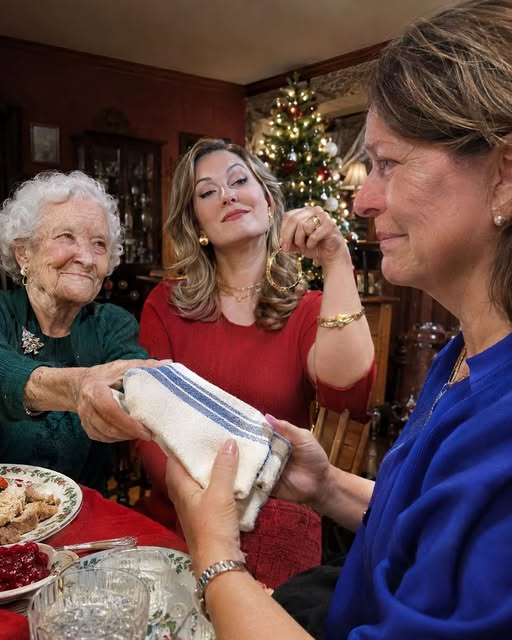
Last Christmas, my mother-in-law gave her daughter a gold bracelet and handed me a dish towel. The whole table laughed. She’d done it for twenty-six years. “You’re the one in the kitchen, hon.”
Ray and I moved into Frances’s house on Elm Street nine years ago, after her hip went. Ray died two years later, at sixty-one. His heart gave out, and I stayed in the house. Somebody had to do Frances’s pills and her hair and her Tuesday bath.
“Eileen, my pills,” she would call from her chair, and I’d come running.
“Eileen, this soup’s too salty.”
“Eileen, you put my good slip in the dryer again.”
Frances had been a school principal for thirty years. She ran her house the same way, with a list in her head and no patience for excuses. She didn’t say thank you much. That was how she’d always been, or so I told myself.
Candace, her daughter, drove up from the city for holidays and left before the dishes were done. Frances gave her a little velvet box every Christmas. A gold bracelet, a chain, earrings with little hearts. Then she’d hand me a dish towel, folded in tissue paper.
“Mom, you should’ve got her a mop,” Candace said one year.
The whole table laughed, and Candace laughed the loudest. I laughed along sometimes, because I didn’t know what else to do. I never cried in front of them.
I kept every towel in the bottom drawer and used them all.
I’m sixty-eight. I served lunch at the middle school in Oneonta for twenty-eight years. My whole life was in that house, right down to my Medicare card in the junk drawer with the twist ties. I won’t pretend I didn’t know what it meant when Frances got sick for good. I was scared, and I was tired, and I still believed Candace would do right by her mother.
Frances died in April, in her own bed, with me holding her hand. Her last week, she couldn’t eat, so I read her the obituaries out loud. She liked to hear who had gone before her.
“Eileen,” she said the night before she died. “You put up with me.”
That was the closest she ever came to saying thank you, and I was grateful for it. I was also ashamed of how much I wanted her to say it.
Candace arrived the next afternoon and asked where the jewelry box was. I told her it was on Frances’s dresser, where it had always been. She had it in her car before the funeral home called back.
At the funeral, Bea sat beside me in the second row. Candace sat up front. Bea held my hand through the service and never said why. I thought she was trying to comfort me. I didn’t ask.
Two weeks ago, at Sunday dinner, Candace set her fork down on her plate. Her husband looked at the tablecloth. Bea was there too, quiet as she’d been at the funeral.
“Eileen, I’ve listed Mom’s house with a realtor. I need you out by Christmas.”
“Out where?” I asked. My voice came out like a little girl’s.
“Candace, I took care of your mother for nine years.”
“And you lived here free for nine years,” she said. “I’d call that even.”
Then she picked her fork back up. “You were Ray’s wife, Eileen. Not Mom’s family.”
I looked over at her husband. He kept his eyes on his plate. Nobody else at the table spoke. I was furious with all of them, and with myself for still wanting one of them to tell her she was wrong.
I have my school pension and my Social Security, and that’s it. A room over the laundromat on Main Street costs more than both of them put together. I went upstairs and cried in the bathroom with the fan on, so nobody would hear me. Maybe she was right. Maybe I was only ever the help in that house.
I was scared that fighting her would cost me Ray’s whole family, every cousin and every Christmas card. I was also scared of being put out of the only home I’d had since Ray died. I should have asked about the house papers years earlier. I never did.
After dinner, Bea found me alone at the kitchen sink. She was eighty-four and sharp as a tack. Under her arm she had a package wrapped in tissue paper.
“Frances made me promise,” she said. “One more. After she was gone.”
She pressed it into my hands. It was a dish towel, white with a blue stripe, just like all the others.
“Turn it over, Eileen.”
I turned it over. In one corner, stitched in tiny blue thread, were two letters and a year: F.D. 1957.
“Did you never look close at those towels?” Bea asked.
I shook my head. I’d been too busy drying dishes with them.
“Go get them,” she said. “All of them.”
I ran upstairs, pulled the bottom drawer clear out, and carried the whole stack down. We laid all twenty-six towels on the kitchen table. Bea turned them over one by one, slow, like she was dealing cards. Every single one had the same tiny initials and the same year in the corner.
Candace came in from the living room for more coffee and stopped in the doorway.
“What is all this?” she said. “Mom’s old rags?”
Bea didn’t even look up at her.
“What does it mean, Bea?” I asked.
Bea laid her old hand flat on the pile.
“It means your mother-in-law cut every one of these out of the linen tablecloth her mother made for her wedding in 1957,” she said. “And she left you the house.”
Candace’s hand stopped on the coffee pot. Mine was still resting on the towel with the little blue initials.
“That’s not funny,” Candace said.
“I’m not joking,” Bea replied. “Frances told me why she gave you the towels. She told me what she put in her will.”
Candace looked at me as if I’d arranged this in secret. I hadn’t even known Frances had made a will. I had assumed the house would go to her daughter. Candace had acted as if it already had.
Bea explained that the tablecloth had been a wedding gift from Frances’s mother. It was good linen, carefully stitched around the edges. Frances had kept it for years, but it had a stain down the middle that wouldn’t come out. She cut around the stained part and made dish towels from what was left. The blue initials and year were already embroidered on the cloth.
“She made these herself?” I asked.
“Every one,” Bea said. “She asked me to help with the hems.”
Candace gave a small laugh, but it sounded different from the one at Christmas. “So the towels were made from an old tablecloth. That doesn’t mean she left Eileen the house.”
“No,” Bea said. “The will does.”
I looked at the pile again. For years I had dried dishes with pieces of Frances’s wedding tablecloth. She’d handed them to me in tissue paper while Candace got gold. I could not make that feel kind just because I knew where the cloth came from.
Bea saw my face. “She knew how it looked,” she said. “She was proud and hard-headed. She could have said thank you out loud. She didn’t.”
“Then why didn’t she?” I asked.
“Because she didn’t know how to make it easy,” Bea said. “She said the towels were a way of giving you something that had belonged to her from the start.”
That answer made my throat tighten, but it didn’t erase the years of laughter. I was glad Frances had cared in her own way. I was also angry that she had left me to guess.
Candace set the coffee pot down. “Mom would’ve told me.”
“She did tell me,” Bea said. “She asked me to wait until after she was gone. She didn’t want Eileen staying because she thought she owed Frances a house.”
I didn’t know what to say. Bea had known while Candace told me I had until Christmas. She had sat there through Sunday dinner while I thought my home was gone.
“Why didn’t you stop her?” I asked.
Bea pressed her lips together. “I should have. I thought Candace knew what the will said. I thought the lawyer would be in touch before she went making promises about the house. I was wrong.”
Candace pulled out a chair and sat down. “I was handling things. Nobody else was doing anything.”
“You were at the house for the jewelry before the funeral home called back,” I said. “You knew exactly where the box was.”
Her face tightened. “I didn’t know about this.”
“About the towels or about the will?”
“Either one.”
Bea stood and went to the drawer by the phone. She took out a small card with the lawyer’s office number on it. She’d been keeping it there since Frances died. I stared at it, embarrassed that she had the sense to keep a number I hadn’t thought to ask for.
“I was a witness when Frances signed,” Bea said. “The lawyer has the original.”
Candace shook her head. “Mom said the house would be mine.”
“She left you the jewelry,” Bea said. “She left Eileen the house.”
“She wouldn’t do that.”
“She did.”
Candace turned toward me. “You knew?”
“No. I found out at the same time you did.”
I wanted to leave it there. My hands were shaking, and the towels were spread out between us like evidence in a case I hadn’t meant to bring. But if I let Candace walk out thinking I’d accepted her version, she’d keep telling the family the house was hers.
“I want to see the will,” I said.
Candace’s mouth pinched. “You don’t have to make a scene.”
“I didn’t make one. You told me to leave a house you didn’t own.”
It was a hard thing to say. I wish I’d said it more calmly, but I meant every word.
The next morning I called the lawyer using Bea’s card. I told the person who answered that Frances had died in April and that I had just learned there was a will. I gave my name and waited while they checked. Then they set a time for Bea and me to come in.
I almost canceled before we left. I was afraid of walking into that office and finding out Bea had misunderstood, or that the will said something different than she’d told us. If I was wrong, Candace would never let me forget it. If I was right, I might lose whatever scraps of family goodwill were left.
Maybe they were right about me. Maybe I had been a guest in that house all along. I went anyway.
The lawyer had the will in a folder. Bea sat beside me while he went through it. Frances had signed it after Ray died. Bea had witnessed it. The house was left to me. Candace was left Frances’s jewelry and personal belongings. The will named Bea to handle the estate.
I listened twice because the first time I couldn’t take in every word. The house was not a promise Bea had heard in a hallway. It was written down, signed, and witnessed.
The lawyer made a copy for me and another for Bea. He explained that the house still had to go through the ordinary estate paperwork. He also said Candace had no authority to list it as if it were hers. Until the paperwork was settled, the realtor needed to be told who was handling the estate.
Bea put both hands on her purse. “I can take care of that.”
“I want to be there,” I said.
The lawyer looked up at me. He didn’t smile or tell me I was brave. He just nodded and said he would contact the realtor with us.
Candace and her husband came to the office later that week. I asked them to come because I didn’t want the will passed around in pieces and turned into another family story. Candace brought her purse and sat on the edge of the chair. Her husband sat beside her, still looking at his hands.
The lawyer put the copy on the desk and read the part about the house. Candace watched his finger follow the lines.
“Mom wouldn’t have wanted Eileen to have to leave,” Bea said. “She made that clear.”
Candace leaned back. “I thought she was leaving it to me. I’m her daughter.”
“You have the jewelry,” the lawyer said. “The will says what it says.”
Candace looked at me. “You could have told me you wanted it.”
“I didn’t know it was mine to want.”
“You’ve been living there for years.”
“Because I cared for Frances. You said that meant we were even.”
Her husband finally looked up. “You told me Eileen knew she had to move,” he said to Candace.
Candace turned toward him. “I said I was talking to her.”
“You said she agreed.”
“I thought she would.”
That was the first time she admitted she had made a decision for me and counted on me to accept it. Her husband looked down again, but this time he didn’t hide behind his plate. He looked ashamed.
Candace rubbed her thumb over the strap of her purse. “I figured the house was supposed to be mine. Mom never said otherwise to me.”
“Did you ask her?” I said.
She didn’t answer.
“Did you ask me before you told the realtor I was leaving?”
“I was trying to get things settled.”
“You told me to be out by Christmas.”
“I thought you could find somewhere.”
I felt my temper come up. “You knew what my pension and Social Security were. You knew I couldn’t pay what a room costs on Main Street.”
Candace’s eyes went to the will again. “I didn’t think you’d fight me over it.”
There it was. Not a grand scheme. She thought the house should be hers because she was Frances’s daughter, and she thought I would keep my voice down as I had at every Christmas table. I had spent a long time making that easy for her.
“You don’t get to call it even,” I said. “Not after nine years of me being there for her.”
Candace’s husband shifted in his chair. “You shouldn’t have told her to leave before we knew what the will said.”
“I thought I knew.”
The lawyer closed the folder. “The estate will be handled according to the document. The realtor will be told not to proceed with a sale.”
Candace didn’t argue with him. She looked at Bea, then at me. “I didn’t think Mom would choose you over me.”
“She didn’t choose one of us over the other,” I said. “She left you the things she wanted you to have, and she left me a place to live.”
It was the first time I had said what I believed about Frances without making excuses for her. Candace left the office with her husband. She didn’t apologize. I was disappointed, though I had no right to be surprised.
Bea and I met with the realtor and the lawyer. The realtor had the listing information and said he would take the house off the market once he had confirmation from the person handling the estate. Bea provided it. The house wasn’t sold, and no buyer had made an offer. Candace’s plan ended there.
For a while, relatives called to ask what was happening. Candace had told some of them she was selling Frances’s house and that I had decided to move. I told them the will left the house to me. I sent a copy to the people who asked. A few apologized for assuming I had nowhere to go. One cousin said she hadn’t known how much I did for Frances. I didn’t ask her to make up for the years she hadn’t noticed.
The estate paperwork took time. Candace was allowed to keep the jewelry Frances had left her. I didn’t ask for it back. After the estate was settled, the house was put in my name. The realtor removed the listing, and Candace stopped telling people I was leaving by Christmas.
I kept the towels. I still use them, though not the one Bea brought me that night. I folded that one and put it in the drawer by itself. Its little blue stitching is rough in one place, where Frances’s hand must have caught the thread.
The first time I opened the drawer after the paperwork was finished, I moved my Medicare card back beside the twist ties. Then I hung the towel with F.D. 1957 over the oven handle.