My brother-in-law threw me out of my own lake house in front of 20 relatives, calling me a “worthless freeloader.” I didn’t argue or try to stop him. I simply picked up my military bag and walked away. He thought he had humiliated me and won. But less than an hour later, an Army vehicle pulled into the driveway, and he had no idea who was about to step out…
PART 1: THE DAY MY BROTHER-IN-LAW THREW ME OUT OF MY OWN HOUSE
“GET OUT! THIS IS A PRIVATE FAMILY GATHERING, AND YOU’RE NOT INVITED!”
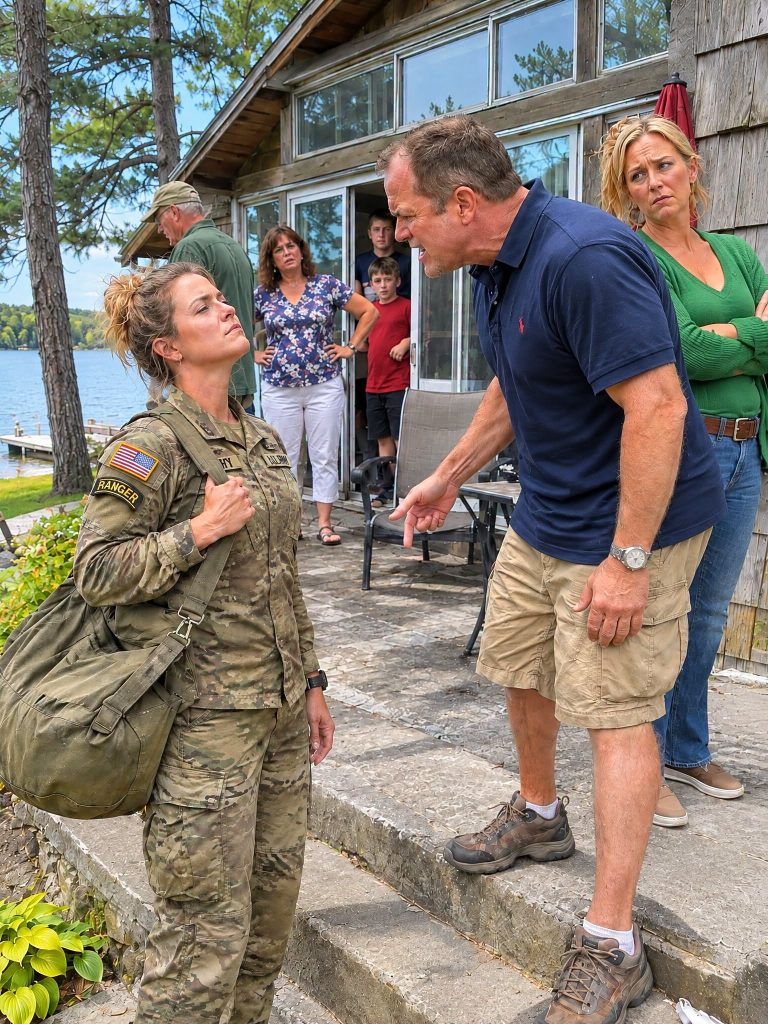
My brother-in-law, Ryan Mitchell, stood in the doorway of my lake house, ordering me to leave while nearly twenty relatives watched. Some laughed at his insults, while others looked at me as though I were an unwelcome stranger who had interrupted their celebration.
I adjusted the strap of my black duffel bag and reminded him that the property belonged to me. Ryan laughed and insisted that my older sister, Jessica, had given him permission to use it.
“Stop acting like you own everything just because you have some comfortable government job!”
I turned toward Jessica, who was standing beside the kitchen island, avoiding my eyes. When I asked whether she intended to let her husband throw me out, she sighed impatiently.
“Emily, it’s only one weekend. Why can’t you be generous for once?”
Her words hurt more than Ryan’s insults because I had spent years quietly supporting her family. Neither Ryan nor his relatives knew how much financial assistance I had provided, and almost none of them understood what I actually did for a living.
My name is Emily Carter, and I’m thirty-eight years old. I had served eleven years in the United States Army and had been promoted to full colonel just three weeks before that confrontation.
I commanded a specialized operational unit, although much of my work couldn’t be discussed outside official channels. My family assumed I held an ordinary administrative position at a military installation, and I had never felt the need to correct them.
I preferred being treated as Emily rather than according to my rank. That desire for privacy was one reason I had purchased a three-bedroom cedar house overlooking Missouri’s Lake of the Ozarks four years earlier.
The property featured a wide porch, a stone fireplace, and a private dock. I had paid for it using my savings and deployment earnings, without receiving financial assistance from anyone.
After seven months away, I finally had seventy-two hours of leave. I wanted nothing more than a quiet weekend beside the water, but when I arrived at four o’clock Friday afternoon, the driveway was crowded with unfamiliar vehicles.
Someone had even parked on the flowers beside my walkway. Country music played loudly inside, children were jumping on my furniture, and empty beer cans covered the kitchen counter.
A stranger was drinking from my favorite blue ceramic mug when Ryan approached me.
“What is this freeloader doing here?”
I demanded an explanation for the unexpected gathering. Ryan announced that his relatives were having a reunion and that I wasn’t invited.
Jessica admitted she had given them access to the property because she assumed I wouldn’t return from my assignment. When I reminded her that I’d told her about my leave two days earlier, she dismissed my concerns.
“The house sits empty most of the year, Emily. Stop making such a big deal about it.”
I thought about the money I had sent her over the years for car repairs, her children’s dental treatment, and her college tuition. When Ryan’s contracting business struggled, I had also secretly paid eight thousand dollars toward four months of their mortgage.
Jessica had promised to keep that assistance private because Ryan was sensitive about money. Now she was standing silently while he accused me of being a parasite.
I asked her one final question.
“Jessica, do you really want me to leave?”
“Please, Emily. Just go.”
I turned toward Ryan and made sure he understood that he was ordering me off property I legally owned. He confirmed it without hesitation, apparently convinced that I was powerless to challenge him.
I walked to my car and drove away without arguing further. Less than a mile down the road, I stopped in a quiet parking area and began making phone calls.
I had no intention of surrendering my home, but I was about to discover that the unauthorized family reunion was only part of a much larger deception.
PART 2: THE MILITARY CAPTAIN WHO EXPOSED MY SECRET
My first call was to my attorney, Daniel Okonjo. I asked him to verify the ownership records for my lake house and investigate whether anyone had attempted to borrow money against the property.
Next, I contacted Carla Dunn, who managed the company responsible for maintaining my house during deployments. I requested copies of the security footage and recent access records because I wanted to establish exactly what had happened while I was away.
Carla hesitated before telling me that someone had recently requested changes to my property’s authorized contacts.
“Colonel Carter, your sister submitted a power of attorney and asked for permission to handle property matters.”
Six years earlier, I had given Jessica limited authority to address emergencies during my military assignments. That document was never intended to authorize major financial transactions or allow her to make decisions about my property without consulting me.
I instructed Carla to preserve every relevant document and approve no changes. My third call went to my military command because the family dispute might affect my scheduled transportation.
The duty officer informed me that my transport officer was already nearby and offered to send him to check on me. I agreed, then opened the security camera application on my phone.
Inside the house, Ryan was still drinking with his relatives. Jessica stood alone in the kitchen, looking nervous as she picked up a thick envelope and slipped it into a drawer.
I wondered why she would hide paperwork in my home. Before I could examine the recording further, an exterior camera showed a dark green military Chevrolet Tahoe entering my driveway.
Captain Andre Lawson stepped out of the vehicle and approached the house. Ryan immediately confronted him, apparently believing another uninvited visitor had arrived.
“Good afternoon, sir. I’m here to check on Colonel Emily Carter. I understand this is her residence.”
Ryan burst into laughter and turned toward the relatives gathered nearby.
“Colonel? Emily? You’ve got to be kidding! Apparently our little freeloader is a colonel!”
Captain Lawson remained professional and asked whether I was home. Ryan proudly informed him that he’d ordered me to leave.
“You told Colonel Carter to leave her own residence?”
“That’s right. Now get off our property!”
Rather than argue, Lawson returned to his vehicle. Twelve minutes later, he located me near the lake and confirmed that I was safe.
He described his conversation with Ryan, and I almost laughed at the absurdity. However, my amusement disappeared when Daniel called with the results of his initial investigation.
“Emily, someone has submitted an application for a home-equity loan against your property.”
I asked how much money was involved.
“One hundred and twenty thousand dollars. Your sister submitted the application using the limited power of attorney you gave her.”
Daniel explained that the document didn’t authorize Jessica to borrow against the house. He had already contacted the lender, and the application had been placed on hold pending further investigation.
The loan documents had been delivered earlier that week and were supposed to be signed and returned by Monday. I immediately remembered the envelope Jessica had hidden in my kitchen drawer.
Suddenly, the reunion seemed less like an inconsiderate family gathering and more like an attempt to keep me away from something important.
I asked Daniel to prepare the documents revoking Jessica’s authority. Then I contacted the county sheriff’s office and requested assistance returning to my property without escalating the confrontation.
Captain Lawson agreed to accompany me as a witness. At approximately 5:40 that afternoon, we returned to the lake house with a sheriff’s deputy.
When our vehicles entered the driveway, the music stopped. Ryan appeared on the porch and began shouting before anyone could explain why we were there.
“ARE YOU SERIOUS? YOU CALLED THE POLICE ON FAMILY?”
Deputy Karen Hollister calmly informed him that she had reviewed the deed and confirmed that the property belonged exclusively to me. Ryan looked stunned and turned toward Jessica.
“That’s impossible. My wife told me something completely different.”
I looked directly at my sister, who had suddenly become very quiet.
“Jessica, what exactly have you been telling your husband about my house?”
PART 3: THE $120,000 SECRET MY SISTER TRIED TO HIDE
Ryan looked from Deputy Hollister to Jessica, struggling to understand how the house could legally belong to me. He explained that Jessica had told him our late father left the property to both of us and that I had used my inheritance to purchase her share.
I immediately corrected him because our father had died when I was nineteen. He had never owned the lake house, which I had purchased four years earlier using my own savings.
The relatives gathered on the porch became quiet as Ryan realized he had been repeating a story that wasn’t true. Jessica avoided my eyes, and I asked her about the envelope she had hidden in my kitchen drawer.
“Jessica, where are the documents you put away when you thought nobody was watching?”
Her expression changed immediately. Ryan hurried into the kitchen and returned with the envelope I’d seen on the security footage.
He opened it and began reading the first page aloud.
“Home Equity Line of Credit. Borrower: Emily R. Carter. Amount: $120,000.”
Ryan stared at Jessica, apparently unable to believe what he was holding. The documents showed that someone had attempted to obtain a substantial loan against property that neither of them owned.
“Jess, what have you done?”
Jessica sat down on the porch steps and began crying. She admitted that Ryan’s contracting business had accumulated debts they could no longer manage, including unpaid suppliers, bank obligations, and tax problems.
She had hidden the severity of their financial situation from her husband because she feared how he would react. As the pressure increased, she decided to use my lake house as collateral without asking my permission.
Jessica believed she could secure the money, pay their creditors, and repay the loan before I discovered what had happened. She had convinced herself that borrowing against my property was a temporary solution rather than a serious betrayal.
I asked why she had organized a large family gathering at the house.
“The property appraiser was coming this weekend. I needed to be here to let him inside.”
I realized the reunion had been arranged partly to conceal the appraisal appointment. By filling the house with relatives, Jessica had created an explanation for her presence and hoped I wouldn’t question the activity.
Then I asked why she had allowed Ryan to insult me and describe me as a freeloader.
Jessica covered her face before answering.
“Because if Ryan knew how much you’d helped us, he’d never agree to use your house. I needed him to believe you owed us something.”
Her admission hurt more than the attempted loan itself. She had deliberately misrepresented me to her husband so he would feel justified in taking advantage of my property.
Ryan looked at me in disbelief and asked whether I had really paid their mortgage the previous spring. I confirmed that I had covered all four months, totaling eight thousand dollars.
He explained that Jessica had told him the money came from her own family resources. Until that moment, he had no idea I was the person who had helped them avoid falling behind on their payments.
“I called you a parasite in the home you paid for.”
I didn’t respond immediately because there was nothing I could say that would make the situation less painful. Ryan had humiliated me, but Jessica had deliberately created the false impression that made his behavior possible.
Deputy Hollister explained that I could pursue appropriate legal action concerning the attempted loan. Daniel had already prevented the transaction from proceeding, but the unauthorized application still required careful handling.
As everyone tried to absorb the revelations, Ryan’s father stepped forward. Roy Mitchell was seventy-four, a retired truck driver and former Marine who had served in Vietnam.
He turned toward Captain Lawson and asked whether I truly held the rank of colonel.
“Yes, sir. Colonel Carter was promoted three weeks ago.”
Roy removed his cap and looked at me with obvious embarrassment. He apologized for accepting my hospitality while remaining silent as his son insulted me.
Then he straightened his back and saluted.
Ryan began crying as he approached with the loan documents. He apologized again, acknowledging that he had treated me terribly without knowing the truth about my home, my career, or my generosity.
I accepted the envelope, but my attention remained on Jessica. She was the person I had trusted with access to my home, and she had used that trust to put everything I had worked for at risk.
PART 4: THE DECISION THAT CHANGED OUR FAMILY
After learning the truth about Jessica’s attempted loan, I had to decide what consequences were appropriate. Deputy Hollister had explained my legal options, and Daniel was already preparing to revoke the authority my sister had misused.
I looked toward the children standing near the porch and realized they had done nothing wrong. Many relatives had traveled considerable distances for the reunion, and I didn’t want to punish them for Jessica and Ryan’s decisions.
I told everyone that the visiting relatives could remain at the lake house for the weekend. However, Jessica and Ryan would need to have a serious conversation with me about what had happened.
“The power of attorney is revoked, and the loan application has been stopped. You will never use my name or property without permission again.”
Jessica nodded through her tears. She appeared relieved that I wasn’t ordering everyone to leave, but I wanted her to understand that my decision wasn’t the same as forgiveness.
I explained that she and Ryan needed professional financial advice. Their debts required an honest assessment and a realistic repayment plan rather than another emergency contribution from me.
Then I made the boundary completely clear.
“I won’t be sending you any more money.”
Jessica immediately began pleading, but I refused to reconsider. I had already helped with car repairs, dental expenses, tuition, and mortgage payments, yet she had responded by trying to borrow against my home.
“I love you, Jess, but I can’t keep rescuing you while you destroy my trust.”
That evening, we spent several hours discussing their financial situation. Jessica finally admitted how frightened she had become as the debts increased and how desperately she had wanted to avoid admitting that her household was in trouble.
Ryan learned that his contracting business was struggling more severely than he realized. He also understood that Jessica had concealed important information because she feared his reaction to financial failure.
Neither of them could solve those problems simply by borrowing more money. I encouraged them to work with a financial counselor and confront their obligations directly.
The conversation was difficult, but it was more honest than anything we’d discussed in years. I began to recognize that my constant financial assistance had allowed Jessica to avoid dealing with problems that required lasting changes.
The following morning, I woke before sunrise and carried my favorite blue ceramic mug onto the porch. The lake was quiet, with a light mist floating above the water and a blue heron standing near the dock.
For the first time in seven months, I enjoyed my coffee without anyone asking me for help. I appreciated the peaceful surroundings that had motivated me to purchase the property in the first place.
Roy joined me a little later and sat beside me while we watched the sunrise. After several minutes, he complimented the house and addressed me by my military rank.
“This is a beautiful place, Colonel.”
I smiled and gently corrected him.
“It’s Emily.”
He nodded, and we continued watching the water. His willingness to treat me with simple respect meant more than the salute he’d offered the previous afternoon.
On Monday, Captain Lawson arrived to transport me to my next assignment. Before leaving, I noticed that the reunion guests had cleaned the house and repaired what they could.
Jessica approached me for a final conversation. She looked exhausted but seemed to understand that our relationship could never return to its previous arrangement without meaningful change.
“Why didn’t you ever tell us you were a colonel?”
I explained that my rank was important to my military responsibilities, but it wasn’t how I wanted my family to see me. When I came home, I wanted to be treated as Jessica’s younger sister rather than someone whose achievements determined whether she deserved respect.
“Because when I come home, I don’t want to be Colonel Carter. I just want to be your little sister.”
Jessica began crying and admitted that her behavior had taken away the sense of comfort I should have felt around my own family. I hugged her, but I didn’t withdraw the boundaries I’d established.
I left for my assignment knowing that the immediate financial threat had been stopped. Whether Jessica and Ryan would genuinely change was something only their future actions could demonstrate.
PART 5: THE $8,000 APOLOGY I NEVER EXPECTED
Seven months after the confrontation at my lake house, I returned from another military assignment. This time, the driveway was empty, and the property looked peaceful rather than crowded with unfamiliar vehicles.
The flowers that had been damaged during the reunion had been replanted. Someone had also repainted the porch railing, and a new welcome mat waited outside the front door.
Its message made me smile.
“THE COLONEL IS IN.”
Inside, the house was clean and quiet. On the kitchen counter, I discovered an envelope from Jessica containing a handwritten letter and a check for eight thousand dollars.
It was the exact amount I had secretly contributed toward her family’s mortgage payments. I hadn’t asked her to repay that money, so finding the check surprised me.
Jessica’s letter explained that she and Ryan had begun working with a professional financial counselor. They had finally confronted their debts instead of relying on emergency assistance or hiding problems from each other.
Ryan had closed his struggling contracting business and accepted a stable position with another contractor. Although the decision had been difficult, it provided a dependable income without the financial uncertainty that had overwhelmed their household.
Jessica had completed her dental hygiene certification and found employment. For the first time in years, she was earning money that allowed her to contribute consistently to their expenses.
She wrote that they were gradually learning to support themselves and make responsible financial decisions. Their progress hadn’t been immediate, but they were finally taking ownership of problems they had previously expected someone else to solve.
Near the end of her letter, Jessica addressed the damage she had done to our relationship.
“I’m sorry for the lies, Emily. You were always generous, and I took advantage of that. I’m learning how to stand on my own, and I hope someday you can trust me again.”
I read those words several times before setting the letter aside. I appreciated the repayment, but I understood that money alone couldn’t restore the trust she had broken.
Jessica had misused a limited power of attorney, attempted to borrow one hundred and twenty thousand dollars against my property, and allowed her husband to humiliate me in front of nearly twenty relatives. Those decisions had consequences that couldn’t simply disappear because she had written an apology.
Nevertheless, her letter showed that she was beginning to understand the difference between receiving help and becoming dependent on someone else’s generosity. She and Ryan had made practical changes rather than merely promising to behave differently.
I carried the letter onto the porch and sat overlooking the lake. The same peaceful view that had welcomed me after purchasing the house four years earlier reminded me why the property mattered so much.
It represented years of military service, careful saving, and personal sacrifice. I had purchased it because I wanted somewhere I could return after difficult assignments and enjoy a life that didn’t revolve around my professional responsibilities.
When Ryan ordered me to leave, he believed I was an ordinary government employee who could be intimidated. He had no idea that I was a colonel commanding a specialized Army unit, but my rank was never the reason I deserved to remain in my own home.
Jessica had made a different mistake. She believed that because I had repeatedly helped her, she could continue using my resources without asking permission or considering the consequences.
For years, I had confused protecting my sister with solving every problem she faced. I paid bills, offered financial assistance, and avoided uncomfortable conversations because I didn’t want her family to suffer.
But that approach had allowed her to depend on me without taking responsibility for her own circumstances. By establishing firm boundaries, I had finally given her an opportunity to make the changes she needed.
I thought about Roy’s apology and the way he had saluted me after learning my rank. His gesture was sincere, but I valued the quiet conversation we’d shared the following morning even more.
When he called me Emily instead of Colonel, he treated me as a person rather than a title. That simple acknowledgment was exactly what I had always wanted from my family.
I also remembered how calmly I had responded when Ryan insulted me. Some people might have expected me to announce my rank immediately or confront everyone until they admitted I owned the house.
Instead, I had stepped away, gathered information, and protected my property through the appropriate channels. Remaining composed allowed me to discover the attempted loan before Jessica could complete the transaction.
The experience reinforced something I had learned during eleven years in the Army. Strength didn’t require shouting louder than everyone else, and authority didn’t need to be displayed simply to win an argument.
Real strength often meant making careful decisions under pressure, recognizing when trust had been violated, and refusing to allow another person’s anger to determine your actions.
I had never needed a military uniform to prove my worth to Ryan or Jessica. I was Emily Carter long before anyone called me Colonel, and my home belonged to me regardless of what anyone thought about my career.
As I looked across the water, I felt grateful that Jessica and Ryan were finally learning to manage their own lives. Their progress didn’t erase the past, but it offered the possibility of a healthier relationship built on honesty rather than dependence.
The greatest satisfaction wasn’t watching my relatives discover my military rank. It was knowing that I had protected what I’d worked for while finally teaching my family that kindness wasn’t weakness.
And generosity would never again be mistaken for permission to take whatever they wanted.