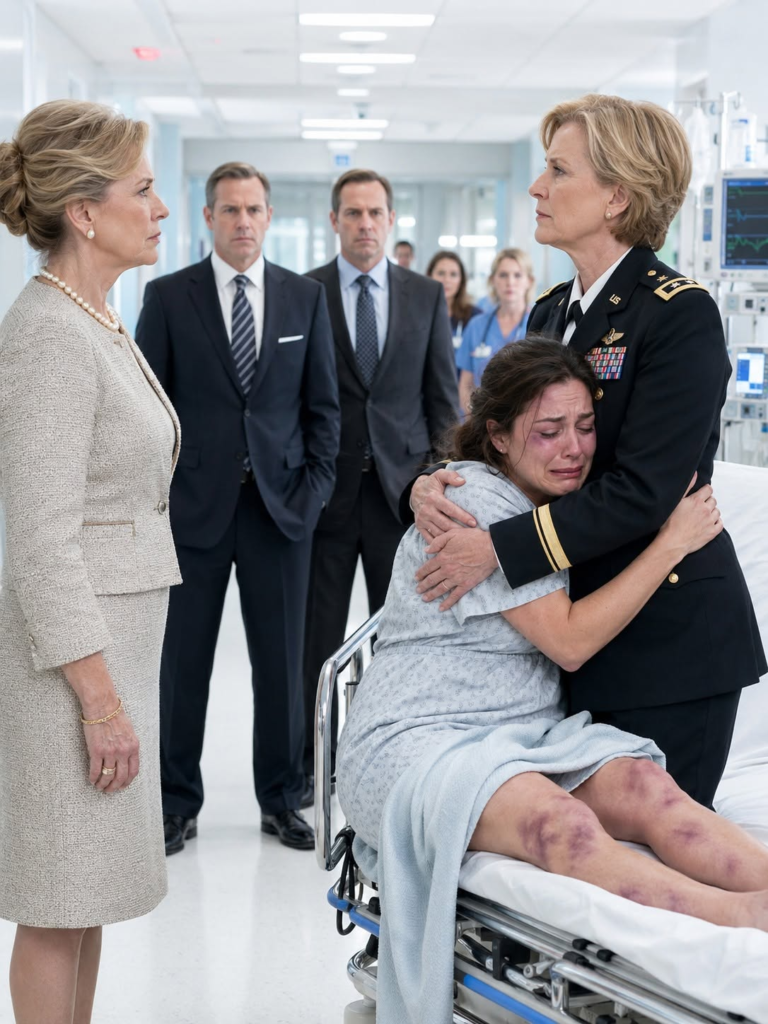
“Mom, come get me… my husband’s family beat me.”
A U.S. Army Colonel rushed to rescue her daughter. But when one of the most powerful families in America tried to humiliate her, they realized far too late they had chosen the wrong mother to cross.
I was still wearing my uniform when I pulled away from Fort Liberty that evening. My black service jacket was perfectly pressed. The ribbons and medals across my chest caught the last rays of sunlight as I drove through Charlotte, North Carolina, straight toward St. Bernard Hospital.
The gold nameplate above my pocket read: COLONEL RACHEL GARDNER.
I walked into the emergency department like a force no one could stop. A nurse stepped in front of me.
“Ma’am, you can’t go back there—”
“My daughter,” I said. “Where is Abigail Ferguson?”
She looked up into my face. Whatever she saw there made her step aside without another word.
I found Abigail in a small observation room at the very end of the hallway. She was curled beneath a thin hospital blanket. One eye had swollen completely shut. Her lip was split. Dark bruises shaped like fingerprints covered both of her arms. Her white designer dress was torn and stained.
My daughter. The same little girl who used to call me every night while I was overseas just to describe the colors of the sunset. The same child who drew pictures for soldiers and taped them to the refrigerator every time I came home.
Now she could barely lift her head.
“Mom…”
— Abigail, My Daughter, Barely Able To Lift Her Head
I crossed the room and wrapped my arms around her. Her entire body shook — like a frightened little girl.
Then I heard laughter behind me.
“She’s always been so dramatic.”
I slowly turned around.
Standing in the doorway were her husband Nicholas Ferguson, his mother Patricia, and his older brother Gregory. Tailored suits. Luxury watches. Perfectly polished smiles. Faces filled with wealth, arrogance, and contempt.
Patricia wore diamond earrings and a smile cold enough to freeze the room.
“Colonel Gardner, your daughter simply had an emotional breakdown. She fell. No one touched her.”
— Patricia, His Mother, Diamond Earrings, Ice Cold Smile
Abigail gripped my sleeve. “No, Mom. They locked me inside the guest house. They took my phone away. They told me if I ever left Nicholas, they’d destroy my reputation.”
Nicholas rolled his eyes. “She’s exaggerating. She’s always been overly sensitive.”
Gregory chuckled quietly. “Some women marry into families they’re never really prepared for.”
Without letting go of my daughter, I stood.
Patricia stepped closer. “There’s no need to make this ugly,” she said. “Our family has connections with the courts, the media, and people in state government.” She leaned in slightly further.
“Your military rank doesn’t frighten us.”
— Patricia Ferguson, To A U.S. Army Colonel
Gregory smirked. “Take your daughter home and be grateful we’re not filing a defamation lawsuit against her.”
I looked at each of them. One by one. Calmly. Silently.
Far too calmly.
They mistook my silence for weakness.
That was the first mistake they made.
(To be continued…)
Advice
If your child — regardless of their age — calls you and says they have been hurt, go. Don’t wait for a full explanation. Don’t try to understand every detail over the phone. Don’t consider whether it will be inconvenient or uncomfortable. Go first. Ask questions when you get there. The call itself is all the reason you need.
Wealthy and well-connected families often rely on the assumption that their power will discourage people from fighting back. They count on intimidation, on threats about reputation and legal action, on the belief that most people will calculate the cost of opposing them and decide it is too high. That calculation is exactly what they want you to make. Do not make it.
Document everything in the hospital — photographs, medical reports, the names of every person present, and the exact words they used. Evidence gathered in those first hours is among the most important that will ever exist in a case like this. A nurse who witnessed a threat. A doctor who documented injuries. These details matter enormously when powerful people later try to rewrite the story.
Lesson of the Story
The Ferguson family walked into that hospital room carrying everything they had always used to make problems disappear — money, connections, legal threats, and the practiced confidence of people who have never faced real consequences. They looked at a woman in a service uniform and saw a rank they could dismiss. They never stopped to consider what the person wearing that uniform had spent a career doing.
Patricia said: “Your military rank doesn’t frighten us.” That sentence tells you everything about the mistake they were making. Colonel Gardner wasn’t standing there because of her rank. She was standing there because of her daughter. And a mother who has spent a career leading people through impossible situations does not become less dangerous when the situation becomes personal. She becomes more focused.
The silence that filled the room after Gregory’s smirk was not the silence of a woman who had nothing to say. It was the silence of someone who had already decided exactly what came next — and knew that announcing it in advance would only give them time to prepare. That kind of quiet is not weakness. It is the calm that arrives when someone has stopped considering whether to act and has simply begun.
— StoryBroadcast —