My father stole my Lake Tahoe 020
My father stole my Lake Tahoe villa and gave it to my sister’s family, sneering, “Go back to your base, Commander.
You’re not welcome here.” I smiled, picked up my duffel bag, and left, because before they moved in,
I had already turned their dream home into the beginning of their worst nightmare.
The champagne cork burst above me just as my military duffel bag landed on the marble floor.
I had driven straight to Lake Tahoe after three sleepless weeks of naval exercises, still in uniform, my shoulders aching and my eyes burning from exhaustion.
I had expected silence.
A hot shower.
One peaceful night in the only place that had ever truly felt like mine.
Instead, I found my father and my sister Olivia standing on my rooftop terrace, raising crystal glasses beneath the evening sun.
Suitcases were already stacked beside the front door.
My stepmother Susan was showing Olivia through the kitchen.
Olivia’s husband, David, was measuring the living-room wall and discussing where they would mount their television.
For one confused second, I wondered if I had entered the wrong house.
Then Dad looked down at me from the terrace.
“Good. You’re here.”
“What is going on?” I asked.
He slowly came down the stairs, wearing the expression of a man about to announce a decision he believed nobody had the right to challenge.
“This villa is too big for one person,” he said. “Olivia has a husband and children. They need it more than you do.”
I stared at him.
“This is my house.”
His mouth twisted into a sneer.
“You live on a military base. The government gives you food, housing, and everything else you need.”
He pointed at my uniform.
“Go back to your base, Commander. This belongs to your sister’s family now. You’re no longer welcome here.”
Olivia raised her champagne glass.
She did not look ashamed.
She looked victorious.
My fingers loosened around the handle of my duffel bag.
It dropped with a heavy thud.
That sound seemed to carry every sacrifice I had made for them over fifteen years.
The $35,000 SUV I bought Olivia because she and David claimed public transportation was beneath them.
The $25,000 I wired from overseas after Dad called during a restricted operation and said gambling creditors were threatening him.
The $50,000 I handed over three weeks after burying my husband, James, because Dad claimed the bank was about to take the family home.
More than $110,000.
I had worked through deployments, sleepless nights, dangerous territories, and military investigations to protect them.
They had never asked whether I was safe.
They only asked when the next payment would arrive.
And now they were standing inside the home I had bought with what remained of my savings, celebrating as if my life were simply another family asset Dad had the authority to hand away.
“You gave them my villa?” I asked.
Dad crossed his arms.
“I made the right decision for this family.”
“You cannot give away something you do not own.”
His laugh was short and contemptuous.
“Do not start talking to me like one of your sailors. I’m your father.”
Olivia stepped closer, her expensive sunglasses resting on top of her head.
“Lauren, don’t make this ugly. You’re barely here. We’ll actually use the place.”
David nodded from behind her.
“The kids deserve somewhere peaceful.”
I looked at all of them.
Not one person mentioned the money I had spent.
Not one person remembered that I had bought the villa.
Not one person cared that I had returned exhausted and found strangers planning their lives inside my sanctuary.
They believed my discipline made me emotionless.
They mistook my silence for surrender.
I bent down, picked up my duffel bag, and gave my father a small smile.
It was the same calm smile I used during hostile negotiations when the person across the table had just revealed exactly how vulnerable they were.
“All right,” I said.
Dad’s eyebrows lifted.
He had prepared for an argument. Tears. Maybe another check.
He had not prepared for agreement.
“That’s it?” Olivia asked suspiciously.
“That’s it.”
I turned and walked back outside.
Behind me, the celebration resumed almost immediately.
Another cork popped.
Olivia laughed.
Dad told David where he kept the spare keys.
By the time I reached my truck, they had already forgotten I was there.
I drove away without looking back.
For the first hour, I gripped the steering wheel so tightly my hands hurt.
I refused to cry.
The military had taught me how to keep functioning when fear, exhaustion, and grief tried to shut my body down.
But it was James who had taught me what loyalty was supposed to mean.
He had been an officer too.
Three years earlier, I sat beside him in a military hospital as machines kept his failing body alive.
His final words were barely audible.
“Take care of the family.”
He had meant love them.
Protect them.
Make sure grief did not destroy us.
My father turned those words into a financial weapon.
Whenever I refused a demand, he invoked James.
“Your husband wanted you to help us.”
“James would be ashamed.”
“You made him a promise.”
For years, I believed honoring my husband meant allowing my family to empty me piece by piece.
That night, I finally understood something James never had the chance to learn.
These people were not asking to be cared for.
They were asking to own me.
I pulled over on a dark mountain road and sat in silence.
Then I looked at my reflection in the rearview mirror.
I was not the grieving widow Dad could frighten with memories anymore.
I was Commander Lauren Martin.
I had spent fifteen years managing complex military logistics, identifying weaknesses, protecting assets, and preparing for outcomes before anyone else knew a problem existed.
My father had just seized what he believed was an undefended property.
He had forgotten to check whether the owner knew how to fight.
The following morning, I walked through the reinforced gates of the San Diego naval base.
“Morning, Commander,” a young sailor said as he passed.
He saluted.
I returned it.
That simple gesture carried more genuine respect than my family had shown me in years.
Inside my office, I placed the villa’s documents in a neat stack.
The original deed.
Insurance records.
Tax payments.
Renovation invoices.
Every page carried one name.
Mine.
Then I called Michael Vance, a former military attorney who had once saved my career during a complicated investigation.
“I need to protect a property,” I told him.
“From whom?”
“My family.”
There was a brief silence.
“Bring me everything.”
My second call was to Ethan Wright, a former naval electronic-warfare officer and the most resourceful person I knew.
He had helped me solve impossible problems under deadlines that would have broken most people.
He answered with his usual calm voice.
“What happened?”
“My family has decided to occupy my Lake Tahoe villa.”
“Do they have permission?”
“No.”
“Do they believe they do?”
“Completely.”
I heard him exhale.
“That makes them predictable.”
Over the next several days, Michael closed every legal opening my father might try to exploit.
Old permissions were revoked.
Access rights were canceled.
Formal notices were prepared.
The villa was registered under protections my family could not simply bully their way around.
Then Olivia called.
At first, she cried.
She said the children needed space.
She said Dad’s blood pressure was rising because of me.
She said family should help family.
In the background, I heard David whispering instructions.
“Mention the kids again.”
Olivia’s sobs grew louder.
I waited until she finished.
“Are you done?” I asked.
The crying stopped instantly.
Her voice hardened.
“We’re moving in Sunday. Dad said you can’t stop us.”
I looked at the white bandage wrapped around my hand from the coffee mug I had broken after Dad used James’s name against me one final time.
“Try it,” I said.
Sunday afternoon, I sat in my apartment watching the property’s exterior cameras.
The SUV I had bought Olivia rolled into my driveway.
Dad stepped out first, surveying the villa like a king arriving at a conquered palace.
Susan followed.
Then Olivia and David began unloading suitcases, boxes, children’s toys, and framed family photographs.
They were not visiting.
They intended to erase me.
At the front door, they found the formal notice Michael had installed.
Private property.
Unauthorized entry prohibited.
Automated security active.
Contact the registered owner before entering.
Susan ripped it down.
Dad laughed.
“She’s throwing another tantrum.”
David inserted the spare key.
For half a second, nothing happened.
Then the lock clicked.
The door opened.
All four of them dragged their belongings across my threshold, laughing as they disappeared inside.
I watched from three hundred miles away, perfectly calm.
Beside my laptop sat a sealed legal folder, an encrypted phone, and one final document bearing my signature.
My father believed he had taken my villa.
Olivia believed she had inherited a luxury home.
None of them knew who legally owned the property now.
And they had no idea what would happen the moment the house recognized that four unauthorized people had just entered…
A chime sounded through the villa.
Dad stopped in the foyer with one hand still wrapped around his suitcase.
The laughter upstairs died first.
Then every recessed light brightened at once.
A calm electronic voice came from the ceiling speakers.
“Resident credentials invalid. Private zones secured. Property monitoring has been notified.”
Olivia stared upward.
“What the hell is that?”
David tried the hallway door leading toward my study.
It did not open.
He pulled harder.
A second chime sounded.
“Unauthorized access attempt recorded.”
Dad’s face changed.
Only slightly, but I saw the first crack in the confidence he had carried through my front door.
He looked directly at the camera above the entryway.
“Lauren.”
I sat back in my chair in San Diego.
On my laptop, the security dashboard marked every movement inside the house with a timestamp. Ethan had configured the system so each recording was copied automatically to an off-site server.
The front door still opened from the inside. Nobody was trapped. Olivia’s children had not come yet; they were staying with David’s mother until the villa was “ready.”
Dad pulled out his phone and called.
I answered on the third ring.
“What did you do?” he demanded.
“I protected the house.”
“You locked us in.”
“No. You can leave through the front door.”
He checked.
The door opened.
His anger deepened.
“Turn this garbage off.”
“No.”
Susan appeared behind him.
“Lauren, please. Your father’s blood pressure—”
“Then he should leave a house he does not own.”
Dad snatched the phone closer.
“I do own it.”
I looked at the sealed folder beside my laptop.
There it was.
The sentence Michael had told me to wait for.
“Do you?” I asked.
Dad went silent.
Olivia looked at him.
It lasted one second, but frightened people reveal entire histories in one second.
“You know what I mean,” Dad said.
“No. Explain it.”
His eyes moved toward the black leather briefcase he had carried inside.
Dad followed my silence and realized I had noticed.
“You’re watching us.”
“Yes.”
“Turn off those cameras.”
“No.”
“This is a family matter.”
“You tore down a written notice and entered a property without permission. What you are doing is evidence now.”
Olivia whispered, “Dad?”
He ended the call.
Ten minutes later, he stood on the terrace speaking to the sheriff’s department.
He called me a disturbed military officer.
He claimed grief had made me unstable.
He said I had locked him out of a property he legally controlled.
Then he said the words that made Michael, listening through our secure line, inhale sharply.
“I have the transfer paperwork right here.”
Michael’s voice came through my earpiece.
“There it is.”
Dad carried the briefcase to the dining table and pulled out a document bearing a blue notary stamp.
Olivia leaned over him.
“What is that?”
“Proof.”
“Of what?”
“That Lauren signed the villa over.”
The room seemed to tighten around them.
David picked up the document.
His eyes moved to the bottom.
“Robert.”
Dad’s name sounded strange in his mouth.
“What?”
“This says Lauren transferred the villa into the Martin Family Trust eighteen months ago.”
“So?”
David’s face went pale.
“Why is James listed as a witness?”
Nobody moved.
I stopped breathing.
Michael had warned me there might be forged material.
He had not told me what was on it.
James had been dead for three years.
The document on my dining table claimed he had witnessed my signature eighteen months ago.
Dad snatched it back.
“It’s a clerical error.”
“James being dead is a clerical error?” Olivia asked.
“Watch your tone.”
“No.” She stepped away from him. “What did you do?”
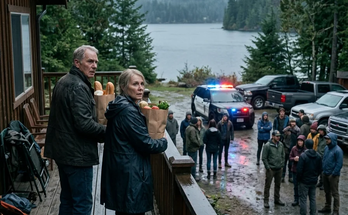
A sheriff’s vehicle turned into the driveway.
Then another.
Dad straightened immediately, gathered the papers, and walked outside wearing the same practiced expression he had used on bankers, relatives, and creditors for most of my life.
One deputy, a woman with gray threaded through dark hair, held out her hand.
“May I see the document, sir?”
Dad gave it to her.
She read it twice.
“Who is James Martin?”
“My son-in-law.”
“Where is he?”
Dad hesitated.
“He passed.”
“When?”
“Three years ago.”
She looked at the date again.
“Then how did he witness this transfer eighteen months ago?”
The mountain wind moved through the pines.
For several seconds, the only sound was a loose packing strap tapping against one of Olivia’s boxes.
Dad looked toward the camera.
Toward me.
His face no longer said victory.
It said calculation.
My phone rang.
Michael.
“Lauren, there’s more.”
“What?”
“When I locked down the title, I found a private lender inquiry tied to the villa. They funded one hundred eighty thousand dollars six weeks ago.”
My hand tightened around the phone.
“Against my house?”
“Against a fraudulent trust interest. The money went to your father.”
I closed my eyes.
One hundred eighty thousand dollars should have shocked me.
Instead, what hurt was how familiar the pattern felt.
Emergency.
Pressure.
Secrecy.
Then money disappearing.
“Gambling?” I asked.
“Yes. The lender required a casino-credit payoff statement.”
On the screen, Dad was still arguing with the deputies.
Susan had both hands over her mouth.
Olivia looked as though the floor had vanished beneath her.
Michael continued.
“The forged transfer, the false witness, the lender application—this is beyond a property dispute. I need to know what you want to do.”
For years, whenever Dad crossed a line, I moved it.
When he lost money, I replaced it.
When he invoked James, I surrendered.
Family had become the name I gave to every boundary I was afraid to enforce.
Then Olivia called me.
Her voice was ragged.
“Lauren.”
“Did you know about the loan?” I asked.
“No. I swear.”
I believed her.
Then she whispered, “But I knew the house wasn’t ours.”
My throat tightened.
There it was.
Not innocence.
Truth.
“Dad said you would complain and then give in like always. He said if we moved fast enough, you wouldn’t embarrass the family by calling police.”
“Why did you do it?”
She stared through the terrace doors at the boxes, the framed photographs she had brought to replace mine.
“Because I wanted this place.”
“I wanted people to think it was mine. I told myself you didn’t need it because you were gone all the time.”
Her breath shook.
“But I knew.”
Behind her, Dad shouted, “Olivia, get off that phone.”
She turned.
“No.”
The word was small.
Dad stared at her.
She said it again.
“No.”
Then she looked back toward the camera.
“Lauren, I have messages.”
Dad froze.
“What messages?”
“He told David and me to move in before you returned. He said occupancy would make the lender comfortable. He told us that if you objected, we were supposed to say you gave verbal permission.”
Dad stepped toward her.
One deputy moved between them.
Olivia unlocked her phone with trembling fingers.
David came beside her.
“I have them too,” he said.
Dad turned on him.
“You ungrateful bastard.”
David’s face hardened.
“You used my children’s address on a loan application.”
“You were getting a free house.”
“It wasn’t ours.”
The silence after that sentence seemed to spread through the entire property.
Michael spoke quietly in my ear.
“I need your decision on the trespass complaint and fraud report.”
I watched my father.
He had once seemed enormous to me.
His approval could change the temperature of a room.
Now he stood beside torn warning notices while his own daughter handed over his messages.
He looked smaller.
Not harmless.
Exposed.
Then he saw the camera.
“Lauren!” he shouted. “You call this off right now.”
I pressed the speaker control.
My voice came through the exterior system.
“No.”
“I am your father.”
“Yes.”
“You owe me.”
“No.”
“I raised you.”
“And I spent fifteen years paying for the privilege of being reminded.”
Susan began crying.
Dad pointed at the house.
“This should have been mine. Everything you have came from the family that made you.”
My knees weakened, but I kept my hand on the desk.
“You do not get ownership of the life you helped create.”
His face twisted.
“You think James would be proud of this?”
Hospital lights flashed through my memory.
James’s cold fingers.
Take care of the family.
Dad saw the hesitation.
He smiled.
Even now, with forged papers in his hand, he believed the dead man I loved was a leash he could pull.
I opened the sealed legal folder.
Inside was the document I had signed three days earlier.
The villa no longer belonged to me personally.
It belonged to the James Martin Harbor Trust, a private charitable trust Michael had created at my direction for military widows, widowers, and families recovering from loss.
I retained residential use, but no relative could inherit it or borrow against it.
No one could turn James’s memory into another invoice.
“Michael.”
“I’m here.”
“File everything.”
“Everything?”
“Yes. No bailouts. No quiet repayment deal.”
“Understood.”
Dad called me cruel, unstable, brainwashed by the Navy.
Then he made his last mistake.
He told the deputies the loan would have been repaid after he refinanced the villa.
The female deputy’s expression sharpened.
“Sir, are you saying you arranged the financing?”
Susan whispered, “Robert, stop.”
He did not.
That had always been his fatal weakness.
Dad believed volume could overpower consequence.
He insisted the house should have been his and said I had every right to “correct” a selfish decision.
The deputies listened.
The cameras recorded.
With every sentence, Dad dismantled the defense he might have had.
By sunset, the briefcase was evidence, the phones had been copied with Olivia’s and David’s consent, and Dad was served with a formal trespass order.
He laughed.
Then the deputy explained that returning without authorization could mean arrest.
The laugh stopped.
I flew north the next morning.
Michael met me outside the villa before noon.
Boxes still sat where my family had abandoned them.
The torn warning notice lay against a planter.
I picked it up.
Michael watched me smooth the paper.
“You don’t need to save that.”
“I know.”
I folded it anyway.
Inside, the house smelled of champagne and cardboard. One crystal glass stood on the terrace rail.
I washed it.
My hands were shaking.
Michael leaned against the kitchen island.
“The lender is cooperating. Your father represented that he controlled the trust. They also have emails from him.”
“What happens now?”
“Likely fraud and forgery charges. The lien can be voided. The trust protects the villa.”
I gripped the sink.
“You won,” Michael said softly.
Something inside me broke.
I slid down against the cabinet and sat on the kitchen floor.
Not because I had lost.
Because I finally understood how tired I was.
Michael sat several feet away.
For a while, neither of us spoke.
The refrigerator hummed.
Wind brushed the terrace doors.
A boat engine sounded far out on the lake.
“I kept thinking,” I said, “if I gave enough, they would stop needing proof that I loved them.”
Michael looked at the floor.
“They weren’t asking for proof.”
“I know.”
My voice cracked.
“They were asking for permission to keep taking.”
I pressed my palms against my eyes.
“I thought the villa was the first thing they stole.”
“It wasn’t.”
“No.”
I lowered my hands.
“It was just the first thing I refused to let them keep.”
Olivia came that afternoon.
Alone.
She did not walk in.
She knocked.
Three quiet taps.
When I opened the door, she held out the old villa key.
“I brought this back.”
I took it.
She looked past me but stayed outside.
“I’m selling the SUV.”
“That’s your choice.”
“I want to repay you.”
“No.”
She blinked.
“If you repay me because you think money buys forgiveness, then we learned nothing from Dad.”
Her eyes filled.
“What am I supposed to do?”
“Live without using me.”
She looked down.
“The kids think you hate them.”
“I don’t.”
“I told them this would be our house. I made you the villain before you even got here.”
I let the silence stay between us.
“Tell them the truth they are old enough to hear.”
She nodded.
Then she turned to leave.
“Olivia.”
She looked back.
“If you want a relationship with me, it cannot be built on access. Not to my money. Not to my house. Not to my guilt.”
Her lower lip trembled.
“What can it be built on?”
“Time.”
She nodded once.
“Okay.”
It was not reconciliation.
It was the first honest foundation we had ever laid.
Susan came two weeks later.
She had left Dad and moved into her sister’s spare room in Carson City.
At a small café, she twisted a paper napkin until it tore.
“I knew he was asking too much from you,” she said.
I waited.
“I didn’t know about the forged deed or the loan. But I knew he used James against you.”
“And you let him.”
“Yes.”
“Why?”
Her eyes stayed on the table.
“Because when he was pressuring you, he wasn’t pressuring me.”
Susan’s apology did not sound beautiful.
That was why I believed it.
“I am sorry I chose comfort while he was hurting you,” she said.
She did not ask me to forgive her.
I did not promise to.
But when we stood to leave, I touched her shoulder once.
For now, that was enough.
Dad was indicted six months later.
The lender preserved emails.
Olivia and David turned over messages.
The notary stamp had been copied from an old document.
The signature attributed to James had been traced from a letter he once wrote Dad after our wedding.
That detail nearly destroyed me.
I recognized the shape of the J.
Dad had taken the handwriting of a dead man who loved me and used it to steal from me.
He accepted a plea before trial.
The fraud conviction ended his access to the credit networks he had manipulated. The lender pursued its losses, and the family home was eventually sold to satisfy debts he had hidden.
For the first time in my adult life, his emergency did not become mine.
He called once from his attorney’s office.
“They’re taking the house,” he said.
“I heard.”
“You could stop it.”
There it was.
The same open hand.
The same demand.
“No.”
Silence.
Then, quietly, “James would have helped me.”
My throat tightened.
But the words no longer owned me.
“James helped everyone. That was one of the best things about him.”
Dad waited.
“And it was one of the things you exploited.”
I ended the call.
That night, I opened a storage box I had not touched since James died.
I had brought it to Tahoe because the trust needed some of his records.
Inside were photographs, medals, old receipts, a broken watch, and the blue hospital wristband I had never been able to throw away.
At the bottom was a small digital recorder.
I remembered it immediately.
James used it during treatments because medication made him forget things he wanted to tell me.
My hands shook as I replaced the battery.
There were four files: a grocery list, a retirement reminder, twelve seconds of static with James laughing at the wrong button, and one recording made two days before he died.
I almost stopped.
His voice filled the room.
Weak.
Breathless.
Still him.
“Lauren, if you find this later, remember something, because I know your father, and I know you.”
I stopped breathing.
“When I say take care of the family, I mean you too.”
My knees buckled.
I sat on the edge of the bed.
“You always put yourself outside the circle. Your dad, your sister, the Navy, me. Everybody gets protected except you.”
A long pause followed.
“I don’t want my death to become another order you think you have to obey.”
I covered my mouth.
“If they love you, they will still love you when you say no.”
Another breath.
“And if saying no makes them leave, sweetheart, they were already gone.”
The recording ended with a soft click.
For three years, I had carried four words like a commandment.
Take care of the family.
Dad had repeated them until they became a chain.
James had known.
Somewhere inside a box I had been too afraid to open, he had left me the permission I kept refusing to give myself.
I cried then.
Not quietly.
I bent forward and cried until my ribs hurt.
When it was over, I pressed the recorder against my forehead.
“I finally did,” I whispered.
The following spring, the James Martin Harbor Trust welcomed its first family.
A Navy widow named Claire arrived with two children and three suitcases.
She stood in the foyer the way I once had, uncertain whether she was allowed to occupy so much beautiful space.
Her son stared at the lake.
Her daughter touched the marble counter as if it belonged in a museum.
Claire looked at me.
“We can really stay here?”
“For three weeks.”
“For free?”
“Yes.”
Her eyes filled.
“I don’t know what to say.”
“You don’t have to say anything.”
Ethan had simplified the security system.
No dramatic voice.
No locked private hallway for guests.
Just safe access and a small brass plaque near the entry.
Michael had suggested the words.
A place to breathe.
The people who needed the villa did not need my family history.
They needed quiet.
Olivia came that summer with the children.
She asked first.
That mattered.
Her daughter ran toward me in the driveway, then stopped halfway, uncertain.
I opened my arms.
She finished the distance.
Olivia watched us with tears in her eyes.
Later, while the children skipped stones at the shoreline, she stood beside me.
“I sold the SUV.”
“I heard.”
“We bought something used.”
“Does it run?”
“Most days.”
I laughed.
So did she.
It was the first time our laughter had not required somebody else to lose.
David had taken a second job.
They were in counseling.
They were learning.
So was I.
Before leaving, Olivia handed me an envelope.
There was no check inside.
Only a photograph.
James at our wedding, standing between Olivia and me, grinning while Dad argued with the photographer in the background.
On the back, Olivia had written:
I should have remembered who looked happy when you were happy.
I read it twice.
Then I placed it beside James’s recorder upstairs.
Not as proof that everything was healed.
As proof that something had begun.
By autumn, I retired from active command.
The ceremony was small.
A few officers.
Michael.
Ethan.
Olivia and the children.
Susan sat near the back.
Dad was not invited.
When the final salute ended, grief and relief arrived together.
For fifteen years, the uniform had been my strongest boundary.
Now I had to learn how to live without armor.
I drove to Tahoe alone that evening.
The first snow had begun to fall.
At the villa, I carried one duffel bag inside.
The same one I had dropped on the marble floor the night Dad told me I was no longer welcome.
I set it down in the foyer.
The sound was almost identical.
Heavy fabric against stone.
But this time, no champagne cork exploded above me.
No one measured my walls.
No one told me where I belonged.
I walked onto the terrace.
The lake was dark glass beneath the snow.
Behind me, the house was warm.
A family staying through the trust had left that morning, and on the kitchen counter they had placed a child’s drawing of the villa beneath a giant yellow sun.
Four stick figures stood by the water.
A fifth stood a little apart wearing something that looked vaguely like a naval uniform.
Above it, in crooked handwriting, were four words.
Thank you for sharing home.
I carried the drawing outside.
For years, I thought home was the place no one could take from me.
Then Dad tried.
And I discovered that walls were not the thing I had been defending.
I had been defending the right to exist without paying admission to my own life.
The right to love people without financing their entitlement.
The right to honor James without obeying anyone who borrowed his voice.
The right to call something mine and still choose to share it.
Snow gathered along the terrace rail.
I closed my eyes.
In the quiet, I could almost hear James laughing on the old recorder.
Take care of the family.
For the first time, the words did not hurt.
I opened my eyes and looked through the glass doors at the warm rooms behind me.
At the child’s drawing in my hand.
At the duffel bag waiting in the foyer.
At a home that no longer represented what I had survived, but what I had chosen to become.
Then I stepped inside, closed the door against the snow, and turned the lock gently.
Not because I was afraid someone would take my home.
Because at last, I knew exactly who was welcome.