Three days after I let
Three days after I let
my son David and his wife Sarah
move into my four-bedroom home rent-free, Sarah stood
in my kitchen, sipped
her iced latte, and ordered me to
empty my own master bedroom by
11 a.m. David backed her up and
told me to
“show
some respect,” so at 9:15,
I quietly decided exactly what would be
moved instead. PART
1 “Move your things,” Sarah said,
lifting her iced latte
as casually as if she were asking me
to pass the salt. “We’re taking your
bedroom.” I stood beside
my kitchen sink with a damp dish towel
in my
hands and stared at my daughter-in-law. My
name is Kimberly Porter. I am sixty-four years
old, and I
bought this four-bedroom house with my late
husband twenty years ago. David
had called me a month earlier because their
rent was going
up. I offered my son and
his wife the guest room so they could
save money for a place of
their own. They had
been living
with me exactly three days. “Excuse me?” David
walked into the kitchen just
then. He would not meet my eyes. Instead,
he studied the
tile floor as though the grout had
suddenly become fascinating. “Mom, Sarah needs
the space. The guest room doesn’t have a
walk-in
closet for her clothes, and
she works
from home now.” Then he added the
sentence I still remember
perfectly. “Just show some respect and let us
have the master.” Respect.
In the house I owned. I looked
at my son. David had always been passive,
the kind of
person who bent toward whichever voice
happened to be loudest. At that moment, the
loudest voice belonged to his
wife. “Your room is
the guest room,”
I said, folding the towel. “That is
the arrangement.” Sarah
rolled her eyes and set her
cup on my granite counter
with a sharp clink. “I’ve already
decided. The movers
are bringing the rest of our bedroom
furniture this morning. Make sure the room is
empty by eleven.” She
walked out. David muttered something
about errands and followed her. Their silver SUV
disappeared down my driveway at
9:15 a.m. I
did
not yell. I did not cry. I
made myself a fresh
cup of tea and listened to
the refrigerator humming
in the sudden silence. Then I
went upstairs. I walked straight past my
master bedroom. My oak
dresser stayed
where it had always been. So did my
mattress and my late husband’s reading chair.
Instead,
I opened the guest-room door. Sarah’s
skincare covered the dresser. David’s shoes lay
against the baseboard. Suitcases
sprawled across the floor. I pulled out
their largest bags and began packing. Sarah’s silk
blouses were folded carefully. David’s
socks were paired. Their
toiletries went into
a waterproof bag. I
did not throw
a single thing. By
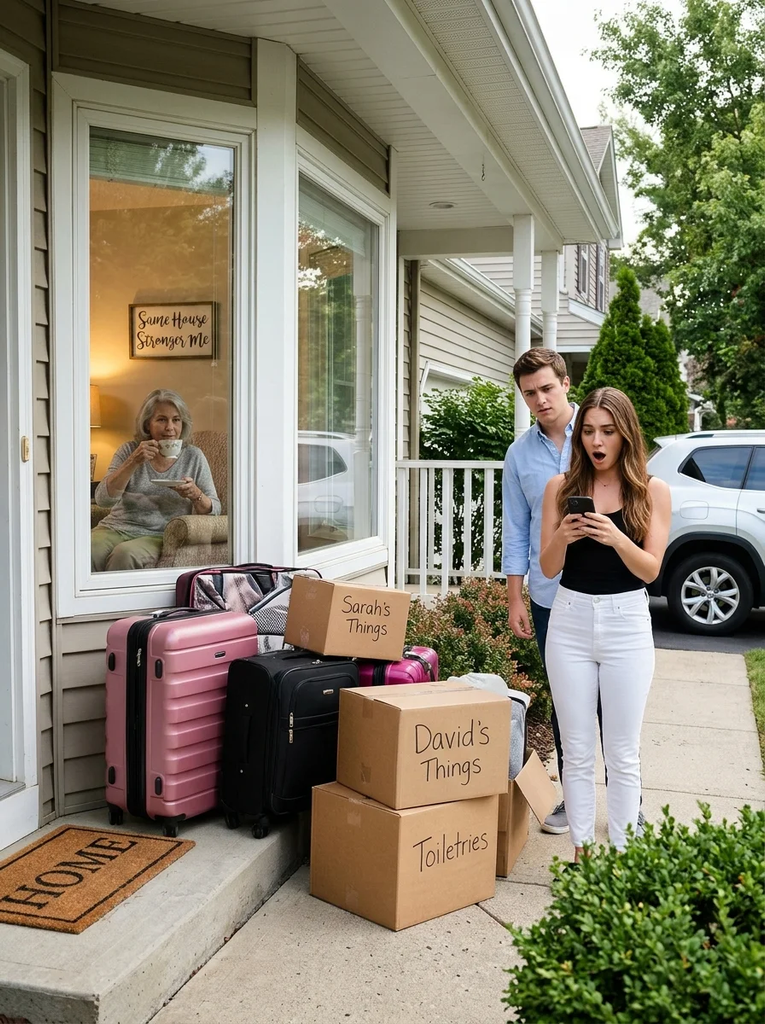
10:30, four suitcases
and three cardboard boxes were packed. I carried
every one downstairs. Then I
placed them neatly on my front porch
beside the geraniums, locked the door, and sat
in my favorite chair by the
window. At
10:55, their SUV turned into the driveway. Sarah
stepped out laughing
into her phone. Then she saw the
porch. Her laughter stopped. Would you have emptied
your own bedroom after being ordered
to leave it in
the
house you
paid
for?
I already knew my answer.
No.
Sarah stood beside the SUV,
staring at the luggage.
Her phone remained against her ear.
Whatever the caller was saying
no longer mattered.
David climbed out behind her.
He shut his door slowly.
Then he saw everything.
His face went pale.
Sarah lowered her phone.
“What is this?”
I remained beside the window.
She looked toward the house.
Then toward the porch.
Then back toward David.
“David.”
He said nothing.
“Why are our things outside?”
His eyes found mine.
The glass separated us.
For several seconds,
neither of us moved.
Then Sarah marched toward the porch.
She grabbed the front doorknob.
It did not turn.
She tried again.
Harder.
Then she pulled out her key.
I watched her insert it.
The key would not turn.
Her head snapped upward.
I had made another telephone call
after they left.
The locksmith arrived at 9:40.
He finished before ten-thirty.
I had not mentioned him earlier.
There had been no reason.
Until now.
Sarah rattled the handle again.
“Kimberly!”
I rose from my chair.
My knees felt strangely steady.
I crossed the living room.
Then I opened the inner door.
The storm door remained locked.
Sarah stared through the glass.
“What did you do?”
“I packed your belongings.”
“You changed the locks?”
“Yes.”
Her mouth fell open.
“You cannot do that.”
“I took advice first.”
That was also true.
At 9:18,
I had called my attorney.
I explained everything.
Including their three-day stay.
Including our text messages.
Including the guest-room arrangement.
Including Sarah’s demand.
He asked several questions.
Then he told me
what steps applied to my situation.
I followed them exactly.
Sarah pointed toward the luggage.
“You threw us out.”
“No.”
I looked at the boxes.
“I packed your things carefully.”
“That is the same thing!”
“No, Sarah.”
“It really is not.”
David finally approached.
“Mom.”
His voice was quieter.
“Open the door.”
“No.”
He blinked.
“Please.”
“No.”
Sarah gave a bitter laugh.
“She has lost her mind.”
I looked at David.
“Did you hear that?”
He looked away.
“David.”
His shoulders tightened.
“Did you hear your wife?”
“Yes.”
“And?”
He rubbed his forehead.
“Mom, everyone is upset.”
Everyone.
That word almost made me laugh.
Instead, I unlocked the storm door.
I stepped onto my porch.
Then I closed it behind me.
Sarah moved toward me.
I raised one hand.
She stopped.
“Do not step closer.”
Her expression hardened.
“I am not afraid of you.”
“I did not ask you
to be afraid.”
The driveway became very quiet.
Across the street,
my neighbor Helen watered roses.
She was trying very hard
not to look toward us.
Sarah folded her arms.
“We live here.”
“You were guests here.”
“We moved in.”
“You brought seven suitcases.”
“Our furniture is coming.”
“That was your decision.”
“You knew we needed somewhere.”
“I offered somewhere.”
I pointed upstairs.
“The guest room.”
Sarah’s eyes narrowed.
“That room is tiny.”
“It is fourteen by sixteen.”
“That is not the point.”
“Then explain the point.”
She opened her mouth.
Nothing came out.
David stepped between us slightly.
“Mom, can we calm down?”
“I am calm.”
He stared at me.
He knew I was right.
That seemed to frighten him.
I had spent years
mistaking calmness for surrender.
David probably had too.
Sarah certainly had.
A truck appeared down the street.
Large.
White.
Slow-moving.
Sarah glanced over.
Her expression changed instantly.
“The movers.”
The truck turned inward.
It stopped behind their SUV.
Two men climbed from the cab.
A third opened the rear door.
I could see furniture inside.
A king-sized bed frame.
Two nightstands.
A dresser.
Boxes marked with room names.
Sarah marched toward them.
“Bring everything upstairs.”
The older mover checked his tablet.
Then looked toward my house.
I walked down the porch steps.
“Nothing enters this property.”
Sarah spun around.
“Excuse me?”
The mover looked between us.
“Who owns the home?”
“I do.”
Sarah pointed at David.
“My husband lives here.”
I looked at the mover.
“This delivery was not authorized.”
He frowned at his tablet.
“Ma’am, we need access permission.”
“You do not have mine.”
Sarah’s cheeks reddened.
“I booked this service!”
“Yes, ma’am.”
The mover remained polite.
“But we cannot enter
against the owner’s instruction.”
Sarah turned toward David.
“Say something.”
He swallowed.
“Mom, just let them unload.”
“No.”
“Where are we supposed
to put this stuff?”
I looked at him.
“That is something adults arrange
before ordering furniture.”
Sarah laughed once.
Sharp.
Disbelieving.
“You are enjoying this.”
That accusation hurt.
Not because it was true.
Because part of me wished
she could understand how false
it really was.
I looked at David.
“I am not enjoying anything.”
Then my voice softened.
“I am looking at my son
and wondering when he decided
I mattered less than a closet.”
David flinched.
Sarah rolled her eyes.
“Oh, please.”
I looked at her.
“That reaction answers enough.”
She stepped toward the truck.
“Take it to storage.”
The mover nodded.
“There will be additional charges.”
“Fine.”
David looked at her.
“How much?”
She ignored him.
“Sarah.”
“What?”
“How much?”
She exhaled.
“I don’t know.”
“You booked it.”
“I said I don’t know.”
The first crack appeared
between them.
It was small.
Almost invisible.
But I noticed it.
The mover closed the truck.
Sarah turned back toward me.
“Give us our boxes.”
“They are yours.”
“And the suitcases.”
“Also yours.”
David climbed the porch steps.
He stopped beside his largest bag.
His hand rested on the handle.
Then he looked at me.
“Where do you expect us
to sleep tonight?”
There it was.
The question he thought
would make me surrender.
It might have worked
ten years earlier.
Maybe even five.
But something had changed.
Perhaps grief had changed me.
Perhaps sixty-four years had.
Perhaps being ordered
from my own bedroom
had simply made things clear.
“You are thirty-eight years old.”
He stared at me.
“You have a job.”
I looked toward Sarah.
“She has a job.”
Then back at him.
“You have savings.”
His expression shifted.
Sarah looked away.
That caught my attention.
“What?”
David’s jaw tightened.
“What do you mean?”
“You said you had savings.”
He glanced at Sarah.
She stiffened.
“David.”
“How much do we have?”
“Not here.”
He stared at her.
“Sarah.”
She grabbed a suitcase.
“We are not discussing finances
on your mother’s lawn.”
I felt something cold
move through my stomach.
David had told me
they wanted six months
to rebuild their savings.
That had been why
I opened my home.
I had believed him.
Now he looked surprised.
Not embarrassed.
Surprised.
The distinction mattered.
Sarah dragged her suitcase downward.
“Get the rest.”
David did not move.
She turned.
“David.”
He looked at me.
Then at her.
“How much is left?”
Sarah’s face hardened.
“We’ll discuss it privately.”
“How much?”
The movers fell silent.
Even Helen stopped watering.
Sarah lowered her voice.
“You are humiliating me.”
David almost laughed.
The sound held no humor.
“You ordered my mother
out of her own bedroom.”
Sarah froze.
It was the first time
he had said it plainly.
My chest tightened.
Not with victory.
With grief.
Because I had needed him
to say those words
three hours earlier.
Inside my kitchen.
Before I packed anything.
Sarah pointed at him.
“Do not start.”
“I asked one question.”
“And I answered.”
“No.”
“You avoided it.”
Sarah glanced toward me.
“This is what she wants.”
David’s face changed.
“What?”
“She wants us fighting.”
I shook my head.
“No.”
Sarah ignored me.
“She never wanted us here.”
“That is not true.”
“She wants you dependent on her.”
I almost admired
how quickly the story changed.
Three hours earlier,
I was selfish for keeping
my own bedroom.
Now I was controlling
because I refused
to finance their comfort.
David rubbed both hands
over his face.
“Stop.”
Sarah stepped back.
“What?”
“I said stop.”
His voice was quiet.
But different.
I had rarely heard David
speak that way.
Neither had Sarah.
She stared at him.
He picked up two boxes.
“Where is the hotel?”
“I haven’t booked one.”
He stopped.
“You said you did.”
“I said I would.”
“When?”
“When we needed it.”
David looked at our luggage.
Then at the moving truck.
Then at me.
Something in him collapsed.
Not dramatically.
His shoulders simply lowered.
For years,
I had mistaken his passivity
for gentleness.
Sometimes it was gentleness.
Sometimes it was fear.
And sometimes,
I suddenly understood,
it was convenience.
If someone else decided everything,
David never had to risk
being blamed.
Sarah made decisions.
I cleaned consequences.
He stood between us
and called that peace.
Not anymore.
I walked back upstairs.
Sarah called after me.
“Where are you going?”
I did not answer.
Inside my bedroom,
the late-afternoon sunlight
fell across Thomas’s reading chair.
My husband had been gone
almost four years.
I still called it his chair.
Some habits survived death.
I opened my nightstand.
Inside lay a small envelope.
Emergency cash.
Thomas had always insisted
we keep some nearby.
I counted three hundred dollars.
Then I stopped.
For one dangerous moment,
my old instincts returned.
Give David money.
Find them a hotel.
Fix the immediate problem.
Make everyone comfortable.
Prevent anger.
Prevent consequences.
Prevent discomfort.
I stood there
holding three hundred dollars
and heard Thomas’s voice
from years earlier.
Kim, stop rescuing him.
He had said it gently.
David was twenty-six then.
He had missed a car payment.
I quietly covered it.
Thomas found out later.
“He needs to learn,”
Thomas had told me.
“He will.”
“When?”
I had no answer.
Back then,
I had called Thomas strict.
Maybe he had simply seen
what love without boundaries became.
I returned the money.
Then I closed the drawer.
Downstairs,
David was loading boxes.
Sarah sat in the SUV.
Her arms remained folded.
I stepped onto the porch.
David looked up.
“I found a hotel.”
“Good.”
“Twenty minutes away.”
“Good.”
He waited.
I knew what he expected.
An offer.
Money.
A reversal.
Something.
I gave him none.
He looked toward my door.
“Can I get my laptop?”
“It is in the black case.”
I pointed beside the planter.
His eyebrows lifted.
“You packed it?”
“Carefully.”
“My charger?”
“Front pocket.”
He opened the case.
Everything was there.
That mattered to me.
I wanted him to understand
that this was not revenge.
Revenge breaks things.
I had protected everything.
Except their assumption
that I would disappear
inside my own home.
David closed the case.
“Thanks.”
I nodded.
He carried it down.
At the SUV,
he turned around again.
“Mom?”
“Yes?”
“I’ll call you.”
I looked at him.
“Call when you are ready
to speak honestly.”
His eyes lowered.
Then he nodded.
Sarah never looked at me.
They drove away.
The moving truck followed.
The street became quiet.
Helen crossed over slowly.
She carried her watering can.
“I was not watching.”
I smiled despite myself.
“Of course not.”
She looked at the driveway.
Then at me.
“Are you all right?”
That simple question
nearly broke me.
I had been so controlled
for so many hours
that kindness felt dangerous.
I nodded too quickly.
Helen knew me well enough
not to believe it.
She placed the watering can down.
Then she hugged me.
I did not sob.
Not immediately.
I lasted perhaps five seconds.
Then everything came out.
Not because Sarah wanted
my bedroom.
Not really.
I cried because David
had stood beside her.
I cried because my son
had looked at the floor
while someone ordered his mother
out of her own room.
I cried because Thomas
would have been furious.
I cried because part of me
still wanted to call David
and make his problem easier.
Helen held me quietly.
When I finally stepped back,
my face felt swollen.
“Sorry.”
“Don’t be ridiculous.”
She picked up her can.
“You want dinner?”
“I have soup.”
“That was not my question.”
I almost smiled.
“Yes.”
She nodded.
“Seven o’clock.”
Then she pointed at me.
“And do not bring anything.”
“I can bring bread.”
“Kimberly.”
“All right.”
That evening,
I ate lasagna
at Helen’s kitchen table.
Her husband Paul talked
about tomatoes for fifteen minutes.
He did it deliberately.
I knew that.
Normal conversation can be mercy.
For two hours,
nobody asked me
what I planned to do
about my son.
When I returned home,
the porch was empty.
The geraniums were still there.
One blossom had broken
beneath a suitcase wheel.
I crouched and lifted it.
The stem was bent.
Not severed.
I tied it gently
to a small wooden stake.
Then I went inside.
My house felt enormous.
Too enormous.
I stood in the foyer
and listened.
The refrigerator hummed.
The air conditioner clicked.
A clock sounded upstairs.
Three days earlier,
those ordinary noises
had meant solitude.
That night,
they meant ownership.
Not financial ownership.
Something deeper.
The right to exist
without negotiating every inch
of my own peace.
I slept badly.
At 2:14 a.m.,
my phone lit up.
Twenty-three messages.
Most were from Sarah.
I read none.
One was from David.
Mom, are you awake?
I stared at it.
Then another appeared.
I’m sorry about today.
I began typing.
Then stopped.
Sorry about which part?
The bedroom?
The insult?
The money?
Standing silent?
I deleted everything.
At 2:22,
another message appeared.
Can we talk tomorrow?
I wrote three words.
Not tomorrow. Friday.
He answered immediately.
Okay.
I turned the phone over.
Then I slept.
The next morning,
I entered the guest room.
For the first time,
I saw it clearly.
The room smelled faintly
of Sarah’s perfume.
A coffee ring marked
my grandmother’s dresser.
A charging cable remained
behind the nightstand.
Three empty shopping bags
sat beside the closet.
I gathered the forgotten items.
Then I opened
the bottom dresser drawer.
Something caught underneath it.
A folder.
Cream-colored.
Thick.
I assumed it belonged to David.
I lifted it carefully.
My address was printed
on the front.
I opened it.
The first page
was a contractor estimate.
Master closet expansion.
Bathroom renovation.
Built-in office cabinetry.
The second page
showed measurements.
My measurements.
My bedroom.
My bathroom.
My upstairs hallway.
I stopped breathing.
There were photographs.
My bedroom window.
My bathroom.
Thomas’s reading chair.
My jewelry cabinet.
My closet doors.
Pictures taken
inside my private room.
I had never seen them.
My hands began shaking.
The estimate was dated
two weeks earlier.
Two weeks before
David and Sarah moved in.
I sat on the bed.
For several minutes,
I could only stare.
This had not started
that morning.
Sarah had not spontaneously decided
my room suited her better.
She had planned it.
Before arriving.
Before carrying one suitcase
through my door.
Before thanking me
for helping them.
Before calling me generous.
I turned another page.
There was a handwritten list.
I recognized Sarah’s writing.
Primary bedroom.
Office downstairs.
Garage storage.
Replace living-room sofa.
Guest room for Kimberly.
My throat tightened.
Guest room for Kimberly.
I read it again.
Then again.
The words did not change.
My future had been planned
in someone else’s handwriting.
I photographed every page.
Then I called my attorney.
His assistant answered.
“Ms. Porter?”
“Yes.”
“My name is Kimberly Porter.”
My voice sounded unfamiliar.
“I need an appointment today.”
At eleven-thirty,
I sat across from
Martin Alvarez.
He had handled
Thomas’s estate.
He had also known
our family eighteen years.
Martin read the folder silently.
He removed his glasses.
Then he looked at me.
“How did you find this?”
“In the guest room.”
“Did you authorize any work?”
“No.”
“Did you discuss renovations?”
“No.”
“Did you promise them ownership?”
“No.”
“Did you promise David the house?”
“No.”
He nodded once.
“Good.”
Then he leaned back.
“Kimberly, I need to ask something.”
“All right.”
“Does David still hold
your financial power of attorney?”
I felt my stomach drop.
Years earlier,
after Thomas died,
I had named both children.
David and my daughter Leah.
It had seemed practical.
“Yes.”
Martin folded his hands.
“That needs review.”
“Can he take my house?”
“Not simply because he is named.”
His voice remained calm.
“But authority should reflect trust.”
I looked at the folder.
Trust.
The word hurt more
than I expected.
“What would you do?”
“I cannot make that choice.”
He slid a paper toward me.
“But I would protect clarity.”
That afternoon,
we did exactly that.
My estate plan was updated.
My emergency documents were revised.
No one received authority
without clear safeguards.
The house remained mine.
Entirely.
Nothing changed
because of anger.
Everything changed
because assumptions had become dangerous.
Before leaving,
Martin stopped me.
“One more thing.”
“Yes?”
“Do not make inheritance decisions
while you are hurt.”
I appreciated that.
“I wasn’t planning to.”
“Good.”
He smiled slightly.
“Protection and punishment differ.”
I thought about those words
all the way home.
At four-ten,
my sister called.
Then my cousin.
Then Leah.
That told me something.
Sarah had started talking.
I answered Leah first.
“Mom?”
“I’m here.”
“What happened?”
I closed my eyes.
“What did you hear?”
“That you threw David
and Sarah into the street.”
I almost laughed.
“Of course.”
Leah sighed.
“I assumed there was more.”
That surprised me.
“Why?”
“Because you have never thrown
anyone anywhere.”
Despite everything,
I smiled.
Leah was forty-one.
She lived forty minutes away
with her husband Marcus
and their two children.
She had inherited
Thomas’s directness.
Sometimes that had frightened me.
Now I understood its value.
I told her everything.
No embellishment.
No insults.
Just what happened.
When I mentioned the folder,
Leah went silent.
“How old is the estimate?”
“Two weeks.”
Another silence.
Then she said,
“Mom.”
“Yes?”
“Do you know what David
told me last month?”
My fingers tightened.
“No.”
“He said you were probably
giving him the house eventually.”
The room tilted slightly.
“What?”
“I asked why.”
Leah sounded uncomfortable.
“He said you had
too much house anyway.”
I sat down.
“Did he say I promised?”
“No.”
Her answer came quickly.
“He said it made sense.”
I closed my eyes.
There it was.
Not a promise.
An assumption.
Perhaps Sarah had built
an entire future
around something David
never had the courage
to ask me directly.
Leah continued.
“I told him not
to count your property.”
“What did he say?”
“He laughed.”
That hurt.
I looked toward the staircase.
Toward the bedroom
they had already redesigned.
“Leah.”
“Yes?”
“I owe you an apology.”
“For what?”
“For something older.”
She became very quiet.
I took a breath.
“Your brother always needed rescuing.”
“Yes.”
“And I kept rescuing him.”
“Yes.”
The answer was gentle.
That made it worse.
“I made you easier to overlook
because you handled yourself.”
“Mom.”
“No.”
I pressed my fingers
against my eyes.
“I need to say this.”
She let me.
“When David needed money,
I helped him.”
“When he needed rides,
I rearranged everything.”
“When he made mistakes,
I explained them away.”
“You rarely asked for anything.”
“So I assumed you needed less.”
My voice broke.
“That was unfair.”
Leah breathed slowly.
“I know you loved me.”
“I did.”
“I know.”
“But love does not erase patterns.”
She was silent.
Then she said,
“No.”
It was not cruel.
It was honest.
“I’m sorry.”
My daughter exhaled.
“I wanted you to notice.”
The sentence hit me hard.
“I notice now.”
“I know.”
“I should have earlier.”
“Yes.”
There was no dramatic forgiveness.
No instant healing.
Just truth.
And somehow,
that felt more loving
than easy reassurance.
Leah came over that evening.
She brought Marcus.
Their daughter Sophie came too.
Their son Owen carried cookies.
No one mentioned David
during dinner.
Afterward,
Leah followed me upstairs.
I showed her the folder.
Her expression changed
with every page.
When she reached
Guest room for Kimberly,
she stopped.
“Oh, Mom.”
I looked away.
Leah touched my shoulder.
“They had moved you
out in their minds already.”
That was exactly it.
The room suddenly felt cold.
I closed the folder.
“Not anymore.”
Friday arrived.
David chose a diner
near the highway.
Neutral territory.
I arrived first.
He entered five minutes later.
He looked exhausted.
His shirt was wrinkled.
He had not shaved.
For one second,
my maternal instincts surged.
Feed him.
Comfort him.
Tell him everything
would be all right.
Then I remembered Thomas.
Stop rescuing him.
David sat opposite me.
“Hi, Mom.”
“Hello.”
A waitress poured coffee.
Neither of us touched it.
Finally,
David spoke.
“Sarah is furious.”
“I assumed.”
“She says you humiliated her.”
I waited.
David looked down.
“I told her she humiliated herself.”
That surprised me.
He noticed.
“I should have said it earlier.”
“Yes.”
He nodded.
“I know.”
The waitress returned.
We ordered breakfast.
Then silence settled again.
David rubbed his palms together.
“I need to tell you something.”
“I’m listening.”
“Our rent was increasing.”
“All right.”
“That part was true.”
“But?”
He swallowed.
“We were already struggling.”
“With what?”
“Credit cards.”
“How much?”
He stared at the table.
“Thirty-seven thousand.”
I felt my stomach tighten.
“Thirty-seven?”
He nodded.
“Does that include the furniture?”
“No.”
I sat back.
“How much was the furniture?”
“Almost nine.”
My mouth went dry.
“David.”
“I know.”
“No.”
My voice stayed low.
“I do not think you do.”
He looked at me.
“You told me
you were saving money.”
“I thought we could.”
“That is not what I said.”
He closed his eyes.
“You are right.”
“What happened?”
He glanced toward the window.
Then began talking.
Not blaming.
Not entirely.
That mattered.
Sarah had wanted
a particular lifestyle.
New furniture.
Weekend trips.
Clothes.
Restaurants.
A newer SUV.
David had wanted peace.
So he said yes.
Again.
And again.
When cards filled,
he opened another.
When Sarah worried,
he reassured her.
When he worried,
he said nothing.
Then the rent increase came.
Not catastrophic.
But enough
to expose everything underneath.
Sarah suggested my house.
David agreed.
“She said six months?”
I asked.
He winced.
“At first.”
“At first?”
“She thought we could
stay longer.”
“How long?”
He did not answer.
“David.”
“A year.”
I stared at him.
“Maybe more.”
My chest tightened.
“And my bedroom?”
He rubbed his forehead.
“She complained about the guest room.”
“That does not answer me.”
“I know.”
He looked ashamed.
“She said you rarely use
half the house.”
“That still does not answer me.”
His eyes met mine.
“I told her
you would probably agree.”
I felt absolutely still.
“Why?”
“I don’t know.”
“Yes, you do.”
He looked away.
“Because you usually do.”
There it was.
The ugliest truth
in the simplest sentence.
Because you usually do.
I had trained my son
to expect my surrender.
Not intentionally.
But repeatedly.
Every rescued payment.
Every forgiven insult.
Every changed holiday plan.
Every time I said
it was easier
to avoid a fight.
All of it
had taught something.
I stared at my coffee.
“So this is partly mine.”
David’s head jerked upward.
“No.”
“Yes.”
“Mom, no.”
“I am not responsible
for your choices.”
I looked at him.
“But I helped create expectations.”
He shook his head.
“Dad warned me.”
I froze.
“What?”
David stared at his hands.
“He warned me about this.”
“When?”
“A long time ago.”
My heart began pounding.
“How long?”
David hesitated.
“The hospital.”
I could barely breathe.
Thomas had spent
his final twelve days
in a hospice wing.
David visited every day.
I had assumed
they discussed sports.
Work.
Ordinary things.
“What did he say?”
David’s eyes filled.
“He said you give
until people stop noticing
what it costs you.”
My throat tightened.
“He told me
never to use that.”
A tear slid
down David’s cheek.
“He said I was
too comfortable being rescued.”
I looked away.
Outside the diner,
cars moved through sunlight.
Ordinary people.
Ordinary morning.
Inside me,
something old broke open.
“Why did you never tell me?”
“I was embarrassed.”
“Did you listen?”
“No.”
His answer came immediately.
“I thought Dad was being hard.”
I almost smiled sadly.
“So did I.”
David wiped his face.
“Mom, I’m sorry.”
I said nothing.
He continued.
“Not because you changed the locks.”
“Not because the hotel is expensive.”
“Not because Sarah is angry.”
He drew a shaking breath.
“I’m sorry I stood there.”
My eyes filled.
“I’m sorry you had
to defend your home from me.”
That was the apology
I had needed.
It did not erase anything.
But it was real.
I reached for a napkin.
Then I asked,
“Did you know about the folder?”
His face changed.
“What folder?”
I placed photographs
on the table.
One by one.
The contractor estimate.
The measurements.
The room photographs.
The handwritten plan.
David stared.
His color disappeared.
“I never saw this.”
I watched carefully.
I believed him.
Not because I wanted to.
Because surprise is difficult
to imitate that completely.
He picked up
the final photograph.
Guest room for Kimberly.
His hand began trembling.
“She wrote this?”
“Yes.”
He stood abruptly.
The table shook.
A spoon hit the floor.
Several people looked over.
David sat again.
“Mom.”
His voice barely worked.
“I did not know.”
“I believe you.”
He covered his mouth.
“I did tell her
you might eventually downsize.”
My stomach tightened.
“But I never said
she could plan this.”
“What did you say exactly?”
David closed his eyes.
“That the house
would probably come to us someday.”
“Us?”
“Leah and me.”
“That is not true.”
“I know that now.”
“No.”
I leaned forward.
“You need to understand something.”
“My death is not
a financial plan.”
He winced.
“You cannot spend
an inheritance you do not own.”
“You cannot assign rooms
inside another person’s life.”
His face crumpled.
“I know.”
“Do you?”
“Yes.”
This time,
I believed him.
We sat quietly.
Then I asked,
“Where is Sarah?”
“At the hotel.”
“Does she know about this meeting?”
“Yes.”
“Does she know
you are showing me
your financial situation?”
“No.”
“Why not?”
David stared toward the window.
“Because everything becomes a fight.”
I let that sit.
Then I said,
“That is your marriage.”
He looked at me.
“I will not tell you
whether to stay or leave.”
His eyes filled again.
“That decision belongs to you.”
“But whatever you choose,
stop asking other people
to carry the cost.”
He nodded slowly.
Our breakfast arrived.
Neither of us ate much.
When the check came,
David reached for it.
“I’ve got mine.”
I almost protested.
Then I stopped.
He noticed.
A small sad smile appeared.
“Dad would approve.”
I smiled too.
“Probably.”
Outside,
we stood beside our cars.
David shifted awkwardly.
“Can I hug you?”
That question mattered.
He asked.
He did not assume.
“Yes.”
He hugged me tightly.
For a moment,
he became six years old again.
Then twelve.
Then eighteen.
Then thirty-eight.
All at once.
I held my son.
But I did not rescue him.
When we separated,
he wiped his eyes.
“I’m finding an apartment.”
“Good.”
“Something small.”
“Good.”
“I might need
a reference.”
“I can confirm
your employment history?”
He laughed unexpectedly.
“No.”
Then he shook his head.
“Actually, that was funny.”
“I was serious.”
“I know.”
He smiled faintly.
“I’ll handle it.”
Those words
were better than an apology.
I watched him drive away.
Then I sat
inside my own car
for nearly ten minutes.
I cried again.
This time,
the tears felt different.
Grief was still there.
But so was relief.
Change rarely arrives
looking beautiful.
Sometimes it looks
like seven boxes
beside geraniums.
Saturday morning,
Sarah came alone.
I saw her SUV
through the kitchen window.
She walked toward the porch
carrying an envelope.
I opened the door.
But not the storm door.
She noticed.
Her mouth tightened.
“I need my mail.”
“I have it.”
I lifted a small bundle.
She held out her hand.
I passed it through
the narrow opening.
Then she raised the envelope.
“I brought something.”
“What?”
“An apology.”
I waited.
She exhaled sharply.
“Can I come inside?”
“No.”
Her expression hardened.
“I am trying to apologize.”
“You can apologize from there.”
She stared at me.
For several seconds,
I thought she would leave.
Instead,
she looked downward.
“I handled things badly.”
I waited.
“I was stressed.”
Silence.
“Our finances are a disaster.”
More silence.
“I thought moving here
would fix things.”
“That part I understood.”
She looked at me.
“Then why did you
throw us out?”
“Because moving here
was not the problem.”
I kept my voice even.
“Trying to move me was.”
Sarah’s jaw tightened.
“I should not have said eleven.”
I almost laughed.
“That is not the issue.”
“I was angry.”
“Two weeks earlier?”
Her face froze.
I held up the folder.
Every trace of confidence disappeared.
“Where did you find that?”
“In my guest room.”
She looked away.
“That was just planning.”
“For what?”
“Possibilities.”
“Inside my bedroom?”
She said nothing.
I lifted the page.
“Guest room for Kimberly.”
Sarah closed her eyes.
“Kimberly.”
“No.”
I had rarely interrupted people.
I was learning.
“You came into my home
already planning my removal.”
“That is dramatic.”
“It is written here.”
“I meant eventually.”
“When?”
She looked at me.
“When you downsized.”
“I never said I would.”
“David said you might.”
“Might.”
The word hung there.
“Might is not permission.”
She folded her arms.
“You have four bedrooms.”
“Yes.”
“There are only you.”
“I am aware.”
“Most people your age
do not need this space.”
Something inside me
became completely calm.
“My age does not
reduce my ownership.”
“That is not what I meant.”
“It is exactly
what you keep meaning.”
She looked furious.
Then exhausted.
Her shoulders dropped.
“I thought David
would inherit it.”
“Someday?”
“Yes.”
“After I die?”
Her face reddened.
“When exactly were you
planning to start living
inside that inheritance?”
She said nothing.
I continued.
“I am sixty-four.”
“I am not dead.”
“I am not incapable.”
“I am not waiting
for someone younger
to distribute my rooms.”
Sarah looked toward the street.
A long silence followed.
Then she whispered,
“I thought you liked me.”
The sentence surprised me.
“I did.”
Her eyes snapped back.
“Did?”
“I liked the woman
who thanked me
for opening my home.”
Her face tightened.
“I do not know
the woman who measured
my bedroom without permission.”
She wiped one eye angrily.
“I panicked.”
“About money?”
“About everything.”
Her voice finally cracked.
For the first time,
I saw something underneath
the arrogance.
Fear.
Not innocence.
Fear.
Those are different things.
“I grew up
moving every two years.”
She stared past me.
“My parents rented forever.”
“Every landlord eventually said leave.”
“I hated it.”
She pressed her lips together.
“When David said
you owned this place outright,
I thought maybe
we could finally stop.”
I understood her more.
But understanding
did not erase responsibility.
“You wanted security.”
“Yes.”
“So did I.”
She looked at me.
“This house is mine.”
“My husband and I
worked twenty years
to make it secure.”
“Thomas died here?”
“No.”
“He lived here.”
I touched the doorframe.
“He planted those geraniums.”
“He built the shelves.”
“He chose that reading chair.”
I swallowed.
“You tried to turn
my security into yours
without asking me.”
Sarah began crying.
Quietly.
I did not open the door.
That was difficult.
Compassion still pulled me forward.
But compassion was not
the same as access.
“I am sorry,”
she finally said.
This time,
the words sounded different.
I believed she felt regret.
I did not yet know
whether she understood it.
“Thank you.”
She nodded.
Then she looked
at the folder.
“Can I have that?”
“No.”
Her eyebrows lifted.
“Why?”
“Because it concerns my property.”
“It was mine.”
“It was left here.”
I paused.
“My attorney has a copy.”
Sarah’s expression changed.
“Are you suing me?”
“No.”
“Are you calling police?”
“No.”
Relief crossed her face.
I continued.
“But no contractor
will enter this house.”
“No account using my address
will be authorized.”
“No financial arrangement
will involve my property.”
“And you will not
move back in.”
Her relief disappeared.
“I apologized.”
“Yes.”
“That does not restore access.”
She stared at me.
“So that’s it?”
“For living here?”
“Yes.”
“What about family?”
“That depends on behavior.”
She looked wounded.
I did not soften the truth.
“Trust is not restored
by one conversation.”
Her eyes lowered.
Then she nodded.
“I understand.”
I hoped she did.
She turned toward her SUV.
Before reaching it,
she stopped.
“David is leaving me.”
I felt my chest tighten.
“He told you that?”
“He said he needs space.”
“I am sorry.”
She gave a humorless laugh.
“Are you?”
“Yes.”
She looked surprised.
“I never wanted
your marriage to fail.”
“I wanted my home respected.”
“Those are different things.”
Sarah studied me.
Then she nodded slowly.
“I know.”
She drove away.
I stood behind
the locked storm door
until her SUV disappeared.
Then I sat down.
The envelope remained
on the porch.
She had forgotten it.
I waited fifteen minutes.
Then I retrieved it.
Inside was a handwritten note.
The first half
defended her behavior.
The second half
apologized for it.
That felt appropriate.
People rarely transform
in one clean moment.
Neither did I.
The following weeks
were uncomfortable.
David moved into
a one-bedroom apartment.
It had beige walls,
old carpet,
and no walk-in closet.
He sent me one photograph.
A folding chair.
A mattress.
A coffee maker.
His message said,
Starting over small.
I replied,
Small can be peaceful.
He wrote back,
Learning that.
Sarah rented a room
from a coworker.
She and David
began marriage counseling.
I stayed out of it.
That was harder
than it sounds.
David called twice
wanting advice.
The first time,
I listened.
Then he asked,
“What should I do?”
I answered carefully.
“What do you think
you should do?”
He groaned.
“That sounds like Dad.”
“Good.”
He laughed.
Then thought.
The second time,
he asked me
whether Sarah could change.
I said,
“Anyone can.”
Then I added,
“Wanting change
and doing change
are different things.”
He became quiet.
“So what do I watch?”
“Patterns.”
That answer became
important for both of us.
I watched David’s patterns.
He stopped asking for money.
He paid his own deposits.
He sold the expensive SUV.
He bought an older sedan.
He began tracking expenses.
He met with a counselor
without Sarah.
He called Leah.
That conversation lasted
almost two hours.
I learned about it
from Leah afterward.
“He apologized,” she said.
“For what?”
“For being the family emergency
for twenty years.”
I closed my eyes.
“How did you respond?”
“I told him
apologies need legs.”
I smiled.
“That sounds like you.”
“It sounded like Dad first.”
We both laughed.
Then Leah grew serious.
“He asked me
if I hated him.”
“What did you say?”
“I said no.”
She paused.
“I hated the pattern.”
That distinction healed something.
Not everything.
Something.
Sunday dinners slowly returned.
At first,
Leah came with her family.
David did not.
Then one Sunday,
he asked if he could join.
He asked.
Again,
that mattered.
I said yes.
He arrived carrying pie.
He knocked.
He waited.
I opened the door.
He did not walk past me.
“May I come in?”
My throat tightened.
“Yes.”
He stepped inside.
His eyes moved
toward the staircase.
He looked away quickly.
During dinner,
nobody discussed Sarah.
We talked about Sophie’s school.
Owen’s baseball team.
Marcus’s broken lawnmower.
Helen’s aggressive tomato plants.
Normal things.
After dessert,
David helped with dishes.
He stood beside
the same kitchen sink
where everything began.
For several minutes,
we worked quietly.
Then he said,
“I still hear myself.”
I glanced over.
“What?”
“Show some respect.”
His face twisted.
“I cannot believe
I said that.”
I dried a plate.
“I can.”
He looked hurt.
Then I continued.
“Because I remember
who you were that morning.”
He nodded.
“So do I.”
I set the plate down.
“The question is
who you become afterward.”
He stared at me.
“Do you forgive me?”
I thought carefully.
“Yes.”
His eyes filled.
“But forgiveness
does not mean forgetting.”
“I know.”
“And trust?”
I looked at him.
“That is growing.”
He nodded.
“I’ll take growing.”
So would I.
Three months passed.
Then four.
Sarah and David
remained separated.
Counseling continued.
Sometimes they made progress.
Sometimes they did not.
I heard only
what David chose to share.
I did not ask.
That was another change.
Eventually,
he came over
on a rainy Thursday evening.
He carried a small cardboard box.
His expression told me
something had happened.
We sat at the table.
“Sarah and I
are filing for divorce.”
I felt sadness.
Real sadness.
“I’m sorry.”
He nodded.
“So am I.”
“Are you certain?”
“Yes.”
I waited.
He rubbed his thumb
along the box edge.
“We tried.”
“I know.”
“She is doing better.”
“That is good.”
“She found her own apartment.”
“Good.”
“She is paying down debt.”
“That is also good.”
He looked at me.
“We just became people
who made each other worse.”
That was painfully mature.
“I’m glad you recognize that.”
He nodded.
Then pushed the box
toward me.
“I found something.”
“What?”
“In my storage unit.”
He opened the lid.
Inside were old photographs.
Thomas’s fishing cap.
Two baseballs.
A cracked watch.
Then an envelope.
My breath caught.
Thomas’s handwriting.
DAVID.
I touched the letters.
“When did he write this?”
“Before he died.”
“Did you read it?”
“No.”
I stared at him.
“Four years?”
He nodded.
“I couldn’t.”
His voice trembled.
“I kept thinking
if I opened it,
then there would be
nothing left from Dad
I had not heard.”
That made perfect sense.
Grief creates strange bargains.
He pushed the envelope
toward himself again.
“I opened it last night.”
I waited.
“What did he say?”
David looked at me.
Then he handed it over.
“You should read it.”
I unfolded three pages.
Thomas’s handwriting slanted
slightly to the right.
The first paragraph
made me laugh.
David,
if your mother gives you this,
she has ignored my instructions.
Because apparently
even death could not stop
Thomas teasing me.
I kept reading.
He wrote about childhood.
Fishing trips.
David’s first bicycle.
The time David
broke our garage window
and blamed a squirrel.
Then the tone changed.
Thomas wrote
that being a good man
was not about
never making mistakes.
It was about
who paid for them.
Your mother,
he had written,
will pay for yours
if you let her.
Not because you deserve it.
Because she loves you.
Do not mistake
her willingness to carry you
for your right
to remain carried.
My vision blurred.
I continued.
One day,
I will not be there
to tell her no.
That means
you must learn
to tell yourself no.
Do not use
her kindness
to avoid becoming
the man you should be.
And if she ever
opens her home to you,
remember one thing.
You are entering
her peace.
Do not rearrange it
to suit yourself.
I stopped reading.
The kitchen disappeared
behind tears.
David was crying too.
Neither of us spoke.
I looked down again.
There was one final paragraph.
Take care of your mother.
But understand this clearly.
Taking care of her
does not mean
taking over her life.
Respect her choices.
Respect her home.
Respect her no.
I covered my mouth.
David whispered,
“He knew.”
“Yes.”
“He knew exactly
what I would do.”
“No.”
I lowered the letter.
“He knew what
you might become
if nobody challenged you.”
David nodded painfully.
“I wish I opened it.”
“When?”
“Four years ago.”
“So do I.”
He looked at me.
Then I squeezed his hand.
“But you opened it now.”
He cried harder.
I moved beside him.
This time,
I hugged him first.
We sat together
at the kitchen table
while rain tapped
against the windows.
Thomas had been gone
four years.
Yet somehow,
his voice had reached us
exactly when we finally
knew how to hear it.
David left the letter
with me overnight.
I read it twice.
Then a third time.
The next morning,
I carried it upstairs.
I sat in Thomas’s chair.
Sunlight touched the armrest.
I imagined him there.
His newspaper folded.
His glasses crooked.
His coffee too strong.
“You were right,”
I whispered.
The room remained quiet.
Then I smiled.
“Do not get smug.”
For some reason,
that made me laugh.
I laughed until
I began crying again.
Grief and joy
sometimes use the same door.
Six months after
the morning with the suitcases,
another envelope arrived.
Sarah’s return address
was printed in the corner.
I nearly set it aside.
Then I opened it.
The letter was short.
No excuses.
No requests.
Sarah wrote
that she had spent months
thinking about the folder.
She admitted
the renovations were planned
before they moved in.
She admitted
she had convinced herself
that eventual inheritance
meant eventual permission.
Then eventual permission
became immediate entitlement.
Her wording surprised me.
She wrote something else.
I treated your generosity
like an available resource,
not a gift.
I read that sentence twice.
She apologized
for photographing my bedroom.
For ordering me out.
For insulting me.
For putting David
between wife and mother
when she knew
he avoided conflict.
She did not blame him.
That mattered.
At the bottom,
she wrote,
You were right
not to let me return.
I folded the letter.
I did not suddenly
want a relationship with her.
I did not forget.
But I believed
she finally understood
what had happened.
I wrote one reply.
Thank you for acknowledging it.
I wish you peace.
That was all.
It was enough.
The divorce became final
two months later.
There was no dramatic trial.
No screaming courthouse scene.
No last-minute reconciliation.
Two adults signed papers
and divided debts.
David kept his old sedan.
Sarah kept the furniture.
Including the enormous bed
that never entered my house.
I confess,
that detail made me smile.
Not because she suffered.
Because life occasionally
has an excellent sense
of proportion.
David continued counseling.
He also continued
paying his debts.
Every few months,
he showed me progress.
Not because I demanded it.
Because he was proud.
One evening,
he handed me
a small envelope.
“What is this?”
“Money.”
I frowned.
“For what?”
“The car payment.”
I understood immediately.
Years earlier,
I had covered
three of his payments.
I had forgotten.
He had not.
“You do not owe me.”
“Yes, I do.”
“That was a gift.”
“You called it a loan.”
I thought back.
He was right.
I had called it
a loan while knowing
I would never collect.
He smiled slightly.
“I am paying my loans now.”
I took the envelope.
Not because I needed money.
Because he needed
to finish something.
“Thank you.”
His shoulders relaxed.
Then he said,
“I finally understand
why Dad hated
when you rescued me.”
“He did not hate it.”
“He worried.”
I nodded.
“So do I.”
David smiled.
“You worry differently now.”
“How?”
“You let me struggle.”
“That sounds terrible.”
“It is actually helpful.”
We both laughed.
My relationship with Leah
changed too.
Or perhaps
I finally saw it.
I began calling her
without needing anything.
We had lunch.
Just us.
No crisis.
No emergency.
No brother discussion.
One afternoon,
she told me
she had been offered
a leadership position
at her company.
My first response
was not about childcare.
Not about stress.
Not about whether Marcus approved.
I simply said,
“That sounds exciting.”
She stared at me.
“What?”
“Nothing.”
“Leah.”
Her eyes filled.
“That is what Dad
would have said.”
I smiled.
“Then he taught me too.”
She accepted the job.
Three months later,
she invited me
to her promotion dinner.
David came.
So did Helen and Paul.
At one point,
I looked around
the long restaurant table.
For years,
I thought keeping family together
meant preventing discomfort.
I had been wrong.
Sometimes family becomes stronger
when discomfort finally
has nowhere to hide.
Back at home,
I changed the guest room.
Not immediately.
For months,
I left it untouched.
Then one Saturday,
Sophie came over.
She stood in the doorway.
“Grandma?”
“Yes?”
“Why does this room
look sad?”
Children can identify
things adults avoid naming.
I laughed.
“It had a difficult year.”
She considered that.
“Rooms can do that?”
“Apparently.”
She pointed toward the wall.
“Paint it yellow.”
“Yellow?”
“Happy yellow.”
I raised an eyebrow.
“There are many dangerous yellows.”
She laughed.
We chose a warm cream
with golden undertones.
Not quite yellow.
Close enough for Sophie.
David helped paint.
Before entering,
he asked.
“Are you sure?”
“Yes.”
That question
had become his habit.
He asked before
moving furniture.
Before opening cabinets.
Before using tools.
At first,
it was almost excessive.
Then I realized
he was retraining himself.
So I never mocked it.
We painted for hours.
At one point,
David stood where
Sarah’s contractor photographs
had been taken.
He looked around.
“This was going
to be your room.”
I dipped my roller.
“According to Sarah.”
He winced.
“I am sorry.”
“I know.”
“I still feel sick
when I think about it.”
I looked at him.
“Then stop only feeling sick.”
“What?”
“Learn from it.”
He nodded.
“That is what Dad
would say.”
“Your father is becoming
very inconveniently wise.”
David laughed.
“He always was.”
By evening,
the walls glowed softly.
I moved in
a writing desk.
A bookcase.
A comfortable chair.
Sophie brought
a ridiculous sunflower pillow.
Owen contributed
a ceramic dinosaur
he made at school.
I placed both proudly.
The room became
a place for reading.
Writing.
Grandchildren.
Quiet.
Nobody called it
the guest room anymore.
Sophie named it
Grandma’s sunny room.
The name stayed.
My bedroom remained upstairs.
Unchanged.
Thomas’s chair stayed
beside the window.
My oak dresser stayed
against the wall.
The closet remained
exactly large enough.
Funny how quickly
a room stops seeming inadequate
when nobody is trying
to steal it.
The following spring,
the geraniums bloomed heavily.
More than ever.
The stem damaged
by the suitcase wheel
had survived winter.
It grew sideways
for several inches
before turning upward.
Helen noticed first.
“Look at that.”
I crouched beside it.
The old bend
was still visible.
Above it,
bright red flowers opened.
Helen smiled.
“Stubborn thing.”
I touched one leaf.
“Yes.”
Then I laughed.
“I like it.”
One year passed.
Exactly one year
after Sarah ordered me
out of my bedroom,
I woke before sunrise.
For a moment,
I did not remember
the date.
Then I saw
Thomas’s letter
on my nightstand.
I kept it there now.
Not as a warning.
As a reminder.
My phone buzzed.
A message from David.
Breakfast?
My treat.
I smiled.
Then another message.
And I will knock.
I laughed aloud.
At nine,
he arrived
with coffee and bagels.
He knocked.
I opened the door.
He held up the bag.
“Permission to enter?”
“Granted.”
He stepped inside.
Then he stopped.
“Wait.”
“What?”
He looked at me.
“Happy anniversary.”
I stared.
“That is a strange thing
to celebrate.”
“Not the fight.”
He smiled.
“The day you stopped
letting me be a child.”
My eyes filled.
“That sounds
like your anniversary.”
“Fair.”
He handed me flowers.
Geraniums.
Of course.
“You are ridiculous.”
“I learned from Dad.”
“That is not true.”
“He was extremely ridiculous.”
I laughed.
We ate breakfast outside.
Leah arrived later.
Marcus brought fruit.
Sophie brought markers.
Owen brought noise.
Helen wandered over
without invitation,
which was allowed.
Paul brought tomatoes.
Too many tomatoes.
By noon,
my patio was full.
Laughter drifted
through the open doors.
Nobody took over.
Nobody demanded rooms.
Nobody decided
what I should surrender.
They simply came
because they were welcome.
There is a difference.
A profound one.
That afternoon,
David helped Paul
repair a loose gate hinge.
Leah sat beside me.
Sophie drew flowers
across three sheets
of expensive paper.
I pretended not to notice.
Then Leah nudged me.
“You okay?”
I looked around.
“Yes.”
She smiled.
“Really?”
I thought carefully.
“Really.”
That evening,
after everyone left,
I walked upstairs.
The house settled
around me.
I entered my bedroom.
Golden light stretched
across the floor.
Thomas’s chair waited
beside the window.
For years,
I had thought
the hardest part of widowhood
was learning to live alone.
I had been wrong.
The hardest part
was learning that alone
did not mean available.
My time was mine.
My money was mine.
My choices were mine.
My home was mine.
And love,
real love,
did not require
handing those things away.
I sat in Thomas’s chair.
Outside,
the geraniums moved
in a soft evening breeze.
I remembered Sarah’s latte.
David staring at the floor.
The suitcases.
The locked door.
The moving truck.
The folder.
The diner.
Thomas’s letter.
Leah’s honesty.
David asking permission
to enter.
Every painful moment
had become connected
to something better.
Not because pain
automatically creates wisdom.
It does not.
Pain can simply hurt.
What changed everything
was what we did afterward.
Sarah learned
that fear did not
justify entitlement.
David learned
that avoiding conflict
still makes choices.
Leah learned
her mother finally saw
what she had carried quietly.
And I learned
that generosity without boundaries
can become permission
in someone else’s mind.
The lesson cost me.
But not my house.
Not my son.
Not my daughter.
And finally,
not myself.
I stood
and walked toward the window.
Down below,
one bent geranium stem
held three bright flowers.
I thought about replacing it
when it first broke.
Instead,
I supported it.
That difference mattered too.
Supporting something
is not the same
as carrying it forever.
I finally understood that.
Thomas would have smiled.
Probably smugly.
I could almost hear him.
I touched the window glass.
“Do not start.”
The empty room
gave no answer.
But somehow,
I did not feel alone.
I turned back
toward my bed.
My bed.
My bedroom.
My house.
The words no longer
felt defensive.
They simply felt true.
I switched off the lamp.
Then I paused
beside Thomas’s chair.
“Good night.”
Outside,
the evening wind
moved gently through
the flowers.
Downstairs,
every door was locked.
Nothing felt cold.
Nothing felt empty.
For the first time
in a very long while,
silence did not mean loneliness.
It meant peace.
And the room
Sarah once ordered me
to surrender
remained exactly where
it had always been.
So did I.