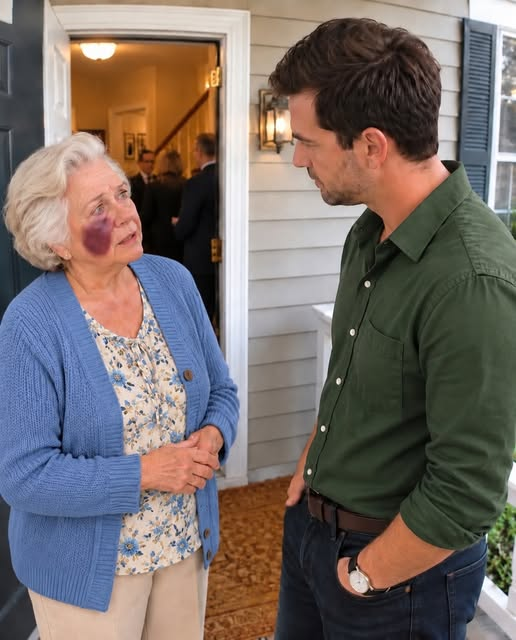
Part 2 – The Account That Shouldn’t Exist
Marcus did not let me stay to hear the answer.
That irritated me at first. At seventy-three, I had endured childbirth, widowhood, layoffs, pneumonia, eviction notices, a factory supervisor who used to throw clipboards when quotas slipped, and one Christmas when Adrian was nine and I had four dollars after rent. I did not need shepherding from my own family drama like a fragile witness being led from a courtroom.
But Marcus stood beside the open passenger door of his sedan and said, “You called me because you needed help leaving. Leave first. Learn the rest when you’re somewhere you can choose whether to listen.”
I looked back at the house. Through the glass beside the front door, Adrian was a blurred figure in the foyer, the papers still in his hand. Sloan stood beyond him, almost motionless.
“I hate when you sound reasonable,” I said.
“I learned it from a woman who used to make me rewrite apology letters before she’d let me mail them.”
“You spelled ‘sincerely’ wrong three times.”
“I was distraught.”
“You were lazy.”
He smiled then, and some of the pressure around my ribs eased.
The apartment Marcus had arranged belonged to a client who was overseas for three months and preferred having someone trustworthy in the place rather than leaving it empty. It was on the third floor of an older brick building near German Village, smaller than Adrian’s kitchen and warmer than his entire house. The windows looked toward a row of maple trees turning copper along the street.
A knitted throw lay folded over the back of the sofa. There were mismatched mugs in the cabinet and a scratch across the dining table. I touched the scratch with two fingers and nearly cried.
“It looks lived in,” I said.
Marcus set my suitcase inside the bedroom. “That’s usually considered a defect in real estate photography.”
“It looks wonderful.”
He did not mention the bruise again. Instead, he showed me the locks, the thermostat, the building intercom, and a handwritten sheet with the Wi-Fi password. He put his business card on the counter even though his number was already in my phone.
“You’ll tell me if Adrian comes here?”
“He doesn’t know the address.”
“Good.”
“He is my son, Marcus.”
“I know.”
“You say that like it’s an unfortunate medical diagnosis.”
“I say it like being your son does not entitle him to hurt you.”
I sat at the table. “He apologized.”
Marcus pulled out the chair across from me. “Do you want me to tell you what that apology means?”
“No.”
“Good. Because neither of us knows yet.”
That was why I trusted him.
At eleven, Nina arrived carrying a paper bag from the little bakery near her office and wearing a navy trench coat over jeans. She was forty-four, with thick dark hair streaked naturally at the temples and the alert eyes of someone who had spent two decades noticing what other people hoped she would miss. She stopped when she saw me, and all her professional composure vanished.
“Oh, Loretta.”
“Don’t.”
“I wasn’t going to say anything.”
“You were about to hug me.”
“I absolutely was.”
“Fine.”
She did.
I held her longer than I expected to. Nina smelled faintly of rain and coffee, and for a moment I remembered her at twenty-one, sitting at my kitchen table with a textbook open and terror in her eyes because her mother’s fever had risen again. I had told her to study. I would sit with Rosa. Nina had passed the exam the next morning.
When she stepped back, her eyes were wet but her voice had steadied. “I brought cinnamon rolls and three notebooks because apparently I’m incapable of visiting without turning it into an investigation.”
“Marcus already has the legal face on.”
“I was born with this face.”
“You were born nosy.”
“That too.”
Elias arrived twenty minutes later, apologizing for traffic. At forty-nine, he had kept the slight stoop of the too-tall college boy I remembered, though everything else about him had sharpened: close-cropped hair, wire-frame glasses, deliberate movements. He carried a laptop case and a folder thick enough to concern me.
“You found something,” Marcus said.
“I found several things.”
I looked at the folder. “Already?”
Elias glanced at me. “You gave me six months of bank records and the account name Sloan provided for your transfers. That’s enough to start.”
Nina poured coffee for everyone. “Start where?”
Elias opened his laptop on the scratched table.
“Loretta transferred twelve hundred dollars on or near the first of each month for six months. Seven thousand two hundred total.”
“I know what I paid.”
“I know. I’m establishing sequence.”
“Sorry.”
“No need.”
He turned the screen so all of us could see. “The receiving account is in Sloan’s name only.”
Marcus leaned closer. “Not a joint account?”
“No.”
“And not an account used for household expenses?”
“Not primarily, from what I can tell.”
My stomach tightened. “How can you tell?”
“Because you sent me the statements Sloan accidentally left in your shared printer tray three months ago.”
I stared at him, then remembered. I had photographed those pages because the first thing I saw on them was a transfer bearing my name. At the time, I had felt foolish doing it, like some suspicious old woman collecting scraps that meant nothing.
“What was the account for?” Nina asked.
Elias enlarged a set of transactions. “Most of Loretta’s monthly payments were moved within twenty-four hours into a brokerage account. The amounts don’t match exactly every time, because Sloan mixed other money into the checking account, but the pattern is consistent.”
Marcus looked at me. “Did Sloan ever tell you she was investing the money?”
“No.”
“Did you authorize her to?”
“No.”
Nina folded her arms. “That’s ugly, but it isn’t necessarily criminal.”
“No,” Marcus said. “Misrepresentation can create civil issues depending on what was said and documented, but we’re not leaping ahead.”
I disliked being discussed in categories, even sensible ones. “What did she invest in?”
Elias hesitated.
That hesitation frightened me more than his answer would have.
“Elias.”
He adjusted his glasses. “Mostly ordinary funds. But there are transfers out to another account with a company name attached.”
“What company?”
“Northline Consulting LLC.”
Nina’s expression changed. “Never heard of it.”
“You wouldn’t have. It was formed eleven months ago.”
“By Sloan?”
“No.”
Elias turned the screen back toward himself and tapped several keys. “Registered agent is a corporate filing service. Mailing address is a rented box. The organizer is listed as Thomas Renner.”
Marcus frowned. “Who is Thomas Renner?”
“I don’t know yet.”
I thought about the envelope in Sloan’s hand that morning. “Could that be what Adrian saw?”
“Possibly,” Elias said. “But I haven’t seen the documents.”
Nina opened one of her notebooks. “What does Northline do?”
“On paper? Business strategy and project management.”
“Does it have clients?”
“I can’t tell from public filings.”
“Does it have employees?”
“Not that I can find.”
Marcus sat back. “And Sloan was sending money there.”
“Repeatedly.”
“How much?”
“Over the period I can trace from what Loretta photographed, just over thirty-eight thousand dollars.”
That was not my money, not all of it. Yet hearing the number made the room feel smaller.
Nina looked at me. “Did Adrian ever mention financial trouble?”
“No. The opposite. He talked about bonuses. The house. Travel. Sloan used to joke that they were finally living the life they deserved.”
“What does Adrian do exactly?” Elias asked.
“He’s a regional operations director for Bellwether Medical Supply.”
Nina wrote it down. “And Sloan?”
“Interior design. At least she says she is. She takes private clients.”
Marcus glanced at Elias. “Could Northline be connected to either business?”
“I’m checking.”
The phone rang.
Adrian.
Everyone looked at the screen lying beside my coffee.
“I’m answering it,” I said.
Marcus gave a single nod.
“Hello?”
For several seconds there was only breathing.
“Mom.”
His voice sounded different. No clipped impatience. No irritation. He sounded like a man standing in a room after the lights had gone out.
“Yes.”
“Where are you?”
“Safe.”
“I need to talk to you.”
“You are.”
“No. In person.”
I looked at Marcus.
“About Sloan?” I asked.
A longer silence.
“She lied to me.”
“So did you,” I said.
The words came quietly. That gave them more weight.
He inhaled. “I know.”
I waited.
“I don’t know how to explain yesterday.”
“Then don’t explain it yet.”
“Mom—”
“I asked for one thing. No smoking in the house because I cannot breathe properly around it. You hit me for saying it.”
My voice began to shake. I hated that and kept going anyway.
“You want me to hear that Sloan lied to you, and I will. But her dishonesty does not erase what you did. I will not let you use her wrongdoing to make yours smaller.”
No one at the table moved.
Adrian whispered, “I know.”
This time it sounded as though he might.
“What did she lie about?”
“Your money, for one thing.”
“For one thing?”
He let out a breath. “There’s more.”
Elias quietly turned his laptop toward Marcus and pointed to something on the screen. Marcus’s eyebrows rose.
Adrian continued. “The account she had you paying into? I didn’t know. I swear to you, Mom. I thought you were giving her grocery money because you insisted.”
“I did insist on contributing.”
“Not twelve hundred.”
“No.”
“I found statements. She has accounts I’ve never seen. She’s been moving money for months.”
“To Northline Consulting?”
The silence on the phone became absolute.
“How do you know that?”
“I asked people I trust to help me understand my own finances.”
“Your finances?”
“My payments are part of it.”
“Mom, Northline isn’t about you.”
Elias shook his head sharply, signaling something.
“What is it about?” I asked.
Adrian did not answer immediately.
When he did, his voice was nearly a whisper. “My job.”
Marcus stood up.
Nina stopped writing.
I pressed the phone tighter to my ear. “What about your job?”
“I can’t explain this on the phone.”
“Try.”
“Someone at Bellwether has been steering vendor contracts. Sloan says she was investing in a private consulting opportunity. But Northline received payments connected to companies we use.”
“We?”
“Bellwether.”
Elias typed quickly.
“What are you saying, Adrian?”
“I’m saying I think Sloan may have gotten involved in something she didn’t understand.”
Nina’s mouth tightened at the phrasing.
“And you?” I asked.
“What about me?”
“Did you understand it?”
He said nothing.
That silence was answer enough to chill me.
Finally, he said, “There are approvals with my name on them.”
Marcus reached for a legal pad.
“Did you make those approvals?” I asked.
“Yes, but not for what they became.”
“What does that mean?”
“It means I trusted numbers someone else prepared. It means I signed things without asking enough questions. It means if this looks the way I think it looks, I could lose my job even if I never took a dollar.”
His voice broke on the last word, just slightly. It was the first crack I had heard since childhood.
I closed my eyes. There had been a time when I would have rushed immediately to comfort him. That instinct was still there, old as bone. But another truth now stood beside it: love was not the same as rescue.
“Where is Sloan?”
“She left.”
“When?”
“Twenty minutes after you did.”
“Do you know where she went?”
“No.”
Marcus held out his hand for the phone. I shook my head.
“Adrian,” I said, “listen carefully. Do not destroy anything. Do not delete anything. Do not move money around. Do not call Sloan and threaten her or accuse her of crimes. And do not lie to your employer if they ask you questions.”
Marcus gave me a look of surprised approval.
“I wasn’t planning to—”
“I raised you. I know what fear makes people plan.”
He was quiet.
“I need to see you,” he said.
“Not today.”
“Mom.”
“Not today.”
A ragged breath came through the line.
Then he said, “There’s something else.”
Of course there was.
I looked toward the window, where leaves dragged along the pavement in little spirals. “Tell me.”
“The envelope Sloan had?”
“Yes.”
“It was a notice from the bank about a home equity line.”
I frowned. “Your mortgage?”
“Our house.”
“What about it?”
“She borrowed against it.”
Nina mouthed how much?
“How much, Adrian?”
“Two hundred and sixty thousand dollars.”
My hand tightened around the phone.
Marcus swore softly.
“I didn’t sign for that,” Adrian said.
Everyone at the table went still.
I opened my eyes. “What do you mean?”
“I mean the signature on the papers is supposed to be mine.”
“And?”
“It looks like mine.”
His breathing hitched.
“But I didn’t put it there.”
Part 3 – What the House Was Hiding
By noon, the story had stopped being about twelve hundred dollars a month.
That should have made my own grievance feel smaller. In some ways it did. Forged signatures, vendor contracts, quarter-million-dollar loans—those were large, adult words for large, adult disasters. A bruise on an old woman’s cheek could seem almost embarrassingly simple beside them.
Marcus must have guessed where my thoughts had gone because he shut Elias’s laptop and said, “None of this changes what happened to you.”
“I didn’t say it did.”
“You didn’t have to.”
Nina pushed a cinnamon roll toward me. “Eat.”
“I’m not hungry.”
“That has never stopped you from ordering me to eat.”
“Because you got headaches.”
“And you get shaky.”
I tore off a piece.
There was something strange and humbling about sitting at that scratched table while three people I had once helped in small, ordinary ways now helped me. I had never thought of feeding Marcus, sitting with Rosa, or making space for Elias at supper as investments. I certainly had not expected repayment.
Yet perhaps kindness was not a ledger. Perhaps it was more like planting trees beside roads you might someday travel again.
Elias reopened the laptop. “I found the connection.”
Marcus leaned in. “Between Northline and Bellwether?”
“Yes.”
Nina moved her chair closer.
Elias brought up a corporate record. “Thomas Renner, organizer of Northline Consulting, is the brother of Bellwether’s vice president of procurement, Kenneth Renner.”
Marcus went very still. “That’s significant.”
“It gets more significant.”
Elias clicked to another document. “Northline received transfers from at least two vendors who won expanded Bellwether contracts this year. I can’t see internal records, so I can’t say why the money moved. But the timing is notable.”
“And Sloan sent money into Northline too?” I asked.
“Yes.”
Nina frowned. “Why would Sloan pay into a company receiving vendor money?”
“I don’t know.”
“What about Adrian?”
“No direct transfers from accounts I can see.”
Marcus pointed at the screen. “You’re working only with public information and Loretta’s documents?”
“Correct.”
“Good. Keep it that way.”
Nina closed her notebook. “There’s something bothering me.”
“What?” I asked.
“If Sloan were secretly enriching herself through some arrangement with Bellwether vendors, why take your twelve hundred dollars every month? That’s petty compared with thirty-eight thousand, let alone a two-hundred-sixty-thousand-dollar credit line.”
Elias nodded. “I had the same thought.”
“Maybe she’s greedy,” Marcus said.
“Maybe. But complicated financial behavior usually has a logic, even when the logic is bad.”
I thought back over the last six months. Sloan insisting I transfer money rather than write checks. Sloan telling me utilities had risen. Sloan complaining about property taxes, groceries, cleaners. Sloan growing increasingly tense whenever Adrian discussed work at dinner.
“There was a man,” I said.
All three turned toward me.
“What man?” Nina asked.
“I don’t know his name.”
Marcus sighed. “Loretta.”
“I didn’t know it mattered.”
“What happened?”
I searched my memory. “About two months after I moved in, Adrian was traveling for work. Sloan had someone over during the afternoon. A man. Maybe late forties, early fifties. Expensive coat. Very polite.”
“What did he look like?”
“Dark hair going gray. Thin face. Little scar under his chin.”
Nina was writing again. “Did you hear a name?”
“Sloan called him Ken once, I think.”
Elias and Marcus looked at one another.
“Kenneth Renner?” Nina asked.
“I wouldn’t know.”
“What were they doing?”
“Talking in the study.”
“About what?”
“I wasn’t eavesdropping.”
Nina raised an eyebrow.
“I wasn’t intentionally eavesdropping.”
Marcus almost smiled.
“I heard Sloan say, ‘Adrian signs what lands on his desk if the numbers look right.’ Then the man said something about timing. When I walked past, they stopped talking.”
“Did Sloan explain who he was?” Marcus asked.
“She said he was a design client.”
Nina’s pen froze. “A design client named Ken.”
“Possibly.”
Elias typed Kenneth Renner’s name and pulled up a headshot from a Bellwether industry page. He turned the laptop toward me.
“That him?”
The hair in the photograph was neater, the suit more formal. But the narrow face, the scar beneath the chin, the close-set eyes were the same.
“Yes.”
Nobody spoke for several seconds.
Marcus finally said, “All right.”
I hated the way he said it.
“What does all right mean?”
“It means Sloan’s connection to Bellwether’s procurement chief wasn’t incidental.”
“Could Adrian know?” Nina asked.
I heard yesterday again: Maybe now you’ll stop talking.
I did not want to defend him. I did not want to condemn him either. Both impulses felt too easy.
“I don’t know what my son knows anymore,” I said.
At two-thirty, Adrian called again.
This time Marcus answered after asking my permission.
“Adrian, it’s Marcus Bell.”
A burst of speech came through so fast I could not make out the words.
Marcus interrupted. “Slow down.”
More speech.
Marcus’s expression changed.
“When?”
He stood.
“Do not touch anything. Yes, I understand. No, don’t call him. Absolutely do not call him.”
He ended the call.
“What happened?” I asked.
Marcus looked at Elias. “Bellwether suspended Adrian pending an internal review.”
My heart sank despite everything.
“They know already?” Nina asked.
“Apparently someone contacted compliance this morning.”
Elias stared at his screen. “That’s fast.”
“Adrian thinks Sloan did it.”
“Why?”
“Because the concerns raised involve his approvals specifically.”
Nina’s gaze sharpened. “Meaning someone may be positioning him as the responsible party.”
Marcus nodded.
I pushed back from the table. “I’m going to see him.”
Marcus shook his head. “Loretta—”
“No. This is not me crawling back into that house. I want to know what he knows, and I want to look at him while he tells me.”
“You don’t owe him that.”
“I’m not going because I owe him.”
That ended the argument.
Marcus insisted on driving. Nina came because she was Nina, and Elias stayed at the apartment to keep reviewing what we had legitimately obtained. No one called him an investigator while we were in the car. The word had begun to sound too cinematic for the sadness of what we were doing.
Adrian’s house looked different when I returned that afternoon.
The size had once impressed me: the wide driveway, black shutters, stone entryway, three-car garage. Then it had intimidated me. Now it simply looked expensive, which was not the same as beautiful.
Adrian opened the door before we knocked.
He had changed from the pressed blue shirt he wore that morning into an old Ohio State sweatshirt. His hair was disordered, and there were dark half-moons beneath his eyes. When he saw Nina, recognition flickered.
“Nina Alvarez.”
“You remember me.”
“Mom had your graduation picture on the refrigerator for years.”
“Until the magnet broke,” I said.
Adrian looked at me. “Come in.”
Marcus stayed close enough that I noticed. Adrian did too.
“I’m not going to hurt her.”
Marcus’s voice was neutral. “Good.”
Adrian flinched.
We went to the study. The room smelled faintly of Sloan’s perfume. Papers covered the desk in piles that seemed to have been arranged and rearranged several times.
“Where is she?” I asked.
“No idea.”
“Has she called?”
“Twice. I didn’t answer.”
Marcus nodded. “Probably wise for now.”
Adrian looked at me. “I told HR everything I know.”
“Everything?”
He swallowed. “Everything I know.”
Nina sat in an armchair but did not take out her notebook. “What did compliance say?”
“That there are concerns about procurement irregularities and approval controls. They asked whether I had relationships with certain vendors.”
“Do you?”
“Professionally.”
“Financially?”
“No.”
“With Kenneth Renner?”
“He’s procurement. Of course I have a professional relationship with him.”
“Did you know he knew Sloan privately?”
Adrian’s face emptied.
There it was.
“What?”
“I saw him here,” I said. “Months ago.”
“No.”
“Yes.”
“You’re sure?”
“Elias showed me his photograph.”
Adrian sat down heavily behind the desk.
“He was here?”
“Sloan said he was a design client.”
“She never mentioned it.”
Nina exchanged a glance with Marcus.
Adrian covered his mouth with one hand. “Jesus.”
“Language,” I said automatically.
He looked at me in disbelief.
I almost laughed. The sound rose unexpectedly, fragile and ridiculous, and Nina covered a smile with her fingers. Even Marcus’s mouth twitched.
Adrian did not laugh.
“I deserve that,” he said.
“No,” I replied. “You deserve consequences. You do not deserve every bad thing that happens from now until you die.”
He stared at me.
It was the first generous thing I had said to him since the slap, and I resented how much effort it cost.
He opened a desk drawer and removed a stack of documents. “These are copies of the home equity papers.”
Marcus put on reading glasses.
“The signature?” he asked.
“Last page.”
Marcus studied it. “Looks like yours?”
“Very close.”
“Not yours?”
“No.”
“You’re certain?”
“Yes.”
“Where were you on the date?”
Adrian pointed at the page. “Chicago. Bellwether conference.”
“Can you prove that?”
“Hotel receipt, flight record, conference badge scans.”
“That helps.”
Nina rose and walked toward the shelves. Framed photographs lined them: Adrian and Sloan in Cabo, Adrian at an awards dinner, the two of them beside a sailboat they did not own. Nina looked at one, then another.
“Loretta,” she said.
Something in her tone made us all turn.
She pointed to a framed photograph taken at a charity gala. Adrian and Sloan stood at the center beside four other couples and executives.
“Is that Kenneth Renner?”
Adrian approached.
“Yes.”
“Who is the woman beside him?”
“His wife, Beth.”
Nina stared at the picture. “And this man?”
She pointed at someone near the edge.
Adrian leaned closer. “Thomas Renner. Ken’s brother.”
“Northline’s organizer,” Marcus said.
Adrian looked at him sharply. “What?”
So Marcus told him.
Not every detail, but enough.
With each sentence, Adrian seemed to fold inward. He sat again and pressed both palms against the desktop.
“I approved contracts tied to their vendors.”
“Did you receive money?” Marcus asked.
“No.”
“Gifts?”
“No.”
“Trips? Entertainment? Anything of value?”
“No.”
“Did Sloan?”
“I don’t know.”
“Did she influence your approvals?”
“No. I mean—” Adrian stopped. “She asked about work sometimes. Complained I was always reviewing spreadsheets at home. Once or twice she pointed out that I was overthinking things.”
Marcus’s eyes narrowed. “Meaning?”
“She’d say, ‘You trust your team, don’t you? Then sign it and come to bed.’”
The room went silent.
I remembered Sloan in the kitchen, scrolling her phone while Adrian worked at the island. I remembered thinking they were intimate in that easy, modern way couples could be, each absorbed in separate things but comfortable in the same room.
Nina said, “Did she ever have access to your work laptop?”
Adrian looked toward the desk.
“Yes.”
Marcus straightened. “Password?”
“She knew it.”
“You need to tell Bellwether immediately.”
“I will.”
A phone began vibrating.
Not mine.
Adrian’s.
Sloan’s name appeared across the screen.
He stared at it.
“Do I answer?” he asked Marcus.
Marcus considered. “You can. Don’t accuse. Don’t threaten. Don’t promise anything. If Ohio recording law applies and you’re a participant—”
Nina lifted a hand. “Don’t turn this into a seminar.”
Adrian answered and put it on speaker.
“Sloan.”
Her voice came thin through the room. “Thank God.”
“Where are you?”
“I’m safe.”
The phrase was identical to the one I had used with him that morning.
“What did you do?” Adrian asked.
Marcus pointed one finger sharply downward: calm.
Adrian closed his eyes. “I’m asking what happened.”
Sloan began to cry.
I had heard Sloan cry only once before, at her father’s funeral. Even then, she had done it soundlessly behind sunglasses. This was different—messier, frightened.
“I didn’t know it would go this far.”
“What would go this far?”
“Ken said it was consulting.”
Nina looked at Marcus.
“Consulting for what?” Adrian asked.
“Helping vendors prepare bids. Making introductions. Helping them understand what Bellwether wanted.”
“You discussed my work with him?”
“I never gave him confidential documents.”
“Did you show him anything from my laptop?”
Silence.
“Sloan.”
“I looked at things.”
Adrian gripped the edge of the desk.
“Did you send them?”
“No. Not exactly.”
“What does that mean?”
“I told him numbers. Ranges. What vendors were likely to make the shortlist. I thought everyone does that kind of thing.”
“No, Sloan. Everyone does not.”
Her crying sharpened. “He said it wasn’t illegal.”
“Ken?”
“Yes.”
“What about Northline?”
“He told me to use it for consulting fees.”
“Fees you were getting?”
“Some.”
“How much?”
Another silence.
Adrian stood. “How much?”
“I don’t know.”
“You know.”
“Adrian, please.”
“Did you forge my signature on the house loan?”
A broken sound came through the speaker.
My stomach turned.
“Sloan?”
“I was going to pay it back.”
“That’s not an answer.”
“I needed liquidity.”
“For what?”
“Ken said the vendors had to see that I could participate.”
“Participate in what?”
“A fund.”
“What fund?”
“I don’t know what to call it.”
Marcus shook his head in disbelief.
Adrian’s voice dropped. “You borrowed two hundred and sixty thousand dollars against our house for something you don’t know how to name?”
“I thought it was temporary.”
“Did you forge my signature?”
“Yes.”
The room became motionless.
Sloan spoke quickly now. “But listen to me. That isn’t the worst part.”
Adrian closed his eyes.
I had begun to hate that phrase.
“What is?”
“Ken knew compliance was starting to ask questions.”
“When?”
“Last week.”
“And?”
“He said somebody had to make the approvals look intentional.”
Adrian’s face went white.
“What did you do?”
“I didn’t do it.”
“What did you do, Sloan?”
“I gave him access.”
“To what?”
“Your email.”
Adrian staggered one step backward.
Marcus whispered, “Oh, no.”
Sloan was crying so hard now her words came unevenly.
“He said he was only going to find old approvals. He said he needed to show the vendors you knew about the consulting arrangement so nobody would panic. I swear I didn’t know he would create messages.”
Nina stood.
Adrian’s voice had gone almost inaudible. “Create what messages?”
“Emails.”
“From me?”
“Yes.”
“To whom?”
“Ken. Thomas. Two vendor executives.”
“And what do they say?”
Sloan sobbed.
Adrian shouted then, not at us, not even quite at her, but at the awful shape of the answer forming before him.
“What do they say?”
Her reply came in a whisper from the phone.
“They make it look like you asked for money.”
Part 4 – The Message in the Drafts Folder
Nobody moved for several seconds after Sloan’s confession.
The phone remained on the desk, speaker lit, her ragged breathing filling the room. Adrian stood beside his chair with one hand braced against the wood as if the floor had shifted beneath him.
Marcus was the first to recover.
“Sloan,” he said.
She stopped crying long enough to ask, “Who is that?”
“Marcus Bell. I represent Loretta.”
“What are you doing there?”
“That is not important. Listen carefully. Adrian should not discuss the substance of these allegations further with you right now.”
“Marcus,” Adrian said.
“I know you want answers. But she just admitted to unauthorized access, forgery, and allowing another person into your email account. You need counsel who specializes in employment and potential criminal exposure before you turn this into a free-form confession between spouses.”
The word spouses hit the room strangely.
Sloan whispered, “Adrian, don’t do this.”
He laughed once, with no humor in it. “Don’t do what?”
“Turn everyone against me.”
I watched his face change.
There are phrases people choose because they reveal how they understand the world. Not because they mean to confess anything, but because the language slips out from beneath the careful version of themselves.
Sloan had not said, Don’t leave me.
She had said, Don’t turn everyone against me.
Adrian picked up the phone.
“Where are you?”
Marcus shut his eyes briefly.
“At a hotel.”
“Which one?”
“I don’t think I should tell you.”
“Fine.”
“Adrian.”
He was silent.
“I didn’t mean for any of this to happen.”
He looked at me then.
A bruise still covered my cheek.
“I know something about not meaning for things to happen,” he said. “It doesn’t undo them.”
He ended the call.
That sentence was the first sign he had truly begun to understand.
Not that I forgave him. Understanding is not forgiveness. It is merely the point at which excuses lose their shelter.
Marcus immediately started making calls from the hall. Adrian contacted Bellwether’s compliance director and reported the possibility that his credentials had been used by another person. Nina and I remained in the study.
For several minutes neither of us spoke.
Then she said, “I’m going to tell you something you may not like.”
“That has never stopped you.”
“I don’t think you should let me report on this.”
I looked at her.
“You’re a journalist.”
“Yes.”
“And this is news.”
“Potentially.”
“So why not?”
“Because I know you. I know Adrian. I know Marcus and Elias. If this becomes a public story, I should not be the person deciding what to publish.”
I appreciated the answer immediately, though I did not like it.
“You think someone else will write about it?”
“If Bellwether’s review becomes public, perhaps. If law enforcement gets involved, very likely.”
My chest tightened. “My son’s name.”
“May appear.”
“Even if he was framed?”
Nina’s expression softened. “Facts take time to catch up with headlines.”
That sentence frightened me in a different way.
I sat on the edge of the armchair. “I used to think getting older meant fewer things could scare you.”
“What does it mean?”
“You get better at naming what scares you.”
She sat opposite me.
“What scares you now?”
I considered lying. Old habits are stubborn.
“That Adrian will be guilty of enough carelessness to lose everything even if he is innocent of the worst thing.”
Nina nodded.
“That Sloan has done something she cannot fix. That I will soften because I remember Adrian at six instead of seeing him at forty-six. That if I don’t soften, I’ll become hard in ways I don’t like.”
Nina waited.
“And,” I said, “I am afraid I have nowhere that is truly mine.”
“That apartment—”
“Is borrowed.”
“Yes.”
“My whole life I kept thinking the next place would be permanent. The Columbus apartment wasn’t. The duplex after that wasn’t. My little house on Whitman was, until the stairs became difficult and the furnace died twice in one winter. I sold it because Adrian said moving in with him made sense.”
Nina looked toward the window.
“What happened to the money from Whitman?”
“I have it.”
“All of it?”
“Most. I paid debts, replaced my hearing aids, helped Adrian with something.”
Her head turned. “Helped Adrian with what?”
I suddenly wished I had not said it.
“Loretta.”
“It was before I moved in.”
“How much?”
“Thirty thousand.”
“For what?”
“He said he needed to bridge a short-term tax problem after a bonus.”
Nina’s investigative face appeared.
“Did you give it to Adrian?”
“Yes.”
“Directly?”
I tried to remember.
Sloan had been at my little house that day, helping pack dishes. Adrian was traveling. I could see Sloan standing at the counter, sleeves pushed to her elbows, telling me Adrian hated asking because he was embarrassed.
“No,” I said.
Nina leaned forward. “Who did you give it to?”
My mouth went dry.
“Sloan.”
We stared at each other.
“Do you have a record?”
“A cashier’s check.”
“To whom?”
“I don’t remember.”
“Think.”
“I am thinking.”
The memory returned in pieces: the bank lobby, the clerk asking me to verify the payee, Sloan texting instructions, my reading glasses buried in a moving box.
“Northline,” I whispered.
Nina’s face changed.
“No.”
“I think so.”
“Loretta, are you sure?”
“I thought it was some financial service Adrian used. Sloan said it was easier because that was where the obligation was being settled.”
Nina stood so fast the chair legs scraped.
“Marcus!”
He came in still holding his phone.
“What?”
I told him.
By the time I finished, his expression had become grim.
“That means Northline received at least thirty thousand directly from Loretta before the monthly transfers ever began.”
“Possibly,” I said.
“Not possibly if the check confirms it.”
Adrian entered from the hallway. “What check?”
No one answered immediately.
His eyes moved from me to Nina to Marcus.
“Mom?”
I looked at him. “The thirty thousand dollars.”
“What thirty thousand?”
The room seemed to narrow around us.
“You told Sloan you needed money because of a tax problem.”
“No, I didn’t.”
I felt cold all over.
“Yes, you did.”
“When?”
“Last spring. Before I sold Whitman.”
“I never asked you for thirty thousand dollars.”
“Sloan said you were embarrassed.”
His face collapsed into disbelief.
“Mom, I swear to you, I never asked.”
I had already heard that tone from him once today: when he saw the forged signature on the loan papers.
Marcus pulled out a chair for me, but I remained standing.
“I wrote a cashier’s check.”
“To Sloan?”
“To a company.”
“Which company?”
“Northline.”
Adrian sat down.
He put both hands over his face.
The money mattered, of course. Thirty thousand dollars represented years of skipped vacations, overtime shifts, secondhand furniture, careful grocery lists, and telling myself that new shoes could wait until next month.
But that was not why tears came to my eyes.
I had given Sloan the money because I believed my son needed help and could not bear asking.
She had used my love for him as a key.
Adrian lowered his hands. “She stole from you.”
Marcus spoke carefully. “We need documentation before using criminal labels. But if Loretta was induced to transfer money under false pretenses, this is substantially more serious than a household dispute.”
“I’ll get the bank record,” I said.
“You don’t need to do it today.”
“Yes, I do.”
Adrian looked at my bruised cheek. “Mom.”
Something inside me snapped, not loudly but cleanly.
“Stop saying it like that.”
He blinked.
“Like what?”
“Like you can put all your regret into one word and make me carry it for you.”
He recoiled.
I continued, because if I stopped I might never say it.
“You are frightened right now. I understand that. Your wife lied to you. Your job is in danger. Someone may have used your identity. But I will not become useful to you again simply because you are in pain.”
His eyes filled.
“I’m not asking you to.”
“You don’t have to ask. You look at me the way you looked at me when you were ten and had a fever, and every part of me wants to start fixing things.”
My voice broke.
“But yesterday you hit me.”
“I know.”
“No. Listen to it. Don’t make it smaller because worse things happened today.”
He looked down.
“I hit my mother,” he said.
The sentence lay between us.
Nina quietly moved toward the doorway, but I stopped her with a glance. I wanted witnesses—not for humiliation, but because shame had kept too many important sentences private in my life.
“Why?” I asked.
Adrian rubbed both hands over his face.
“I don’t know.”
“That’s not enough.”
“I know.”
“Then try again.”
He was silent a long time.
Finally, he said, “I had been getting emails from compliance for two days. Questions about approvals. Sloan kept telling me it was routine. I hadn’t slept. I was scared and angry and trying not to let either show.”
“That explains your mood.”
“I know.”
“Not your hand.”
His jaw tightened.
Then he said, “When you told her not to smoke, she looked at me.”
I remembered it.
Sloan leaning against the counter. Cigarette between two fingers. That small sideways glance toward Adrian.
“What did the look mean?” Nina asked.
Adrian shook his head. “I don’t know exactly. Something like, Are you going to let her control everything again?”
I stared at him. “Again?”
He winced.
“Sloan thought you judged her.”
“For smoking?”
“For a lot of things.”
“Did you?”
“Sometimes.”
There was no point denying it.
“She said you treated her like she was irresponsible. That you moved in and started correcting everything.”
“I asked her to stop smoking near me. I asked that the kitchen window latch be fixed. I asked why the dryer vent smelled like burning.”
“I know.”
“Those are not acts of tyranny, Adrian.”
“I know.”
He looked at me then, and his voice grew rough.
“I wanted her to think I was on her side.”
That was the truth.
Not stress. Not confusion. Not a momentary loss of control.
A choice.
He had used me to prove loyalty to his wife.
The realization hurt more deeply than the bruise.
“You wanted to impress her,” I said.
He began to cry.
My son had cried as a child with his whole face, as though grief were weather passing through him. As a man, he tried to hold it inside, and that made it worse to watch.
“I don’t know who I was in that moment,” he said.
“Yes, you do.”
He closed his eyes.
“You were yourself,” I said. “The part of yourself you let grow because you thought I would always forgive you.”
No one spoke.
Then Marcus’s phone rang.
He stepped away, answered, listened, and looked toward Adrian.
“I need to take this.”
He left the room.
A minute later, my own phone buzzed with a text from Elias.
CALL ME. IMPORTANT.
I called.
He answered instantly. “Loretta, is Adrian with you?”
“Yes.”
“Put me on speaker.”
I did.
Elias did not waste time.
“I found the cashier’s check.”
“How?” I asked.
“You sent me photographs of the folder where you keep major financial documents. One image caught the lower half of the bank receipt.”
I remembered photographing the folder because Sloan had once gone into my room without asking. I had wanted a record of what was in it.
“The payee?” Nina asked.
“Northline Consulting LLC. Thirty thousand even.”
Adrian closed his eyes again.
“But there’s something else,” Elias said.
“What?”
“I’ve been comparing dates.”
His keyboard clicked in the background.
“The check cleared April 18. Two days later, Northline sent twenty-nine thousand five hundred dollars to a title company.”
“A title company?” Adrian said.
“Yes.”
“For what?”
“I couldn’t know from banking data alone. But I searched property records tied to the Renners and Sloan.”
Nina moved closer to the phone.
“And?”
“There’s a condominium.”
“Whose?” I asked.
“Title is held by an LLC called Sparrow Ridge Properties.”
“Who owns that?”
“I had to trace two layers of filings. The managing members are Sloan and Kenneth Renner.”
Adrian stopped breathing for a second.
My hand tightened around the phone.
Elias continued. “The condo was purchased in May.”
“What does that have to do with my money?” I asked.
“The title-company deposit Northline made two days after your cashier’s check matches the earnest money and closing escrow amount.”
The room blurred slightly.
My thirty thousand dollars.
Not Adrian’s tax problem.
Not a temporary loan.
A property.
Sloan and Kenneth Renner.
Adrian whispered, “She bought a condo with him?”
“Partly, it appears.”
Nina’s face had gone very still.
Adrian stood so abruptly the chair tipped backward.
“Address,” he said.
“No,” Marcus said from the doorway.
We all turned.
He had returned, pale and serious, phone still in his hand.
Adrian pointed toward mine. “She owns a condo with Ken.”
“I heard.”
“I’m going there.”
“No, you’re not.”
“Marcus—”
“No. And not just because confronting them would be reckless.”
Something in his voice stopped Adrian.
Marcus looked at me first, then at Nina, and finally at my son.
“That call was from a lawyer I know at Bellwether.”
Adrian’s face drained.
“What happened?”
“They’ve found the emails Sloan mentioned.”
Adrian gripped the desk.
“And?”
Marcus’s expression hardened.
“They are bad.”
“How bad?”
“They appear to show you discussing percentages, payment channels, and vendor awards.”
“They’re fake.”
“Possibly. But that is not the only problem.”
Adrian stared at him.
Marcus came fully into the room and shut the door behind him.
“One of the emails was not sent.”
“What?”
“It was saved as a draft.”
“So?”
“So drafts are often overlooked when someone fabricates a thread after the fact.”
Adrian frowned.
Marcus held his gaze.
“This draft is dated four months before Sloan says Kenneth got access to your account.”
The color disappeared from Adrian’s face.
“I don’t understand.”
Marcus’s voice was quiet.
“Neither do I.”
“What does it say?”
Marcus hesitated.
Then he looked at me.
“It begins, ‘Ken, I spoke with my mother. She can put in thirty thousand without asking too many questions.’”
Part 5 – The Draft That Lied
For several seconds, no one in Adrian’s study seemed willing to disturb the sentence Marcus had just read.
“Ken, I spoke with my mother. She can put in thirty thousand without asking too many questions.”
The words sounded like my son. That was the cruelty of them. They had his briskness, his habit of cutting unnecessary words, even the faint impatience that had crept into his speech as his career rose and his hours lengthened. Whoever had written that sentence understood him well enough to borrow his voice.
Adrian sank slowly into the desk chair. “I never wrote that.”
Marcus did not reassure him. “Then we establish that.”
“I didn’t.”
“I heard you.”
“You believe me?”
Marcus removed his glasses and folded them. “Belief is not evidence.”
Adrian looked wounded by the answer, but I understood it. Faith had already done enough damage in that house. Sloan had relied on Adrian’s faith in her, I had relied on faith in Adrian, and all of us had called questions disloyal until questions became the only things that could save us.
Nina crossed her arms. “Can Bellwether tell when the draft was actually created, not just the date displayed in the mailbox?”
“That’s what their forensic team will examine,” Marcus said. “Login history, device fingerprints, server records, editing timestamps, recovery data. The fact that a draft exists doesn’t automatically prove who typed it.”
Adrian stared at the desk.
“I used to leave my laptop here.”
Everyone looked at him.
He pointed toward the corner of the room. “On that credenza. If I was working late, I’d leave it open while I got coffee or showered. Sometimes I’d sleep with the thing still connected.”
“You told us Sloan knew your password,” Nina said.
“Yes.”
“Since when?”
“Years.”
Marcus’s expression hardened. “And did Kenneth ever visit this house before the day Loretta saw him?”
Adrian rubbed his forehead. “At least twice, for dinners. Company people came over. Sloan liked hosting.”
“Did Kenneth have physical access to this room?”
“Everybody did. It wasn’t locked.”
The room suddenly felt less like a study and more like a crime scene built from ordinary carelessness.
I looked toward the computer monitor, the shelves, the charging cables, the basket where Sloan used to toss mail. Nothing about any of it seemed sinister. That, I realized, was what made deception so effective. It rarely announced itself with dark corridors and whispered passwords. Most of the time it sat beside the family photographs.
Marcus’s phone rang again.
He checked the number. “Bellwether.”
Adrian stood.
“Can I hear it?”
“If they consent.”
Marcus answered and stepped into the hall. The conversation remained low, mostly Marcus listening and occasionally asking brief questions. Adrian paced twice between the desk and window before I told him to stop because he was making me dizzy.
He stopped immediately.
That small obedience hurt.
A day ago, he would have told me I was being dramatic.
Nina came to sit beside me. “How’s your breathing?”
“Fine.”
“That answer has historically meant the opposite.”
“My breathing is acceptable.”
“Better.”
Adrian looked over. His eyes settled on my bruised cheek, and shame crossed his face again.
I did not rescue him from it.
Marcus returned ten minutes later.
“They’ve isolated several suspicious drafts and sent messages.”
“How many?” Adrian asked.
“Eleven at the moment.”
Adrian gripped the chair back.
“Eleven?”
“Some are obvious parts of the same fabricated chain.”
“Can they tell who made them?”
“Not yet conclusively.”
Adrian swore under his breath.
“However,” Marcus continued, “they found something unusual about the thirty-thousand-dollar draft.”
Everyone waited.
“It was first created from a browser session that did not match the normal company device profile assigned to Adrian.”
Nina leaned forward. “Meaning?”
“Meaning it may have been accessed through webmail from another computer.”
Adrian’s eyes widened. “Sloan’s laptop?”
“Possibly.”
“Can they tell?”
“They’re working on it.”
He exhaled shakily.
“That helps, right?”
“It helps,” Marcus said. “It does not erase your other issues.”
“What other issues?”
“You still approved contracts without adequate review. You allowed another person to know your company credentials. You apparently discussed internal processes at home. Even if you did not participate in kickbacks, Bellwether may decide your judgment was unacceptable for your position.”
Adrian nodded slowly.
“I know.”
It was strange hearing him say those words without arguing.
Nina looked at me. “Loretta, the thirty-thousand-dollar check predates the draft?”
“Yes.”
“By about four months,” Marcus said.
“Then whoever wrote the draft already knew about the money.”
“Correct.”
“And presumably knew Loretta had been told the money was for Adrian’s tax issue.”
“Yes.”
Nina’s gaze moved to Adrian. “Who knew that story?”
He answered immediately. “Not me.”
“Sloan obviously.”
“Yes.”
“Kenneth?”
“I don’t know.”
“But if Sloan created the story, she could have told Kenneth later and used it to build a fake narrative backward.”
Marcus nodded. “That is one possible explanation.”
I should have felt relieved.
Instead I felt tired.
The distinction between whether my son had stolen my money and whether his wife had stolen it while pretending he needed it was enormous legally. Emotionally, I could not yet find the strength to measure the difference. Both possibilities had grown in soil that belonged to the same family.
My phone buzzed.
Sloan.
The message contained only five words.
I need to tell you why.
I showed Marcus.
“Do not respond yet.”
Another message appeared.
Please. Not Adrian. You.
Adrian saw it over my shoulder.
“She wants you alone?”
“That’s what it sounds like.”
“No.”
The word came too quickly, too commandingly.
I looked up.
He caught himself.
“I mean… I don’t think that’s safe.”
“Safe from what?”
“I don’t know what she’s doing anymore.”
“That makes two of us.”
A third message came.
There are things he still doesn’t know.
Adrian went pale.
Nina read it and sighed. “Of course there are.”
Marcus extended his hand. “May I?”
I gave him the phone.
He typed carefully, then showed me before sending.
I will speak with you, but not alone. Marcus will be present. Choose a public place.
I nodded.
He sent it.
Sloan responded almost immediately.
No Marcus. He’ll tell Adrian.
“He will,” Adrian said.
Marcus ignored him.
Another message appeared.
I need Loretta to understand before Adrian hears it.
I took the phone back.
“Maybe I should hear her.”
Marcus frowned. “Not alone.”
“I didn’t say alone.”
Nina looked toward the window. “She might talk to me.”
“You’re a journalist,” Marcus said.
“I’m also not Adrian.”
“And she may later claim she believed the conversation was off record, protected, confidential, or something equally messy.”
Nina gave him a dry look. “You lawyers take all the romance out of catastrophe.”
“We try.”
I read Sloan’s message again.
There are things he still doesn’t know.
Adrian sat on the edge of the desk. “Ask her whether Ken is with her.”
I did.
The reply came slowly.
No.
Then:
I never want to see him again.
Adrian’s jaw clenched.
I typed without consulting anyone.
Were you having an affair with him?
The room went silent as everyone watched the screen.
Sloan took nearly a minute.
No.
Then another message.
What I did was worse in a different way.
Nina muttered, “That’s ominous.”
I typed:
Tomorrow. Eleven. Marcus comes. You choose somewhere public.
Sloan did not argue this time.
She named a quiet hotel café downtown.
Marcus took a screenshot of the exchange.
Adrian walked to the window. “I should be there.”
“No,” I said.
He turned.
“If Sloan wants to tell me something she’s afraid to tell you, your being there guarantees she won’t.”
“She might manipulate you.”
“So might you.”
He flinched.
“Mom.”
“I’m serious. I spent six months letting both of you explain reality to me. I’m finished with that.”
He lowered his eyes.
“I’ll hear her, and then I’ll decide what I believe.”
There was no answer he could give that would improve on silence.
We left shortly afterward. Marcus drove me back to the borrowed apartment, and Nina came upstairs carrying groceries because she apparently believed emotional crises could be stabilized by soup ingredients. Elias was still at the dining table, surrounded by notes.
He looked up when we entered.
“You all look terrible.”
“Thank you,” Nina said.
“I meant spiritually.”
“Much better.”
Marcus summarized the Bellwether developments. Elias listened without interrupting, then tapped one page in front of him.
“I found something that may matter.”
I sat down.
“What now?”
“The home equity line.”
My stomach tightened again.
“What about it?”
“The proceeds didn’t all go to Northline.”
“How much did?”
“About one hundred eighty thousand can be traced through transfers associated with Sloan or the consulting company. The remainder moved elsewhere.”
“Where?”
“I don’t know yet.”
Marcus frowned. “Why?”
“Because the account number on the image Loretta took is incomplete.”
Nina opened the refrigerator. “Could it be a personal account?”
“Possibly.”
“Could Kenneth control it?”
“Possibly.”
I rubbed my forehead.
“Everything is possibly.”
Elias gave me an apologetic look. “That’s what investigation sounds like before it becomes certainty.”
I thought of all the certainty I had possessed six months earlier.
My son was successful.
His wife was difficult but dependable.
Their marriage was strong.
Their house was safe.
I was fortunate to be there.
Certainty, it turned out, had been the least reliable person in the room.
The following morning I woke before seven. The bruise was beginning to fade from deep purple into yellow at the edges. I studied it in the bathroom mirror and wondered whether healing always looked ugly halfway through.
I dressed simply: navy pants, cream blouse, gray coat.
Marcus picked me up at ten-fifteen.
“You can still cancel,” he said once I was in the car.
“No.”
“You can also leave at any time.”
“I know.”
“If she starts blaming you—”
“I know.”
“If she asks for money—”
“Marcus.”
He stopped.
“I raised boys with worse judgment than Sloan.”
“You raised one boy.”
“I fed enough extras to qualify.”
He smiled reluctantly.
The café occupied the ground floor of a business hotel where people met to discuss contracts over coffee no one finished. Sloan sat in a corner booth away from the entrance. For the first time since I had known her, she looked unassembled.
No makeup.
Hair pulled into an uneven knot.
Sweatshirt beneath a wool coat.
She had always dressed as though life might photograph her unexpectedly. Now she looked like she had stopped caring whether life recognized her at all.
Her eyes went immediately to my cheek.
“Oh, God.”
“Don’t.”
She swallowed.
“I’m sorry.”
“Sit with that until it means something.”
Marcus pulled out my chair.
Sloan glanced at him. “You tell Adrian everything?”
“Anything you say to me in this setting should be assumed not confidential.”
She nodded.
“I figured.”
I sat across from her.
“What do you need me to understand?”
She wrapped both hands around a cup of untouched coffee.
For a while she said nothing.
Then she looked at me.
“When I met Adrian, he was already becoming someone important.”
“That bothered you?”
“No. I loved it.”
She gave a tired laugh.
“That was part of the problem.”
Marcus remained silent beside me.
Sloan continued. “Every room we walked into, people knew what Adrian did. They asked about his work. His promotions. His decisions. I had clients, but I never built the design business I imagined. I would get three projects, lose two, spend more finding clients than I earned from them.”
“You never told me that.”
“I didn’t tell anyone.”
“Why?”
“Because I wanted everybody to think I was doing well.”
The answer was so ordinary it made everything that followed more terrible.
“Kenneth knew,” she said. “He’d seen me at company events for years. Last fall he asked if I’d ever thought about consulting for vendors who needed help presenting themselves better.”
“Design?”
“Branding. Proposal presentation. Positioning. That’s how he described it.”
“And then?”
“I did legitimate work at first. Decks. Materials. Meetings. I got paid more for six weeks than I’d made in six months on interiors.”
Her fingers tightened around the cup.
“Then Ken started asking harmless questions.”
“There are very few harmless questions in this story.”
“I know.”
“What kind?”
“Who Adrian thought was strongest in a bid. Which regional teams were pushing for faster delivery. Which numbers mattered to executives.”
“And you answered.”
“Yes.”
“Using things Adrian told you?”
“Sometimes.”
“Things you saw on his laptop?”
She closed her eyes.
“Yes.”
Marcus made a note.
Sloan looked at him bitterly. “You already knew that.”
“We knew you admitted accessing information. Details matter.”
She turned back to me.
“Ken kept saying it wasn’t confidential because vendors could infer most of it anyway. Then Northline started receiving consulting fees. He told me I could have a percentage if I helped bring in clients.”
“The thirty thousand.”
Her eyes dropped.
“That came later.”
“What did you tell me it was for?”
“Adrian’s taxes.”
“Was Adrian having tax trouble?”
“No.”
The answer hurt even though I already knew it.
“Why me?”
Sloan’s face crumpled.
“Because you trusted me when I said it was for him.”
I stared at her.
There was no sophistication in it. No clever financial scheme. She had simply identified the easiest door and opened it with my love.
“You knew I would give him anything.”
“Yes.”
“And you used that.”
“Yes.”
Marcus shifted slightly, perhaps expecting me to stand.
I remained seated.
“Did Adrian know?”
“No.”
“About the money?”
“No.”
“About Northline?”
“He knew I had started consulting.”
“What kind?”
“He thought branding and business development.”
“Did he ever tell you to stop asking about Bellwether?”
Sloan hesitated.
“Yes.”
“How many times?”
“A few.”
“Did you stop?”
“No.”
She wiped her eyes.
“He liked the money, though.”
There it was.
Not guilt, exactly.
Complicity of comfort.
“What do you mean?”
“When my income went up, he didn’t ask many questions. We renovated the patio. Took a trip. I bought furniture. He knew I wasn’t getting enough design clients to explain all of it.”
“Did he ask?”
“Once.”
“What did you say?”
“That consulting paid well.”
“And he accepted that?”
“Yes.”
I thought of Adrian approving contracts because the numbers looked right, trusting Sloan because the lifestyle felt right, accepting explanations because doubt was inconvenient.
A pattern.
Not corruption.
But cowardice wearing expensive shoes.
“What about the condo?” I asked.
Sloan’s cheeks reddened.
“Ken said we needed a property that wasn’t tied directly to Northline for meetings and record storage.”
“You bought it together.”
“Yes.”
“Was it romantic?”
“No.”
“You expect me to believe that.”
“I don’t care what you believe about that anymore. I am telling you the truth. Ken and I were business partners. I liked that he treated me as useful. Important.”
She stared at the table.
“I think that was my affair, if you want to call it one. Not with him. With being important.”
That sentence I believed.
“Why forge the home loan?”
“Northline needed money because two vendors delayed payment and Ken said we had obligations coming due. He convinced me the credit line would be temporary.”
“You forged Adrian’s name.”
“Yes.”
“And the emails?”
Her face changed.
“Ken did most of those.”
“Most?”
“I created two drafts.”
Marcus’s pen stopped.
“Which?”
“One about vendor percentages. One about your thirty thousand.”
I felt the air leave my lungs.
“You wrote that sentence?”
“Yes.”
“Why?”
“Ken said we needed proof Adrian understood where the seed money came from.”
“So you manufactured it.”
“Yes.”
“Four months ago.”
“Yes.”
“Before you say Kenneth had access.”
“He had access earlier.”
Marcus leaned forward. “How much earlier?”
“Since February.”
“You lied on the phone.”
“Yes.”
“Why?”
“Because I was trying to make my part sound smaller.”
At least she finally said it plainly.
Marcus asked, “How did Kenneth access Adrian’s account?”
“I gave him the password and approved the login code when it came to Adrian’s phone.”
“How?”
“Adrian was showering. His phone was on the kitchen counter.”
Marcus stared at her.
Sloan covered her face.
“I know how it sounds.”
“No,” I said. “You know how it is.”
Her hands lowered.
Tears streaked her face.
“I have proof.”
Marcus straightened.
“What kind?”
“Records. Messages from Ken. Instructions. Copies of the original proposal drafts before he altered them. Transfers.”
“Where?”
She looked at me.
“That’s why I needed to see you.”
“Where are they?”
“At the condo.”
Marcus’s voice became firm. “Do not go there and remove or alter anything without advice from your own attorney.”
“I have an attorney now.”
“Good.”
“I already told her about the files.”
“Then let counsel arrange preservation and production.”
Sloan nodded.
I watched her carefully.
“You said there were things Adrian didn’t know.”
“There are.”
“What else?”
She looked frightened again.
“Ken found out yesterday morning that I was panicking.”
“How?”
“I called him after you left.”
“You called him before you left the house?”
“Yes.”
“What did you tell him?”
“That Adrian had found the bank documents. That you had brought a lawyer. That I couldn’t keep doing this.”
“And what did Kenneth say?”
“He told me to leave.”
“Why?”
“Because he said the plan had already changed.”
Marcus went very still.
“What plan?”
Sloan swallowed.
“The original plan was to make Adrian look careless enough that Bellwether would remove him quietly. Ken said nobody wanted a public scandal.”
“And the new plan?”
“He said too many records had surfaced.”
Her voice dropped.
“He said now Adrian had to look like the person who designed everything.”
I felt cold.
Marcus asked, “How?”
“The forged emails. The vendor payments. The draft. Whatever else Ken has.”
“And you helped him create those.”
“Some. Not all.”
“What is the ‘whatever else’?”
“I don’t know.”
Marcus leaned closer. “Sloan.”
“I don’t.”
She reached into her coat pocket.
Marcus instantly said, “Keep your hands visible.”
She froze, then slowly pulled out her phone.
“I’m showing you a message.”
She unlocked it and turned the screen toward us.
A text from Kenneth appeared.
ADRIAN IS THE STORY NOW. STICK TO WHAT WE AGREED.
Below it, another.
IF YOU CHANGE YOUR VERSION, I WILL SHOW THEM THE RECORDING.
Marcus frowned.
“What recording?”
Sloan looked at me.
Her face had gone gray.
“I don’t know.”
“Then why are you frightened?”
“Because Ken only records people when he thinks he owns the outcome.”
“Who would be on it?”
“I thought Adrian.”
“You thought?”
Sloan’s hands began to shake.
“Then this morning my attorney received an anonymous file.”
Marcus became completely still.
“What file?”
Sloan’s eyes met mine.
“It’s a recording from your house.”
“Of what?”
She swallowed.
“Adrian talking to Ken.”
“When?”
“Last December.”
“What are they saying?”
Sloan’s voice barely carried across the table.
“Adrian says he knows I’ve been giving Ken information.”
The café seemed to recede around me.
Marcus spoke first.
“Does he say he knows about money?”
Sloan shook her head.
“No.”
“Does he approve the arrangement?”
“I don’t know how to interpret it.”
“What are his exact words?”
She looked down at the phone.
“He says, ‘I know what Sloan’s doing. I don’t want details. Just keep my name out of it.’”
I closed my eyes.
The difference between innocence and guilt had narrowed again.
And this time, the voice on the recording was unquestionably my son’s.
Part 6 – What Adrian Chose Not to Know
Marcus listened to the recording three times.
The first time he listened as a lawyer, motionless except for one finger resting against his chin. The second time he asked Sloan to start it ten seconds earlier. The third time he closed his eyes.
Adrian’s voice came through clearly.
“I know what Sloan’s doing. I don’t want details. Just keep my name out of it.”
Kenneth answered, “Then we understand each other.”
A door closed somewhere on the recording.
That was all.
Twenty-one seconds.
Twenty-one seconds were enough to change the shape of my son again.
I looked at Sloan.
“What was he talking about?”
“I wasn’t there.”
“Where was it recorded?”
“Our house.”
“How do you know?”
“I recognize the room. You can hear the old grandfather clock.”
I listened again.
Behind the voices came a faint, steady ticking.
The clock had belonged to Adrian’s father’s parents. I had given it to Adrian when he bought the house because he finally had a foyer tall enough for it.
Marcus stopped the audio.
“This does not establish that Adrian knew about kickbacks or fraud.”
Sloan’s shoulders slumped with what might have been relief.
“It does establish,” Marcus continued, “that his claim of knowing nothing about your relationship with Kenneth may be incomplete.”
Relief vanished.
I stood.
“Loretta,” Marcus said.
“I want to go home.”
He understood which home I meant.
Not Adrian’s.
The borrowed apartment.
Sloan stood too. “Please.”
I looked at her.
“You used my money.”
“I know.”
“You forged my son’s name.”
“Yes.”
“You used information from his work.”
“Yes.”
“And when everything started falling apart, you helped a man create evidence against your husband.”
Tears filled her eyes.
“Yes.”
“Then you asked me here because you wanted me to understand you.”
“I wanted you to know the truth.”
“No. You wanted the truth arranged in the order most merciful to you.”
She recoiled.
I was not shouting. I had no desire to shout. Anger at seventy-three did not need volume. It had spent decades learning how to stand.
“You began with your insecurity. Then Kenneth’s manipulation. Then Adrian’s carelessness. Then the evidence against Adrian. You placed your choices between explanations until they looked smaller.”
Sloan stared at me.
“I did the same thing,” I said.
Her brow furrowed.
“For six months I arranged Adrian’s behavior into excuses. He’s busy. He’s stressed. Sloan’s difficult. I should be grateful. I don’t want conflict. Every explanation made the next indignity easier to swallow.”
My cheek had started aching again, or perhaps I was simply noticing it.
“Explanations are useful,” I told her. “They are not erasers.”
Sloan lowered her eyes.
“I will repay you.”
“Yes.”
She looked up, startled.
“You will repay me because the money is mine. That is not forgiveness. It is arithmetic.”
Marcus stood beside me.
“We’re leaving.”
Sloan’s voice stopped me.
“There’s one more thing.”
I almost laughed.
Of course there was.
“What?”
“The seventy or eighty thousand from the home equity line that Elias couldn’t trace.”
My head snapped toward her.
“How do you know he couldn’t trace it?”
“You mentioned there was money unaccounted for.”
“I did not.”
Sloan froze.
Marcus’s expression changed instantly.
“No,” he said. “You did not.”
Her face drained.
“Sloan.”
“I—”
“Who told you?”
She looked toward the window.
Marcus stepped between her and the aisle, not blocking her, simply forcing her to meet his gaze.
“Who told you there was an untraced portion of the loan?”
Sloan whispered, “Ken.”
“When?”
“Yesterday.”
“So Kenneth knows someone is following the money.”
“Yes.”
“How?”
“I don’t know.”
“You need to stop saying that when you mean you did not ask.”
Her eyes filled again.
“He said he knew Loretta’s people were digging.”
My stomach tightened.
Marcus spoke carefully. “Did you give Kenneth any names?”
“No.”
“Did you mention Elias?”
“No.”
“Nina?”
“No.”
“Me?”
“He already knew who you were after you came to the house. Adrian said your name.”
“How would Kenneth know Elias was tracing money?”
“I don’t know.”
This time even Sloan seemed to hear how useless the sentence had become.
Marcus took out his phone.
“We’re done here.”
On the drive back, he called Elias and instructed him to stop contacting any institution or person associated with Northline until they understood how Kenneth knew he was investigating. Elias was offended for approximately thirty seconds, then practical.
“I haven’t contacted anyone,” he said through the car speaker. “Everything I did came from public filings and Loretta’s own documents.”
“Could your searches be visible to anyone?”
“Not in a way that would identify what I’m doing.”
“Then Kenneth may be guessing.”
“Or Sloan told him more than she admits.”
I looked out the passenger window.
Downtown Columbus slid past in glass, brick, traffic lights, pedestrians carrying lunches and coffee. It offended me slightly that the city looked normal.
“Could Kenneth be monitoring Sloan?” I asked.
Marcus glanced at me.
Elias answered. “Possibly her accounts or devices, but we have no basis to assume that.”
“What about Adrian?”
Marcus frowned. “His credentials were compromised.”
“Then if Adrian has been searching or messaging about our investigation…”
“He could expose details without realizing it.”
Marcus called Adrian.
No answer.
He tried again.
Still nothing.
A strange pressure entered the car.
“Call the house,” I said.
Marcus did.
No answer there either.
“Maybe he’s with Bellwether,” Elias said.
Marcus checked a message. “He was told to remain available from home today.”
My pulse quickened.
“Drive there.”
“Loretta—”
“Drive there.”
He did.
The house stood quiet when we arrived. Adrian’s car was in the driveway.
Marcus told me to remain in the car.
I ignored him.
The front door was unlocked.
“Adrian?” I called.
No answer.
We found him in the study sitting on the floor, surrounded by boxes of old files, receipts, notebooks, and cables.
He looked up.
“What happened?”
Marcus swore. “Why aren’t you answering your phone?”
Adrian pointed toward the desk.
“My phone is there.”
“Why?”
“Because Bellwether told me to stop using it. They think my personal devices may be relevant.”
He looked at me.
“Why are you here?”
“Because Sloan played us a recording.”
His face changed.
“What recording?”
I watched him carefully.
“December. You and Kenneth.”
He went completely still.
That was answer enough.
“You remember.”
“Yes.”
“What did you mean?”
He looked at Marcus.
“Do I need a lawyer before I answer?”
Marcus nodded once. “You need your own lawyer regardless. But your mother is asking you a personal question. Whether you answer is your choice.”
Adrian looked back at me.
“I knew Sloan was talking to him.”
“About what?”
“Work.”
“What work?”
“Bellwether.”
My chest tightened.
“How much did you know?”
“Not enough.”
“That is another arrangement of words.”
He looked away.
I stepped farther into the room.
“Adrian.”
His shoulders sagged.
“I knew she was helping some vendors prepare presentations.”
“That part was legitimate.”
“I thought most of it was.”
“Most?”
“She asked me questions sometimes.”
“What questions?”
“About what executives cared about. How bids were scored. Why certain vendors lost even when they were cheaper.”
“Did you answer?”
“General things.”
“Did you know she was asking for Kenneth?”
“Eventually.”
“When?”
“December.”
The month of the recording.
“What happened?”
“Ken came over after a company dinner. Sloan was upstairs. I told him I didn’t like him using her to fish for information.”
“And he said?”
“That everyone in procurement talks to consultants. That Sloan wasn’t getting confidential material. That I was overreacting.”
“And then you said you knew what she was doing.”
Adrian looked sick.
“Yes.”
“And told him to keep your name out of it.”
“Yes.”
“Why?”
He pressed his palms against his knees.
“Because I didn’t want to know more.”
The truth was so simple it made me furious.
“You knew enough to be suspicious.”
“Yes.”
“You knew enough to warn him.”
“Yes.”
“But you didn’t want details because details might require you to do something.”
He closed his eyes.
“Yes.”
I remembered Marcus telling me that belief was not evidence.
This was evidence of something different.
Not theft.
Not bribery.
Not forgery.
Moral laziness.
The habit of choosing comfort over clarity until the cost belonged to somebody else.
“Why didn’t you tell us yesterday?”
Adrian looked toward Marcus.
“Because I was afraid the recording existed.”
Marcus stiffened.
“You knew he recorded you?”
“I suspected.”
“You concealed that from us?”
“Yes.”
“Why?”
“Because I thought if I could prove the rest was fake, this wouldn’t matter.”
Marcus stared at him with disbelief.
“You are under internal investigation, potentially facing allegations of financial misconduct, and you decided to withhold damaging information from the people trying to understand your exposure?”
“When you say it like that—”
“There is no flattering way to say it.”
Adrian buried his face in his hands.
I sat in the chair opposite him.
“You did the same thing again.”
He lowered his hands.
“What?”
“You avoided the thing that frightened you and hoped somebody else would deal with what came afterward.”
His eyes reddened.
“I know.”
“No. I think you are beginning to know.”
The distinction mattered.
Marcus’s phone vibrated.
He checked the message and frowned.
“Your employment counsel can meet this afternoon.”
Adrian nodded.
“I’ll go.”
“And this time,” Marcus said, “you tell them everything.”
“I will.”
“Everything includes the December conversation.”
“Yes.”
“The password sharing.”
“Yes.”
“Your suspicions about Sloan.”
“Yes.”
“The money she was suddenly making.”
“Yes.”
“Any other fact you decided was inconvenient.”
Adrian looked exhausted.
“Yes.”
We spent the next hour sorting personal papers from Bellwether materials without opening anything that might complicate the company’s investigation. At one point I found an old envelope wedged inside a file box.
My handwriting was on the front.
ADRIAN—COLLEGE.
I opened it.
Inside were copies of tuition receipts from his final two years at Ohio State and a note I had written to myself after taking a second factory shift.
Eight more months. Keep going.
Adrian saw the paper.
“What’s that?”
“Nothing you need.”
He recognized my handwriting anyway.
“You kept those?”
“I keep everything.”
“I thought scholarships covered most of junior year.”
“They did.”
“Most?”
“Most is not all.”
He sat back against the desk.
“How much did you work then?”
“Enough.”
“Why didn’t you tell me?”
“Because you were supposed to study, not worry.”
He looked at the note for a long time.
I realized with some discomfort that I had taught him something I never intended.
Love meant hiding burdens.
Love meant solving problems without letting the people you loved see the cost.
Love meant saying I’m fine.
Perhaps children learned not only from what parents demanded but from what parents concealed.
I folded the note.
“I should have told you sometimes,” I said.
He looked surprised.
“Told me what?”
“That I was tired. That money was tight. That helping you cost me something.”
“Why?”
“Because maybe then you would have learned that love does not make cost disappear.”
His face crumpled.
“I’m sorry.”
“For college?”
“For all of it.”
I put the envelope away.
“One apology at a time.”
That afternoon, Adrian met with his employment attorney and Bellwether investigators. He was gone nearly four hours.
When he returned, Marcus and I were still at the house because Elias had uncovered another property filing connected to Northline and wanted us to examine old mail for a matching address. Adrian came through the door looking ten years older.
“Well?” I asked.
He took off his coat.
“I told them everything.”
“And?”
“They already knew about the recording.”
Marcus nodded grimly.
“Did they believe you?”
“They didn’t say.”
“What did they say?”
“That the forensic review found evidence of unauthorized logins from devices not issued to me. Several fabricated messages were created during times I can document being elsewhere.”
Relief rose inside me, but Adrian lifted a hand.
“There’s more.”
Of course.
“They also found that I forwarded two internal procurement summaries to my personal email last year.”
Marcus closed his eyes.
“Why?”
“I was working from home.”
“Against policy?”
“Yes.”
“Did Sloan have access to that email?”
“Yes.”
The room went quiet.
Adrian gave a broken laugh.
“I built the door and handed her the key.”
“No,” I said. “She still chose to walk through it.”
He looked at me.
“But you built the door.”
He nodded.
“What happens now?”
“I’m still suspended. They said termination is possible regardless of whether they clear me of financial misconduct.”
He swallowed.
“I may lose my career because I kept deciding rules were for people with worse intentions than mine.”
There was nothing to say to that.
Near sunset, Elias called.
This time his voice sounded excited rather than alarmed.
“I traced the missing loan money.”
Marcus put him on speaker.
“Where did it go?”
“To an account controlled by Sparrow Ridge Properties, then split. Some covered condo costs. About forty-eight thousand went to Northline. Twenty-seven thousand went to a bank account in Kenneth Renner’s name.”
Sloan had not received that part.
“And the rest?” Marcus asked.
“Fees and debt payments.”
“What does that prove?”
“By itself, that Kenneth personally received money derived from a home equity line obtained with Adrian’s forged signature.”
Marcus began taking notes.
“That matters.”
“There’s something else.”
I almost groaned.
Elias continued. “I found a recorded lien release attached to Sparrow Ridge’s condo file. The filing contains an exhibit that should not have been public but was uploaded with the record.”
“What exhibit?”
“A Northline internal accounting summary.”
Nina would have called that a gift from careless bureaucracy.
“What does it show?” I asked.
“Vendor payments, distributions, reimbursements.”
“And?”
“Adrian’s name isn’t anywhere in the payment columns.”
Relief hit me so hard I had to sit.
Marcus asked, “Sloan?”
“Yes.”
“Kenneth?”
“Yes.”
“Thomas?”
“Yes.”
“Adrian?”
“No.”
My son closed his eyes.
For a moment, I saw his shoulders loosen.
Then Elias said, “Loretta, there is one name on the sheet I didn’t expect.”
The relief vanished.
“Whose?”
“Yours.”
I frowned.
“That makes no sense.”
“It lists a payment to L. Mercer.”
My full name was Loretta Mercer.
“How much?”
“Fifteen thousand dollars.”
“I never received fifteen thousand dollars.”
“I know.”
“When?”
“August.”
I stood.
“That’s impossible.”
Elias’s voice was careful.
“Then somebody created a payment record using your name.”
Marcus looked toward me.
“Or sent money somewhere under Loretta’s identity.”
My hands went cold.
“Where?”
“I don’t know yet.”
Adrian stared at me.
I suddenly remembered something from August.
Sloan asking for my Social Security card.
Not the number.
The card.
She had said Adrian’s insurance company needed a copy because I lived in the household.
I had given it to her.
For nearly an hour.
I looked at Marcus.
His face told me he already understood.
“Sloan didn’t just use my money,” I said.
“No,” he replied.
I thought of the card in her hand, the photocopier in Adrian’s study, the closed door.
“She used my name.”
Part 7 – The Price of Looking Away
The bank account opened in my name had existed for eighty-three days.
Elias found it the next morning after I obtained my credit reports and bank-screening records through the proper channels. The account had been opened online using my Social Security number, my date of birth, and an address I had never lived at.
The mailing address was the Sparrow Ridge condominium.
I stared at the report until the words blurred.
“Fifteen thousand went in,” Elias said.
“How much came out?”
“Almost all of it.”
“To where?”
“Several places. Two transfers to Northline. One payment toward the condo. One withdrawal I can’t identify yet.”
“So they made it look like I was receiving money.”
“Yes.”
“Why?”
Marcus answered.
“To create an explanation for your thirty thousand if anyone traced it. If questioned, Northline could claim you were an investor who later received a return.”
I laughed.
It came out harsh and unfamiliar.
“They stole thirty thousand from me, then pretended to pay fifteen back into an account I didn’t know existed.”
“That appears to be the structure.”
“Using my identity.”
“Yes.”
I pressed both hands flat against the borrowed apartment’s scratched table.
Something about the false account offended me more than the money.
Money could be counted.
Identity was less tidy.
My name had belonged to me through seventy-three years of ordinary life. It had been printed on factory badges and school permission slips, utility bills, condolence cards, birthday checks, library cards, hospital bracelets. I had signed that name beneath my husband’s on a marriage license and alone beneath forms after he died.
Sloan had turned it into camouflage.
Nina arrived with coffee and found us sitting in silence.
“What happened?”
Elias told her.
Her mouth tightened.
“Does Sloan admit it?”
“We haven’t asked yet,” Marcus said.
“Why not?”
“Her attorney contacted me this morning. Sloan is preparing a formal statement and evidence preservation agreement. I’d rather not conduct amateur interrogations while that’s happening.”
Nina sat beside me.
“How are you?”
“Angry.”
“Good.”
Marcus looked at her.
“What?”
“She spent months convincing herself she had no right to be.”
Nina squeezed my hand.
I let her.
By noon, Sloan’s attorney had confirmed that Sloan admitted opening the account using my identity. She claimed Kenneth proposed it as “documentation of investor participation,” and she provided the personal information needed to establish it.
The phrase documentation of investor participation made me want to throw a mug.
“I was not an investor.”
“No,” Marcus said.
“I was a seventy-three-year-old woman whose daughter-in-law lied to her.”
“Yes.”
“Then why do people use phrases that make theft sound like office work?”
“Because language can be a hiding place.”
I looked at him.
“You lawyers know that better than anyone.”
He accepted the accusation.
“Fair.”
Adrian called after lunch.
I let it ring twice before answering.
“Hello?”
“Mom.”
“Yes.”
“I heard about the account.”
“From Marcus?”
“My attorney.”
I waited.
“I’m sorry.”
“So am I.”
“Can I come see you?”
“No.”
The silence lasted several seconds.
“All right.”
That surprised me.
“You’re not going to argue?”
“No.”
“Why?”
“Because you said no.”
Such a small thing.
Such a late thing.
Yet my eyes filled unexpectedly.
“What happened with Bellwether?”
“They finished the first phase of the review.”
“And?”
“They don’t believe I received money.”
I closed my eyes.
“They believe several messages were fabricated. The device data supports unauthorized access. Sloan’s evidence apparently matches some of the forensic timeline.”
“And the recording?”
“They have it.”
“What did you tell them?”
“The truth.”
“Which is?”
“That I knew Sloan and Ken were crossing lines I didn’t want to understand.”
His voice grew quieter.
“I told them I warned Ken to keep me out of it instead of reporting him. I told them I knew Sloan’s consulting income didn’t make sense. I told them I shared credentials and forwarded documents to personal email.”
“What did they say?”
“That even if I wasn’t part of the financial scheme, I violated security rules and failed in my responsibilities as a director.”
I heard traffic behind him.
“Where are you?”
“Parked outside my attorney’s office.”
“What happens now?”
“They offered me the option to resign instead of waiting for termination.”
My hand tightened around the phone.
“Will you?”
“Yes.”
There was no self-pity in the answer.
That mattered too.
“I spent twenty years building that career,” he said.
“I know.”
“I keep wanting to say losing it isn’t fair because I didn’t take money.”
I waited.
“But that isn’t the whole truth.”
“No.”
“I helped create conditions where people could do damage. Then when I sensed something was wrong, I protected myself instead of the company.”
“Yes.”
“And I lied by omission after the investigation started.”
“Yes.”
He was silent.
“I think I understand why you won’t come home.”
I looked around the borrowed apartment.
“I don’t have a home with you anymore.”
“I know.”
The words hurt us both.
But they were clean.
After we hung up, I cried for ten minutes.
Not because I wanted to return.
Because there is grief in finally receiving the understanding you needed after it can no longer restore what was lost.
Three days later, the story reached the public.
Bellwether issued a short statement announcing an internal investigation involving vendor procurement practices and the departure of two senior employees. Kenneth Renner’s name was not included in the first release. Adrian’s was not either.
Nina refused to cover it herself.
Her editor assigned another reporter.
“I’m too close,” she told me. “I gave them documents that were already public and disclosed my relationship to you. That’s all.”
“Will Adrian’s name come out?”
“Possibly.”
“Sloan’s?”
“Possibly.”
“Mine?”
“Less likely unless formal proceedings make it relevant.”
I nodded.
I had spent years thinking privacy meant keeping painful things hidden.
I was beginning to understand that privacy and secrecy were not the same.
Privacy protected dignity.
Secrecy protected whatever happened behind closed doors.
I no longer intended to confuse them.
On Friday, I went to the police station with Marcus.
Not because he pressured me.
He had done the opposite.
“You decide,” he had said. “Not Adrian. Not Sloan. Not me.”
So I decided.
I reported the slap.
The officer photographed the fading bruise, took my statement, and asked careful questions about whether I feared Adrian would hurt me again.
“No,” I said.
“Do you feel safe around him?”
“I don’t know yet.”
That answer was allowed.
I had never realized how powerful it could be to say I did not know.
It left room for truth to arrive later.
Adrian’s attorney informed him that afternoon. He called once and left a voicemail.
“I understand why you did it. I won’t ask you to change anything. I’m sorry.”
I saved the message.
Not as evidence.
As a marker.
There had been a time he would have called five times, demanded an explanation, made his fear my responsibility.
This time he did not.
Meanwhile, Sloan began cooperating through counsel. Her evidence included messages from Kenneth, Northline bookkeeping files, login instructions, and records showing how vendor payments were routed. She admitted her own role rather than presenting herself merely as a victim.
Whether that came from remorse or necessity, I could not tell.
Marcus said it did not matter yet.
“Motives can change. Conduct is easier to measure.”
The recovered records showed that Kenneth had arranged for selected vendors to receive inside guidance through Sloan and Northline. In exchange, the consulting company received fees that increased after successful awards. Thomas Renner helped establish the shell structure.
Sloan received a substantial portion.
Kenneth received more.
Adrian received none.
That answered the largest financial question.
It did not make Adrian innocent of everything.
I preferred the truth that way.
Complete enough to hurt everyone honestly.
A week later, Sloan asked—through Marcus—whether I would accept a written restitution agreement for my money while the broader case proceeded.
“Yes,” I said.
“Do you want to speak with her?”
“No.”
“Do you want an apology letter?”
“No.”
“Why not?”
“Because she’ll write what she thinks an apology is supposed to sound like.”
Marcus smiled faintly.
“You’ve become difficult.”
“I’m practicing.”
The agreement covered the thirty thousand dollars from my house-sale proceeds, the seven thousand two hundred dollars in monthly payments obtained through misrepresentation, expenses connected with correcting the identity theft, and any additional documented losses.
The money would not arrive all at once.
That was fine.
I wanted restoration, not theater.
The fraudulent account was frozen.
Fraud alerts went on my credit files.
The forged home equity loan entered a separate legal dispute in which Adrian and the lender would determine liability. Sloan’s admission and supporting records mattered greatly, though Marcus warned that nothing involving banks moved as fast as people expected.
For once, I was not in a hurry.
I had spent too long making urgent decisions for other people.
Then came the house.
Adrian could not comfortably carry it alone.
The credit-line dispute complicated matters, but his attorneys and financial advisers worked through the immediate options. He told me one evening on the phone that he planned to sell once the title issues were resolved.
“You love that house,” I said.
“I loved what I thought it meant.”
“What did it mean?”
“That I made it.”
“And now?”
“Now it means I bought too much space because I liked people seeing it.”
I smiled sadly.
“That sounds expensive.”
“It was.”
He paused.
“I found your ceramic cardinal.”
The one he made in fifth grade.
“I thought I packed it.”
“You packed one box. There was another in the upstairs closet.”
“I wondered where the Christmas photographs went.”
“I’ll bring the box to Marcus.”
“Thank you.”
He hesitated.
“Mom?”
“Yes?”
“I started seeing someone.”
My chest tightened.
“A woman?”
Despite everything, he laughed.
“A therapist.”
“Oh.”
“Did you think I was dating?”
“I was preparing to hang up.”
That made him laugh harder.
For the first time in weeks, I laughed too.
It startled both of us.
Then we became quiet.
“I’m working on why I did what I did,” he said.
“You know why.”
“I know the surface.”
“What’s underneath?”
“I think I spent years believing being successful meant nobody could question me. Sloan liked that version of me. I liked that she liked it.”
He inhaled slowly.
“When you moved in, you questioned small things. The smoking. Spending. Work hours. The way I spoke to people. I started treating concern like disrespect.”
I did not answer.
“I’m not telling you this because I want you to forgive me.”
“Good.”
“I’m telling you because you asked me why.”
“That is closer to an answer.”
“I know.”
Weeks passed.
October leaned toward November.
My bruise disappeared.
The yellow faded first, then the faint green at the edge. One morning I looked in the mirror and saw only my face.
I touched the place anyway.
The body remembered after the evidence vanished.
Nina began coming by on Sundays. Elias returned to his own actual job after making me promise never again to become accidentally involved in a financial investigation. Marcus pretended he had always intended to spend this much unpaid time on my life.
“You billed me once,” I reminded him.
“For one dollar.”
“You haven’t collected.”
“I’m accruing interest.”
At the beginning of December, the first restitution payment from Sloan arrived.
I stared at the bank notification.
Five thousand dollars.
Not enough to restore trust.
Enough to confirm that something had begun.
That same afternoon, Marcus called.
“Kenneth and Thomas Renner have been formally charged in connection with the vendor scheme.”
I sat by the window.
“And Sloan?”
“Her case is being handled separately because of her cooperation and admissions. She is still facing consequences. The forged loan and identity theft are not disappearing.”
“Adrian?”
“No financial charges expected based on what I’m hearing. The employment side is finished.”
“He resigned.”
“Yes.”
“And the assault?”
“That’s moving through the local process. Adrian’s attorney has indicated he intends to accept responsibility rather than contest the basic facts.”
I looked at the maple branches outside, bare now.
“What does that mean?”
“Likely a modest legal consequence given the circumstances and record, along with required conditions. I won’t promise an outcome.”
“I don’t need punishment to be dramatic.”
“I know.”
“I need what happened to count.”
Marcus was quiet.
“It does.”
That evening Adrian texted.
May I ask you something without pressuring you?
I almost ignored it.
Instead I wrote:
Ask.
His reply came.
Would you meet me for coffee sometime before Christmas? Public place. Marcus can come if you want. If the answer is no, I won’t ask again.
I read the message several times.
Nina would have told me there was no wrong answer.
Marcus would have told me I owed nobody access.
Elias would probably have built a spreadsheet comparing possible emotional outcomes.
But this decision was mine.
I typed:
December 18. Ten in the morning. Franklin Park conservatory café.
Adrian replied:
Thank you.
Nothing more.
The morning of December 18 was bright and bitterly cold.
I arrived first.
Adrian came in five minutes early carrying a cardboard box.
He had lost weight.
His expensive winter coat was gone, replaced by an older one I remembered from years before. He set the box beside his chair but did not reach for me.
“Hi, Mom.”
“Hello, Adrian.”
We ordered coffee.
For several minutes we talked about nothing important.
Weather.
Parking.
The conservatory’s holiday display.
Then he put both hands around his cup.
“I accepted the court conditions yesterday.”
I waited.
“Counseling. Community service. A fine. No-contact restrictions unless you initiate contact. They said because you did not request a protective order and I have no prior record, that’s likely how it resolves if I comply.”
“Will you?”
“Yes.”
He looked at me.
“I didn’t ask my lawyer to make you sound confused or difficult.”
The fact that he knew this needed saying told me how much he had learned about the machinery of excuses.
“Good.”
“I also wrote something.”
My shoulders tensed.
“An apology?”
“Yes.”
“I may not want it.”
“You don’t have to read it.”
He placed a sealed envelope beside the box.
“You can throw it away.”
I left it there.
“What’s in the box?”
“Your things.”
He opened the flaps.
The ceramic cardinal sat on top.
Beneath it were photograph albums, my late husband’s old pocketknife, recipe cards in my mother’s handwriting, and the Christmas photographs I thought had vanished.
I lifted one album.
“You found all this?”
“In the hall closet and attic.”
“You went into the attic?”
“I nearly died.”
“You always hated ladders.”
“I still do.”
For a moment we were mother and son in an ordinary way.
Then Adrian’s face grew serious.
“The house is under contract.”
“That was fast.”
“I priced it to move.”
“Where will you go?”
“A small rental in Clintonville.”
“Apartment?”
“Two bedrooms.”
“You haven’t lived in an apartment since college.”
“I remember how doors work.”
“That’s encouraging.”
He smiled.
Then his expression changed.
“I found something else while packing.”
He reached into the box and took out an old yellow envelope.
My name was written on it.
Not his handwriting.
Sloan’s.
The envelope had already been opened.
“She told me she put it in your things weeks ago,” he said.
My pulse quickened.
“You spoke to her?”
“Through lawyers about property. She said this belonged to you.”
I did not touch it.
“What is it?”
“I don’t know. I didn’t read it.”
“Why not?”
“Because it has your name on it.”
Such a simple boundary.
Such a remarkable thing to hear from him.
I picked up the envelope.
Inside were three sheets of paper.
The first was a handwritten letter from Sloan.
The second was a copy of a bank document.
The third was a photograph.
I read the letter first.
Loretta,
I know you said you did not want an apology letter, so I am not asking this to count as one. I found something while gathering records for my attorney. I should have shown you months ago.
Before you moved in, Adrian asked me if having you with us would be difficult. I said yes. He said he didn’t care. He said you had spent your whole life making room for him and it was his turn.
For a while, he meant it.
I am telling you this because I helped make you believe he invited you into that house only because you were useful or because he felt obligated. That isn’t true.
The other document is something I found among the house paperwork.
I kept reading.
My eyes moved to the bank sheet.
It showed an account transfer from Adrian’s personal savings dated seven months before I moved in.
Forty thousand dollars.
The destination was a renovation contractor.
I looked at Adrian.
“What is this?”
He frowned.
“I don’t know.”
I studied the contractor name.
Then I understood.
“The downstairs renovation.”
The guest bathroom.
The widened doorway.
The handrail discreetly added near the back steps.
I had assumed those features were part of the house when Adrian and Sloan bought it.
“They renovated for me?”
Adrian stared at the page.
His eyes filled.
“Yes.”
“Forty thousand dollars?”
“We planned to make the first floor accessible so you wouldn’t have to use stairs forever.”
“But you put me upstairs.”
His face broke.
“I know.”
The contradiction sat between us.
He had once spent forty thousand dollars preparing a home for his aging mother.
Months later he allowed resentment, vanity, and a failing marriage to turn her into an inconvenience.
People did not become monsters all at once.
Sometimes they abandoned their better selves one choice at a time.
I looked at the photograph.
It showed the downstairs room during renovation, walls open, tools scattered. On the back, Sloan had written a date.
Beside it were words in Adrian’s handwriting.
Mom’s room. Make the window bigger. She likes morning light.
I pressed my thumb against the sentence.
Adrian was crying now.
“I forgot who I was,” he said.
I looked at him.
“No.”
He waited.
“You stopped practicing who you wanted to be.”
His face tightened.
“That’s worse.”
“It is.”
I put the photograph back into the envelope.
He wiped his eyes.
“Can we ever fix this?”
There it was.
Not Can you forgive me?
Not Can I come home?
Not Can we go back?
Can we fix this?
I looked across the café at my only child.
The answer was not simple.
And for once, I did not rush to give him one.
Part 8 – A Room With Morning Light
I did not answer Adrian at the café.
That was important.
For most of my life, I had believed love required immediate answers. Someone needed money, I found money. Someone was hungry, I fed them. Someone was frightened, I reassured them. Someone apologized, I eased their shame before deciding whether my own hurt had finished speaking.
At seventy-three, I learned that silence could be honest without being cruel.
I folded Sloan’s letter, placed the photograph back in the yellow envelope, and finished my coffee.
Adrian waited.
Finally, I said, “I don’t know yet.”
His eyes lowered.
“All right.”
“You asked whether we can fix this.”
“Yes.”
“I don’t think we can fix what happened.”
He looked up.
“You struck me. Sloan stole from me. You ignored things because knowing would have inconvenienced you. I spent six months shrinking myself to remain welcome in a house that was supposedly being prepared for me.”
He nodded.
“We cannot turn any of that into something else.”
“No.”
“But we may be able to build something after it.”
His breath caught.
I lifted one hand.
“Do not turn that into forgiveness before I mean it.”
“I won’t.”
“Do not call every day.”
“I won’t.”
“Do not send gifts.”
“All right.”
“Do not use therapy as a report card.”
He blinked.
“What?”
“I don’t need weekly announcements that you attended therapy and learned a new word for your childhood.”
A reluctant smile appeared.
“That sounds fair.”
“And do not ask Marcus how I’m doing.”
“I did that once.”
“I know.”
“He told me to ask you.”
“That is why Marcus remains invited to Christmas.”
A little of the tension left his face.
“What can I do?”
“Live differently.”
“That’s it?”
“That is not small.”
He considered that.
“No,” he said. “It isn’t.”
We left separately.
He carried the cardboard box to Marcus’s car because Marcus had met me afterward to help transport it, but Adrian did not linger. He hugged neither of us. At the curb, he simply said, “Merry Christmas, Mom.”
“Merry Christmas, Adrian.”
Then he walked away.
Marcus watched him cross the parking lot.
“He’s changing.”
“He’s trying.”
“Distinction noted.”
“Lawyers love distinctions.”
“Distinctions pay my mortgage.”
Christmas was quiet.
Nina invited me to her sister’s house, where twelve people talked simultaneously and three children argued about a board game whose rules no adult understood. Elias came for dessert. Marcus appeared late carrying a pie he claimed to have baked himself, which nobody believed.
Adrian spent the day alone.
I knew because he did exactly what I asked.
He did not call.
At seven that evening, I called him.
He answered on the second ring.
“Merry Christmas.”
His surprise was audible.
“Merry Christmas.”
“What are you eating?”
He hesitated.
“Cereal.”
I closed my eyes.
“I raised you better than that.”
“I burned chicken.”
“How?”
“I’m not ready to discuss it.”
I laughed.
So did he.
We spoke for eleven minutes.
Not about Sloan.
Not about Bellwether.
Not about court.
We talked about the disastrous chicken, Nina’s nephews, and whether the Buckeyes would break his heart again.
When we hung up, I did not feel healed.
I felt peaceful.
There was a difference.
In January, Sloan entered a formal agreement resolving part of the financial case while continuing to cooperate in the investigation of Northline. Marcus explained the legal details carefully, but what mattered to me was simpler.
She admitted what she had done.
She did not blame me.
She did not blame Adrian.
She did not blame Kenneth for choices that were hers, even while providing evidence of his role.
Her consequences included restitution obligations and legal penalties I had neither designed nor demanded.
Kenneth’s case continued separately, supported by Northline records, vendor testimony, forensic evidence, and Sloan’s cooperation. Thomas’s role was smaller but documented. Bellwether tightened its procurement controls and pursued its own claims.
The machinery of law moved slowly.
I stopped watching every gear.
My thirty thousand did not return all at once. Neither did the additional money Sloan had taken from me through monthly transfers.
But payments came.
Five thousand.
Then another.
Then smaller scheduled amounts.
By spring, enough had been restored that I stopped checking my account every morning.
The fraudulent account in my name was permanently closed. My credit record was corrected. The institutions involved sent letters confirming the identity theft documentation.
I placed those letters in a folder.
Then, after considering it, I labeled the folder CLOSED.
Not forgotten.
Closed.
Adrian completed the conditions imposed in the assault case without complaint. He continued counseling after the required period ended, which meant more to me than the fact that he had started.
He found a new job in March.
Not as an executive.
Not even close.
A mid-sized logistics company hired him as an operations manager after he disclosed why he had left Bellwether. The salary was less than half what he had earned before.
He told me over lunch.
“I have a cubicle.”
“Tragic.”
“I can hear the man beside me chew almonds.”
“Character building.”
“There is no executive parking.”
“I’ll light a candle for you.”
He smiled.
Then he said, “I like the work.”
That surprised me.
“Why?”
“I have to actually know what is happening.”
“What did you do before?”
“Mostly ask other people whether things were happening.”
“That sounds dangerous.”
“Apparently.”
Our lunches became monthly.
Public places at first.
Then one afternoon I invited him to the apartment.
He stood in the doorway as though entering a church.
“You can come in,” I said.
“Are you sure?”
“I would not have invited you otherwise.”
He stepped inside.
The borrowed apartment had accumulated pieces of me over the months. A yellow blanket Nina gave me. A lamp Elias repaired. Marcus’s ridiculous one-dollar invoice framed above the desk after I found it in a file.
Adrian stared at the invoice.
“You framed that?”
“He deserves recognition.”
“For billing you?”
“For charging a reasonable rate.”
Adrian laughed.
Then he saw the ceramic cardinal on the bookshelf.
He walked toward it but did not touch.
“I remember making that.”
“You cried because the wing fell off.”
“You glued it.”
“Your art teacher glued it. I took the credit.”
He looked at me.
“Scandal.”
“I have my secrets.”
That spring, the owner of the apartment returned from overseas.
I had known the date was coming.
For months people asked where I would go next, and for months I answered truthfully: I was deciding.
I could have rented.
I could have moved into a senior community.
Adrian once cautiously offered to help me find a place near him, then immediately added, “Not with me. I know better.”
But something had changed in me.
I no longer wanted my next home to be the place someone else thought made the most sense.
I wanted to choose it.
Nina came with me to the first three showings and rejected every kitchen on philosophical grounds.
“This counter is hostile.”
“It is granite.”
“Hostile granite.”
Elias built a spreadsheet.
Of course he did.
Marcus inspected every contract clause as though the sellers were attempting international espionage.
Adrian stayed out of it until I asked his opinion.
The place I eventually chose was a modest two-bedroom condominium in an older building near Franklin Park. It had an elevator, wide hallways, a small balcony, and a kitchen that Nina described as “surprisingly non-hostile.”
The second bedroom faced east.
Morning light poured through the window.
The first time I stood there, I remembered the photograph Sloan had given me.
Mom’s room. Make the window bigger. She likes morning light.
I cried.
Not because I wanted Adrian’s house back.
Because something tender could remain true even when the larger story around it had failed.
I bought the condominium with what remained from selling Whitman, the restitution money already returned, and a small mortgage I could comfortably afford.
My name went on the deed.
Only mine.
At closing, Marcus handed me the pen.
“You sure?”
“Yes.”
“You read everything?”
“Twice.”
“Elias checked the numbers?”
“Three times.”
“Nina inspected the emotional integrity of the countertops?”
“She issued conditional approval.”
Marcus smiled.
“Then sign.”
I did.
Loretta Mercer.
My name.
Mine again.
I moved in during May.
Adrian asked whether he could help.
I said yes.
He arrived at eight in the morning wearing old jeans and carrying a toolbox.
“You own tools?”
“I purchased tools.”
“That is not the same thing.”
“I watched videos.”
“That concerns me more.”
He assembled a bookshelf backward.
Then rebuilt it.
He hung one curtain rod two inches too low.
I made him fix it.
He did not sigh.
That mattered more than the curtain.
Around noon, we ate sandwiches sitting on unopened boxes.
Adrian looked around the living room.
“This suits you.”
“It has flaws.”
“So do you.”
I stared at him.
He froze.
“I meant the condo has character and you—”
I burst out laughing.
He covered his face.
“I had one job.”
“You did.”
We laughed until my stomach hurt.
Then the laughter faded naturally into quiet.
Adrian looked toward the eastern bedroom.
“You chose that room because of the light.”
“Yes.”
He nodded.
“I’m glad.”
I studied him.
Months earlier, I would have worried whether my silence made him uncomfortable.
Now I let silence belong to both of us.
“Adrian.”
“Yes?”
“I forgive you.”
He stopped breathing.
I had not planned to say it that day.
Perhaps that was why I trusted it.
His eyes filled immediately.
“You don’t have to—”
“I know.”
He lowered his head.
I continued.
“Forgiveness does not mean what happened becomes acceptable.”
“I know.”
“It does not mean I trust you exactly as I did before.”
“I know.”
“It does not mean you get to decide when I should be finished being hurt.”
“I know.”
I reached across the space between us and took his hand.
“It means I am no longer carrying the hope that the past will become different.”
He cried quietly.
So did I.
After a while he whispered, “Thank you.”
“Don’t make me regret it.”
A tiny laugh escaped him through tears.
“I’ll do my best.”
“No.”
He looked at me.
“Do better than your best when your best is lazy.”
He nodded.
“Yes, ma’am.”
That summer, Sloan sent the final personal letter she ever sent me.
This time I read it.
Not because she was entitled to be heard.
Because I was ready.
She wrote that she had begun selling what she could to satisfy restitution obligations. She said she had spent years thinking dignity came from appearing successful and only understood after losing nearly everything how much humiliation that performance had cost other people.
She did not ask forgiveness.
She did not ask me to answer.
At the bottom she wrote:
I am sorry I made your kindness look like weakness. It wasn’t.
I folded the letter.
Then I placed it in the CLOSED folder.
Adrian and Sloan divorced.
There was no dramatic final confrontation.
Their attorneys divided what remained.
The large house sold after the loan dispute was resolved.
The luxury car went.
The carefully staged rooms belonged to another family by autumn.
I drove past once.
Only once.
A bicycle lay in the front yard.
Someone had hung a wind chime by the porch.
The upstairs window of the room I had slept in was open.
I felt nothing dramatic.
No triumph.
No grief.
Just recognition.
That place had been one chapter.
It did not deserve the whole book.
On my seventy-fourth birthday, I invited Marcus, Nina, Elias, and Adrian to dinner.
My own dinner.
At my own table.
The table was round oak, secondhand, scratched near one edge. Nina had tried to persuade me to buy something newer.
“I like scratches,” I told her.
“Since when?”
“Since I learned immaculate things make me nervous.”
Marcus arrived with wine, remembered I rarely drank it, and left with the same bottle. Nina brought flowers. Elias brought dessert and a printed spreadsheet titled LORETTA’S FIRST-YEAR HOMEOWNERSHIP BUDGET, which I threatened to burn.
Adrian brought nothing.
Exactly as I had asked.
He came early and helped chop onions.
“Smaller,” I told him.
“They’re onions.”
“They are enormous.”
“They cook down.”
“Not in my house.”
He smiled and chopped them smaller.
The phrase hung between us.
My house.
Neither of us commented.
At dinner, Marcus told the story of the first night he stayed on my old couch at nineteen and tried to convince me he was not hungry.
“You ate four pork chops,” I said.
“I was being polite.”
“That was the least polite thing I ever saw.”
Nina reminded everyone how I used to call her university if she skipped class to care for her mother.
“You threatened to tell my dean.”
“I had his number.”
“You did not.”
“You never tested me.”
Elias raised his glass.
“To Loretta, whose principal method of helping young people was intimidation.”
“Effective intimidation.”
Adrian looked around the table.
He was quiet for a while.
Then he said, “You did this for everybody.”
“Did what?”
“Made room.”
I looked at Marcus, Nina, Elias.
All those years ago, there had been no strategy.
No expectation of gratitude.
Just an extra plate.
A couch.
An afternoon beside someone’s sick mother.
A few dollars when a student was short.
Ordinary things.
I had thought I was helping people survive individual hard days.
I had never considered that I was building a community I might someday need.
“We made room for each other,” I said.
After dinner, Nina washed dishes despite my protests. Elias dried. Marcus occupied a chair and claimed supervision was a legitimate contribution.
Adrian stepped onto the balcony with me.
The evening was warm.
Franklin Park spread green beyond the rooftops, and the last sunlight softened the brick buildings across the street.
Adrian rested his forearms on the railing.
“I drove past the old house.”
“So did I.”
“How did it feel?”
“Like someone else’s house.”
He nodded.
“That’s how it felt to me too.”
We stood quietly.
After a moment he said, “Do you ever miss living with me?”
I considered the question carefully.
“I miss what I thought it was going to be.”
He accepted that.
“That makes sense.”
“I don’t miss needing permission to breathe in the kitchen.”
His face tightened.
“I know.”
I touched his arm.
“But I like having you here.”
He looked at me.
“Here?”
“My home.”
His eyes filled.
“Yeah?”
“Yes.”
He nodded and looked away quickly.
We returned inside when Nina shouted that Marcus had eaten a second slice of cake before she finished washing dishes.
Later, after everyone left, I stood alone in the kitchen.
Five plates waited in the drying rack.
A crumb lay beneath the table.
One chair was slightly crooked.
The room looked lived in.
I turned off the kitchen light and walked toward the eastern bedroom.
On the shelf beside the door sat Adrian’s ceramic cardinal, one wing slightly uneven where it had broken nearly sixty years earlier.
I picked it up.
There had been a time I thought strength meant holding everything together so tightly that nothing could crack.
I knew better now.
Some things cracked.
Some relationships changed shape.
Some money came back slowly.
Some trust returned differently.
Some consequences could not be avoided and should not be.
Healing had not restored my old life.
It had given me a new one.
The next morning, sunlight entered through the bedroom window before my alarm.
I lay there for a while watching it move across the wall.
No cigarette smoke drifted beneath the door.
No footsteps overhead made me wonder whether I had overstayed my welcome.
No one had assigned me the room.
No one had given me permission to remain.
I rose, opened the window, and breathed the cool morning air as deeply as my lungs allowed.
Then I went to the kitchen and made coffee.
My phone sat on the counter.
There were messages from Nina, Elias, and Marcus complaining about one another in the group chat.
A message from Adrian waited beneath them.
Thank you for yesterday. Love you.
I read it.
Then I typed:
Love you too. Your onions were still too big.
Three dots appeared.
I smiled before his answer arrived.
Outside, the city was waking.
Inside, the coffee finished brewing.
I carried my cup to the window in the second bedroom, the room with the morning light, and sat in the chair I had chosen for myself.
For the first time in a very long while, nothing in my life needed to be escaped, exposed, repaid, defended, or endured.
It was simply mine.
And that was enough.