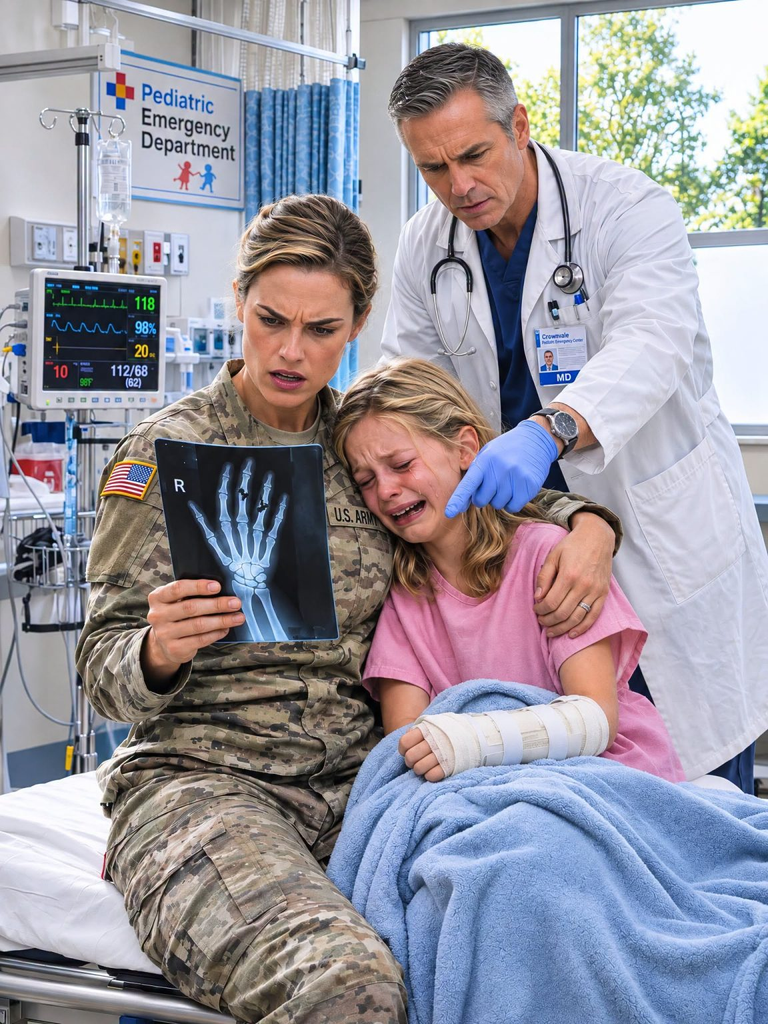
While I was deployed overseas, an ER doctor called and said, “Your 9-year-old says her stepmother br:ok:e her fing:ers when she tried to call you. She’s terrified we’ll send her back home.” Her father was already waiting to take her with him. I hung up and went straight to my commander. He reached for the phone and said, “We’re flying you home now.” I wasn’t going back to argue. I was going back to make sure this ended for good.
Part 1: The Midnight Call That Sent Me Home From Kuwait
At 2:17 a.m., while I was stationed at Camp Arifjan in Kuwait, an unexpected telephone call changed everything I believed about my daughter’s safety. I was Captain Rochelle Dunwoody, a United States Army logistics officer, and I had just completed nineteen exhausting hours coordinating an emergency fuel redistribution when my civilian phone rang.
The caller introduced himself as Dr. Leland Frazier, a pediatric emergency physician at Riverbend Memorial Hospital in Clarksville, Tennessee. He explained that my nine-year-old daughter, Harriet Ashby, whom everyone called Hattie, had been brought to the emergency department by an elderly neighbor.
“Captain Dunwoody, your daughter is physically stable, but she has several fractures in her left hand. We have serious concerns about how those injuries occurred.”
I immediately asked whether Hattie had fallen, hoping there was an innocent explanation. Dr. Frazier told me that her father had reported an accident, but the medical findings did not support his account.
“Your daughter told me that her stepmother injured her because she was trying to call you. She’s terrified of being sent home.”
He added that Hattie’s father had arrived at the hospital and was demanding to take her back. Hearing that my little girl was begging the nurses to protect her left me frightened, furious, and determined to reach her.
Three years earlier, I had divorced Hattie’s father, Glenn Ashby, a regional heating-and-cooling sales manager in Clarksville. We had agreed to joint custody, and although our marriage had ended, I believed he would always put our daughter’s welfare first.
When I received orders for a nine-month deployment to the Middle East, I had to establish a military Family Care Plan identifying who would care for Hattie during my absence. My mother, Verlie Dunwoody, had died eighteen months earlier, and we had no nearby relatives who could assume that responsibility.
Glenn agreed to become Hattie’s primary caregiver while I was deployed. By then, he had married Krista Vance, a thirty-three-year-old aesthetician who repeatedly assured me that she would treat my daughter as her own.
“She’s my daughter, Rochelle. Go do your job, and I’ll make sure she has everything she needs.”
Krista offered similar reassurances when I said goodbye to Hattie at the airport. Although I had reservations about leaving my daughter for so long, I trusted that both adults understood their responsibilities.
For the first eight weeks, our weekly video calls continued normally. Hattie showed me her watercolor paintings, talked excitedly about school, and played new piano pieces she had been practicing.
Then Glenn began offering increasingly frequent excuses for missed conversations. Sometimes he claimed Hattie was sick or attending a church activity, while other times he blamed technical problems.
As a logistics officer, I was trained to document inconsistencies rather than ignore them. Over seven months, I recorded forty-one missed communication opportunities, nineteen unanswered urgent emails, and three formal welfare requests that Glenn dismissed as unnecessary.
“You’re overseas, Rochelle, and you’re imagining problems. Hattie is doing perfectly well, so stop interfering.”
After Dr. Frazier’s call, I realized those missed conversations might have concealed something far more serious than I had imagined. I immediately reported to Lieutenant Colonel Edwin Prather, my commanding officer, and explained the hospital’s findings.
Prather listened carefully before contacting the military legal liaison, flight coordinator, and Red Cross representative. He arranged emergency transportation so I could return to the United States without unnecessary delay.
“Captain Dunwoody, you’re coming off this assignment. We’ll get you on the next available military flight.”
Before I left, he warned me to follow proper legal procedures rather than confront Glenn and Krista recklessly. I promised that my priority was protecting Hattie and ensuring that the authorities could investigate what had happened.
Twenty-six hours later, I reached Atlanta, exhausted but determined to catch my connecting flight to Nashville. While checking my phone, I discovered a voicemail from Thelma Bickford, the elderly neighbor who had taken Hattie to the hospital.
“Rochelle, please don’t speak to Glenn until you’ve talked to me. I saw what happened to Hattie’s hand, and sweetheart, this wasn’t the first time.”
I immediately called Mrs. Bickford back, realizing that what she had witnessed might explain everything Glenn had been hiding during my deployment.
Part 2: The Neighbor Who Witnessed My Daughter’s Suffering
While waiting for my connecting flight to Nashville, I called Thelma Bickford, the elderly neighbor who had taken Hattie to the hospital. She answered immediately and explained that she had spent the night watching Glenn’s house, terrified that something else might happen.
“Rochelle, I saw Glenn loading bags into his car earlier. I don’t know what he’s planning, but you need to hear everything before you speak to him.”
Mrs. Bickford explained that Hattie had appeared on her doorstep shortly before midnight, barefoot and wearing only a thin nightgown despite the cold weather. My daughter had been holding her injured left hand against her body and desperately begging not to be returned home.
“She was so frightened, Rochelle. She kept asking me to hide her because she thought Krista would come looking for her.”
Thelma then admitted that she had witnessed another disturbing incident three months earlier. While gardening near the shared fence, she had seen Krista angrily confront Hattie for attempting to contact me using an old telephone.
Krista had grabbed Hattie’s wrist and dragged her inside while accusing her of disobeying household rules. The following day, Thelma noticed that my daughter’s arm was bandaged, but Krista claimed she had fallen from her scooter.
“I should have reported what I saw. I believed their explanation, and I’ve regretted that decision ever since.”
When I asked about the latest incident, Thelma described seeing Krista confront Hattie over a school laptop. She witnessed Krista forcefully bend my daughter’s fingers against the kitchen counter before taking the computer away.
Hattie had escaped through a small side door shortly afterward and run directly to Thelma’s house. I thanked the woman for protecting my daughter and asked her to remain available to investigators.
After landing in Nashville, I received transportation assistance from my unit’s rear detachment and drove to Riverbend Memorial Hospital. I presented my military identification and went directly to the fourth-floor pediatric ward, where Hattie was recovering in Room 412.
My daughter lay in bed with her left arm immobilized in a protective splint, clutching her worn stuffed rabbit with her other hand. When she recognized me, her frightened expression changed to disbelief.
“Mommy? Are you really here, or am I dreaming?”
“I’m here, sweetheart. You’re safe, and I’m not leaving you.”
I embraced her carefully, avoiding her injured arm while she held tightly to my uniform. Then she began apologizing for breaking Krista’s rules, explaining that she had only wanted to hear my voice again.
“I forgot what you sound like when you say goodnight. I just wanted to talk to you, Mommy.”
I assured her that she had done nothing wrong and that she would never be punished for wanting to contact me. As she gradually calmed down, Dr. Frazier returned with Detective Joyce Marchetti and child protection investigator Tamika Rowell.
Before they could explain the next steps, Glenn and Krista arrived in the hallway, demanding that Hattie be released into their custody. Krista immediately claimed that my daughter had slipped on wet porch steps while retrieving a jump rope.
Dr. Frazier challenged their explanation, stating that the medical findings indicated injuries inconsistent with an ordinary fall. He also revealed evidence of an older forearm fracture that had not received appropriate treatment.
Detective Marchetti informed Glenn that an emergency protective order had placed Hattie in my care and prohibited him and Krista from approaching her. Glenn protested that our military Family Care Plan gave him authority, but the detective explained that it did not override a court’s protective order.
Krista quietly warned me that Hattie’s account would never outweigh the testimony of two adults. I refused to argue and returned to my daughter’s room, determined to let the investigation establish the truth.
As soon as I approached her bedside, Hattie reached for my hand and whispered something unexpected.
“Mommy, Krista took my school computer last night, but she doesn’t know what I did.”
I leaned closer, realizing that my nine-year-old daughter might have preserved the evidence everyone needed to expose what had been happening inside that house.
Part 3: The Secret Recordings That Exposed Krista’s Cruelty
I pulled a chair beside Hattie’s hospital bed and asked what she meant when she said Krista didn’t know what she had done. My daughter glanced nervously toward the doorway before explaining that she had secretly recorded several incidents involving her stepmother.
At school, her teacher, Mrs. Finch, had introduced the students to a voice-recording application on their Chromebooks. Hattie had begun using it whenever Krista became angry about her attempts to contact me.
“I pressed the red recording button whenever she started yelling. I saved everything in a folder called Piano Songs – Grade 4.”
She explained that the folder contained eleven recordings, including one from the previous night. Although Krista had confiscated the Chromebook, Hattie believed the files remained accessible through her school Google Drive account.
“She said she was going to erase everything so nobody could hear my lies. But I saved the recordings online, Mommy.”
I immediately informed Detective Joyce Marchetti and child protection investigator Tamika Rowell. Marchetti contacted the appropriate judicial authorities to obtain a search warrant for Glenn and Krista’s home, hoping to secure the computer before anyone destroyed potential evidence.
Meanwhile, a sixty-one-year-old attorney named Lenora Pickett arrived at the hospital. She had previously served as a senior trial counsel in the Army Judge Advocate General’s Corps, and Colonel Prather had arranged for her to assist with my custody case.
“Captain Dunwoody, I need every document you have. Give me dates, messages, records, and anything else that can establish what happened.”
I showed Lenora my spreadsheet documenting forty-one missed communication opportunities, nineteen unanswered emails, and repeated attempts to arrange welfare checks. She immediately recognized that the records could challenge Glenn’s claim that I had neglected Hattie during my deployment.
Lenora then asked whether my daughter possessed any money or property held in trust. Her question reminded me that my late mother, Verlie Dunwoody, had established a custodial education fund containing approximately $52,400 for Hattie’s future schooling and musical instruction.
Glenn had been appointed temporary custodian because I was preparing for deployment when the estate arrangements were finalized. The account statements were supposed to reach my civilian email address, but I hadn’t received one for nine months.
“Glenn told me the bank’s security system couldn’t send verification messages overseas. He promised the money hadn’t been touched.”
Lenora immediately began requesting the financial records from First Federal Trust Bank of Tennessee. She explained that the emergency custody hearing was scheduled for Thursday and instructed me to avoid direct arguments with Glenn or Krista.
Early the following morning, Detective Marchetti returned with an update. Investigators had found Hattie’s Chromebook beneath her bed, exactly where she said it would be, but Krista had already reset the device.
Fortunately, the school district’s technology director, Arnold Bessemer, was able to recover the recordings from its cloud system. All eleven files remained intact, including the final recording uploaded shortly before Hattie escaped to Mrs. Bickford’s house.
The search also uncovered a spiral notebook hidden inside Krista’s kitchen desk. Its entries contained dates, the words Attempted Mama Call, and a final notation reading Corrected.
There were forty-one entries, precisely matching the number of missed calls I had documented during my deployment. The discovery suggested that Krista had deliberately tracked Hattie’s attempts to reach me rather than simply reacting to isolated incidents.
Detective Marchetti explained that investigators were preparing criminal charges based on the medical findings, witness statements, recordings, and notebook. Lenora continued organizing the evidence for the custody hearing, determined to demonstrate how Glenn and Krista had concealed my daughter’s suffering.
I spent the remaining time beside Hattie, reassuring her that the adults investigating her case were taking her seriously. She was still frightened, but knowing that her recordings had survived gave her some comfort.
By Thursday morning, we had enough evidence to challenge Glenn’s entire account, including one recording that would reveal exactly what he had known about Krista’s behavior.
Part 4: The Courtroom Recording That Destroyed Their Lies
On Thursday morning, I entered the Montgomery County courtroom wearing my formal Army Service Uniform. My attorney, Lenora Pickett, sat beside me with the medical reports, communication records, witness statements, and digital evidence gathered during the investigation.
Across the courtroom, Glenn sat with his attorney, Brock Hatley, while Krista occupied a seat directly behind them. Both appeared determined to defend their version of events despite the evidence that had emerged.
Judge Annette Corbin opened the emergency hearing concerning Hattie’s custody and the requested protective order. Hatley immediately argued that Glenn had provided a stable home while I voluntarily remained overseas pursuing my military career.
“Captain Dunwoody signed a Family Care Plan naming my client as the child’s caregiver. Now she’s attempting to remove his parental rights based on accusations from a troubled nine-year-old.”
He repeated the claim that Hattie had suffered an unfortunate household accident. According to his argument, the injuries and her emotional distress had been exaggerated because she was struggling with my deployment.
Lenora responded by presenting the actual provisions of the Family Care Plan. She explained that Glenn had agreed to facilitate weekly communication and report significant medical issues, obligations he had repeatedly failed to fulfill.
“Your Honor, we have forty-one documented communication attempts that were blocked or rejected, along with nineteen unanswered emails.”
She then introduced Dr. Leland Frazier’s medical findings, which contradicted the explanation that Hattie had simply fallen. The records also identified an older forearm injury that had not received appropriate treatment.
When Hatley attempted to dismiss the medical evidence as a technical disagreement, Judge Corbin instructed him to allow Lenora to continue. My attorney next presented the notebook investigators had recovered from Krista’s desk.
“Forty-one dates appear in this notebook, Your Honor. Each is associated with the words Attempted Mama Call and the notation Corrected.”
The entries matched the communication attempts recorded in my military spreadsheet. Lenora argued that the correspondence demonstrated a deliberate effort to prevent Hattie from contacting me.
Finally, she requested permission to play one of the eleven audio recordings recovered from Hattie’s school account. Hatley objected to its admission, questioning the reliability of the digital evidence, but the judge allowed the authenticated recording to be presented.
Hattie’s frightened voice could be heard pleading with Krista to let her contact me. Krista responded by telling my daughter that I had abandoned her and that she would have to obey the household rules.
“Your mother isn’t coming back for you, Harriet. She chose her uniform over you.”
The recording captured Hattie’s distress during the confrontation. Then Glenn’s voice became audible, revealing that he had been aware of what was happening.
“Krista, keep it down. Just make sure the marks don’t show when she goes to music class tomorrow.”
I struggled to control my emotions because Glenn’s own words contradicted his repeated claims of ignorance. The judge listened carefully before condemning the conduct revealed by the evidence.
Judge Corbin granted me sole legal and physical custody of Hattie and imposed protective restrictions preventing Glenn and Krista from contacting her. She also referred the evidence for criminal investigation and prosecution.
Krista protested that she was a respected member of the community and had not been given a fair opportunity to defend herself. Before she could continue, Detective Marchetti entered with sheriff’s deputies and announced an arrest warrant for aggravated child abuse.
Glenn remained seated as Krista was taken into custody. He then turned toward me and insisted that he hadn’t understood how seriously Hattie had been mistreated.
“I didn’t know it was that bad, Rochelle. I was only trying to keep the peace.”
“You were on the recording, Glenn. You heard what was happening, and you told Krista to hide the evidence.”
Before ending the proceedings, Judge Corbin ordered Glenn to produce complete records concerning Hattie’s education trust. A separate hearing would examine how the money had been managed during my deployment.
As Glenn’s attorney considered the order, he turned toward his client with an expression of alarm.
“Glenn, what exactly did you do with that child’s money?”
I had returned from Kuwait to protect my daughter from mistreatment, but the next investigation would reveal that Glenn and Krista had also been stealing from the future my mother had worked to provide for her.
Part 5: The Stolen Inheritance and the Day My Daughter Played Again
Three weeks after the custody hearing, I returned to the Montgomery County courthouse for another confrontation with Glenn. This time, the proceedings concerned the education trust my late mother, Verlie Dunwoody, had established for Hattie.
While I attended the hearing, Hattie stayed with Mrs. Thelma Bickford, happily baking cookies in her neighbor’s kitchen. Her injured hand remained protected by a splint, but she was finally beginning to feel safe.
My attorney, Lenora Pickett, presented financial records obtained from First Federal Trust Bank. She explained that my mother had left $52,400 specifically for Hattie’s education, medical needs, and future musical instruction.
“Your Honor, our investigation shows that $47,620 was withdrawn from this child’s trust for expenses that had nothing to do with her welfare.”
The first major transaction involved $27,900 transferred to Vance Commercial Contracting for renovations to Krista’s beauty studio. Another $9,000 had been used toward a luxury Ford Expedition registered to Glenn and Krista’s business.
Additional records revealed $6,300 spent on a vacation in Gulf Shores, Alabama, and $4,420 used to pay Krista’s personal credit card balances. During that expensive vacation, Hattie had remained home while her school lunch account carried an unpaid balance of forty-two dollars.
Lenora also demonstrated that Glenn had changed the trust’s mailing address in March, preventing financial statements from reaching me. The timing suggested that he had deliberately concealed the withdrawals while I was deployed.
Judge Annette Corbin questioned Glenn about whether any of the money had benefited Hattie’s education or medical care. He admitted that the funds had been spent on unrelated expenses.
“No, Your Honor. The money wasn’t used for those purposes.”
The court entered a financial judgment against Glenn and Krista’s business, ordering repayment of the misused funds along with applicable interest and attorney’s fees. Liens were placed on their property and business assets, and the Ford Expedition was designated for seizure and auction.
The recovered money would be directed into a court-supervised trust administered for Hattie’s benefit. The judge also referred the financial evidence for possible criminal charges concerning the misuse of her funds.
Four months later, Krista pleaded guilty to two counts of aggravated child abuse after prosecutors presented the recordings, notebook, and witness evidence. She received an eight-year prison sentence, with restrictions on early release.
Glenn pleaded guilty to felony child neglect and misapplication of fiduciary funds. His sentence included six years of intensive supervised probation, three hundred hours of community service, and restitution payments taken from his future earnings.
His employer terminated his contract after the case became public, leaving him facing serious financial consequences. By then, I was no longer interested in watching his life unravel because my attention was entirely focused on Hattie’s recovery.
Colonel Edwin Prather helped arrange a permanent reassignment that allowed me to remain close to my daughter. I received orders transferring me to the 101st Airborne Division at Fort Campbell, Kentucky, for a stable three-year assignment without deployment.
When I read those orders, I cried with relief because I could finally remain present throughout Hattie’s recovery. For the first time in months, I could plan our daily lives without worrying about another extended separation.
Mrs. Bickford became an important part of our family, joining us for Sunday dinners and helping Hattie regain her confidence. My daughter affectionately began calling her Grandma Thelma, and we eventually adopted a friendly golden retriever puppy.
Hattie’s physical recovery required extensive treatment, including surgery involving a small titanium pin and occupational therapy three times a week. Her emotional recovery was slower, especially because unexpected telephone calls reminded her of the conversations Krista had prevented.
To reassure her, I began answering calls on speakerphone whenever possible. I wanted Hattie to understand that she no longer had to fear secret conversations or punishment for contacting someone she loved.
By spring, her splint had been removed, and she was gradually regaining movement in her fingers. One Saturday afternoon, she approached the upright piano that had remained untouched throughout her recovery.
“Mommy, do you think I can still play?”
“Of course, sweetheart. Play whatever feels right to you.”
Hattie carefully placed her fingers on the keys and began playing Amazing Grace. She missed several notes and struggled with certain movements, but after pausing to examine her hand, she smiled and started again.
I listened as the familiar melody gradually became steadier, grateful that my daughter could enjoy something she had once loved without being afraid. Her laughter filled the room, and I realized how much progress she had made since the night she escaped to Mrs. Bickford’s house.
When I left Kuwait, I believed my mission was to expose the people who had harmed my child and hold them accountable. The courts had helped accomplish that, but the greatest reward was something much simpler.
It was watching Hattie sit at her piano in the afternoon sunlight, playing her favorite music without fear, knowing that her mother was finally home to stay.