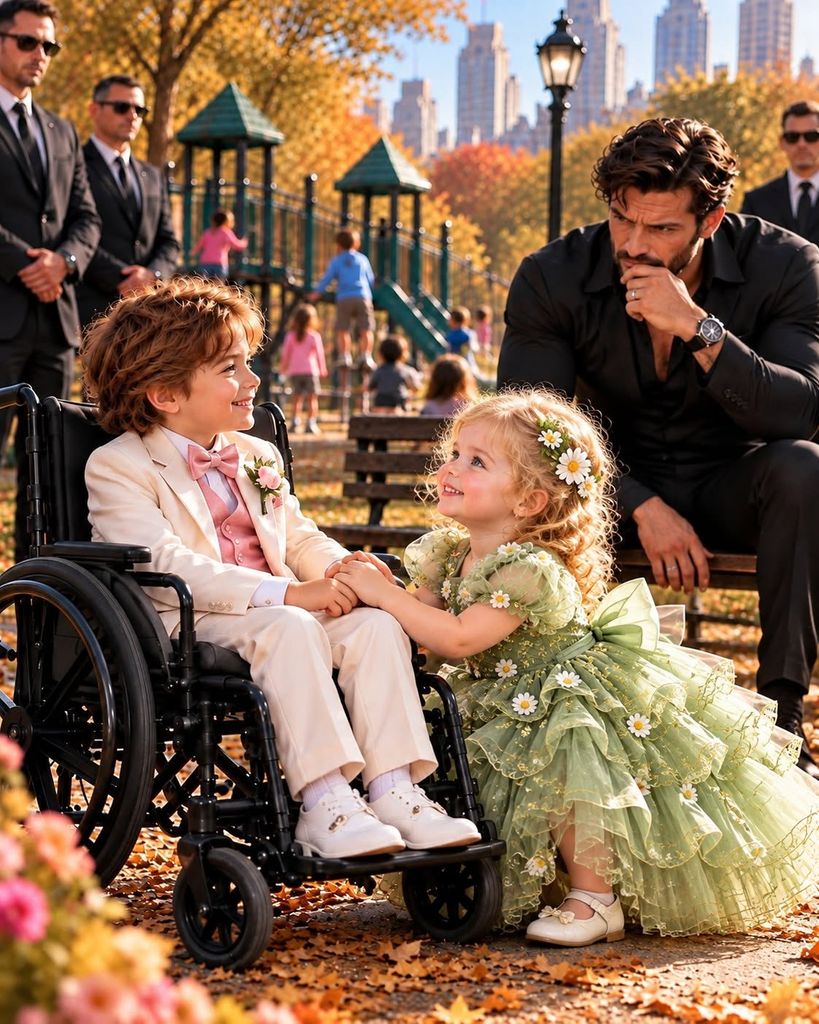
My paralyzed son sat alone in Central Park while other children avoided him, terrified of the armed men protecting him. I was one of New York’s most feared mafia bosses, yet all my power couldn’t buy my little boy a single friend. Then a poor red-haired girl named Lyla Everly walked past my bodyguards, approached his wheelchair, and did something no one had dared to do in months.
“Boss,” Vincent whispered, his fingers still wrapped around my arm, “you need to know who that little girl is.”
I pulled my gaze away from Lucas and looked at him.
“What about her?”
Vincent glanced toward the playground, where Lyla had settled into the chair beside my son as if she belonged there.
“She’s been coming here for weeks.”
“That doesn’t make her dangerous.”
“I didn’t say she was.”
“Then choose your next words carefully.”
Vincent lowered his voice.
“She doesn’t simply wander into the park.”
I watched Lyla lean toward Lucas, her faded red curls falling over one shoulder.
“Close your eyes,” she told him.
Lucas hesitated.
“What for?”
“So you can guess what I’m thinking.”
“That’s not how I Spy works.”
“It is when I make the rules.”
For the first time in months, my son gave a quiet laugh.
The sound reached me more deeply than any report, warning, or business victory ever had.
Vincent seemed to notice it too, because his expression softened before duty returned to his face.
“She arrives around the same time every afternoon,” he continued.
“She comes alone, leaves alone, and never asks anyone for money.”
“Then she’s a child who likes the park.”
“She’s also been seen near the church on Madison, the public library, and the food pantry on Ninth.”
I turned toward him.
“How do you know that?”
“I had someone keep an eye on the area after she started coming here.”
My jaw tightened.
“You followed a little girl?”
“I made sure she wasn’t part of something aimed at Lucas.”
“Everything is not a threat, Vincent.”
“I know.”
“Do you?”
He accepted the rebuke without looking away.
“My job is to notice what you don’t have time to notice.”
“My job is to decide what matters.”
Across the path, Lyla lifted one hand and pointed toward a bright yellow kite caught in the branches of a tree.
“I spy something yellow,” she announced.
Lucas studied the park with exaggerated concentration.
“The flowers?”
“No.”
“A taxi?”
“Too far away.”
“The kite.”
Lyla smiled.
“You’re good at this.”
Lucas looked pleased, then suddenly self-conscious.
“It was easy.”
“Easy things count too.”
The words made something inside me shift.
For months, every doctor had spoken to Lucas in careful measurements.
Range of motion.
Muscle response.
Therapy tolerance.
Progress indicators.
No one had told him that easy things counted.
I had been so focused on getting him to walk again that I had forgotten he was still learning how to live inside a life that had changed.
“Boss,” Vincent said quietly.
“Not now.”
He looked toward Lyla.
“She may not be dangerous, but she is hiding something.”
“So is everyone.”
That answer silenced him.
I had built my entire life around secrets.
I knew what people concealed in their smiles, what they buried in their ledgers, and how quickly loyalty could change when money or fear entered a room.
Yet the girl beside my son did not look like someone plotting anything.
She looked tired.
Not ordinary afternoon tired, either.
There was a stillness beneath her liveliness, as if she had learned to conserve her strength.
When she thought Lucas wasn’t looking, she rubbed her wrist.
When someone nearby opened a paper bag, her eyes flicked toward it before returning to the game.
And when a mother walked past with two children and a stroller, Lyla’s smile faded for half a second.
Then she turned back to Lucas.
“I spy something blue.”
Lucas pointed at the sky.
“That’s cheating.”
“The sky is blue.”
“You have to pick something people can see.”
“I can see the sky.”
He smiled again.
I had almost forgotten how young he was.
Almost.
The thought struck me with a force that left me ashamed.
Lucas had turned seven three months earlier.
His birthday cake had been decorated by a private pastry chef, his presents had filled half the library, and a string quartet had played in the east garden because Catherine had once said music made birthdays feel important.
But Lucas had spent most of that day staring at the empty chair beside him.
He had not asked for another toy.
He had asked whether his mother was still somewhere in the hospital.
I had told him no.
I had told him she was gone.
Then I had buried myself in work because I did not know how to explain that some absences could not be repaired.
Lyla glanced at me.
“Are you his father?”
The question was so direct that Vincent stiffened.
I answered before he could interrupt.
“Yes.”
“Do you always stand over him like that?”
I looked at the men surrounding us.
“I’m protecting him.”
“From what?”
“People who might hurt him.”
She examined the guards with an expression far too serious for her small face.
“They look like they might scare him.”
No one moved.
One of my men looked toward me, uncertain whether he should object.
Lucas lowered his eyes.
I felt the truth of her words settle over the group.
“Are you scared of them?” Lyla asked him.
Lucas glanced at the guards.
“A little.”
The admission hurt more than it should have.
I had told myself that the men were there for his safety.
I had convinced myself that security was another form of love.
But Lucas had never asked for armed escorts.
He had never asked for tinted windows, private elevators, or guards stationed outside his bedroom door.
He had only asked for his mother.
“Everyone,” I said, “move back.”
Vincent’s head turned sharply.
“Boss?”
“You heard me.”
The guards exchanged uneasy glances.
“Ten feet,” I continued.
“No weapons where he can see them.”
“Maxwell—”
“Now.”
They stepped away.
The space around Lucas opened slowly, like air returning to a room.
Lyla watched them retreat, then looked at me.
“That’s better.”
I almost smiled.
“Is it?”
“Yes.”
“Why?”
“Because now he can see the park.”
Lucas looked around.
He was right.
For the first time, there was nothing between him and the children running near the fountain.
Nothing except the invisible distance created by fear.
Lyla tapped the side of his wheelchair.
“Can you move this yourself?”
Lucas’s hands tightened around the rims.
“A little.”
“Show me.”
“I’m not supposed to go too far.”
“Then go a little.”
I looked toward Vincent.
“Call the therapist.”
“Here?”
“Here.”
Within minutes, Dr. Harper arrived from the waiting vehicle, carrying the small exercise bands she usually brought to the mansion.
She looked surprised to find Lucas surrounded by fewer guards and sitting beside a girl she had never seen.
“Your father says you want to try something,” she told him.
Lucas looked at Lyla.
“She said I should.”
Lyla shrugged.
“I said he could try.”
Dr. Harper crouched beside him.
“What would you like to try?”
Lucas stared at his hands.
“Moving forward.”
The doctor glanced at me.
I nodded.
She explained the exercise carefully, showing him how to place his palms on the wheels and push without straining his shoulders.
Lucas tried once.
The chair moved less than an inch.
He looked disappointed.
Lyla leaned closer.
“That counted.”
“It barely moved.”
“It moved.”
“Not enough.”
“Enough for the first try.”
Dr. Harper smiled.
“Lyla is right.”
Lucas tried again.
This time, the wheelchair rolled several inches along the path.
His face changed.
The disappointment loosened first, followed by surprise.
Then pride.
I had watched surgeons repair impossible injuries and negotiators turn disasters into victories, but nothing had ever seemed as extraordinary as those few inches.
Lucas looked at me.
“Did you see?”
“I saw.”
“I moved it.”
“You did.”
His voice grew brighter.
“Can we do it again tomorrow?”
The question was directed at Lyla.
She nodded.
“I come every day.”
“Promise?”
Lyla’s expression flickered.
Promises, I would later learn, were difficult things for her.
Still, she raised her little finger.
“Promise.”
Lucas hooked his finger around hers.
I looked away before either of them could see what their simple agreement had done to me.
For the next hour, Lyla played with him as if his wheelchair were not an obstacle or a tragedy.
She invented games that involved reaching, turning, and noticing details.
She challenged him to spot birds in the trees and count the red umbrellas around the fountain.
When he tired, she changed the game to storytelling.
She claimed the statue near the lake was a sleeping giant who had been turned to stone for refusing to share his sandwiches.
Lucas argued that no giant would waste a sandwich by turning it into stone.
Lyla said that was why giants were terrible at making decisions.
His laughter carried across the grass.
People looked over.
Some smiled.
Others hurried past when they noticed the guards.
I kept expecting Lyla to become uncomfortable under their attention, but she never did.
She seemed to have learned long ago that being watched did not mean being seen.
Near sunset, Dr. Harper suggested that Lucas rest.
Lyla stood and brushed grass from her knees.
“I have to go.”
“Where?” Lucas asked.
“Home.”
“Where is that?”
She pointed vaguely toward the northern edge of the park.
“My brother is waiting.”
“You have a brother?”
“He’s six.”
“Is he funny?”
“Sometimes.”
“Can I meet him?”
Lyla looked toward me.
The question in her eyes was not fear.
It was calculation.
She was trying to determine whether I was the kind of adult who would say yes, demand an explanation, or make her regret speaking.
I had seen that look on grown men who owed me money.
I had never seen it on a child.
“Perhaps another day,” I said.
“Why not today?” Lucas asked.
“Because we don’t know where she lives.”
Lyla’s face closed at once.
“I didn’t ask you to come.”
The words were quiet, but they carried a warning.
“I know.”
“Then don’t.”
She turned away.
Lucas looked at me, hurt.
“Dad.”
I felt the old reflex rise within me, the need to control every detail before it could become a danger.
Then I remembered his smile when the guards stepped back.
“Lyla,” I called.
She stopped.
“Would you like a ride home?”
“No.”
“It’s getting dark.”
“I know how to get home.”
“Do you?”
Her chin lifted.
“Yes.”
“Then you can walk in front, and we’ll follow far behind.”
She studied me.
“Why?”
“So I know you reach your brother safely.”
“That’s still following.”
“Yes.”
“And if I say no?”
“Then I’ll respect that.”
Vincent stared at me as though I had announced I was giving away the mansion.
Lyla seemed equally surprised.
She looked at Lucas, who was watching her with quiet hope.
Finally, she sighed.
“You can follow, but not too close.”
We left the park together.
Lyla walked along the pavement with quick, practiced steps.
She did not skip or stop to look at shop windows.
She checked every crosswalk twice, kept to the side of the sidewalk, and turned around often enough to make certain we remained behind her.
Vincent drove the armored vehicle at a distance while I followed in a second car with Lucas.
Through the window, I watched Lyla pass a bakery.
She slowed for half a breath, then continued.
At a corner, she stopped to pick up a paper napkin that had blown against a railing.
She folded it neatly and placed it in her pocket.
Lucas leaned toward the glass.
“Why did she do that?”
“I don’t know.”
“She keeps things.”
“Perhaps she needs them.”
He grew quiet.
Ten minutes later, Lyla led us to an aging brick building squeezed between a laundromat and a closed furniture store.
The front steps were cracked.
A single light flickered above the entrance.
She turned toward us.
“You can wait here.”
Lucas looked at me.
I nodded.
Lyla climbed the stairs and unlocked the front door with a key tied to a piece of blue string.
Before entering, she looked back.
“Thank you for walking behind me.”
“You’re welcome.”
She disappeared inside.
The door closed.
Lucas turned to me.
“Can we help her?”
“With what?”
“Whatever she needs.”
I looked at the building.
“You don’t know what she needs.”
“She needs food.”
The certainty in his voice unsettled me.
“How do you know?”
“She looked at the bakery.”
Children noticed what adults trained themselves to ignore.
I said nothing.
A minute passed.
Then another.
The light above the door flickered again.
I reached for my phone.
“Vincent.”
“I’m here.”
“Find out who owns this building.”
He frowned.
“Do you want a background check on the girl?”
“No.”
“You just said—”
“I want to know whether the landlord is exploiting a family, whether the building is safe, and whether there’s a food pantry nearby.”
Vincent stared at me.
“Only that?”
“Only that.”
He nodded and stepped away.
Lucas’s eyes remained fixed on the door.
“Will she come back tomorrow?”
“Yes.”
“How do you know?”
“Because she promised.”
He seemed satisfied with that answer.
I was not.
That night, Lucas asked for his dinner in the dining room instead of the television room.
He asked whether Lyla could sit with us the next time she came.
He asked whether she liked pancakes.
He asked whether her brother had a wheelchair.
When I told him no, he frowned.
“He should have one if he needs it.”
“I agree.”
“Can we buy one?”
“Lucas.”
“I’m not trying to buy Lyla.”
“I didn’t say you were.”
“You sounded like you thought I was.”
I set down my glass.
“I’m sorry.”
He looked at me carefully.
“You say sorry more now.”
“Do I?”
“Mom said people only said sorry when they wanted to change something.”
The mention of Catherine entered the room like a sudden winter draft.
I had avoided speaking her name too often because every memory seemed to bring another wound.
But Lucas deserved more than my silence.
“Your mother was right.”
“Can you change?”
I looked at my son.
“I’m trying.”
He nodded and returned to his pancakes.
Later, while he slept, I stood in my study and reviewed the information Vincent had gathered.
Lyla Everly was eleven years old.
Her brother’s name was Noah.
Their mother was Elena Everly, a licensed practical nurse whose employment history ended abruptly eight months earlier.
There was no current record of her working anywhere.
The apartment lease was three months behind.
The building owner had begun a legal notice but had not yet filed for eviction.
A local food pantry had recorded Lyla’s visits nearly every evening.
She had also been seen doing small jobs for nearby shopkeepers.
Carrying boxes.
Sweeping entrances.
Sorting donated clothes.
She had never asked for more than food.
I read the report twice.
Then I noticed the final line.
No adult guardian observed entering the apartment during the last four months.
I called Vincent.
“Where is the child’s mother?”
“We don’t know.”
“You told me she had disappeared.”
“I said there was no record of her.”
“That is not the same thing.”
“I’m still looking.”
“Look quietly.”
“I understand.”
“No police, no pressure on the landlord, and no one approaches the children.”
Vincent was silent.
“Did you hear me?”
“Yes.”
“Good.”
I ended the call and returned to the report.
Elena Everly.
The name stirred nothing at first.
Then I saw the date of her last employment.
It was two weeks before Catherine’s accident.
I stared at the screen.
The connection could have been meaningless.
New York held millions of names, and coincidence was an easy thing to mistake for fate.
Still, I searched Catherine’s old medical files.
Her private nursing records had been moved to an encrypted archive after the crash.
I accessed the folder and scrolled through the names of everyone assigned to her during the final months of her pregnancy.
Doctors.
Therapists.
Consultants.
Nurses.
At the bottom of the list, under temporary staff, was a name I had never noticed.
Elena Everly.
My hands went still.
I opened the attached notes.
Most were routine observations about Catherine’s blood pressure, sleep, and medication.
One entry had been written three days before the accident.
The handwriting was uneven, hurried.
I read it once.
Then again.
Patient expressed concern regarding visitors connected to husband’s business.
Advised patient to discuss concerns directly with Mr. Thornton.
No further action requested.
There was another note beneath it.
Patient stated, “Do not trust the men who come after midnight.”
My breathing changed.
Catherine had never mentioned that to me.
I had believed her final fear belonged to the crash, to the pain, to the uncertainty of whether Lucas would survive.
But perhaps something had frightened her before that night.
Something she had kept from me.
A sound came from the hallway.
I closed the file.
Lucas stood in the doorway wearing blue pajamas, his hair tousled from sleep.
“Dad?”
I rose immediately.
“What are you doing awake?”
“I had a bad dream.”
I crossed the room and knelt beside him.
“What happened?”
“Mom was calling me.”
My chest tightened.
“Where was she?”
“In the car.”
I held his shoulders gently.
“Was she hurt?”
He nodded.
“Did you see anything else?”
He looked past me toward the dark windows.
“She kept trying to reach under my seat.”
The room seemed to lose all its warmth.
“Are you sure?”
Lucas frowned.
“She said something was there.”
“What was there?”
“I don’t know.”
He rubbed his eyes.
“Then she told me not to look at the men.”
I felt the old memory rise inside me.
Catherine’s bloodstained hand.
The shattered glass.
Her fingers reaching toward Lucas.
For a year, I had believed she was reaching for him.
Now, for the first time, I wondered whether she had been reaching beneath his car seat.
“Did she say anything else?”
Lucas’s eyes began to close.
“She said Lyla.”
The name struck me harder than any accusation.
“Lyla?”
He nodded sleepily.
“She said, ‘Find the girl with the red hair.’”
I stood frozen beside him, unable to speak.
Outside, the city moved through the night with its usual restless rhythm.
Inside, every memory I had trusted began to rearrange itself.
And somewhere across Manhattan, a little girl named Lyla Everly was sleeping beside a six-year-old boy, carrying a secret that might have been connected to the night my wife died.
Part 3 – The Warning in the Notebook
I stood frozen beside Lucas, unable to speak.
The name Lyla seemed to hang between us, fragile and impossible, as though saying it again might change what it meant.
Lucas’s eyelids fluttered.
“Dad?”
I forced myself to look at him.
“What did Mom say about Lyla?”
He frowned, struggling to gather the pieces of his dream.
“She said I had to find her.”
“Why?”
“I don’t know.”
“Did she say anything else?”
Lucas’s small hand closed around the sleeve of my shirt.
“She was scared.”
The answer moved through me with a coldness that had nothing to do with the winter air pressing against the windows.
Catherine had been many things during the last weeks of her life.
Tired.
Anxious.
Protective.
But she had never seemed afraid of me.
I had mistaken that absence of fear for trust.
Now I wondered whether she had simply become very good at hiding what she knew.
“Come on,” I said gently.
“Let’s get you back to bed.”
Lucas did not release my sleeve.
“Are you angry at Lyla?”
“No.”
“Are you angry at Mom?”
The question stopped me.
I lowered myself until we were eye to eye.
“Never.”
“But you look angry.”
I glanced toward the closed study door.
“I’m trying to understand something.”
“Understanding can make people angry.”
“Sometimes.”
“Then don’t understand it tonight.”
Despite everything, a faint smile touched my mouth.
“That sounds like advice.”
“Lyla says you need advice.”
“What kind?”
“To stop looking like you’re going to fight the furniture.”
A quiet laugh escaped me, surprising us both.
Lucas smiled sleepily.
For one brief moment, the room felt ordinary again.
Then his expression turned serious.
“Will you still let me see her tomorrow?”
“Yes.”
“Even if Mom knew her?”
“I said yes.”
He nodded and allowed me to guide him back to his room.
After he fell asleep, I returned to the study and reopened Catherine’s medical file.
The entry from Elena Everly remained on the screen.
Patient stated, “Do not trust the men who come after midnight.”
I read it until the words blurred.
The note had been entered eight months before Elena disappeared and nearly a year before the accident.
If Catherine had been worried about people connected to my business, why had she never told me?
The more troubling question was why Elena had written the warning down at all.
A nurse could document a patient’s concerns without believing them.
She could also recognize danger before the person at the center of it understood what was happening.
I reached for the phone.
“Vincent.”
His answer came immediately.
“You found something?”
“I found several things.”
“I’m listening.”
“Pull every security log from the month before Catherine’s accident.”
“That’s a lot of data.”
“Then start with the house.”
“I already checked the standard reports.”
“I’m not asking for standard reports.”
Silence settled between us.
Vincent knew the difference between an investigation and an order.
This was both.
“I want every visitor, service vehicle, delivery, maintenance call, and after-hours entry,” I continued.
“Cross-reference them with anyone who worked for us or had access to the family.”
“Are you looking for Elena?”
“I’m looking for the men Catherine warned me about.”
Vincent’s breathing changed subtly.
“Do you think the accident was connected to the business?”
“I think I have been asking the wrong question for a year.”
“Maxwell, the crash report was clear.”
“The crash report was written by people who saw the wreckage.”
“That doesn’t mean they missed something.”
“It means I intend to find out.”
He did not argue.
That was one of the reasons I trusted him.
He questioned my decisions when the questioning could save a life, but he never mistook hesitation for wisdom.
“I’ll begin tonight,” he said.
“And Vincent?”
“Yes?”
“Find Elena Everly.”
“We’ll need to be careful.”
“I know.”
“No pressure on the children.”
“I already said that.”
“I’m reminding you.”
The words might have angered me from anyone else.
From Vincent, they sounded like loyalty.
“Find her quietly,” I said.
“And if you discover she’s in danger?”
“Then we help her.”
I ended the call and sat alone in the dark.
For years, I had believed power meant having answers before anyone else.
That night, I understood how easily power could become blindness.
I had surrounded my family with people who obeyed me, systems I controlled, and walls no one could cross without permission.
Yet Catherine had been frightened inside that protection.
Elena had vanished.
Lucas had been left with a memory no one had thought to ask about.
And Lyla, the girl I had nearly dismissed as a hungry child in a worn coat, might have been connected to my wife’s final secret all along.
By morning, I had not slept.
The first light had barely reached the windows when Vincent entered the study with two folders and a face that looked older than it had the previous evening.
“You found something,” I said.
“I found too much.”
He placed the folders on my desk.
The first contained the home security reports.
The second held the records from Catherine’s medical care.
“Start with the house,” I said.
Vincent opened the first folder.
“For six weeks before the accident, three vehicles entered the property after midnight.”
“Whose vehicles?”
“One belonged to a private medical transport company.”
“Catherine’s appointments?”
“No.”
“Then why was it there?”
“That is what I’m still determining.”
He slid a photograph across the desk.
It showed a dark sedan passing through the side gate.
The image was grainy, and the license plate could not be read, but a symbol had been painted on the rear panel.
A narrow circle crossed by three short lines.
I had seen it before.
Not in my business records.
Not in any family document.
Somewhere else.
“Who authorized the entry?” I asked.
“Each visit was logged under household maintenance.”
“By whom?”
Vincent turned another page.
“Marcus Vale.”
I looked up.
“Vale was not responsible for household maintenance.”
“No.”
“What was he doing on the list?”
“That is the second problem.”
Vincent passed me a copy of the access roster.
Marcus Vale had not been employed as a member of my security staff.
He had served as a regional logistics lieutenant, managing warehouses and transport routes across the eastern district.
He had no reason to be entering my home.
“How many times did he come?”
“Four.”
“And nobody told me?”
“Not directly.”
“Who approved the entries?”
Vincent hesitated.
“Your chief of household security.”
I remembered the man.
Graham Pike had worked for me for six years and had resigned three months after the accident, citing health problems.
I had accepted his resignation without question.
At the time, grief had turned every administrative detail into noise.
“Where is Pike now?”
“Retired to Connecticut, as far as we know.”
“As far as we know?”
“He stopped answering messages after I contacted him last night.”
I leaned back in my chair.
“Did you tell him why you were asking?”
“No.”
“Good.”
Vincent opened the second folder.
“The medical records are worse.”
I looked down at the pages.
“Why?”
“Because Elena Everly was not merely assigned to Catherine during the final months.”
“What do you mean?”
“She had been working with her for nearly a year.”
My eyes moved over the documents.
Elena’s name appeared again and again.
Routine observations.
Medication adjustments.
Notes about Catherine’s insomnia.
A record of headaches.
A private comment about unfamiliar vehicles parked near the property.
I turned another page.
“Why was she listed as temporary staff?”
“Her agency contract was renewed several times, but the archive classified her under short-term placements.”
“Who requested her?”
Vincent pointed to a line at the bottom of the page.
“Catherine.”
I stared at the signature.
It looked like hers.
The letters were hurried but unmistakable.
“Why did Catherine request a nurse?”
“She was pregnant, recovering from complications, and under considerable stress.”
“That explains the care.”
“It does not explain why Elena kept separate notes.”
“What notes?”
Vincent removed a photocopy from the folder.
It showed a page torn from a small notebook.
The handwriting matched Elena’s medical entries.
On the page were several dates, each followed by the same symbol.
The circle.
Three lines crossing it.
My pulse quickened.
“What is this?”
“I don’t know.”
“Where did you get it?”
“From the archive.”
“Then why wasn’t it in the original file?”
“It had been scanned separately.”
“By whom?”
Vincent met my eyes.
“Catherine.”
The room seemed to contract around us.
I picked up the page.
Beneath the symbol, Elena had written a single sentence.
He says the shipments are clean, but someone is moving things through the old route.
I read it twice.
Then I looked at Vincent.
“What shipments?”
“That’s what I’m trying to determine.”
“Could it refer to medical supplies?”
“Possibly.”
“Could it refer to my business?”
“More likely.”
I stood and walked to the window.
Below, the city was waking.
Cars moved through the streets.
Workers hurried toward trains.
A delivery truck turned the corner, its white sides bright beneath the morning sky.
For a year, I had built my grief around the belief that the accident was a terrible mistake.
A mechanical failure.
A wet road.
A driver who reacted too slowly.
Now the shape of that belief was changing.
I did not yet have proof of anything.
But suspicion had entered the room, and suspicion rarely left without taking something with it.
“Does Lyla know about this?” I asked.
“Not that we can tell.”
“Then why did Catherine say her name?”
“That is the question.”
Lucas woke before breakfast and refused to let the household nurse dress him.
“I can do it,” he insisted.
The nurse glanced at me.
I nodded.
She stepped back while Lucas worked carefully with the buttons on his shirt.
His fingers shook with concentration.
He managed the first two, struggled with the third, and then looked toward the doorway.
“Lyla can do it faster.”
“That is not a reason to stop trying,” I said.
“I know.”
“Do you want help?”
He considered the question.
“Yes.”
I moved beside him.
Together, we finished the buttons.
It took longer than it would have taken the nurse.
It also felt more important.
At breakfast, Lucas talked about the park as though the previous night had never happened.
He wanted to show Lyla how far he could move his chair.
He wanted to ask whether Noah liked stories.
He wanted to bring a yellow kite because Lyla had said yellow things were easy to find.
I listened while my mind remained caught between Catherine’s note and Elena’s symbol.
“Dad?”
I realized Lucas had stopped speaking.
“What is it?”
“You’re not listening.”
“I’m sorry.”
“You’re thinking about Mom.”
The bluntness of children could be merciless, but Lucas’s expression held no accusation.
Only concern.
“Yes,” I admitted.
“Is it because of Lyla?”
“Partly.”
“Did Mom know her?”
“I don’t know.”
“Can we ask?”
“Who?”
“Lyla.”
The answer seemed obvious once he said it.
I had been searching through files, records, and old reports while avoiding the one person who might have understood the connection.
“You’re right,” I said.
“People should ask before they guess.”
“That sounds like Lyla’s advice.”
“It is.”
We returned to Central Park that afternoon.
At my instruction, the guards remained farther away than before.
They stayed close enough to respond if necessary, but no longer formed a wall around Lucas.
He noticed immediately.
“Lyla will like this,” he said.
“She may.”
“She will.”
He sounded certain.
I envied him.
Lyla arrived twenty minutes late.
She moved quickly through the park, one hand gripping the strap of a faded canvas bag.
Her eyes found Lucas first.
Then they found me.
She slowed.
“You came back.”
“We said we would.”
Lucas reached toward the path.
“I moved six inches yesterday.”
“Seven,” I corrected.
“Six and a half.”
Lyla smiled.
“Then today you have to move seven.”
“That’s not fair.”
“Life isn’t fair.”
“That sounds like something old people say.”
Lyla looked at me.
“Your father says it too?”
Lucas shook his head.
“My dad says things like ‘be careful’ and ‘stay where I can see you.’”
“That’s because he worries.”
“He worries too much.”
“I agree.”
I had no defense against an alliance formed so quickly.
Lyla put down her bag and crouched beside Lucas.
“Ready?”
“Yes.”
“Then show me.”
He pushed against the wheels.
The chair rolled forward, slowly but steadily.
Lyla walked beside him, encouraging him without touching the chair.
When he reached the mark she had made with a fallen twig, he looked up with a grin.
“Seven.”
“Exactly seven.”
“I’m getting stronger.”
“You are.”
The pride in his voice was so open that I felt something inside me loosen.
For a while, we played the games she created.
She had Lucas identify colors, count footsteps, and describe the sounds around him.
When he tired, she opened the canvas bag.
Inside were two bruised apples, a folded sweater, a small book, and a spiral notebook with a cracked green cover.
Lucas reached for the book.
“Is that yours?”
“Mostly.”
“What does mostly mean?”
“It belonged to my mother.”
The easy warmth left her face.
I watched her fingers tighten around the notebook.
“Can I see it?” Lucas asked.
Lyla hesitated.
“It’s boring.”
“Then I’ll decide.”
She gave it to him.
The cover was stained at the edges.
Several pages had been removed.
A blue thread marked the middle.
Lucas opened it and frowned at the cramped handwriting.
“What does this say?”
Lyla took it back too quickly.
“Nothing important.”
Her voice had changed.
I recognized the instinct to protect information before anyone could use it against you.
“Lyla,” I said gently, “we need to ask you something about your mother.”
She stood.
“Why?”
“Because she worked with Lucas’s mother.”
Lyla went very still.
The sounds of the park seemed to recede.
“What did you say?”
“Your mother was a nurse for Catherine.”
Lyla looked from me to Lucas.
“Mrs. Thornton?”
“Yes.”
“How do you know?”
“I found her name in Catherine’s medical records.”
The notebook pressed against Lyla’s chest.
“Then you know where she is?”
“No.”
“You’re lying.”
“I’m not.”
“Adults always say that when they are.”
“I’m telling you the truth.”
She took a step backward.
Lucas looked between us.
“Lyla, we’re not trying to hurt you.”
“You don’t know what you’re trying to do.”
“I want to understand what happened.”
“You want to know about my mother because she worked for your family.”
“Yes.”
“She didn’t abandon us because she wanted to.”
The words came out suddenly, carrying months of fear and anger beneath them.
I kept my voice steady.
“I didn’t say she did.”
“You think poor people disappear because they are careless.”
“I don’t.”
“You think if you give us money, we’ll tell you everything.”
“I have not offered you money.”
“You bought food for the pantry.”
I paused.
“How did you know?”
“People talk.”
“I wanted to help.”
“You wanted to make us dependent.”
“That is not true.”
“Then why did the landlord suddenly stop asking for rent?”
I glanced at Vincent.
He had arranged assistance through a neighborhood charity, carefully avoiding our name.
Lyla had discovered it anyway.
“I helped because you and Noah were struggling,” I said.
“You should have asked.”
“You would have said no.”
“Yes.”
“Why?”
“Because help from people like you always comes with a price.”
The words were not cruel.
They were learned.
That made them harder to hear.
“What price do you think I want?” I asked.
“Information.”
“I want the truth.”
“That is the same thing.”
Lucas reached for Lyla’s hand.
“Please don’t go.”
She looked down at him, and the anger in her face faltered.
“I have to.”
“Why?”
“Because I shouldn’t have told you about my mother.”
“You didn’t tell us anything.”
“I told you enough.”
She snatched up her bag.
I stepped aside, giving her room to leave.
“Lyla.”
She stopped but did not turn.
“If Elena is trying to keep you safe, I need to know what she was afraid of.”
“Maybe she was afraid of you.”
The words struck with quiet precision.
Lucas’s head lifted.
“My dad would never hurt you.”
“You don’t know that.”
“I do.”
“You don’t know what people do when they are scared.”
Lucas looked at me.
For the first time, uncertainty crossed his face.
I felt the distance between us widen.
“Lyla,” I said, “I did not cause your mother to disappear.”
“I didn’t say you did.”
“But you think it.”
She held the strap of her bag with both hands.
“I think my mother told me never to trust the men connected to the Thornton family.”
The park seemed suddenly too bright.
“Why?”
“Because she saw something.”
“What did she see?”
Lyla’s eyes filled, but she refused to let the tears fall.
“She said if anything happened to her, I had to keep Noah away from your people.”
“Did she say what she saw?”
“She wrote it down.”
“In the notebook?”
Lyla looked at the green cover.
“Yes.”
“Then let me help you read it.”
“No.”
“Why not?”
“Because I don’t know whether you are part of the reason she’s gone.”
Lucas pushed his chair forward, placing himself between us as much as he could.
“My dad is not bad.”
Lyla’s expression softened.
“I know you love him.”
“He loves me.”
“I know.”
“Then you can trust him.”
She looked at him for a long moment.
“I want to.”
The honesty in her voice hurt more than anger would have.
She turned and walked away.
Lucas watched until the red curls disappeared beyond the trees.
Then he looked at me.
“You scared her.”
“I know.”
“Are you going after her?”
“No.”
“Why not?”
“Because she asked me not to.”
He seemed surprised.
“But you always go after people.”
“I’m learning not to.”
Lucas lowered his eyes.
“Does that mean we won’t see her tomorrow?”
“I don’t know.”
He wiped his cheek quickly.
I pretended not to notice.
That evening, Vincent returned with a new report.
He placed it on my desk without speaking.
“What now?”
“Graham Pike is dead.”
I stared at him.
“When?”
“Three months ago.”
“How?”
“An apparent heart attack.”
“Apparently?”
“The local report says natural causes.”
“Was his house searched?”
“Not thoroughly.”
“Why not?”
“He had no known connection to a crime.”
I opened the report.
A photograph showed Pike’s small Connecticut home.
The front door stood beneath a porch light.
Beside it was a metal mailbox bearing the same symbol from the vehicle.
The circle.
The three lines.
My hand tightened around the page.
“Did Pike have a family?”
“A daughter who lives in Vermont.”
“Contact her.”
“Already did.”
“And?”
“She says her father kept an old notebook in his workshop.”
“What happened to it?”
“She doesn’t know.”
“Find out.”
Vincent hesitated.
“There’s something else.”
“Go on.”
“The vehicle in the security photograph was not registered to Marcus Vale.”
“Who was it registered to?”
“A company that no longer exists.”
“Name?”
“Everly Medical Services.”
The room fell silent.
I looked again at the symbol.
Then at Elena’s name.
Then at the green notebook in my memory, pressed against Lyla’s chest.
“Could Elena have owned the company?” I asked.
“No.”
“Could she have worked for it?”
“Possibly.”
“Find every record.”
Vincent nodded.
I turned toward the window, but before I could say anything else, my phone rang.
The number was blocked.
I answered.
No one spoke.
Only a faint rustling reached me, followed by a woman’s unsteady breath.
“Who is this?”
The line remained silent.
Then a voice whispered my name.
“Maxwell Thornton?”
“Yes.”
“It’s Elena Everly.”
I gripped the edge of the desk.
“Where are you?”
“I don’t have much time.”
“Are Lyla and Noah safe?”
“For tonight.”
“What does that mean?”
“You need to listen carefully.”
Vincent moved closer.
I raised one hand, telling him to stay silent.
Elena’s breath trembled through the receiver.
“Your wife was right not to trust the men who came after midnight.”
“What happened to Catherine?”
“I tried to warn her.”
“About what?”
“The shipments.”
“What shipments?”
“The ones moving through your organization.”
I heard something in the background, perhaps a door closing.
Elena lowered her voice.
“Someone inside your family arranged the accident.”
My blood seemed to stop moving.
“Who?”
She did not answer immediately.
When she finally spoke, her voice had changed from fear to urgency.
“Look beneath Lucas’s car seat.”
The line went dead.
Part 4 – Beneath the Car Seat
The line went dead.
For several seconds, I remained still, the phone pressed against my ear as though Elena might return if I refused to accept the silence.
Then Vincent said my name.
“Maxwell?”
I lowered the phone.
“Get the car.”
His eyes moved toward the study door.
“Lucas’s wheelchair van?”
“The one from the night of the accident.”
Vincent did not ask why.
He turned toward the hallway, already reaching for his phone.
I followed him, but halfway to the garage, I stopped.
“Wait.”
He looked back.
“Where is Lucas?”
“Asleep.”
“Wake him gently.”
“Why?”
“Because I am not going anywhere without him.”
Vincent’s expression tightened.
“If Elena is right, the vehicle may be evidence.”
“Then we examine it carefully.”
“Your son should not be part of this.”
“My son was part of it the night his mother died.”
The words came out more sharply than I intended.
Vincent accepted them without argument, but concern remained in his face.
I went upstairs alone.
Lucas’s room was dim except for the small lamp beside his bed.
He slept on his back, one hand resting against the blanket, his expression peaceful in a way I rarely saw during the night.
For a moment, I simply watched him.
Then I sat beside him and touched his shoulder.
“Lucas.”
His eyes opened slowly.
“Dad?”
“We need to go somewhere.”
“Is something wrong?”
“I don’t know yet.”
“Is it about Mom?”
I hesitated.
“Yes.”
He pushed himself upright.
“Did you find her?”
“No.”
The disappointment crossed his face so quickly that I almost wished I had softened the truth.
“But someone called,” I continued.
“Someone who knew Mom.”
“Who?”
“Your friend’s mother.”
Lucas’s eyes widened.
“Lyla’s?”
“Her name is Elena.”
“Where is she?”
“She did not say.”
“Is she safe?”
“I don’t know.”
He looked toward the window.
“Then we have to find her.”
“We will.”
“Can Lyla come with us?”
“Not tonight.”
“Why?”
“Because we don’t know where she is either.”
His shoulders lowered.
“Something happened.”
“Yes.”
“Something bad?”
“Something important.”
He studied my face.
“You look like you’re going to fight the furniture again.”
Despite the weight in my chest, I managed a faint smile.
“I’m trying not to.”
“Good.”
I helped him dress, then carried him downstairs while Vincent waited near the entrance.
Lucas’s wheelchair was already beside the door.
The guards stood farther back, as I had ordered, but their presence still changed the air around us.
Lucas noticed.
“Are all of them coming?”
“No.”
“Why not?”
“Because we need quiet.”
That answer seemed to satisfy him.
The old vehicle had been stored in a private facility outside the city since the accident.
I had never returned to it.
At first, I had been unable to bear the sight of the crushed metal.
Later, I had convinced myself that the investigators had taken everything useful from it.
The truth was less noble.
I had been afraid that if I looked too closely, I might find something that changed the story I needed to believe.
The facility belonged to a company I controlled through several layers of paperwork, though only Vincent and I knew the exact location.
We drove through the city in silence.
Lucas sat beside me in the rear of the armored vehicle, his hands folded in his lap.
Every few minutes, he looked toward me.
Finally, he said, “What was under my seat?”
“I don’t know.”
“But Elena does.”
“She thinks something is there.”
“Why didn’t anyone look before?”
I stared through the window at the passing lights.
“I thought the investigators had searched the car.”
“That isn’t what I asked.”
“No,” I said quietly.
“It isn’t.”
He looked down.
“Were you too sad?”
“Yes.”
“Or too busy?”
The question was gentle, but it landed with painful accuracy.
“Both.”
Lucas considered that.
“Mom would have looked.”
“Yes.”
“You should have looked too.”
“I should have.”
The facility was a low concrete structure hidden behind an ordinary freight yard.
Vincent opened the first gate, then the second.
Inside, fluorescent lights awakened one row at a time, revealing shelves of sealed equipment and covered vehicles.
The damaged sedan stood at the far end beneath a gray protective tarp.
Lucas’s breathing changed when he saw it.
“Is that the car?”
“Yes.”
“I don’t want to go close.”
“You don’t have to.”
“I want to see.”
I waited.
“Are you sure?”
He nodded.
Vincent and I removed the tarp slowly.
The vehicle appeared exactly as it had in my worst memories.
The front end was crushed inward.
The windshield had been replaced with a temporary sheet before storage, but thin cracks still marked the dashboard.
One side of the passenger compartment was darkened by old smoke.
The child’s car seat remained secured behind the driver’s seat.
Lucas stared at it.
“That was mine.”
“Yes.”
“Mom was sitting there?”
“She was beside you.”
“Did she say anything?”
I crouched beside him.
“She told you to hold on.”
He looked at the car seat.
“Then she reached under it.”
“That is what you said.”
“I remember now.”
His voice grew faint.
“She was trying to pull something out.”
“What?”
“A little metal box.”
My heart stopped.
“Are you sure?”
Lucas closed his eyes.
“I can see it.”
“Take your time.”
“She had blood on her hand.”
I fought to keep my voice steady.
“What happened next?”
“The car went sideways.”
He opened his eyes.
“Then the glass broke.”
I looked at Vincent.
“Bring the tools.”
He moved toward a workbench.
Lucas reached for my hand.
“Dad?”
“I’m here.”
“Did Mom know she was going to die?”
I looked back at the car.
“No.”
“Are you sure?”
“No,” I admitted.
His fingers tightened around mine.
“I don’t want her to have been scared.”
“Neither do I.”
“Maybe she wasn’t.”
“Maybe.”
“Maybe she was thinking about getting me out.”
“She was.”
“You don’t know.”
“I know your mother.”
The words came from somewhere deeper than certainty.
“She would have been thinking about you.”
Vincent returned with a flashlight, protective gloves, and a set of tools.
I helped Lucas move several feet away from the vehicle before kneeling beside the rear seat.
The car seat was discolored but intact.
Its lower frame had been bent during the impact, and the straps were cut.
I ran the flashlight beneath the padding.
Nothing.
Vincent examined the mounting points.
“Here,” he said.
A thin seam ran along the underside of the seat.
It was almost invisible beneath the fabric.
I looked at him.
“Was that part of the original design?”
“No.”
He used a narrow blade to lift the edge.
A small compartment had been built into the plastic frame.
Inside lay a metal box no larger than my palm.
Lucas drew in a breath.
“That’s it.”
I removed the box carefully.
It was scratched and darkened along one side, but the latch remained closed.
A circle crossed by three short lines had been stamped into the lid.
The same emblem appeared on the vehicle photograph, Pike’s mailbox, and Elena’s notebook.
My hands had begun to shake.
Vincent placed a cloth beneath the box before I opened it.
Inside was a memory card, a folded strip of paper, and a key.
The key bore a number.
17.
“What does that mean?” Lucas asked.
“I don’t know yet.”
I unfolded the paper.
The writing was Catherine’s.
I recognized the graceful slant of every letter.
If anything happens, trust Elena.
The rest of the message had been torn away.
I read the sentence until the words lost their shape.
Vincent looked over my shoulder.
“Is that Catherine’s handwriting?”
“Yes.”
Lucas rolled closer.
“What does it say?”
I folded the paper before he could see.
“It says she wanted us to trust Elena.”
“Then we should.”
The simplicity of his answer cut through the confusion.
A child could see what grief and suspicion had made difficult for me.
The evidence did not belong to my pride.
It belonged to the truth.
I turned to Vincent.
“Can you read the card?”
“Not here.”
“Then take it to the secure office.”
He reached for it, but I stopped him.
“Make three copies.”
“Of course.”
“And the key?”
“I’ll identify the lock.”
“No.”
Vincent paused.
“I will.”
“Maxwell—”
“I need to know what it opens before anyone else does.”
He studied me, then nodded.
We returned to the mansion shortly before dawn.
Lucas fell asleep in the vehicle, his head resting against my shoulder.
I carried him upstairs and placed him in bed.
Before leaving, I looked at the photograph of Catherine on his nightstand.
She was smiling at the camera, one hand resting on the curve of her stomach.
Lucas had been four months from birth.
I remembered that day.
She had been laughing because I had insisted on assembling the crib myself and managed to install one side backward.
She had looked happy.
Safe.
Now I wondered how much fear she had hidden behind that smile.
In the secure office, Vincent connected the memory card to an isolated computer.
The screen filled with folders.
Most were labeled by date.
One carried a single initial.
C.
He opened it.
The first file was a video.
Catherine appeared on the screen seated at the desk in our old library.
She wore a pale blue sweater and looked directly into the camera.
For a moment, I forgot to breathe.
“Maxwell,” she said.
Her voice was soft but steady.
“If you are watching this, then I was not able to explain everything in person.”
I gripped the edge of the desk.
Catherine continued.
“I need you to listen without deciding what you want to believe.”
The message had been recorded weeks before the accident.
She spoke about unfamiliar deliveries, late-night visitors, and documents she had found in a folder that did not belong in our house.
She did not accuse me.
That was worse.
Instead, she said she believed someone inside my organization was using legitimate shipments to move stolen medical equipment and restricted technology through warehouses I controlled.
“The records are being altered,” she said.
“The same symbol appears on vehicles, storage keys, and invoices.”
My eyes moved to the metal key on the desk.
Catherine looked down briefly, as though consulting notes.
“Elena found the pattern before I did.”
The video paused for a moment, then resumed.
“She believes the person responsible has access to transportation schedules and security systems.”
“What did she know?” I asked the screen, though she could not hear me.
Catherine’s expression softened.
“She asked me to leave Maxwell before he discovered what was happening.”
Vincent glanced at me.
I could not look at him.
“I refused,” Catherine continued.
“Not because I believed everything was safe, but because Maxwell deserves the truth.”
Her eyes shone with tears.
“I know his work frightens people.”
“I know some of the things he has done cannot be excused by saying he was protecting us.”
“But I also know the man beneath the choices.”
She took a breath.
“Maxwell, if you are watching this, please understand that I am not asking you to punish anyone.”
The request struck me with particular force.
“I am asking you to protect Lucas from becoming like you.”
I closed my eyes.
Catherine’s voice continued in the dark.
“Give him a life that does not depend on fear.”
The video ended.
For several seconds, neither Vincent nor I spoke.
Then another file opened automatically.
It contained scanned documents, shipment records, photographs, and copies of messages.
At the center of the evidence was a name.
Marcus Vale.
He had been diverting shipments through abandoned routes, using my organization’s vehicles and forged authorizations.
The records showed payments to Graham Pike and several other employees.
The final document was a maintenance report for Catherine’s car.
A replacement brake line had been installed two days before the accident.
The work order had been approved by Pike and paid through a company connected to Vale.
I could hear my own heartbeat.
“Was the brake line sabotaged?” I asked.
“Not according to the report,” Vincent said.
“Then what are we looking at?”
He enlarged the image.
A handwritten note appeared beneath the service details.
Line replaced with damaged part retained for inspection.
I stared at the screen.
“Where is the original part?”
“Not listed in the evidence.”
“Find it.”
“We will.”
“No.”
I turned toward him.
“Find Vale.”
Vincent’s expression hardened.
“We need to be careful.”
“I am not asking you to hurt him.”
“I know.”
“I want him brought in to answer questions.”
“And if he refuses?”
“Then we involve the authorities.”
Vincent looked at the documents.
“You are considering turning this over.”
“I am.”
“That could expose the entire organization.”
“It should.”
He looked at me sharply.
“Maxwell.”
“Catherine asked me to protect Lucas from becoming like me.”
I touched the edge of the screen where her face had been.
“She did not ask me to preserve an empire.”
Before Vincent could respond, my phone rang.
The number was blocked again.
I answered.
This time, a man spoke.
“Mr. Thornton.”
“Who is this?”
“Someone who knows where Elena is.”
“Put her on.”
“That depends on whether you still have the box.”
My eyes moved to the metal container on the desk.
“Who are you?”
“You should be asking why Catherine hid it beneath your son’s seat.”
“What do you want?”
“Not money.”
“Then say what you want.”
“The evidence.”
“You already know I have it.”
“I know you found it.”
“Where is Elena?”
“Alive.”
The single word should have brought relief.
Instead, it carried the weight of a warning.
“What does alive mean?”
“It means she has not been harmed.”
“Yet.”
The man ignored the interruption.
“You will bring the box to the old ferry terminal by noon.”
“I’m not making an exchange.”
“You misunderstand.”
“I understand perfectly.”
“No, you don’t.”
His voice remained calm.
“That box contains proof of more than Marcus Vale’s shipments.”
I glanced at Vincent.
“What else does it contain?”
“The reason Catherine was in the car that night.”
My body went cold.
“She was driving home from the hospital.”
“That is what the report says.”
“Then tell me what happened.”
“The crash was arranged to force you out.”
“By Vale?”
“Vale gave the order.”
“And who carried it out?”
The man paused.
When he answered, his voice was quieter.
“Someone Catherine trusted.”
The line went silent.
I looked at Vincent.
For the first time since I had known him, uncertainty crossed his face.
The caller spoke again.
“You have until noon.”
“What happens if I don’t come?”
“You will receive a message from Elena’s daughter.”
The call ended.
I immediately dialed Lyla’s number, though I had never been given one.
Vincent was already searching his records.
A second later, his phone chimed.
He looked at the screen.
“What is it?”
“A message from an unknown number.”
He opened it.
The photograph showed Lyla and Noah asleep in their small apartment.
On the table beside them lay the green notebook.
Beneath the image were six words.
Ask her who was driving.
I stared at the photograph.
The caller had not threatened the children.
He had shown me that someone could reach them.
That difference made the situation more frightening, not less.
“Find the apartment,” I said.
“Already doing it.”
“No armed team.”
“Maxwell—”
“Quietly.”
I reached for the metal box.
The key marked 17 lay beside it.
Then I noticed something I had missed before.
A second line had been etched beneath the emblem, nearly hidden under the scratches.
It was not a number.
It was a name.
Catherine.
And beneath her name, in smaller letters, was another.
Elena.
I looked toward the darkened screen where my wife’s face had disappeared.
Someone Catherine trusted had been driving the car.
Someone Elena feared was still close enough to reach Lyla and Noah.
And if the key opened the place where the final evidence had been hidden, then the question was no longer whether I should surrender the box.
It was whether I could discover the truth before the person who had betrayed us realized I had found it.
Part 5 – The Choice That Cost Everything
The photograph showed Lyla and Noah asleep in their small apartment.
On the table beside them lay the green notebook.
Beneath the image were six words.
Ask her who was driving.
I stared at the screen until the letters blurred.
Vincent stood beside me, waiting for an order.
For years, people had obeyed me before I finished speaking.
That night, obedience felt useless.
Someone had entered the children’s world without making a sound.
Someone knew where they slept, what they carried, and how to make me understand that the walls around my family were not as strong as I had believed.
“Find them,” I said.
“We will.”
“Not with a team that looks like an army.”
Vincent’s jaw tightened.
“I know.”
“I want Lyla and Noah brought somewhere safe.”
“Will they agree?”
“Then persuade them.”
“Without telling them who sent the message?”
I looked again at the photograph.
“Tell Lyla enough to make her understand that staying there is dangerous.”
“And if she asks whether this is connected to you?”
I thought of the warning in her eyes whenever I offered help.
Then I thought of Catherine’s message.
Give him a life that does not depend on fear.
“Tell her the truth,” I said.
Vincent studied me.
“All of it?”
“As much as we know.”
He nodded and began making calls.
I turned toward the metal box.
The key marked seventeen lay beside it, reflecting the pale light from the desk lamp.
The caller wanted the box delivered to the old ferry terminal by noon.
He had said Elena was alive.
He had said the evidence contained more than proof of Marcus Vale’s shipments.
And he had suggested that someone Catherine trusted had been driving the car.
My mind returned to the final moments before the crash.
Catherine had been beside Lucas.
Her hand had reached beneath his seat.
The car had swerved.
The windshield had shattered.
A second vehicle had disappeared before the investigators arrived.
For a year, I had believed the driver had lost control.
Now I understood that the person behind the wheel might have known exactly where Catherine was sitting.
“Vincent,” I said.
He stopped.
“Who drove Catherine home from the hospital that night?”
“According to the report, she drove herself.”
“Who arranged the report?”
“The police.”
“Who gave them the initial statement?”
He opened a file on his phone.
“Graham Pike.”
The name settled between us.
Pike had controlled the household security system.
He had approved the mysterious visits.
He had been paid by a company connected to Vale.
And he had died three months earlier, taking whatever he knew with him.
“Could Pike have been driving another vehicle?” I asked.
“Possibly.”
“Could he have arranged for someone else to follow Catherine?”
“Yes.”
“Then why does the report say she was alone?”
“Because someone wanted it to say that.”
The room seemed to grow colder.
“What did the security footage show?”
“Only Catherine’s car leaving the hospital entrance.”
“Nothing else?”
“One camera was pointed toward the street.”
“Was it working?”
“It was listed as under repair.”
I closed my eyes.
Every missing detail had once seemed like an unfortunate gap in a chaotic investigation.
Together, they formed a pattern.
Not an accident.
A design.
My phone vibrated.
Vincent glanced at his screen.
“They found the apartment.”
“Are the children there?”
“They are.”
“Take me.”
“You should stay here.”
“No.”
“The caller wants the box.”
“The caller can wait.”
“If he believes you are coming alone, he may harm Elena.”
“If I go to the terminal while Lyla and Noah remain exposed, I may be giving him exactly what he wants.”
Vincent looked toward the image on the screen.
“You cannot protect everyone at once.”
“I know.”
“Then choose.”
The word struck me because Catherine had used it in her recording.
She had asked me to choose Lucas over the empire I had built.
Now the choice had become larger.
There was Elena, somewhere in hiding.
There were Lyla and Noah, asleep in a fragile apartment.
There was the evidence that could expose Vale, Pike, and the network inside my organization.
And there was Lucas, waiting upstairs for a father who had promised to stop letting fear decide everything.
I had spent years believing that control was the same as protection.
That belief had nearly cost me everyone.
“We go to the apartment first,” I said.
“And the terminal?”
“We will decide after we know the children are safe.”
Vincent nodded.
The drive across Manhattan felt longer than it should have.
Rain had begun to fall, turning the windows into sheets of distorted light.
Lucas sat beside me, awake now and watching the city pass.
He had insisted on coming when he heard that Lyla might be in danger.
I had tried to tell him that he needed to remain home.
He had looked at me with the quiet disappointment I had begun to recognize.
“You said we tell the truth,” he reminded me.
“I said we would.”
“Then tell me why I can’t come.”
I had no answer that did not sound like an excuse.
So I brought him.
He held the yellow kite in his lap, though there was no chance of flying it in the rain.
“Are you scared?” he asked.
“Yes.”
“Because of Vale?”
“Partly.”
“Because of Lyla?”
“Because I may not be able to keep everyone safe.”
Lucas considered that.
“Mom couldn’t keep everyone safe either.”
I looked at him.
“Why would you say that?”
“Because she was trying to save me.”
His voice was calm, but his fingers tightened around the kite.
“Sometimes saving someone means you can’t save everything else.”
The words sounded too wise for a seven-year-old.
They sounded like Catherine.
I reached across the seat and took his hand.
“I’m sorry you remember so much.”
“I’m sorry you didn’t ask.”
The truth of it left me unable to speak.
The apartment building looked smaller in the rain than it had before.
One window on the third floor glowed faintly.
Vincent parked around the corner and went inside alone.
Five minutes later, he returned with a pale-faced Lyla and a sleepy Noah wrapped in an oversized coat.
Lyla saw me immediately.
Her expression hardened.
“You came.”
“I did.”
“Did you send the message?”
“No.”
“But you knew where we were.”
“I learned tonight.”
She looked toward the building.
“Someone was inside.”
“Tell me.”
“I woke up because Noah was crying.”
Her hand tightened around her brother’s shoulder.
“There was a man in the hallway.”
“Did he speak to you?”
“He was standing near our door.”
“What did he look like?”
“I don’t know.”
She swallowed.
“It was dark, and I was scared.”
“Did he touch either of you?”
“No.”
“Did he leave anything?”
Lyla glanced at me.
“He left the door open.”
A strange unease moved through me.
“Your apartment door?”
“Yes.”
“Was it locked before?”
“I always lock it.”
“Did he say anything?”
“No.”
“Then why do you think he was there?”
“Because the notebook was gone.”
The rain tapped against the pavement.
“Where is it now?” I asked.
“I found it under Noah’s blanket.”
I looked toward Vincent.
He had checked the apartment before bringing them outside.
“He must have taken it and returned it,” Vincent said.
Lyla pulled the green notebook from beneath her coat.
“I didn’t understand why.”
“May I see it?”
“No.”
“I’m not asking to take it.”
“You’ll still read it.”
“Only if you let me.”
She studied me.
“You said you wanted the truth.”
“I do.”
“My mother wrote that people who want the truth usually want something else too.”
“What do you think I want?”
“To know whether she can hurt your family.”
I did not deny it.
Lyla’s eyes sharpened.
“You think she did something.”
“I think she knew something.”
“So do I.”
“Then we may need each other.”
She looked away.
Noah stirred against her side.
“He’s tired,” she said.
“There is a safe place prepared for both of you.”
“I’m not going anywhere with you.”
“It is not my house.”
“Who owns it?”
“A family foundation.”
“That sounds like something rich people say when they don’t want to give a real answer.”
“It belongs to children’s services.”
“Are there guards?”
“Yes.”
Her face closed again.
“Then no.”
“Lyla, someone entered your apartment.”
“Maybe because you were asking questions.”
“Maybe.”
The word made her look at me.
“I will not pretend I am harmless,” I continued.
“I have enemies.”
“You’re a mafia boss.”
The statement was quiet, but Vincent’s expression changed.
“How did you know?”
“You think children don’t hear things?”
I looked at Noah.
“Did your mother tell you?”
“She told me your name.”
“What else?”
“She said your family had people who moved things at night.”
“Shipments.”
Lyla nodded.
“She said one of them was taking things that didn’t belong to him.”
“Marcus Vale.”
“I don’t know his name.”
“She did?”
“No.”
“Then what did she say?”
“That the man had a silver ring with a black stone.”
Vincent’s head lifted.
I knew the ring.
Marcus Vale had worn it for years.
He claimed it had belonged to his father.
“What else?”
“She said he was not the only one.”
“Who helped him?”
Lyla looked toward the dark building.
“Someone close to you.”
The words echoed the caller’s message.
“Did she say who?”
“She wrote it down.”
I held out my hand.
This time, after a long hesitation, Lyla gave me the notebook.
The cover was damp from the rain.
Several pages had been removed from the center, but the remaining entries were written in Elena’s hurried hand.
I turned carefully through the pages.
Dates appeared beside lists of vehicles, warehouse numbers, and initials.
The same emblem marked each entry.
At the back, beneath a torn page, I found a sentence.
The driver was not Vale.
I looked at Lyla.
“What does this mean?”
She shook her head.
“I don’t know.”
“Was this written before or after the accident?”
“After.”
“Then why didn’t you show it to me?”
“Because I thought the driver might be you.”
The accusation was not dramatic.
It was a child’s attempt to survive uncertainty.
I closed the notebook.
“I was not driving the car that night.”
“How do you know?”
“Because I was at the warehouse.”
“Can anyone prove it?”
“Several people.”
“People who work for you?”
“Yes.”
“Then they could lie.”
“They could.”
Her eyes narrowed.
“You admit that?”
“I have built my life around people who lie for me.”
“That’s why my mother said not to trust you.”
I handed back the notebook.
“Your mother was right to be careful.”
Lyla stared at me.
“You’re not angry?”
“I am angry at myself.”
“For what?”
“For creating a world where children have to decide whether adults are telling the truth.”
The answer seemed to unsettle her more than anger would have.
Behind us, Lucas lowered his window.
“Lyla.”
She turned.
He held up the yellow kite.
“I brought this.”
“It’s raining.”
“I know.”
“Then why bring it?”
“Because you said easy things count.”
Her face softened.
“Noah likes yellow.”
The little boy opened his eyes.
“Is that a kite?”
Lucas nodded.
“It doesn’t work in the rain.”
Noah reached for it.
Lyla let him take the kite.
For a moment, the four of us stood beneath the rain with the city moving around us.
The danger had not disappeared.
Neither had the secrets.
But something in Lyla’s posture loosened.
“We’ll go,” she said.
“Where?”
“To the safe place.”
Vincent opened the vehicle door.
Lyla stopped before getting inside.
“Does Lucas know everything?”
“No.”
“Why not?”
“Because some things are not his burden.”
“He already knows his mother was afraid.”
“Yes.”
“Then don’t lie to him.”
“I won’t.”
She looked at me with a seriousness that made her seem older than eleven.
“And don’t buy us.”
“I won’t.”
“I mean it.”
“So do I.”
At the foundation’s residence, Noah fell asleep before Vincent finished showing them the room.
Lyla remained awake in the sitting area, refusing tea until Lucas rolled beside her.
He placed the kite on the table.
“Noah can fly it when the rain stops.”
“He can’t fly a kite by himself.”
“You can help him.”
“I don’t know how.”
“Neither did I.”
Lyla smiled faintly.
“That is not reassuring.”
“It worked for me.”
She glanced toward me.
“Did your father help you?”
“I’m his father.”
“I meant with the wheelchair.”
Lucas looked at me.
I felt the question enter a place I had avoided.
“I didn’t know how,” I said.
“So you hired people.”
“Yes.”
“Why didn’t you learn?”
“Because I thought money could bring him back to who he was.”
Lucas’s eyes lowered.
“Am I not who I was?”
“You are still Lucas.”
“But you wanted my legs.”
“I wanted your life to be easier.”
“Sometimes you made it harder.”
“I know.”
Lyla looked between us.
The room grew quiet.
“I am trying to change that,” I said.
Lucas reached for my hand.
“Then start by listening.”
“I am listening.”
“Ask Lyla what she wants.”
I turned toward her.
“What do you want?”
She looked startled.
“No one asks me that.”
“I am asking.”
“I want my mother back.”
The answer left no room for anything else.
I nodded.
“Then I will help find her.”
“Even if she knows things that hurt you?”
“Especially then.”
Lyla looked down at the notebook.
“Then the key might help.”
“What key?”
She reached into her coat and removed a small brass key.
The number seventeen had been stamped into its bow.
I stared at it.
“That is the same key.”
“No.”
She shook her head.
“Mine was in the notebook.”
“When?”
“Today.”
“Why didn’t you mention it?”
“Because I didn’t know what it opened.”
I took the key from her palm.
It was identical to the one Catherine had hidden in the metal box.
“Where did you find it?”
“In the back cover.”
She opened the notebook and showed me a narrow slit beneath the lining.
“There was a second one.”
The room seemed to tilt.
Two keys.
One hidden beneath Lucas’s car seat.
One hidden inside Elena’s notebook.
Both marked seventeen.
Vincent entered, carrying a phone.
“Maxwell, the terminal contact is calling.”
I answered.
The man’s voice came through immediately.
“You have the box?”
“Yes.”
“And the key?”
I looked at the second key in my hand.
“Yes.”
“Good.”
“Where is Elena?”
“Waiting.”
“Put her on.”
A pause followed.
Then Elena spoke.
“Maxwell?”
Her voice was weak but unmistakable.
“Are you hurt?”
“No.”
“Where are you?”
“I cannot tell you.”
“Why?”
“Because if I tell you, they will know I contacted you.”
“Who is they?”
“Vale is not acting alone.”
“I know.”
“You don’t know enough.”
“Then tell me.”
There was a long silence.
“Catherine discovered that the accident was meant to frighten you into surrendering control.”
“To whom?”
“Vale.”
“Who was driving?”
Elena’s breath caught.
“You found the note.”
“Yes.”
“Then you know.”
“No.”
“You need to understand that the driver was not the person who arranged the crash.”
“Who was it?”
“I cannot say over the phone.”
“Then meet me.”
“I will.”
“Where?”
“At the terminal.”
Vincent shook his head sharply.
I ignored him.
“What do you need?”
“The box.”
“You said the evidence would be enough.”
“It will be enough to save Noah.”
The room went still.
“What does that mean?”
“Elena?” I demanded.
Her voice broke.
“Maxwell, they have Noah.”
I turned toward the hallway.
Noah’s room stood empty.
The door was open.
Lyla had not noticed.
Neither had any of us.
I heard her gasp behind me.
“Noah?”
She ran toward the room.
I followed, but stopped at the threshold.
The bed was untouched.
The window was closed.
On the pillow lay a folded piece of paper.
I picked it up with trembling fingers.
Only one sentence had been written there.
Bring the evidence, or the boy disappears forever.
Lyla made a sound that seemed to come from somewhere far deeper than fear.
I turned toward the phone.
“Elena, listen to me.”
The line was silent.
Then she whispered, “I’m sorry.”
The call ended.
Vincent reached for his weapon, but I caught his arm.
“No.”
“Maxwell—”
“No armed team.”
“They took Noah.”
“And they want us to answer with exactly what they expect.”
Lyla stood beside the empty bed, clutching the yellow kite against her chest.
Her face was pale.
“What are you going to do?”
For the first time in my life, I had no empire large enough to hide behind.
No amount of money could make this choice disappear.
If I surrendered the evidence, Vale might escape, my organization might collapse, and every crime connected to the network might remain buried.
If I refused, Noah might never come home.
Lucas rolled to Lyla’s side and took her hand.
“Dad will bring him back.”
I looked at my son.
He believed protection meant choosing the person in front of you, not the power behind you.
Catherine had asked me to protect Lucas from becoming like me.
Now I understood what that required.
Not revenge.
Not control.
A sacrifice.
I picked up the metal box and the two keys.
Then I looked at Vincent.
“Call the authorities.”
His eyes widened.
“Before the exchange?”
“Now.”
“Maxwell, if they know—”
“They already know everything.”
I turned toward Lyla.
“We are bringing Noah home.”
“Will you hurt them?”
“No.”
“Can you promise?”
“I promise I will not use violence to decide what happens next.”
She searched my face.
“And if they hurt him?”
“Then I will still bring him home.”
The words sounded impossible even to me.
But they were the only words I could offer her that did not belong to the man I had been.
Vincent moved toward the secure phone.
Outside, rain struck the windows with increasing force.
The old life I had built was closing around me, asking for one final payment.
I placed the evidence in a sealed envelope, then wrote a message of my own.
I was prepared to surrender everything.
The box.
The records.
The names.
The organization.
My freedom.
Anything that stood between Noah and home.
But before I left, Vincent returned with a face drained of color.
“What happened?” I asked.
“The authorities received an anonymous package.”
“What was inside?”
He handed me a photograph.
It showed Catherine’s car before the crash.
Not after.
Before.
She was behind the wheel.
Elena sat in the passenger seat.
And in the back, beside Lucas’s car seat, was a third person whose face had been carefully scratched away.
On the rear window, written in the same black marker used for Noah’s note, were five words.
Ask Maxwell who invited her.
Part 6 – The Life They Chose
The photograph trembled between my fingers.
Catherine was behind the wheel.
Elena sat beside her.
And in the back seat, beside Lucas’s car seat, someone had been deliberately erased.
Beneath the scratched-out face, five words waited like a question I had spent a year avoiding.
Ask Maxwell who invited her.
Lyla stood beside me, clutching the yellow kite so tightly that its wooden frame creaked.
“Who is that?” she asked.
“I don’t know.”
“But you said your wife was driving alone.”
“That is what I was told.”
“By whom?”
I looked at Vincent.
“By Graham Pike.”
Lyla’s eyes narrowed.
“The man your wife warned you about?”
“Yes.”
“And Elena was with her?”
“I don’t know why.”
Vincent carefully took the photograph from my hand.
“We need to establish when this was taken.”
“Before the crash,” I said.
“I know.”
“No,” I replied.
“You don’t understand.”
I pointed to the corner of the image.
“That sign behind the car belongs to St. Agnes Hospital.”
Vincent examined it.
“The hospital where Catherine was treated?”
“The hospital where she visited Elena.”
Lyla drew in a shaky breath.
“Why would my mother be in the car with her?”
“I don’t know.”
“Then find out.”
Her voice did not accuse me.
It carried the exhausted determination of a child who had been forced to wait too long for answers.
I turned toward Vincent.
“Contact the authorities.”
He nodded.
“I already have.”
“Tell them everything.”
“The evidence?”
“The box, the files, the photograph, and every name connected to them.”
His expression tightened.
“That includes our own people.”
“Yes.”
“It includes you.”
“I know.”
“And it may include Catherine.”
I looked toward Lucas, who had been watching from the doorway.
“No,” I said quietly.
“It includes the truth about Catherine.”
Lucas rolled closer.
“Are we going to find Noah?”
“Yes.”
“Will the police help?”
“Yes.”
“Will you tell them everything?”
I looked at him.
“Everything.”
He nodded, as though that answer mattered more than any promise of success.
Lyla turned to Vincent.
“Did they tell you where Noah is?”
“Not yet.”
“Then how will we find him?”
“By following the evidence.”
I crouched beside her.
“We are not going to rush into a place we don’t understand.”
“But he’s alone.”
“He may not be.”
“You don’t know that.”
“No.”
“Then why are you waiting?”
“Because panic is what the people who took him expect.”
Her face tightened.
“What would you do if it were Lucas?”
The question landed with absolute force.
“I would want to run straight toward him.”
“Then why shouldn’t I?”
“Because wanting to save someone and knowing how to save them are not always the same thing.”
Lyla looked away.
“I hate that adults keep saying things like that.”
“So do I.”
The authorities arrived without sirens.
Two detectives entered the foundation residence with a federal investigator and a woman from child services.
They did not treat me like a king or a monster.
They treated me like a man who had finally placed dangerous information on a table and could no longer decide what happened to it.
That distinction mattered.
I gave them the metal box.
I gave them both keys.
I gave them Catherine’s recording, Elena’s notes, the shipment records, and the photograph.
I gave them every name.
When the investigator asked whether my organization had been used to conceal stolen medical equipment, I answered yes.
When he asked whether I had known, I answered no.
When he asked whether I had benefited from it, I told him the truth.
“I benefited from the power that allowed it to exist.”
The room fell quiet.
I had spent my life finding precise words that protected me.
For the first time, precision felt like another form of honesty.
The investigator studied me.
“Do you understand that cooperation does not erase your involvement in the larger organization?”
“Yes.”
“You may face charges.”
“Yes.”
“You may lose your assets.”
“Yes.”
“You may be unable to protect your son in the way you are accustomed to.”
I looked toward Lucas.
“That is the point.”
The authorities traced the key marked seventeen to a storage unit beneath an abandoned rail depot.
The second key opened the same lock.
Inside, they found medical equipment, altered shipping records, and a collection of photographs documenting Vale’s operation.
They also found a phone that had been used to contact me.
A message on the screen gave them the first real lead regarding Noah.
The child was not in the city.
He had been taken to a vacant farmhouse two hours north, a property registered to a company connected to Marcus Vale.
The detectives wanted to move immediately.
I wanted to go with them.
They refused.
For years, people had obeyed the dangerous man in the room.
Now I had to accept that the safest thing I could do was step aside.
Lyla was told as gently as possible that trained officers were going to bring Noah home.
She listened without interrupting.
When they finished, she asked, “Will my mother be there?”
The lead had revealed that Elena was being held in a separate building on the property.
The authorities believed she had been forced to contact me because Vale wanted the evidence destroyed.
“She is alive,” the investigator said.
“We intend to bring her back too.”
Lyla pressed both hands over her mouth.
Lucas rolled beside her.
“She’ll come,” he said.
“How do you know?” Lyla whispered.
“Because my dad is helping.”
She looked at me.
I wished I could give her more than hope.
“I will not stop until they are both safe,” I said.
This time, I did not promise that nothing bad would happen.
I promised only what I could control.
I would tell the truth.
I would cooperate.
I would not let fear turn me into the person Vale expected me to be.
The rescue took less than an hour.
It felt like a lifetime.
We waited at the foundation residence while the investigators sent brief updates.
Noah had been found in a locked upstairs room, frightened but unharmed.
Elena had been discovered in a small caretaker’s cottage beyond the farmhouse.
She was exhausted, dehydrated, and bruised from the long days she had spent hiding and being moved from place to place, but she was conscious.
Marcus Vale had been arrested before he could leave the property.
When the news arrived, Lyla folded in on herself.
No sound came at first.
Then she began to cry.
Lucas reached for her hand.
She took it.
I turned away to give them privacy, but Lyla spoke through her tears.
“Don’t go.”
I looked back.
“I’m here.”
“You said you would bring them home.”
“They’re coming.”
“You have to stay until they do.”
So I stayed.
Near dawn, a vehicle pulled into the drive.
Elena stepped out slowly, supported by an officer.
Noah ran from the second vehicle before anyone could stop him.
Lyla met him halfway.
They collided in an embrace so fierce that both nearly fell.
Elena watched them with tears streaming down her face.
Then she looked toward me.
For a moment, neither of us moved.
I expected accusation.
I expected fear.
Instead, she walked forward.
“I’m sorry,” she said.
“You have nothing to apologize for.”
“I should have told you sooner.”
“You were trying to protect your children.”
“I thought if I stayed hidden, Vale would lose interest.”
“He did not.”
“No.”
Her eyes moved toward Lucas.
“He looks like Catherine.”
“He remembers more than I knew.”
Elena lowered her gaze.
“I was there that night.”
“I know.”
“Catherine asked me to go with her.”
“Why?”
“She had found proof that Vale was using your routes.”
“She wanted to show me.”
“I told her it was too dangerous.”
“She did not listen.”
A faint, sad smile touched Elena’s mouth.
“She loved you.”
“She was angry with me.”
“She could be both.”
The truth of that settled over me.
Catherine had not been a silent victim of my world.
She had challenged it.
She had gathered evidence.
She had trusted Elena.
And in the final moments of her life, she had tried to protect Lucas from the consequences of choices I had made long before he was born.
“Who was driving the other vehicle?” I asked.
“Graham Pike.”
The name no longer surprised me.
“He followed us from the hospital,” Elena continued.
“Catherine saw him in the mirror.”
“She knew?”
“She knew something was wrong.”
“She told me to take the evidence and keep it away from you until I could be certain whom to trust.”
“Why did she not tell me herself?”
“Because she believed Vale had someone watching the house.”
“Pike?”
“Pike and another member of your security staff.”
“Who?”
“Darren Cole.”
Vincent’s face changed.
Cole had been one of the men who guarded the estate during the weeks before the crash.
He had left the organization shortly afterward.
The investigators later confirmed that Cole had disabled the hospital camera, helped Pike alter the security logs, and arranged for Vale to receive information about Catherine’s movements.
“He was not driving the car,” Elena said.
“But he knew what was going to happen.”
“What happened on the road?”
“Pike forced Catherine’s car toward the barrier.”
“She lost control.”
“He struck the rear quarter panel.”
“Why was there no second vehicle in the report?”
“Because Pike left before the police arrived.”
“And Catherine?”
Elena’s eyes filled.
“She was trying to reach the evidence.”
“Not Lucas?”
“She was reaching for both.”
The words broke something open inside me.
For a year, I had remembered Catherine’s bloodstained hand as a symbol of helplessness.
Now I understood it differently.
She had been fighting until the last possible second.
She had been reaching for proof.
She had been reaching for Lucas.
She had been reaching for the future she wanted him to have.
I covered my face with one hand.
Elena stood quietly until I could look at her again.
“Why did you disappear?” I asked.
“Vale found out I had kept copies of the notes.”
“He threatened you.”
“He threatened Lyla and Noah.”
“You should have come to me.”
“I did not know whether you were involved.”
“I was not.”
“You had built the system he used.”
“Yes.”
“That made you dangerous even if you were innocent.”
I could not argue.
She had seen what I had refused to see.
My power had not merely protected my family.
It had created shadows large enough for men like Vale to hide inside.
“I understand,” I said.
Elena looked toward Lyla and Noah.
“I wanted to return every day.”
“Why didn’t you?”
“Because I believed distance was safer than love.”
“That is what I believed too.”
She met my eyes.
“Then perhaps we were both wrong.”
The legal consequences came quickly.
Marcus Vale was charged with fraud, conspiracy, obstruction, and multiple offenses connected to the crash.
Darren Cole agreed to testify.
The evidence from the storage unit established that Catherine’s accident had been deliberate, though Vale had not intended for her to die.
His plan had been to frighten me, destroy the evidence, and force me to surrender control of the organization.
Instead, Catherine’s courage had left a trail he could not erase.
The investigation into my own business was broader.
Some crimes were mine.
Some belonged to men who had used my name.
The distinction mattered legally, but it did not erase my responsibility.
I closed every illegal operation.
I surrendered the warehouses, vehicles, accounts, and properties connected to the network.
I cooperated fully with the authorities.
When I was eventually sentenced for past nonviolent crimes and financial offenses, the judge acknowledged my assistance in dismantling Vale’s network and protecting the children.
The sentence was reduced, but it was not erased.
I did not ask for it to be.
For the first time, consequences felt less like punishment and more like the final cost of refusing to look away.
During those months, Lucas began rehabilitation again.
Not because I demanded progress.
Because he chose it.
Dr. Harper moved his sessions from the private therapy room to the community center established by the foundation.
Other children practiced nearby.
Some used walkers.
Some used braces.
Some navigated chairs with confidence.
Lucas watched them, then joined them.
His friendship with Lyla changed the way he approached every exercise.
When he struggled, she reminded him that small progress still counted.
When she became frightened about Noah or Elena, he reminded her that being afraid did not mean she had to face everything alone.
Noah, meanwhile, became the unofficial keeper of the yellow kite.
He flew it in the park once spring arrived, with Lyla holding the string and Lucas cheering from beneath the trees.
Elena moved into a small apartment near the foundation.
She did not accept money without discussion.
She did not allow me to solve every problem with a signature.
Instead, she became the director of the family support program we created for children caring for younger siblings.
The program offered food, counseling, housing assistance, and safe childcare.
Its first rule was simple.
No child should have to become invisible in order to survive.
I visited whenever I was allowed.
At first, Lucas asked whether I was coming home soon.
I told him the truth.
“I do not know.”
“Are you scared?”
“Yes.”
“Because you might not live with us?”
“Yes.”
“Mom said people can change even when they are afraid.”
“She was right.”
He considered this.
“Then change.”
“I am.”
He nodded, satisfied that I had understood the assignment.
Letters passed between us during the months apart.
Lucas drew pictures of the park.
Noah sent me crooked sketches of kites.
Lyla wrote longer letters, though she pretended they were reports rather than expressions of affection.
She told me when Lucas took three assisted steps.
She told me when Elena laughed without looking over her shoulder first.
She told me when she finally stopped checking the apartment door every few minutes.
I wrote back about the foundation.
About the people who had joined it.
About the books I was reading.
About the things I had never learned to do because I had always paid someone else to do them.
One letter contained only a single sentence.
I learned how to make pancakes.
Lyla responded immediately.
They were terrible.
I laughed aloud when I read it.
The first time I returned to Central Park without armed guards, I did not know where to stand.
The city looked the same.
The fountain still flashed in the sunlight.
Children still ran across the grass.
The old fear around Lucas’s wheelchair had not vanished completely, but the space around him no longer felt like a fortress.
Lucas sat beneath a tree with a pair of parallel bars positioned nearby.
He placed both hands on them.
Dr. Harper stood at his side.
“Ready?” she asked.
Lucas glanced toward me.
“Dad?”
I stepped closer.
“I’m here.”
He pushed himself upward.
His legs trembled.
His arms shook.
For one breath, he seemed suspended between the life he had known and the life he was building.
Then he stood.
Not alone.
Not unaided.
But standing.
Lyla covered her mouth.
Noah began to clap.
I felt tears fill my eyes.
Lucas looked at his legs as if they belonged to someone he had just met.
“I did it,” he whispered.
“Yes,” I said.
“You saw?”
“I saw.”
He remained upright for three seconds before lowering himself carefully into the chair.
Dr. Harper praised his balance.
Noah celebrated as though Lucas had crossed an ocean.
Lyla crouched beside him.
“Three seconds.”
Lucas smiled.
“Four tomorrow.”
“Maybe.”
“Four.”
She laughed.
I watched them together and understood that progress had never been a straight road.
It had been a collection of small decisions.
To try again.
To ask for help.
To trust someone.
To tell the truth.
To let love exist without turning it into control.
A year later, we returned to the same spot near the playground.
There were no armed men surrounding us.
No tinted vehicles waited at the curb.
No one stood between Lucas and the children.
He moved along the path using his chair, faster now, with his hands confident on the wheels.
Lyla walked beside him.
Noah ran ahead with the yellow kite.
A smaller boy sat alone near the edge of the playground, watching the others but not joining them.
Lucas noticed him first.
He stopped.
“Do you want to play I Spy?” he called.
The boy looked uncertain.
“You can play from there,” Lucas added.
“You don’t have to run.”
The boy glanced at his mother, then approached slowly.
Lyla pulled up a chair.
Noah sat on the grass.
Lucas looked at the newcomer.
“I spy something blue.”
The boy searched the park.
“The sky?”
“That’s too easy,” Lyla said.
“Easy things count,” Lucas replied.
I stood a short distance away, watching my son welcome another lonely child into a game that had once saved him.
Elena rested beside me, her hand lightly touching my arm.
“He sounds like Catherine,” she said.
“He does.”
“What are you thinking?”
I watched Lucas laugh.
“That I spent years believing I had to become powerful enough to protect the people I loved.”
“And now?”
“Now I think love is what teaches us to stop protecting people from life.”
Elena smiled.
Across the grass, Lyla pointed toward a red balloon drifting above the trees.
The little boy laughed when he found it.
Noah tugged at the kite string.
Lucas leaned back in his chair, sunlight touching his face.
For the first time since the accident, the park did not feel like a place where I had failed my son.
It felt like a place where he had found himself.
Catherine had not saved us by leaving behind wealth, power, or revenge.
She had saved us with the truth.
Elena had survived by protecting her children until she could trust the world again.
Lyla had taught us that kindness did not need permission.
Lucas had shown me that a life could be rebuilt one honest moment at a time.
And I had finally learned that the greatest legacy I could leave my son was not an empire.
It was the courage to choose love over fear.
As the children continued their game, Lucas looked back at me.
“Dad!”
I raised my hand.
“What is it?”
He smiled.
“I spy something good.”
I looked around the sunlit park.
The laughter.
The kite.
The red curls.
The boy who no longer sat alone.
Then I looked at my son.
“So do I,” I said.