“My Son’s Martial Arts Instructor Called Him Out in Front of the Entire Class, Mocking His Technique Until My Little Boy Fought Back Tears and Stared at the Floor — Then the Instructor Turned to Me in the Stands and Challenged Me to Step on the Mat, Never Knowing I Was a Former Navy SEAL”
PART 2
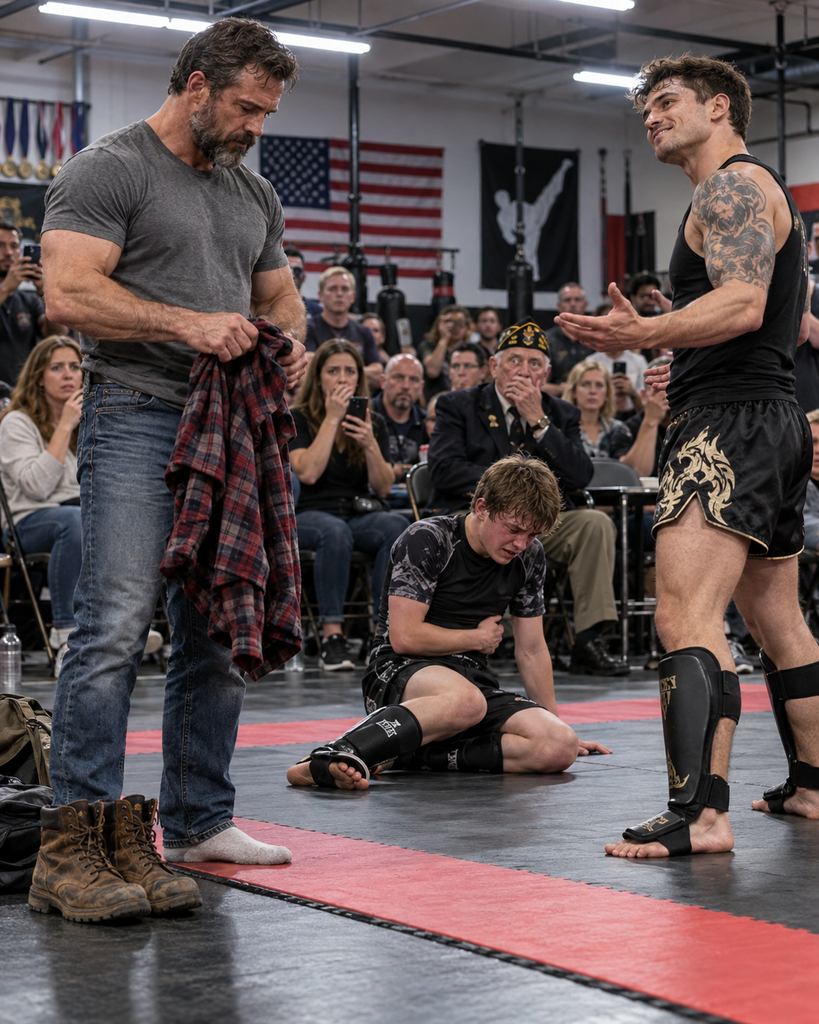
I removed my faded flannel shirt, folded it carefully, and set it on top of the boots.
Underneath, I wore an old charcoal T-shirt.
A small, barely noticeable scar ran along my left forearm.
Blake watched with an amused expression.
“You sure about this, old man?”
I stepped onto the mat wearing only my socks.
“I asked you to apologize to my son.”
“And I told you to get on the mat.”
“I heard you.”
Someone near the back laughed nervously.
Blake began bouncing on the balls of his feet, rolling his shoulders and loosening his arms.
He looked every bit like a professional fighter.
His chest was broad, his waist narrow, and his legs carried the strength of someone who had spent years practicing kicks against heavy bags.
I didn’t underestimate him.
That would have been foolish.
Five state championships weren’t earned by accident.
Whatever Blake lacked in judgment and character, his physical abilities were genuine.
But there was something he had apparently never understood.
A person could spend twenty years learning how to hurt others without ever learning how to control himself.
“Somebody record this,” Blake announced.
Several parents immediately raised their phones.
I glanced toward them.
“Actually, I’d appreciate it if everyone kept recording.”
Blake laughed.
“What, you want proof of how badly you get beaten?”
I shook my head.
“No.”
Then I looked directly into his eyes.
“I want witnesses.”
For the first time since I’d stepped onto the mat, Blake’s smile faltered.
It lasted only a second.
But I noticed.
And then he raised his gloves.
Blake stood several feet away from me, moving lightly across the mat.
I remained still, my hands resting loosely at my sides.
“Put your guard up,” he ordered.
“I don’t need you to teach me that.”
The room went quiet.
Near the back of the bleachers, an elderly man wearing a faded Navy veteran’s cap slowly leaned forward.
I hadn’t noticed him earlier.
He looked to be in his late seventies, with thinning white hair, weathered hands, and the observant expression of someone who had spent a lifetime paying attention to details other people overlooked.
His eyes moved from my face to my feet.
Then they settled on the scar along my forearm.
Something changed in his expression.
Blake clapped his gloves together.
“Last chance to walk away.”
I met his gaze.
“Same offer.”
His jaw tightened.
Then he moved.
The first punch came fast.
It was a straight right, aimed directly at my chin.
Blake drove his shoulder into the movement, expecting me to panic, retreat, or duck wildly out of the way.
Instead, I shifted my head barely two inches.
His fist passed beside my cheek.
I felt the movement of air as it missed.
Blake had committed too much weight to the punch.
Before he could recover, I stepped slightly to the side.
He stumbled forward and barely caught himself before falling.
Several spectators gasped.
Blake spun toward me.
“Lucky.”
I didn’t respond.
He advanced again.
A jab.
A right cross.
A left hook.
I avoided each strike with small, controlled movements.
Nothing dramatic.
Nothing that would impress someone who measured fighting ability by how aggressively a person moved.
I simply shifted enough to remain out of reach.
Blake’s breathing began to change.
He couldn’t understand why his punches kept missing a man who barely appeared to be moving.
“Fight back!” he shouted.
I looked straight at him.
“You’re not giving me a reason to.”
His face reddened.
He threw another hook.
This time, I caught his wrist, redirected his forward momentum, and released him.
He turned halfway around before regaining his balance.
A murmur spread through the spectators.
Blake stared at me.
The confidence was beginning to leave his face.
From the bleachers, I heard a chair scrape against the floor.
The elderly veteran had stood up.
He watched my stance with an expression I recognized immediately.
It wasn’t admiration.
It was recognition.
He took a hesitant step forward and leaned toward the woman sitting beside him.
He whispered something.
I couldn’t make out the beginning, but I heard the final three words.
“Close-quarters combat specialist.”
The woman looked confused.
The veteran covered his mouth.
“My God,” he whispered. “That man was one of ours.”
Blake hadn’t heard him.
He was too occupied trying to convince himself that the previous thirty seconds hadn’t happened.
“Enough games,” he snapped.
He rushed forward.
I recognized what he was preparing before he fully committed to the movement.
His right shoulder dipped.
His left foot shifted.
His weight settled.
He was preparing another spinning kick.
The same technique he’d used against my son.
For an instant, I saw Evan lying on the floor again, one arm wrapped protectively around his ribs.
I heard his voice.
I’m just not strong enough, Dad.
Anger surged through my chest.
It was immediate.
Familiar.
Dangerously tempting.
There had been a time in my life when hesitation could lead to consequences far worse than embarrassment.
I’d spent years learning to recognize danger before it fully developed.
I’d trained beside men who understood physical confrontation in ways most civilians would never need to experience.
And for one terrible second, I wanted Blake to feel the same helplessness he’d forced on my boy.
Then I remembered something my first instructor had taught me.
The moment anger makes your decisions, you’ve surrendered control.
So I waited.
Blake turned.
His leg came around with tremendous force.
Before the kick could fully extend, I stepped inside its arc, caught his balance at the shoulder, and guided his momentum past me.
He landed hard on the mat.
The impact echoed through the gym.
A collective gasp rose from the audience.
Blake rolled onto his side, looking more stunned than injured.
I stepped backward.
“Stay down,” I told him.
He scrambled to his feet.
“YOU CHEATED!”
I said nothing.
“You grabbed me!”
“You said full contact.”
“That doesn’t mean you can—”
I interrupted him.
“You challenged a thirteen-year-old child to demonstrate your strength. Then you challenged his father because he asked for an apology.”
I paused.
“Don’t start changing the rules because you’re losing.”
Several parents nodded.
Blake glanced around the room.
For the first time, he seemed to understand that the spectators were no longer impressed by him.
And that realization made the situation more dangerous.
Humiliation can bring out the worst in someone whose entire identity depends on being feared.
Without warning, Blake lunged.
His right fist came toward my face.
I moved aside.
Another punch followed.
Then another.
His movements were no longer disciplined combinations. He was swinging out of anger, no longer concerned with demonstrating skill.
He wanted to hurt me.
When his right arm extended too far, I caught it, turned with his movement, and brought him onto the mat.
This time, I maintained control of his wrist and shoulder.
Not enough pressure to injure him.
Just enough to prevent another strike.
Blake struggled beneath me.
“GET OFF!”
“Stop fighting.”
He twisted.
I adjusted my position.
“Stop.”
He tried again.
Then he began to understand something he hadn’t expected.
He couldn’t move.
I wasn’t using all my strength.
I didn’t need to.
His breathing grew uneven.
I leaned close enough that he could hear me without the rest of the room catching every word.
“Your students trust you,” I said quietly. “Their parents pay you to teach discipline.”
He continued struggling.
“A thirteen-year-old walked into your gym believing you were someone worth respecting.”
Blake’s expression twisted with frustration.
“He needs to learn how to take a hit!”
“Then teach him safely.”
“He’s weak!”
For an instant, my grip tightened.
Then I deliberately relaxed it.
“No,” I said.
I looked directly into his eyes.
“He trusted you.”
Those three words seemed to disturb him more than being taken down in front of the entire room.
Behind us, someone began clapping.
One slow clap.
Then another.
I glanced toward the bleachers.
The elderly veteran was standing in the aisle.
But he wasn’t applauding.
He was staring at me.
“Damon?”
I froze.
There was something about his voice.
Something distant and familiar.
The old man’s eyes widened.
“Damon Mercer?”
My stomach tightened.
Very few people in Cedar Falls knew the full story of my military service.
Even fewer would have recognized me without a uniform.
I slowly released Blake and stood.
Blake rolled away, coughing and holding his shoulder.
The veteran stepped closer.
And when he spoke again, I recognized his voice before I fully recognized his face.
“Chief?”
He gave a small, disbelieving laugh.
“Lord Almighty.”
I stared at the elderly man approaching the mat.
After twenty years, the past I’d worked so hard to leave behind had finally caught up with me.
PART 3
Chief Raymond Collins.
Twenty years earlier, he’d been one of the senior instructors involved in a specialized combat training program during my early years in Naval Special Warfare.
Time had changed him.
His shoulders were narrower. His hair had turned completely white, and the years had left their marks on his face.
But his eyes were exactly as I remembered.
So was the way he studied people, as though every movement revealed something important.
“I thought you were gone for good,” he said.
“I was trying to be.”
Collins turned toward the stunned spectators.
“Do any of you have the slightest idea who this man is?”
“Chief,” I said sharply.
He stopped.
For a moment, neither of us spoke.
Then he understood.
I didn’t want a speech about my military qualifications. I didn’t want strangers discussing missions or speculating about the men I’d served beside.
I’d spent nine years building a quiet life.
I fixed leaking pipes.
I replaced water heaters.
I helped my son with his homework and took him fishing on weekends.
Until that afternoon, I’d been perfectly content letting everyone believe that was everything there was to know about me.
Collins gave a small nod.
“Understood.”
Blake struggled to his feet.
“You know this guy?”
Collins regarded him calmly.
“I knew him before you were old enough to throw a punch.”
Blake scoffed.
“What’s he supposed to be? Some retired karate instructor?”
Collins’s expression hardened.
“Sixteen years in Naval Special Warfare. A substantial part of that time in a Tier 1 special mission unit.”
Silence settled across the gym.
“A man who trained with people whose work required extraordinary discipline under extraordinary pressure.”
Collins glanced in my direction.
“And someone who apparently has better things to do these days than impress people in a gym.”
Blake looked at me as though he were seeing an entirely different person.
His gaze dropped to the scar on my arm.
Then to my hands.
Finally, he looked at the section of mat where he’d just been lying.
“You’re a SEAL?”
“Former,” I answered.
He swallowed.
“Why didn’t you say something?”
I studied his face.
“Would you have treated my son differently if I’d told you?”
Blake opened his mouth.
No answer came.
“That’s the problem,” I said. “You should have treated him properly because he’s a child. Not because of who his father might be.”
Nobody laughed.
Nobody moved.
Then a woman in the second row rose from her chair.
A little boy wearing a yellow martial arts belt sat beside her.
“My son said Blake hurt him last month,” she announced.
Blake turned sharply.
“Mrs. Patterson, that was a training—”
“He came home with bruises on his ribs,” she interrupted. “You told me he’d fallen during drills.”
The little boy lowered his head.
Another father stood.
“My daughter cried before class last week. She told me she was scared of being chosen for sparring.”
Blake raised his hands.
“Everybody needs to calm down.”
But the room wasn’t calming down.
A parent near the entrance spoke up.
“You told us those were controlled demonstrations.”
“They were!”
“Then why was Evan lying on the floor unable to breathe?”
Blake glanced toward the door.
His confidence had finally collapsed.
And I could see that he was beginning to understand something.
Losing the fight wasn’t the worst thing that had happened to him.
The real problem was that the parents were finally speaking.
And several of them had recordings.
I walked back to my folding chair.
My hands remained steady as I unfolded my flannel shirt, but my heart was pounding beneath the calm exterior.
Not because of the confrontation.
Because I couldn’t stop thinking about what might have happened if I hadn’t attended class that afternoon.
Evan had trained at that gym for five months.
Five months of trusting a man who seemed to believe fear was an acceptable teaching method.
Five months of coming home with bruises he’d told me were normal.
Five months of assuring me that everything was fine.
I slipped my boots back on.
Then I took out my phone.
Blake noticed immediately.
“What are you doing?”
“Calling the police.”
The color left his face.
“For what?”
“For what happened to my son.”
“Come on, man. We just settled this.”
I stopped tying my boot and looked up.
“No. We didn’t.”
“You beat me!”
“That wasn’t justice,” I replied. “And it doesn’t erase what you did.”
A woman standing near the entrance raised her phone.
“I recorded the kick.”
Blake turned toward her.
“Delete that.”
She didn’t move.
“I’m not deleting anything.”
He took a step in her direction.
I stood.
He stopped immediately.
“Leave her alone,” I said.
Blake looked away.
I dialed the police.
When the dispatcher answered, I explained that an adult martial arts instructor had injured my thirteen-year-old son during a demonstration.
I told her I wanted officers to document the incident and speak with the witnesses.
I provided the gym’s address.
Then I explained that Evan had struggled to breathe after the kick and needed medical attention.
The dispatcher gave me emergency guidance and arranged for assistance.
As I listened, a terrible realization settled over me.
I’d checked Evan’s breathing after the incident.
I’d spoken to him and made sure he could stand.
But instead of having him examined immediately, I’d sent him outside to wait in my truck while I confronted Blake.
My anger at the instructor had briefly become more important than my son’s injuries.
That mistake struck me harder than anything Blake had thrown at me.
I had spent years learning how to remain calm in emergencies.
Yet when my own child needed me, I’d allowed my emotions to pull my attention away from what mattered most.
I turned toward Collins.
“Chief, can you help the officers find me? I need to check on Evan.”
He nodded without hesitation.
“Go.”
I didn’t need to be told twice.
I hurried toward the exit, leaving the stunned parents, the defeated instructor, and the memories of my former life behind me.
The confrontation was finished.
But I still had no idea how badly my son had been hurt.
PART 4
The afternoon sunlight was bright enough to make me squint as I stepped into the parking lot.
My old Chevy Silverado sat beneath a row of maple trees near the edge of the property.
I could see Evan through the passenger-side window.
His knees were drawn up, and one hand rested protectively against his ribs.
When he noticed me approaching, he straightened in his seat.
I opened the door.
“Hey, buddy.”
He studied my face.
“Did he hurt you?”
“No.”
“Did you fight him?”
I hesitated.
“Yes.”
Evan glanced at my hands.
“Did you win?”
I crouched beside the truck.
“That isn’t the important part.”
He frowned.
“But did you?”
I sighed.
“I stopped him.”
For a moment, satisfaction crossed his face.
Then it disappeared.
“Is he mad at me?”
That question broke something inside me.
“Evan, look at me.”
He raised his eyes.
“None of this is your fault.”
His eyes filled with tears.
“He kept telling me I was weak.”
I nodded slowly.
“And you believed him?”
Evan stared at his knees.
“He said if I told you I couldn’t handle sparring, I’d never get stronger.”
My throat tightened.
“Did he hurt you before today?”
Evan remained quiet.
Then he nodded.
“Sometimes.”
“How many times?”
“I don’t know.”
“Why didn’t you tell me?”
His lips trembled.
“Because you work so hard, Dad. And you paid for the classes.”
He swallowed.
“I didn’t want you to think I’d wasted your money.”
I looked away for a moment.
Nine years earlier, I’d walked away from a military career that had given my life structure, purpose, and a powerful sense of belonging.
I’d made that choice because Evan deserved a father who came home.
A father who wasn’t constantly leaving with little notice.
A father who attended school plays, helped with homework, and sat beside him when he was sick.
I’d believed that being physically present would be enough to protect him.
But as I listened to my son apologize for being mistreated, I realized how much I’d misunderstood.
Children don’t always tell their parents when they’re suffering.
Sometimes they conceal their pain because they believe they’re protecting the people they love.
I reached into the truck and gently squeezed his uninjured shoulder.
“You could quit every activity I’ve ever paid for,” I told him, “and I wouldn’t be disappointed in you. Not if somebody was treating you like that.”
He wiped his cheek.
“Really?”
“Really.”
Something in his expression softened.
“Dad?”
“Yeah?”
“Are you actually a plumber?”
Despite everything, I laughed quietly.
“Of course I am.”
“But you weren’t always?”
“No.”
“What were you?”
I looked at him.
For years, I’d promised myself that Evan wouldn’t need to know much about the dangerous part of my previous life.
I wanted him to grow up without carrying its weight.
But I’d also taught him that people who loved one another should tell the truth.
And he was old enough to hear mine.
“I served in the Navy,” I said. “For sixteen years.”
His eyebrows rose.
“Like a sailor?”
“Not exactly.”
He stared at me.
“Were you a Navy SEAL?”
I nodded.
For several seconds, he didn’t say anything.
Then he whispered, “Seriously?”
“Seriously.”
“Why didn’t you tell me?”
“Because I wanted you to know me as your dad. Not as somebody who used to do dangerous things.”
He considered that.
Then he asked a question I hadn’t expected.
“Were you scared?”
I smiled faintly.
“Plenty of times.”
“But you were a SEAL.”
“Being trained doesn’t mean you stop feeling fear. It means you learn what to do when you’re afraid.”
Evan looked down at his trembling hands.
“So being scared doesn’t mean I’m weak?”
“No, buddy.”
I leaned closer.
“It means you’re human.”
He nodded.
Then he shifted in his seat and winced.
My attention immediately returned to his ribs.
“Don’t move too much. Help’s coming.”
He looked worried.
“Am I in trouble?”
“Not even a little.”
I remained beside him until the paramedics arrived.
After examining Evan, they recommended further evaluation at the hospital because of the force of the kick and his earlier difficulty breathing.
I rode in the ambulance with him.
As the doors closed, I caught sight of two police vehicles entering the gym’s parking lot.
Chief Collins was waiting near the entrance.
Our eyes met.
I gave him a small nod.
He returned it.
Then the ambulance doors closed.
At the hospital, the doctors examined Evan, checked his breathing, and ordered imaging to rule out serious injuries.
Waiting for the results was worse than anything that had happened inside the gym.
Evan lay on the hospital bed, doing his best to appear brave.
I sat beside him, feeling completely helpless.
I’d spent years training to respond to emergencies.
But now there was nothing I could do except hold my son’s hand and wait for someone else to tell me whether he was going to be all right.
Finally, the doctor returned.
Evan had painful bruising around his ribs, but the examination and imaging showed no fracture or collapsed lung.
I released a breath I hadn’t realized I’d been holding.
The doctor explained the symptoms that would require immediate medical reassessment and instructed us to avoid contact sports while Evan recovered.
Evan turned toward me.
“So I don’t have to go back to the gym?”
“Not that gym.”
“Ever?”
“Ever.”
For the first time all afternoon, he smiled.
That evening, after we returned home, I made grilled cheese sandwiches and tomato soup.
It was Evan’s favorite meal.
He sat at the kitchen table wearing an oversized sweatshirt, moving carefully whenever he reached for something.
We ate mostly in silence.
Then my phone rang.
It was Chief Collins.
“Damon, it’s Ray.”
“Chief.”
“How’s your boy?”
“Bruised ribs. No fractures. Doctor says he’ll be okay.”
“Thank God.”
There was a pause.
Then Collins continued.
“The police took statements from nearly everyone who stayed.”
“What about Blake?”
“He tried telling them the child was injured during normal training. Then one of the parents showed them the video.”
I closed my eyes.
“The footage was clear?”
“Clear enough to show what happened before and after that kick. And several parents gave similar accounts.”
“Good.”
Collins hesitated.
“Damon, there’s something else.”
I glanced toward the living room.
Evan was watching television, finally able to relax a little.
“What is it?”
“That wasn’t the first complaint against Blake.”
I straightened.
“Explain.”
Two former students’ parents had contacted one of the families after the recording began circulating.
Both claimed they’d withdrawn their children the previous year because of excessive physical contact and intimidation during training.
“Did they report it?” I asked.
“One says she complained to the gym’s owners. Another says she considered filing a police report but didn’t believe anyone would take her seriously.”
I looked through the kitchen window.
The sun was disappearing beyond the backyard fence.
For several seconds, I remained silent.
Then I asked the question that would take the investigation in an entirely new direction.
“Who owns the gym?”
PART 5
“A couple named Martin and Susan Keene,” Collins answered. “They own the building and the training business. Blake was their lead instructor.”
“And they knew what he was doing?”
“That’s what the parents are claiming. Nobody’s established it yet.”
I nodded, even though he couldn’t see me.
“Then it needs to be established.”
Collins’s voice softened.
“Damon, I know what you’re thinking.”
“No, Chief. You don’t.”
“I know you want to protect your son.”
I watched Evan laugh quietly at something on television.
“That’s all I’ve ever wanted.”
“Then do it the right way.”
I let the silence stretch between us.
Finally, I answered.
“That’s the plan.”
Over the next several days, the situation became much bigger than anything I’d anticipated.
The recording from the gym spread through local parent groups.
It showed Blake striking Evan during the demonstration.
It showed me approaching the instructor and demanding an apology.
And it showed Blake challenging me to fight.
A shorter recording of our confrontation also began circulating.
Someone added dramatic music.
Another person posted it under the title Plumber Destroys MMA Champion.
I hated it.
Not because I was embarrassed.
Because everyone seemed to be concentrating on the wrong part of the story.
People wanted to know how a middle-aged plumber had managed to defeat a decorated kickboxer.
They wanted details about my military service.
Some wanted interviews.
A local reporter called my plumbing business three times in a single morning.
I refused every request.
I had no interest in becoming famous.
I wanted to know why my son had been hurt.
And I wanted to make certain the same thing never happened to another child.
The police interviewed me twice.
I explained everything I’d witnessed, including what Blake had said before and after the demonstration.
I described our confrontation without attempting to make myself look better.
I told the officers that I’d accepted Blake’s challenge.
I acknowledged restraining him.
I didn’t exaggerate what he’d done to me, nor did I pretend that I’d played no part in the encounter.
The officers reviewed the available recordings.
They explained that their investigation would examine both Blake’s treatment of Evan and the physical confrontation between Blake and me.
I understood.
My military background didn’t place me above the law.
It didn’t give me permission to settle disagreements however I pleased.
I’d known that when I stepped onto the mat.
Eventually, the officers informed me that, based on the evidence available, no charges were being pursued against me for the gym confrontation.
But the investigation into my son’s injuries continued.
Meanwhile, the gym’s owners attempted to contain the growing controversy.
Martin and Susan Keene released a statement describing the incident as an unfortunate misunderstanding during an advanced training demonstration.
Their explanation lasted less than twenty-four hours.
Then more parents began speaking.
One family produced photographs of injuries their son had received during training.
Another shared messages documenting complaints they’d previously made about Blake’s treatment of younger students.
A former assistant instructor described leaving the gym after repeatedly objecting to Blake’s aggressive demonstrations.
Not every accusation had been proven.
Some were supported by records.
Others still required investigation.
But taken together, the complaints revealed a troubling pattern that could no longer be dismissed as one parent’s misunderstanding.
The Keenes were facing questions they could not answer with a carefully worded statement.
Why had multiple children reported being frightened during class?
Why had parents complained about excessive contact?
Why had an assistant instructor felt compelled to leave?
And why had the gym continued allowing Blake to conduct demonstrations that placed smaller students at risk?
The evidence forced the owners to act.
They suspended Blake from his position as lead instructor and canceled the children’s classes while an independent review was arranged.
For the first time since the incident, I felt that meaningful steps were being taken.
But Blake had no intention of accepting responsibility quietly.
He posted an angry video online.
In it, he called the parents dishonest.
He insisted that the gym had been unfairly targeted.
Then he turned his attention directly toward me.
He accused me of using my military training to humiliate him.
The man who had challenged an ordinary-looking father in front of a room filled with witnesses was now presenting himself as the victim.
And once again, he wanted a fight.
PART 6
I watched less than a minute of Blake’s video before turning it off.
Evan was standing behind me.
“Is he talking about you?”
“Yes.”
“Are you going to answer him?”
“No.”
“Why not?”
“Because he wants another fight.”
Evan frowned.
“But he said you cheated.”
I turned toward my son.
“Do you know something I learned a long time ago?”
“What?”
“Winning an argument isn’t always worth having it.”
He considered that.
“Even when somebody lies?”
“Especially then. Sometimes the best answer is evidence and people willing to tell the truth.”
Evan looked at the phone.
Then he nodded.
It was the first time I’d seen him consider a confrontation without automatically assuming he needed to defend himself.
And to me, that mattered far more than anything strangers were saying online.
About two weeks after the incident, Chief Collins came to our house.
He arrived wearing an old Navy sweatshirt and carrying an apple pie from the grocery store.
Evan answered the door.
Collins smiled.
“You must be Evan.”
“Yes, sir.”
“Your dad and I go back a long way.”
Evan looked up at him.
“Were you a SEAL too?”
Collins chuckled.
“I spent years helping train some very stubborn Navy personnel. Your father was one of them.”
“Was he good?”
Collins glanced past Evan toward me.
“Your father was one of the most disciplined men I ever worked with.”
Evan’s eyes widened.
I cleared my throat.
“Chief, don’t start.”
Collins laughed.
We settled into the living room, and Evan began asking questions.
Lots of questions.
He wanted to know about ships.
About military training.
About whether I’d ever jumped out of an airplane.
I answered what I could.
Collins contributed a few harmless stories from my younger years.
He told Evan about a time I’d refused to quit a difficult training exercise even after everyone else in our group had finished.
Then the old chief said something I hadn’t expected.
“But do you know the thing I respected most about your father?”
Evan shook his head.
“It wasn’t how hard he could fight.”
“What was it?”
“He knew when not to.”
I looked toward Collins.
He held my gaze.
“Your dad understood something that takes some men their entire lives to learn. Strength doesn’t give you the right to hurt somebody just because you can.”
Evan grew quiet.
Then he asked, “Is that why Dad didn’t hurt Blake worse?”
Collins nodded.
“Exactly.”
My son turned to look at me.
For the first time since the incident, he seemed proud without also appearing frightened.
And I realized something important.
I’d spent years believing I needed to hide every trace of my former life from Evan.
But perhaps I hadn’t needed to conceal my entire past.
Perhaps I simply needed to teach him what the best parts of that experience had meant.
A month after the incident, the police completed the main phase of their investigation.
Blake was charged in connection with the assault on Evan.
The district attorney’s office reviewed the recordings, witness statements, medical records, and other supporting evidence.
The legal proceedings moved slowly.
There were hearings.
Attorneys.
Delays.
Arguments over what had happened inside the gym and whether Blake’s conduct crossed the line from legitimate instruction into criminal behavior.
His lawyer initially argued that Evan’s injuries had occurred during a consensual martial arts exercise.
But the recording presented a different picture.
It showed an adult instructor using a forceful technique against a much smaller child during what parents had been told was a demonstration.
Witnesses also described Blake’s behavior before the kick and his comments afterward.
Complaints from other families provided additional context, although each allegation had to be evaluated separately.
The prosecutor explained that the case wasn’t about whether martial arts involved physical contact.
Everyone understood that contact could be part of legitimate training.
The real question was whether an instructor entrusted with a child’s safety had intentionally used excessive force.
Several months later, Blake entered a guilty plea to a reduced assault charge.
The agreement was accepted by the court.
He received a suspended jail sentence, supervised probation, and mandatory counseling.
He was also prohibited from teaching martial arts to minors while serving his probation.
In addition, he was ordered to pay restitution associated with Evan’s medical expenses.
The gym permanently terminated his employment.
Martin and Susan Keene refunded tuition to affected families and agreed to a civil settlement with us and several other parents.
Their business eventually reopened under different management, with stronger child-safety policies and independent oversight.
Not everyone was satisfied with the outcome.
Some parents believed Blake should have received a harsher punishment.
Others wanted the gym permanently closed.
I understood their frustration.
But for me, the most important result was that Blake could no longer return to that same gym the following afternoon and treat another thirteen-year-old the way he’d treated Evan.
My son didn’t attend the sentencing.
He told me he didn’t want to see Blake again.
I respected his decision.
Instead, he spent the day fishing with Chief Collins.
When I returned home from court, the two of them were sitting on the back porch, cleaning a small tackle box.
Evan looked up.
“Is it over?”
I sat beside him.
“The court case is.”
“Is he going to jail?”
“Not unless he violates the terms of his sentence.”
Evan thought about that.
Then he asked, “Does he know what he did was wrong?”
I hesitated.
“His guilty plea means he accepted legal responsibility. I can’t tell you what’s in his heart.”
My son looked disappointed.
I understood why.
He wanted the kind of ending children are taught to expect.
The bully admits he’s wrong.
The good guys win.
Everyone learns an important lesson.
But real life rarely provides that kind of certainty.
“Buddy,” I said, “we can’t control whether he becomes a better person.”
“Then what can we control?”
“What we do next.”
Evan stared at me.
Then he turned toward Chief Collins.
“Can I still learn martial arts?”
I blinked.
After everything he’d experienced, it was the last question I expected him to ask.
He had spent months being made to feel weak.
He’d been frightened of disappointing me.
He’d been injured by an instructor he was supposed to trust.
And now, after all of that, he was asking whether he could return to the very activity that had caused him so much pain.
I looked carefully at my son.
“You still want to?”
He nodded.
“Not with Blake. Somewhere else.”
I glanced at Collins.
The old chief was trying unsuccessfully to hide a smile.
I turned back toward Evan.
“Why?”
He took his time answering.
“Because I still want to be strong.”
I felt a familiar ache in my chest.
Then Evan added something that told me he was beginning to understand the difference between strength and cruelty.
“But not like him.”
PART 7
I looked at Evan for a long moment.
Then I smiled.
“Then we’ll find you a good teacher.”
It took another month.
We visited three different martial arts schools.
At each one, I watched the instructors carefully.
Not their impressive demonstrations.
Not the trophies displayed along their walls.
Not the photographs of championship victories or the promises in their advertisements.
I watched how they treated their smallest students.
I paid attention to what happened when a child struggled to understand a technique.
I listened to how the instructors corrected mistakes.
And I noticed whether the children seemed comfortable asking questions.
I’d spent enough years around skilled people to understand that talent and character weren’t always the same thing.
An instructor could possess extraordinary ability and still be completely unfit to guide children.
I wasn’t looking for the strongest fighter.
I was looking for someone my son could trust.
The third school was operated by a woman named Rachel Bennett.
Rachel was a former collegiate wrestler who had spent more than a decade teaching youth grappling and self-defense.
She didn’t begin her introductory class with a lecture about toughness or winning.
She began by explaining the safety rules.
She told the children that tapping out meant their training partner had to stop immediately.
She explained that they could ask questions whenever they were confused.
She emphasized that training should help them become more confident, not more frightened.
Then she said something that made Evan turn and look directly at me.
“Nobody in this room has to earn the right to be treated with respect.”
I knew immediately that we’d found the right place.
Evan began attending beginner classes twice a week.
At first, he was hesitant.
Whenever a larger student moved toward him too quickly, he flinched.
He apologized constantly.
Even when he hadn’t done anything wrong.
Sometimes he seemed more concerned about making a mistake than learning the technique.
But Rachel never embarrassed him.
She never raised her voice simply because he struggled.
Instead, she worked with him patiently.
She taught him how to fall safely.
How to protect his balance.
How to recognize when a training partner was uncomfortable.
And gradually, she helped him learn to trust his own body again.
Progress wasn’t immediate.
Some days were more difficult than others.
There were classes when Evan came home smiling, excited to tell me about something he’d learned.
There were others when he barely spoke during the drive home.
Once, after struggling during practice against a boy two years younger than himself, Evan sat in the truck fighting back tears.
“I still stink at this,” he muttered.
I started the engine.
“You’re learning.”
“Everyone else is better.”
“Some of them have been training for years.”
He folded his arms.
“I thought I’d be better by now.”
I pulled into an empty section of the parking lot and turned off the engine.
“Evan, do you think I was good at everything when I started?”
He gave me a skeptical look.
“You were a Navy SEAL.”
“Eventually.”
He stared at me.
I smiled faintly.
“I failed plenty of things before I learned how to do them right. I was corrected. I was exhausted. Sometimes I was the worst person in the room at a particular skill.”
“Really?”
“Really.”
He considered that.
Then I continued.
“The difference between a good instructor and a bully is what they do when you fail.”
Evan turned toward the window.
For a moment, he said nothing.
Then he looked back at me.
“Coach Rachel doesn’t yell.”
“No.”
“She just shows me again.”
“Exactly.”
He nodded.
“Okay.”
And the following Tuesday, he went back.
Week after week, Evan continued attending classes.
He wasn’t suddenly fearless.
He still had moments of hesitation.
But he was learning that making mistakes didn’t mean he deserved to be criticized or humiliated.
And he was beginning to understand that improvement didn’t happen because someone frightened him into trying harder.
It happened because he felt safe enough to keep learning.
Six months after the incident at Blake’s gym, Rachel arranged a small demonstration for the parents.
It wasn’t a competition.
There were no championship trophies.
No aggressive challenges.
No attempt to prove which student was the toughest.
It was simply an opportunity for the children to show their families what they’d learned.
I sat in the second row beside Chief Collins.
Evan stood on the mat wearing a clean white uniform.
His beginner’s belt was tied carefully around his waist.
He still wasn’t the tallest student.
He wasn’t the strongest.
And he certainly wasn’t the most experienced.
But when Rachel called him forward, he didn’t lower his head.
He walked onto the mat with his shoulders straight.
His training partner was an older boy named Tyler.
The two boys bowed respectfully.
Then they began a controlled grappling exercise.
Evan made a mistake almost immediately.
He lost his balance.
Tyler brought him gently onto the mat.
And for one frightening second, I watched my son’s expression change.
His eyes widened.
His body stiffened.
I recognized that look.
It was the same fear I’d seen six months earlier, when he’d been lying on another gym floor, believing he wasn’t strong enough.
The memory of Blake’s gym seemed to return all at once.
I gripped my knees.
Evan remained on the mat.
And I found myself wondering whether the experience he’d worked so hard to overcome still had the power to take away his confidence.
PART 8
Rachel knelt nearby.
Her voice was calm.
“Take your time, Evan. You’re safe. Remember what we practiced.”
My son took a breath.
Then another.
I watched him adjust his position.
He used the movement Rachel had taught him and carefully worked his way back to his knees.
Rachel smiled.
“Good. That’s it.”
The exercise continued.
Evan didn’t win.
There wasn’t even a winner.
When it ended, Tyler reached down and helped him to his feet.
The boys shook hands.
And Evan smiled.
A real smile.
Not the expression he used when he was trying to convince me everything was fine.
Not the nervous smile he’d worn during those terrible months at Blake’s gym.
Just a happy thirteen-year-old boy enjoying something he’d worked hard to learn.
Chief Collins leaned toward me.
“Look at him.”
“I see him.”
“No,” Collins said quietly. “Really look.”
I did.
Evan was laughing with the other students.
He stood among them comfortably, joining their conversations and sharing their excitement.
He wasn’t standing apart.
He wasn’t lowering his head.
He wasn’t waiting for someone to criticize him.
He belonged.
I swallowed.
Collins placed a hand on my shoulder.
“That’s what winning looks like, Damon.”
I couldn’t answer.
Because he was right.
For months, I’d believed the most important moment of that entire experience had happened when I stepped onto the mat against Blake.
I’d thought protecting my son meant showing an arrogant instructor that he’d underestimated the wrong father.
But watching Evan stand confidently beside his classmates, I finally understood the difference between stopping someone who caused harm and helping someone recover from it.
The confrontation with Blake had lasted less than two minutes.
Helping my son regain his confidence had taken months.
And that second part had required far more patience, humility, and courage than anything I’d done on the mat.
After class, Evan came running toward me.
“Dad! Did you see?”
“Every second.”
“Did I do okay?”
I pulled him into a hug.
“You did great.”
He stepped back, grinning.
“I almost got out of that hold on my own.”
“You sure did.”
“Next time, I think I can do it faster.”
“I believe you.”
Then he turned toward Collins.
“Chief Ray, did you see my escape?”
Collins grinned.
“Son, I was watching every move.”
Evan laughed.
The three of us walked outside together into the cool afternoon air.
As we crossed the parking lot, Evan slipped his hand into mine.
He hadn’t done that in public for a long time.
At thirteen, he was reaching the age when holding his father’s hand was supposed to be embarrassing.
But he didn’t seem to care.
“Dad?”
“Yeah, buddy?”
“Can I ask you something?”
“Anything.”
“Were you really the best fighter in that old gym?”
I thought about Blake lying on the mat.
The shocked expressions on the spectators’ faces.
The phones recording everything.
The look in Chief Collins’s eyes when he’d recognized me.
Then I looked down at my son.
“I don’t know.”
Evan frowned.
“But you beat him.”
“That doesn’t mean I’m the strongest person in every room.”
He looked confused.
“Then how do you know when you’re strong?”
I stopped beside the truck.
For a moment, I thought about the men I’d served alongside during my military career.
Some had been enormous.
Others were smaller than most people expected.
Some had received public recognition for their service.
Others had names that would never be known outside the communities they’d protected.
Some were physically stronger than I was.
Others possessed abilities I could never hope to match.
But the finest men I’d served with shared one important quality.
They understood that real strength wasn’t measured by how much harm a person could cause.
It was measured by what that person was willing to protect.
By what they could endure.
And by what they chose not to do when they possessed the power to hurt someone.
I crouched until my eyes were level with Evan’s.
“You remember the day Blake hurt you?”
He nodded.
“You thought you were weak because you couldn’t stop him.”
His smile faded slightly.
“But you went back to martial arts even though you were scared,” I continued.
I rested a hand gently on his shoulder.
“You trusted another teacher. You kept practicing when things were difficult. And today, when you fell, you got back up.”
Evan looked at me.
“That’s strength, son.”
He was quiet for a moment.
Then he smiled.
“Like you?”
I shook my head.
“No.”
His expression fell.
I squeezed his shoulder.
“Like you.”
He stared at me.
Then he stepped forward and wrapped his arms around me.
Tightly.
I held him there beside our old Chevy Silverado in a nearly empty parking lot, while Chief Collins pretended to be fascinated by the clouds.
Nine years earlier, I’d walked away from a world where strength was often measured by mission success, physical endurance, and the ability to survive extraordinary danger.
I’d traded that life for broken pipes, overdue invoices, school lunches, and Saturday morning fishing trips.
I’d exchanged a career that had given me purpose and a powerful sense of identity for an ordinary job that most people barely noticed.
For a long time, I’d occasionally wondered whether I’d given up too much.
There had been moments when I missed the structure of military life.
The sense of belonging.
The people I’d worked beside.
The certainty that the work we were doing mattered.
But standing in that parking lot with my son in my arms, I finally had my answer.
I’d once been trusted to protect people in situations most of the world would never see.
Now I had one person who mattered more to me than every title, qualification, and commendation I’d ever earned.
And he didn’t need me to be a legendary operator.
He needed me to be his father.
I thought about the man who had started all of this.
Blake had spent years teaching children that the strongest person was the one nobody could beat.
He’d used his accomplishments as proof that other people should fear him.
He’d confused obedience with respect.
He’d mistaken intimidation for discipline.
And he’d convinced vulnerable children that being afraid meant they were weak.
My son was finally learning something better.
That courage could exist alongside fear.
That discipline mattered more than domination.
That a person didn’t need to hurt someone else to prove their worth.
And that walking away from a fight could sometimes require more strength than winning one.
Eventually, Evan released me.
The three of us continued toward the truck.
Collins said goodbye, promising to see Evan again soon.
Evan climbed into the passenger seat while I settled behind the wheel.
As I prepared to start the engine, my son turned toward me with a mischievous smile.
“Hey, Dad?”
“What now?”
“When we get home, can you teach me some of that Navy stuff?”
I laughed.
“I can teach you a few things.”
“Like how to beat somebody with one move?”
I started the engine.
“How about we start with how to avoid a fight?”
He groaned.
“Dad!”
I grinned.
“Trust me. It’s the most useful lesson I ever learned.”
He rolled his eyes, but he was smiling.
As we pulled out of the parking lot, I caught a glimpse of him in the rearview mirror.
He was sitting upright, looking out the window.
His face was relaxed.
His shoulders were no longer hunched as though he were expecting someone to criticize him.
He looked peaceful.
He looked happy.
He looked like a boy who was finally beginning to believe in himself.
I hadn’t seen that expression in months.
For the first time since the afternoon I’d found him struggling to breathe on a gym floor, I felt certain we’d made it through.
Not because I’d defeated the man who hurt him.
Not because strangers had watched a video of me fighting.
Not because people had discovered my military background.
And not even because Blake had faced legal consequences for his actions.
We’d made it through because the man who once frightened my son no longer had the power to define how Evan saw himself.
That was the change I’d wanted more than anything.
Evan was learning that he didn’t have to be the strongest person in the room to deserve respect.
He didn’t have to win every match.
He didn’t have to hide his fear.
He didn’t have to keep painful secrets because he worried about disappointing me.
He could struggle.
He could make mistakes.
He could ask for help.
And he could try again.
I glanced toward him once more.
He was watching the passing trees, still smiling faintly to himself.
I remembered the frightened boy who’d whispered that he wasn’t strong enough.
And I looked at the boy beside me now.
The difference wasn’t that he’d suddenly become a better fighter.
It was that he’d begun to understand his own worth.
I drove home with one hand on the steering wheel and the other resting near my son’s shoulder.
There were no cameras.
No cheering crowds.
No medals.
Just an ordinary father taking his boy home after martial arts practice.
And of all the victories I’d known in my life, that quiet drive was the one I would remember most.