After a week of fishing with an old Army buddy, my husband came home with no fish and a woman’s suitcase. He was thin as a rail and wouldn’t look me in the eye. “It’s nothing, Luddy. Just some things I’m keeping for somebody.” He locked it in his truck. The tag on the handle had a woman’s name I’d never heard. When he finally fell asleep, I took his keys, opened that suitcase, and on top of everything was…
I’m Ludella, seventy-six, and I’ve been married to Melvin Ochoa for fifty-four years in Kingsville, Texas. Melvin is seventy-eight. He drove a feed truck for thirty years, and he’s never been a talker.
He went to Vietnam at nineteen and came home at twenty with a limp he never once explained. He still won’t watch a war movie.
“Some things you leave over there, Luddy,” is all he ever said.
Some nights he’d wake up hollering a name I couldn’t make out, soaked in sweat. I’d hold him till he quit shaking. In the morning he’d make the coffee and act like nothing happened.
I learned not to ask. There’s one other thing I learned not to ask about. On the first of every month for fifty-four years, Melvin has mailed a money order.
Forty dollars. Always to a post office box in Laredo. When we were young and broke, forty dollars was a lot of money.
I asked him once, the first year we were married.
“Melvin, who are you sending money to?”
“A promise,” he said, and walked out to the barn.
I asked again when our first baby came and we were eating beans four nights a week.
“Luddy, please,” he said. “Don’t ever ask me that again.”
So I didn’t. But I’ll be honest with you. For fifty-four years, a little part of me wondered if there was a woman in Laredo.
Maybe a child. Every first of the month, that little part of me ached. We raised three kids on what was left.
I patched jeans, I canned everything that grew, and I never once bought a dress that wasn’t on the clearance rack. And every month, forty dollars went to Laredo. It was the one thing in our whole marriage I wasn’t allowed to touch.
This October, Melvin’s phone rang at supper. He listened for a long time without saying a word. Then he set down his fork.
“Luddy, I’m going fishing with an old Army buddy for a week,” he said.
“Down on the river by Laredo.”
Melvin hasn’t been fishing since 1998. He doesn’t have an Army buddy that I’ve ever met. He packed a bag, took his truck, and left the next morning before daylight.
He didn’t take his fishing poles. They were right there in the hall closet. I stood looking at them for a long time.
He called once that week.
“I’m all right, Luddy. Don’t worry,” he said, and his voice sounded like he’d been crying.
I didn’t sleep more than two hours a night. I told myself every kind of story. Fifty-four years of money orders.
A post office box in Laredo. And now a week on a river with no fishing poles. Maybe I’d been a fool my whole married life, I thought.
Maybe I was the last woman in Kleberg County to know. He came home the next Sunday afternoon. I watched from the kitchen window as his truck pulled in.
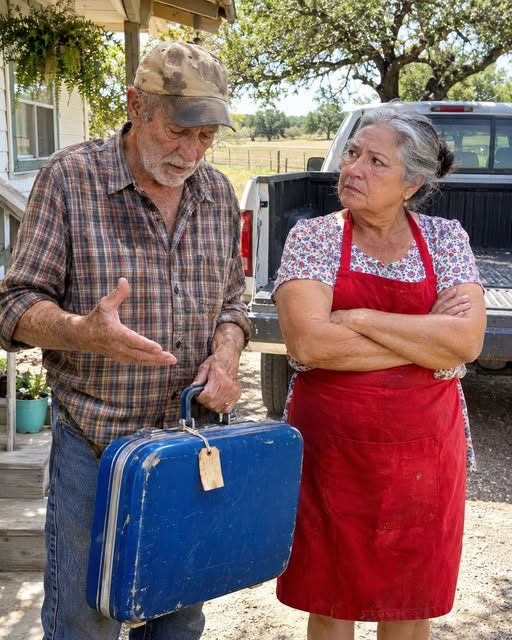
He’d lost weight in one week. His face was gray. He got out, went around to the passenger side, and lifted out a suitcase.
Not his. A woman’s suitcase, old blue hard-shell, the kind with the little silver latches. He saw me in the window.
He stopped. Then he put it in the cab of his truck instead and locked the door. He came in the kitchen and kissed me on the forehead.
“Where’s your fish, Melvin?” I asked.
“Didn’t catch any,” he said.
“Whose suitcase?”
He looked at the floor.
“It’s nothing, Lu. Just some things I’m keeping for somebody.”
“Somebody who?”
“Luddy,” he said, and his voice cracked. “Please let me rest tonight.”
He went to bed at six o’clock and slept like a rock. He didn’t even take his boots off. I pulled them off for him, the way I’ve done when he’s sick, and he didn’t stir.
I sat at the kitchen table till midnight with my coffee going cold. Then I got up. I took his keys off the hook by the door.
I went out to that truck in my nightgown and house shoes, with the porch light on. I unlocked the door. The suitcase was on the seat.
There was a paper tag tied to the handle, the kind the bus station uses. In shaky blue ink it said, Consuelo Ybarra. I’d never heard that name in my life.
I set the suitcase on the hood of the truck under the porch light. My hands could hardly work the latches. They popped open, one and then the other.
On top was a woman’s pink cardigan, folded real neat, smelling like rose powder. Under that was a stack of letters tied with a shoelace, every one of them addressed in my husband’s handwriting. I lifted out the letters.
And there on top of everything else, in an old gold frame, was a picture of my husband at nineteen, in his Army uniform, with his arm around Tomas Ybarra, who carried Melvin out in 1969 and never came home.
For a few seconds, I stayed under the porch light with the picture in my hands. The young man in the frame was my husband, but I had never seen him that way. His arm rested across another soldier’s shoulders. Both of them looked so young they could have been boys.
I carried the picture inside. Melvin was still asleep in his clothes, one boot resting on the floor beside the bed. I stood there looking at him, trying to decide whether to wake him gently or shake his shoulder. I was angry enough to do the second. I sat down on the edge of the mattress and said his name.
“Melvin. Wake up.”
He opened his eyes and saw the picture. His face changed, and he sat up without asking what I had found.
“That’s Tomas,” he said.
“Who is he?”
He rubbed both hands over his face. “The man who got me out. In 1969. He carried me out, and he didn’t come home.”
I had spent half a lifetime wondering whether there was a woman in Laredo. I felt ashamed of that suspicion, then angry that I had been left alone with it for so long.
“And Consuelo?” I asked. “The name on the suitcase?”
“That’s Tomas’s wife.”
“His widow.”
He looked down at the blanket. “Yes.”
I put the picture on the dresser. My fingers were trembling, and I hated that he could see it. “You told me you were going fishing with an Army buddy.”
“I know.”
“You went to see her.”
“Yes.”
“You’ve been sending forty dollars every month to her post office box.”
“Yes, Luddy.”
There was no quick excuse. That made it worse in a way. I wanted him to deny it, or at least give me something I could push against.
“Why did you make me think there was another woman?”
He started to answer and stopped. Then he said, “I was afraid if I told you about Tomas, I’d have to tell you the rest.”
“You were afraid of talking to me?”
“I was afraid of talking about it.”
I was furious. I was also tired enough to feel how many years had gone into that answer. I got up and went to the kitchen. He followed after a minute, slow on his bad leg. I put the letters on the table between us. The shoelace was still tied around them.
“You can tell me now,” I said. “Or you can go back to bed and leave me with another story I have to make up.”
He pulled out a chair and sat. His hands stayed on the table, but he didn’t touch the letters.
“The call at supper was Consuelo,” he said. “She told me she was getting close to the end. She asked me to come.”
“Why didn’t you say that?”
“I couldn’t get the words out.”
“You managed to tell me you were fishing.”
“I know.” His voice got thin. “I lied.”
I sat across from him. For years, I had accepted that asking about the money order was something I wasn’t supposed to do. I had also helped the silence along. I had stopped asking because I loved him and because I didn’t want to hear an answer that would change my life. That part was mine. The lying was his.
“Start with the beginning,” I said.
He looked at the framed picture. “Tomas and I were together in Vietnam. He was older than I was by a little, and he looked after me. When I went down, he carried me out. He never made it home.”
Melvin stopped there and held his hand against his bad leg. It was the first time he had told me even that much about the limp. I waited, but I did not tell him it was all right. It wasn’t all right yet.
“Before he died,” he said, “he asked me to look after Consuelo. He knew she was alone. I told him I would send her money every month.”
“Forty dollars.”
“That’s what I promised. It was what I could do then, and I kept doing it.”
“Why didn’t you trust me with that?”
He turned his wedding ring with his thumb. “I don’t know how to explain it without making it sound better than it was.”
“Try.”
“When I came home, I couldn’t talk about what happened. You were right there, and I still couldn’t say it. The money order was the one part I knew how to do. I could fill it out and mail it. I couldn’t sit at this table and tell you what it was for.”
He had once told me there were things a person left over there. I had thought he meant his memories. I hadn’t understood there was a promise still coming due on the first of every month.
“You let me think you had a secret family,” I said.
“I didn’t want you to think that.”
“You made sure I had no other explanation.”
His mouth tightened. “You told me not to ask.”
That one landed badly. It was the first time all night he had tried to push the blame back to me. I gripped the chair seat to keep my voice even.
“I asked you in our first year. You said it was a promise and walked away. I asked again when we were raising the children, and you told me never to ask again. I listened because I thought I was protecting you. Don’t use my silence to excuse yours.”
He looked at me for a long time. Then he nodded once.
“You’re right,” he said. “I did that.”
“I was wrong to stop asking. I was wrong to go through your suitcase while you were asleep, too. But I opened it because you gave me nothing but a locked truck and a name I had never heard.”
He didn’t argue with that. I pushed the letters toward him.
“What are these?”
“Consuelo kept them. I wrote to her over the years. She had every one I sent.”
“Why were they in the suitcase?”
“She asked me to bring them home.”
He lifted the shoelace and untied it. The top letter was addressed to Consuelo in Melvin’s handwriting. The paper had softened at the folds. He looked at it, then at me.
“She asked you to bring her letters home to me?”
“She said you ought to know who Tomas was. And she said I shouldn’t keep this from you anymore.”
My throat tightened. I didn’t like that a dying woman had done what my husband wouldn’t. I liked even less that she had been carrying the proof of a promise while I sat in our house wondering where forty dollars went.
“Did you love her?” I asked.
“No. I loved Tomas. I cared about Consuelo. She was his wife. I was there for her because I said I would be.”
“Did you ever have a life with her that you hid from me?”
“No.”
I watched his face. There was no quickness in his answer, and no anger. Just the shame of a man who knew the answer didn’t erase the years.
“I never wanted another wife,” he said. “I should have told you the truth. I was scared of what I’d have to remember, and I left you to wonder.”
I looked at the picture again. I could see why he had kept it hidden, and I still resented that it had been hidden from me. Both things sat there together.
“What happened this week?” I asked.
“Consuelo was tired. She said she didn’t want me to leave her alone. I sat with her. She died while I was there.”
He put his hand over his mouth for a moment. Then he lowered it.
“She had the cardigan in the suitcase,” he said. “She wanted you to have it. The picture and the letters, too. She said they belonged with the truth.”
I reached for the pink cardigan. It smelled faintly of rose powder. I remembered the smell from women who kept a little tin of powder by their sink, though I couldn’t have said whose house it reminded me of. I folded it back the way it had been.
“Did she know you were coming home to me?”
“Yes.”
“What did you tell her about me?”
“That I had a wife who’d stayed with me fifty-four years. That you raised our children with me. That you were patient with things you shouldn’t have had to put up with.”
I was surprised he had said that aloud to Consuelo and not to me. I was more surprised that the words hurt.
“You don’t get credit for knowing it now,” I said.
“No,” he said. “I don’t.”
He opened the first letter. It was dated many years ago, and the first line was formal. He had written, “Dear Consuelo,” then told her he was sending the money order and hoped she was well. The next letter was much the same. As he read, I could hear his younger voice in the careful sentences. He asked after her, told her about work, and wrote that he still missed Tomas.
At first, I couldn’t bear to listen. Then I kept listening.
There were no love letters. There were years of a man making sure his dead friend’s widow knew she hadn’t been forgotten. There were also years of my husband choosing not to let me know why he was gone from the room on the first of every month, why that post office box mattered, or why the money went out before we spent anything on ourselves.
A few pages in, I put my hand over the letters.
“That’s enough for tonight.”
He stopped reading. “All right.”
“I need you to understand something. This doesn’t undo what you did to me.”
“I do.”
“No, listen. I loved you through the part you couldn’t tell me. I could have done that with the truth. You made me carry a suspicion that wasn’t mine.”
He looked down. “I know.”
“I shouldn’t have had to be the one to find out from a suitcase.”
“No.”
We sat with the letters between us while the house stayed dark around the kitchen. I was past the age of wanting a grand apology dressed up in pretty words. I wanted him to stop hiding, and I needed him to hear that I had been hurt before he got to ask me for comfort.
“Will you tell me when you can’t talk?” I asked. “You can say you can’t talk. You don’t get to tell me a lie and call it protection.”
“I can do that,” he said. “I should’ve done it before.”
“And no more telling me not to ask.”
He lifted his eyes to mine. “No more.”
That was the choice I had left to make. I could let the old promise stay in the dark because I had already lived with it for so long, or I could bring Tomas into the story of our marriage, even if it made me angry to learn about him this late. I picked up the photograph and set it on the table.
“We’re going to talk about him,” I said. “Not all tonight. But we’re not putting him away again.”
Melvin pressed both hands against the tabletop. His eyes filled, and this time I let him cry without reaching across to stop it. I had held him through nights when he woke shouting. I had thought that was what loving him required. Now I understood I could sit beside him and still ask him to speak.
“Thank you,” he said.
“Don’t thank me yet. There’s still a lot I need to ask.”
“I’ll answer.”
“Even if it’s hard?”
“Especially then.”
He started to reach for my hand, then waited. I let him take it. I wasn’t ready to say everything was fine. I was ready to believe he could sit in the kitchen with me and finish a sentence.
We talked until the coffee pot clicked on in the morning. He told me he had sat beside Consuelo, holding her hand as she died. She had kept the letters because they were the only record of Tomas’s promise and because, as she told Melvin, she wanted his wife to know the man he had loved like a brother. The forty dollars had gone to Consuelo each month, and with her gone, the promise was finished.
I asked him to say Tomas’s name again. He did. I asked him to tell me how the photograph had been taken. He told me what he remembered of the day, and then he told me about the years he couldn’t remember cleanly. I didn’t try to mend each silence for him. I let him sit with the words.
Later, we put the letters back in their bundle and laid the cardigan beside them. I told him I would keep the picture in the house. He looked relieved, but I made him understand it was not a gift to him. It was the truth coming out where I could see it.
“I want our children to know who Tomas was,” I said.
“I’ll tell them,” he said.
“With me there.”
“With you there.”
We did tell them. I won’t put their reactions into words that weren’t theirs. What mattered was that Melvin told the story himself, with me beside him, and nobody had to guess what the money order meant anymore. He didn’t send another one. There was no reason to; Consuelo was gone, and the promise had been kept.
The next first of the month, Melvin made coffee while I put the gold frame on the shelf in the kitchen. For years, the first day of the month had carried a question I was afraid to ask. Now I could look at the young men in the picture and know the name of the one who had come back only through my husband’s memory.
I told Melvin the frame was crooked. He leaned over and straightened it, then set my cup by my hand.