In 1970, my best friend borrowed my wedding dress and disappeared. Last week, my grandson’s bride walked into my sewing room wearing it. She said it was her grandma’s. That night I called her mother. “Mama doesn’t want to be found,” she said. “Let it be.” I didn’t. The next morning I drove six hours to Indiana, and when the door opened, the woman standing there said my childhood name.
I keep the books at my late husband’s hardware store in Sebewaing. I’ve done it since 1971. The sewing room is in the back, past the paint mixer, with my machine, a curtain for changing, and a full-length mirror. I take in hems and fix zippers. Wedding dresses come through now and then. “Ope, mind the pins,” I tell everybody. They never do.
So when my grandson Garrett called and asked if I’d take in his fiancée’s dress, I told him, “You bet.” He and Kenna met at Purdue. She was from Jasper, Indiana, and I’d found her sweet from the first time we met.
The first Saturday in November, Kenna came to the store with a garment bag over her arm. She looked pleased and a little nervous. “It’s my Grandma Rose’s,” she said. “She told me to bring it to the lady at the hardware store in Sebewaing. Nobody else.”
I thought it was an odd instruction. I figured Garrett had told her I did alterations and she was repeating it in a funny way. She changed behind the curtain and stepped out.
I sat down on my stool before my legs could make the decision for me.
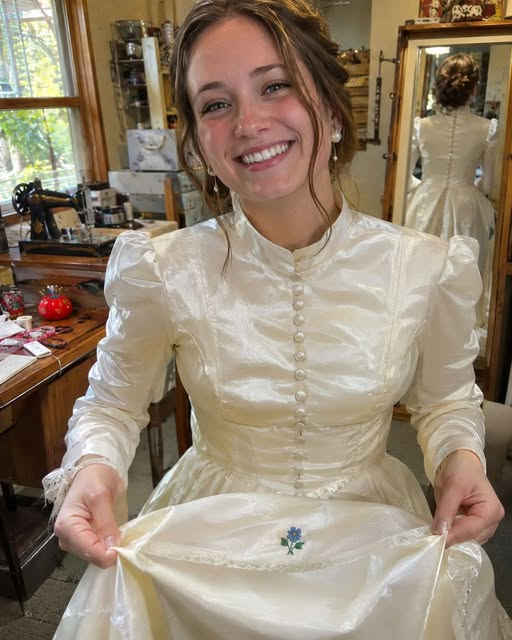
The dress was ivory satin, with long sleeves and tiny covered buttons all the way down the back. I knew every one. My mother had sewn them on by hand at our kitchen table in the spring of 1970. I can still picture her bent over the work while Lawrence Welk played on television.
“Mrs. Wiegand, are you okay?” Kenna asked.
“Turn around for me, honey,” I said. “Let me see the hem.”
I knelt down, and my knees popped like they always do. When I turned up the hem, there was a tiny blue forget-me-not stitched inside, with two little letters beside it: J.B. Jan Bauer. That was me before I became a Wiegand.
I was married in that dress on June 13, 1970. Rosemary Kline, my best friend since second grade, stood beside me in pale yellow. We’d sworn we’d wear the same dress, like sisters. Rosemary was supposed to marry Arlo in August.
In July, she came by and asked to borrow my dress for a fitting. She hugged my mother at the door, then hugged me so tight it hurt. After that, she was gone. There was no note, no wedding, and no answer when I asked where she’d gone. Her parents wouldn’t tell me. The Klines moved to Flint that fall. My dress went with Rosemary.
My mother cried over that empty hanger like she’d lost something living. I didn’t know what to do with her grief, and I didn’t ask enough questions. I wrote Rosemary eleven letters. Every one came back. For fifty-six years, I told myself she’d stolen the dress because she was jealous and the sort of person who took what she wanted.
Now Kenna was standing in front of me in it.
“Kenna,” I said, trying to keep my voice steady. “What’s your grandma’s last name?”
“Pfister now. She married my grandpa in Indiana a long time ago.”
I had my phone out before I could think. I take a picture of every dress I alter for my records. This time I took one for myself. Kenna smiled at me in the mirror and held up the hem, the blue flower in view.
That night I found the number for her mother, Candace. I told her who I was and described the forget-me-not.
She didn’t answer for a long time.
“Mrs. Wiegand, I know who you are,” she said at last. “Mama doesn’t want to be found. She told me years ago you’d never forgive her.”
“I’d like to hear that from her.”
“Let it be,” Candace said. Then her voice went hard. “If you dig this up and upset her, we’ll have the wedding down here, and you won’t be on the list.”
I heard the word wedding and thought of Garrett. “You’d keep me from my grandson’s wedding over a dress?”
“I’m trying to protect my mother,” she said. “Please don’t make this harder.”
I was angry enough to say something I regret. I told her she had no right to decide what I could forgive, and I hung up before she could answer.
Then I sat in my dark kitchen with the phone in my hand.
Maybe Candace was right. Maybe some doors stayed shut for a reason. Maybe I was a foolish old woman chasing a dress because I’d never gotten over being left behind.
But I kept seeing my mother crying over that empty hanger. I wanted to know what had been worth all those years.
At five the next morning, I filled my Thermos and got in my Chevy. I drove six hours on I-69 and the state roads, past fields gone brown for winter. I didn’t call ahead. I didn’t want Rosemary to have time to prepare an answer.
Her address was on the garment bag tag, written in her own hand: “for returning it.” It was a yellow house on Mill Street, right where the tag said it would be. A wheelchair ramp went up beside the steps. A wreath hung on the door.
I sat in the car for twenty minutes with both hands on the wheel. Then I walked up the ramp, because my knees wouldn’t do the steps, and knocked.
Someone shuffled inside. A dog barked once. The door opened, and a little old woman stood there with a walker and short white hair. She looked at my face for a long second, then put her hand to her mouth.
Fifty-six years, and I’d know those eyes in the dark.
“Janny,” she whispered. “I kept it pressed every June, because I promised your mother I’d bring it back to you when I could tell you why I left.”
The answer was that Rosemary had been pregnant with Arlo’s child, and she couldn’t make herself marry him just because a baby was on the way.
I just stood on the ramp and looked at her. The dress was there in her house, and so was the truth I’d been trying to make up for her all these years.
“Come in,” Rosemary said. Her fingers tightened around the walker. “Please.”
I stepped inside. She eased herself into a chair, then pointed to a second one. A folded sheet of tissue paper lay on the table beside her. She’d kept it with the dress. My anger was still there, but I couldn’t pretend I didn’t feel sorry for her, too.
“Why didn’t you tell me?” I asked.
“I was ashamed,” she said. “And then I was ashamed that I’d let so much time go by.”
“That’s not an answer.”
She nodded. “No. It isn’t.”
I sat across from her. “Start at the beginning.”
Rosemary looked down at her hands. “I was already late when I borrowed your dress. I found out a little before that. I thought Arlo would be happy. He wasn’t angry, Janny. He just looked at me and said he’d marry me because it was the decent thing to do.”
She paused, swallowing. “He said we could make a life. But he didn’t love me the way I thought he did. I couldn’t make myself walk down an aisle knowing I’d be the reason he stayed.”
“Why didn’t you tell me? You were supposed to be my best friend.”
“I know.”
“You had me writing letters to a place you weren’t living.”
“I know.”
I was furious. I said the thing I’d held back for decades. “You made me think I wasn’t worth one honest sentence.”
Rosemary’s face tightened. “You were worth more than that. I was a coward.”
I wanted her to argue. I wanted the years to have made her mean enough that I could leave without feeling anything else. She only sat there with her hands folded, taking what I said.
She told me she’d gone to my mother after she left. Not the day she vanished, but later, when she had found a place in Indiana and could write without her parents seeing the letter. My mother had answered. Rosemary had brought that letter with her and set it on the table.
The paper had yellowed at the edges. I recognized my mother’s handwriting at once. The capital J in “Janny” had a little hook that no one else made.
I picked it up.
My mother wrote that she was glad Rosemary had found a place to stay. She said Rosemary should never have taken the dress without asking, and she should never have left me without a word. Then she wrote that she wouldn’t tell me Rosemary’s whereabouts for her, but the truth belonged to me and Rosemary would have to tell it herself.
At the end, my mother had written: “Keep the dress safe. You owe Janny the truth, and you owe her the dress. When you can face her, bring it home.”
The letter shook in my hand. My mother had known. She had known where Rosemary was, and she had let me believe my friend had simply stolen the dress and vanished.
“She kept that from me,” I said.
“Yes,” Rosemary answered. “She didn’t want you to go looking for me while I was trying to get settled. She thought if you knew I was pregnant, you’d feel you had to rescue me, and she didn’t want your wedding and your new life pulled into it.”
I put the letter down. “That was her choice to make? Whether I got to know?”
“No. It wasn’t.”
“How long did she know?”
“Not long after I went. I wrote her once I was safe. She told me she wouldn’t tell you for me. She said I had to come back and do it myself.”
“And you didn’t.”
“No.”
Rosemary explained that she went to Indiana because she had no other place she trusted herself to go. Her parents had been set on her wedding to Arlo. She was afraid they’d insist she go through with it, and she didn’t know how to stand up to them and tell them she was carrying a child. She didn’t want to live with the shame of people knowing, and she didn’t want Arlo to marry her out of obligation.
She left with the dress because it was what she had borrowed. She told herself she’d return it after she was settled. Then the baby came, and there was always some reason she couldn’t face me. Later, she met the man who became Kenna’s grandfather and married him in Indiana.
“You wore it?” I asked.
“I did. I didn’t have another dress, and it was the only thing I’d taken that felt like mine.” Her eyes filled. “I told myself I’d bring it back after the wedding. Then after the baby was older. Then after I’d made a life. I kept making the promise smaller until it was only that I’d keep it safe.”
“And every June?”
“Every June I took it out and pressed it. I’d think, this is the year I go back. I never did.”
I let the letter rest on my lap. It explained how my mother knew. It explained why Rosemary left. It didn’t make the years disappear, or make it all right that I had mourned a friendship without knowing what happened.
“Did you ever try to find me?”
“I looked you up once,” she said. “I saw you had the hardware store. I couldn’t make myself call. I thought you’d hear my voice and hang up.”
“I might have.”
“I know.”
I went quiet, then said, “I spent a long time hating you. I’m not going to say I don’t.”
“You have every right.”
That answer made me angrier again. It was easier when I could picture her as a girl who’d taken the dress to punish me. It was harder to sit across from a woman who knew she’d hurt me and had been afraid to face it.
The phone on the table rang. Rosemary glanced at it, then at me. “That’ll be Candace.”
“Let it ring.”
She didn’t reach for it. It rang again, then stopped.
“Your daughter knows I’m here?” I asked.
“She knows you were coming. She called me last night after you spoke to her.”
Rosemary said Candace had told her I was driving down. Candace had wanted to keep me away because she believed her mother might not be able to bear the meeting. She also didn’t want the family wedding turned into a reckoning. That sounded like care, until I remembered Candace had threatened to take my grandson’s wedding away from me.
“I don’t want to be kept from Garrett,” I said.
“I don’t want that either.”
“Then you need to tell him the truth.”
Rosemary nodded. “I will.”
“And Kenna.”
“Yes.”
I looked at the dress tag in the clear garment bag. “Why did you tell Kenna to bring the dress to me?”
Her eyes moved to the table. “I didn’t. I told her I wanted you to see it. I was going to ask her to bring it when I could find the nerve to come myself.”
“So she was told to bring it to the lady at the hardware store.”
“I said that. I thought if she saw you first, maybe I’d have to stop hiding.”
It was a strange thing to hear. The dress had reached me before the woman who had kept it. I wondered how long Rosemary had planned to say what she’d just said, and how much of her plan depended on Kenna doing the brave part.
“Did Kenna know any of this?”
“No. She only knew the dress was mine and that you’d be the one to alter it.”
The phone rang again. Rosemary answered this time.
“Candace,” she said. “She’s here.”
There was a pause. Rosemary turned the phone so I could hear.
“I’m sorry,” Candace said. Her voice was tight. “I shouldn’t have threatened you.”
“You shouldn’t have.”
“I didn’t know the whole story. Mom told me you’d sent her letters and she couldn’t face you. She said she’d taken the dress and left. I thought keeping you apart was what she wanted.”
“You knew enough to call me Mrs. Wiegand and tell me she’d never forgive me.”
“I did,” she said. “I thought you’d make her tell everything before she was ready.”
“She’s told me. And I’m still here.”
Candace breathed out. “I’m sorry.”
I wanted to accept the apology and be done with it. I couldn’t. “You can’t threaten to uninvite me from Garrett’s wedding because I asked a question about my own dress.”
“I know. I shouldn’t have said it.”
“Tell Garrett what you said. Don’t leave him to hear some other version.”
“I will.”
Rosemary watched me as I set the phone down. “She loves you,” she said.
“She can love me and still be wrong.”
“I know.”
I was tired. My back hurt from the drive, my coffee had gone cold, and there was no way to make the morning easy. I looked at Rosemary and admitted the part I was nervous to say out loud.
“I don’t know if I can forgive you yet.”
She nodded. “You don’t have to.”
That was the first thing she’d said that didn’t ask anything of me.
We stayed in the room a while longer. I asked about the child she’d been carrying, and Rosemary told me she’d had a daughter. She spoke about her in a plain, careful way, like she didn’t want to turn a life into an excuse. I asked what happened to Arlo. She said he went on with his own life, and she never saw him again.
“He didn’t make you leave,” I said.
“No. I did that. I chose not to marry someone who didn’t want me. But I could have come back and told you. I didn’t.”
“And the dress?”
“I took it. I should have asked. I should have returned it.”
I could hear how cleanly she said it. No attempt to put the blame on the baby, or Arlo, or my mother. That mattered, though it didn’t repair the hurt on its own.
When I stood up to leave, she reached for the walker. “Will you let me see Kenna in the dress?”
“I’ll ask her.”
“I know I have no right to ask for anything.”
“You don’t have to keep saying that.”
She stopped. “All right.”
I took the letter with me, after asking if I could. Rosemary said yes. My mother’s handwriting was evidence, but it was more than that. It was the part of her life she’d kept from me. I needed time with it.
The drive back seemed longer. I kept replaying Rose’s words and getting mad all over again. Then I’d remember her hands gripping the walker and feel sorry for her, and then I’d get mad at myself for feeling sorry. I had lived with one answer for so long that learning a different one didn’t settle me.
When I got home, I called Garrett. I told him I’d found Rosemary and that I needed to talk with him and Kenna before their wedding. He asked if something was wrong with the dress.
“Nothing is wrong with the dress,” I said. “The trouble is all of us.”
We met at the hardware store the next afternoon. Kenna came in carrying the garment bag. Garrett stood close beside her. Candace came too. She looked like she hadn’t slept much.
I put my mother’s letter on the worktable. Kenna took it in both hands and read it slowly. Garrett leaned over her shoulder. When she reached the line about bringing the dress home, she looked at me.
“Grandma said it belonged to her,” Kenna said. “I didn’t know she’d taken it from you.”
“She wore it for her wedding,” I said. “And she should have returned it.”
“I should have,” Rosemary said from the doorway.
We all turned. Candace had brought her mother with her. Rosemary stood with her walker, one hand on the handle, her eyes fixed on the letter.
Kenna crossed the room and hugged her. “You could’ve told me.”
“I know, sweetheart.”
“You could’ve told Mom.”
“I know.”
Candace looked at the letter. “You never said Grandma Bauer had written back.”
“No,” Rosemary said. “I didn’t want you to know how long I’d waited.”
“How long did you think you could keep it from Jan?” Candace asked.
Rosemary answered without looking away from me. “I didn’t think it through. I kept telling myself I’d do it later.”
Candace’s mouth tightened. “And you let me tell her not to come.”
“I didn’t tell you to do that.”
“You told me she’d never forgive you.”
“I thought it was true.”
“It might be,” I said. I wasn’t ready to soften it for either of them. “But you don’t get to decide for me.”
Candace looked down at the table. “You’re right.”
Garrett had been quiet. He touched Kenna’s shoulder. “I wish you’d called me when Mom threatened to change the wedding.”
“I didn’t want to drag you into it,” Candace said.
“You already did.”
She nodded. Her face had lost the hard look from the phone. “I was trying to keep Mom from getting hurt. I thought if I stopped this, the wedding would stay about you and Kenna.”
“It can still be about us,” Kenna said. “But I’m wearing Grandma’s dress. That means I want to know where it came from.”
Rosemary put both hands on the walker. “You have a right to know. I ran away because I was carrying a baby and didn’t want to marry Arlo out of duty. I took Jan’s dress without asking. I kept it all these years because I was ashamed to bring it back.”
Kenna reached over and squeezed her hand. “I’m glad you’re here now.”
It was the first time I saw Rosemary cry. She tried to turn her face away, but she was too slow.
I didn’t go to hug her. I was still angry, and I wasn’t going to pretend otherwise. But I moved the letter closer to her and said, “You should tell the rest of the family yourself. No more making other people carry it.”
“I will.”
“And you’ll tell Garrett’s relatives what happened, if they ask why there’s an old dress in the family.”
“I will.”
Candace touched my sleeve. “I want to make this right with you.”
“Then don’t keep me out of my grandson’s wedding.”
“I won’t. You’re invited. You were always invited.” She swallowed. “I made it sound like I could take that away.”
“You did.”
“I’m sorry.”
I nodded. It wasn’t a full forgiveness. It was enough to let her stand there without turning away.
Then Kenna unzipped the garment bag. The satin caught the light from the sewing-room window. I reached for the hem, but she stopped me.
“Before you alter it,” she said, “I want Grandma to see it on me.”
Rosemary stood beside the mirror. Kenna stepped behind the curtain and changed. When she came out, Rosemary’s fingers lifted toward the buttons, then stopped short.
“May I?” she asked.
Kenna turned her back to her. Rosemary ran one finger down the row of tiny buttons. At the bottom, Kenna lifted the hem enough to show the blue flower.
Rosemary looked at it for a long time. “Your great-grandmother stitched that.”
“She did,” I said.
“I used to touch it every June.”
The room was quiet. I could have told her that touching it wasn’t the same as bringing it back. I could have said it again and again. Instead, I put my tape measure around Kenna’s waist and asked her to stand straight.
“Let’s see what needs taking in,” I said.
Garrett smiled at Kenna in the mirror. Candace stood by the door, holding the garment bag. Rosemary stayed close enough to watch, but she didn’t reach for the dress again without asking.
I pinned the satin at the side seam. Kenna held still, and Rosemary watched my hands.
When I finished, I took one more pin from my cushion and tucked it into the hem.