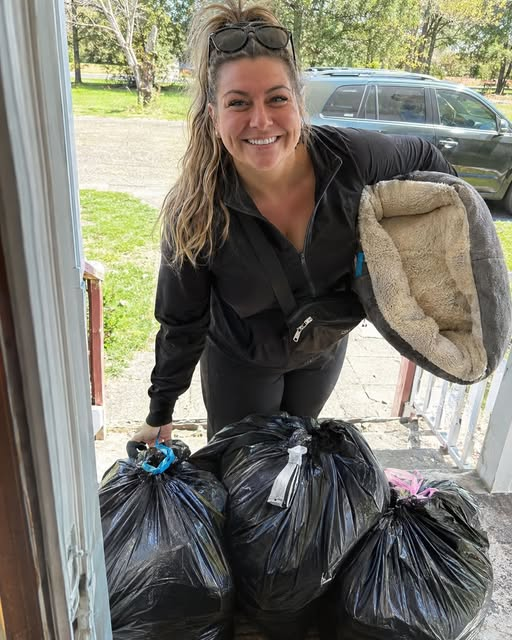
My son’s wife dropped three garbage bags of dirty laundry on my porch. “You’re retired now. You’ve got nothing but time,” she said. The next week it was four bags and the dog’s bed. I smiled and told her next week would be extra special.
“Tami, you sold the shop?” Bobbye hollered across the street the day the sign came down.
“Twenty-six years of funerals and proms,” I hollered back. “My knees voted.”
I’m fifty-four. I ran the little flower shop on the square in our town in southern Illinois from the time I was twenty-eight until I sold it in April. I did every wedding, every prom corsage, and every casket spray in this county. People brought me pictures of their daughters’ dresses and told me what colors their mothers liked. I knew how to make flowers look right even when the family was having a hard day.
The young couple who bought the shop were sweet, and I was ready to let them have it. I wanted to rest my knees and finally go through Mama’s recipe box, which had been sitting on my kitchen counter for years. I told myself I would make every recipe, front to back. I got as far as the A’s.
The first Monday in May, Kasey pulled into my driveway. She stayed in the car long enough to pop the trunk, then came around and carried three black garbage bags up my porch steps. She set them down like she was dropping off groceries.
“Laundry,” she said. “You’re retired now. You’ve got nothing but time.”
“That’s a lot of time,” I said.
She laughed as if I’d made a joke and drove off to her nail appointment. My son worked long shifts at the power plant. Kasey and he had a washer and dryer in their house, a nice set with two bathrooms around it. I knew because I had helped them pick it out.
I could’ve said no right then. I didn’t. I was proud, I hated a fight, and I loved my boy. I told myself I was helping him, even though he hadn’t asked me to do it.
So I washed the work jeans, the yoga pants, and a whole bag of towels. I folded everything on my kitchen table, loaded it into my car, and drove it back Tuesday. Nobody said thank you. I still didn’t call it a problem.
The next Monday, there were four bags and the dog’s bed stuffed on top. It smelled exactly like a dog’s bed.
“Is the dog retired too?” I asked.
“Oh, and could you iron his work shirts?” Kasey said. “He likes them crisp.”
I took the bags inside. I wish I could say I set them back on the porch, but I didn’t. I washed them, too.
The third Monday, Kasey showed up with five bags.
“My sister’s staying with us,” she said. “I threw her stuff in. You don’t mind.”
I did mind. I stood at my kitchen table at midnight folding the underwear of a grown woman I’d met twice. I cried, and I’m not ashamed to say it. It wasn’t about the socks. I had given that family twenty-six years of Saturdays, and somehow I had become the help.
Mama’s recipe box sat on the counter, still stuck on the A’s. I hadn’t made one card all summer, not even her apple butter. I kept looking at the box and then at the laundry, as if I might be able to explain to myself why the laundry always won.
The next morning, Bobbye caught me hauling bags to my car. She’d run the coin laundry on Main Street since before I was born. She was seventy, had been widowed twenty years, and didn’t take much off anybody.
She looked at my face, then at the bags.
“Tami, honey, how many is that?”
“Five.”
“Every week?”
“Every Monday.”
Bobbye set her coffee cup on my porch rail. “Honey, I charge two dollars a pound for wash and fold. Your daughter-in-law owes you about a thousand bucks.”
I laughed for the first time in a month. It surprised me how good it felt.
Right there on the porch, Bobbye and I made a plan. I called my son first because I’m not sneaky with my own boy.
“Your wife’s laundry is coming home a little different next week,” I said.
He groaned. “Mom, please don’t embarrass her. She’ll tell the whole town you’re bitter about selling the shop.”
That stung. Maybe I was bitter. Maybe I was supposed to fold the socks and keep my mouth shut. I hung up and thought about it for a whole day. Then I thought about that dog bed and called Bobbye.
“We’re doing it,” I said.
“Oh, good,” she said. “I already bought the paint.”
That Sunday, Kasey called to make sure.
“Tomorrow, right? I’ve got the guest room sheets too.”
“Oh, honey,” I said. “Tomorrow’s going to be extra special. I promise.”
Monday morning, I got up at five. I’d finally made a batch of Mama’s apple butter that weekend, and I set out a jar for Bobbye. She came across the street at six with a folding table under one arm and her cash box under the other. Her grandson followed with the big shipping scale from the laundry, the one with the hook.
We worked on my porch in our housecoats while the street was still asleep. Bobbye had painted a sign. I put it on the folding table, then brought out a pad of paper and a pen so we could write down what came in and what it would cost. A little before eight, Bobbye went inside to wait in my front room. She peered through the blinds and giggled like a schoolgirl.
At eight, I heard Kasey’s car. I heard the trunk pop. I heard her grunting up my steps with all those bags.
Then I heard her stop. It got so quiet out there I could hear a robin. Bobbye grabbed my arm, and her shoulders shook. I took off my apron, smoothed my hair, and opened the front door.
On the porch, waiting for Kasey, was a hand-painted sign that read, “WASH AND FOLD, $2 A POUND.”
Beside it sat the hanging scale, the cash box, and the paper where Bobbye had written down the price. Kasey stood with two bags still in her hands. She stared at the sign, then looked at me.
“What’s this?” she asked.
“Your laundry has a price now,” I said. My voice shook a little, which annoyed me. I had been brave enough to set everything out, but it was still hard to look her in the face.
Kasey set the bags down harder than she needed to. “You made a business out of this?”
“Bobbye already runs one. This is her price.”
Bobbye stepped into the doorway behind me. She was still smiling, but she had her arms crossed now. “Two dollars a pound for wash and fold. Same as I charge at the laundry.”
Kasey looked from Bobbye to me. “Tami, you’re really going to charge family?”
I felt my temper rise. For weeks, I’d been trying to make this easier for her, as if a softer voice could make the whole arrangement less insulting.
“You didn’t ask me to help,” I said. “You dropped off your laundry and told me I had nothing else to do.”
Her mouth tightened. “I thought you wouldn’t mind.”
“You said that after you brought it. You never asked.”
She glanced at the scale. “It’s just a few things.”
Bobbye reached for the nearest bag. “Then it’ll be quick to weigh.”
“No,” Kasey said. She pulled the bag back. “I don’t want all this turned into a scene.”
I took a breath and looked at the dog bed poking out of the top bag. “You brought five bags and a dog’s bed to my house. It was already a scene. I just didn’t say so.”
Bobbye didn’t laugh this time. She picked up the dog bed and held it out. Kasey looked embarrassed for a second, then angry that we had seen it.
“It’s a lot at our house,” she said. “My sister’s staying with us. He works those long shifts. I thought you had time.”
“I do have time,” I said. “That doesn’t mean it’s yours.”
That was the first time I said the plain thing without padding it. My face felt hot, and I was glad Bobbye stood beside me.
Kasey looked toward the street, then back at the bags. “I thought you liked being useful.”
It landed harder than the first insult. I stared at her, and for a second I could not think of a thing to say.
Bobbye said, “She ran a flower shop for twenty-six years. She knows the difference between being useful and being used.”
“That’s not what I meant,” Kasey said.
“Then what did you mean?” I asked.
She rubbed her thumb across the strap of one bag. “You were home. I had errands. It made sense to bring it over.”
“Your laundry doesn’t become my job because you have errands.”
Kasey looked down at the sign again. “You could’ve just told me no.”
I almost said I had tried, but I hadn’t. I had smiled and made a joke and then washed every bag. I had made it easy for her to pretend I was fine with it.
“I should’ve told you the first week,” I said. “I didn’t. That part is mine. But I am telling you now. I’m not washing any more of your family’s laundry for free.”
She studied my face as if waiting for the smile that would tell her I was kidding. I didn’t give her one.
“So that’s it?” she said. “You want me to take all this home?”
“Yes.”
Kasey shook her head. “I can’t believe you’re doing this over laundry.”
I looked at the pile. “That’s what I said to myself, too. Then I spent a night folding your sister’s underwear.”
Her face changed. She glanced toward Bobbye, who had gone quiet, and then at me.
“You don’t need to tell everybody that.”
“I didn’t. You brought it to my house.”
Kasey’s eyes went to the bags again. “I thought you wanted something to do after you sold the shop.”
That was the line she had been using in her own head. I could see it, and it didn’t make me feel much better.
“I wanted to make Mama’s recipes,” I said. “I wanted to rest my knees. I wanted to spend a Monday doing what I chose.”
For a moment, she looked as if she might argue. Then she looked at the scale and the paper, and something in her shoulders gave way.
“I can’t afford to pay you two dollars a pound,” she said.
“Then don’t,” Bobbye replied. “Take it to your house and use your washer.”
Kasey turned toward Bobbye. “You don’t have to get involved.”
“She asked me for help,” Bobbye said. “You asked her for free laundry.”
Kasey picked up the first bag. She had brought them expecting me to take them inside, not take them back. The bags dragged against her legs as she carried them toward her car.
I stayed in the doorway. “The dog bed too.”
She stopped, looked at me, and then went back for it.
When the trunk was full, Kasey shut it and turned around. She wasn’t smiling now.
“I’ll tell my husband,” she said.
“Please do.”
She got in and drove off without asking if the next week would be different. I watched her turn out of the driveway. Bobbye took the paper off the table and folded it once.
“Well,” she said, “that was more exciting than my Monday usually gets.”
I laughed, but my hands were still trembling. “I don’t know why I let it go on that long.”
“Because you love your son,” Bobbye said. “Now he can know what happened.”
I called him after he finished his shift. I didn’t want him hearing some version of the story from Kasey first. When he answered, I told him she had come by, seen the sign, and taken the laundry home.
He was quiet for a beat.
“Did you really put a price on it?” he asked.
“Bobbye did. It’s what she charges.”
“Mom, I told you not to embarrass her.”
“And I told you the laundry was coming home different. You didn’t ask what I meant.”
He let out a breath. “She said you were making her stand there while you weighed everything.”
“I didn’t weigh a thing. She took it home.”
Another pause. I could picture him at the kitchen table, rubbing one hand over his face the way he did when he was tired. “She said you told her she was using you.”
“Did she tell you she brought five bags every Monday?”
“She said she thought you were helping.”
“I thought I was helping you. I was wrong about that.”
He didn’t answer right away. I was nervous about what he might say next. It wasn’t the laundry I feared losing. It was my boy, believing his wife before he believed what I told him.
Then he asked, “How long has this been going on?”
“Three weeks with the big loads. Before that, I did the first three bags.”
“So since May?”
“Yes.”
He was quiet again. I could hear the plant in the background behind him, the sound of work still happening while we talked. “I knew she was dropping stuff off,” he said. “I didn’t know it was every week.”
“You knew enough to ask me not to embarrass her.”
“You’re right.”
That was all he said at first, but it mattered. I had been worried he would tell me it was nothing, or that I should’ve kept doing it because I had time. Instead, he asked if he could come by after work.
When he came, the sign was still on the folding table. Bobbye had gone back across the street, but the scale and the paper were there. I hadn’t put them away. I wanted my son to see what I had seen: a plain price, on a plain sign, for a job nobody had asked whether I wanted.
He stood on the porch and read the sign.
“She said you were trying to shame her,” he said.
“I didn’t put it up for the whole town. I put it up where she left the laundry.”
He picked up the paper. Bobbye had written the price on it and left space to record the weight. There were no weights on the page because Kasey had taken the bags home. He looked at the empty spaces, then at the scale.
“She told me you charged her for the bags she brought,” he said.
“I didn’t charge her anything. She took them home.”
He rubbed the back of his neck. “She was mad.”
“So was I.”
He looked at the bags nowhere on the porch, the place where they had been stacked every Monday. “I should have asked you what was happening instead of telling you to protect her from the town.”
I was still hurt by what he had said before. I didn’t want to wave it away just because he was standing in front of me now.
“That hurt,” I told him. “You made it sound like I was petty for wanting my own time back.”
“I know. I’m sorry, Mom.”
He looked at the sign again. “Why did she think you would do it?”
“I don’t know. Ask her.”
He did. He called Kasey from my porch, and I could hear her voice through the phone, though I couldn’t make out every word. He didn’t put it on speaker. He walked down the steps and stood by the driveway while they talked. I went inside, but the front door was open. I could hear the parts she said loud enough for me to hear.
“I told you I thought she was okay with it,” she said.
My son answered too quietly for me to catch.
“I was trying to get the house under control. I had things to do. She was home.”
Then he said, “But you never asked her.”
There was a pause.
“I thought she’d say something if she minded,” Kasey said.
I stood in my kitchen with my hand on the edge of the counter. That was the whole truth of it. She had counted on my not saying anything.
My son came back inside a few minutes later. He looked tired and uncomfortable.
“She said she figured you had time, and it saved her a trip to the laundry,” he said. “She says she wasn’t trying to make you feel like the help.”
I looked at him. “She told me I had nothing but time.”
He looked down at the porch floor. “I know.”
“She laughed when I tried to answer her. Then the bags kept coming.”
He nodded once. “I’m sorry I didn’t see it.”
I wanted to tell him it was all right. It wasn’t. I wanted to be the easy mother, the one who didn’t make a fuss, but I had already spent months doing that. So I let the apology sit between us without fixing it for him.
He reached for the folding table. “Do you want me to take this down?”
“No. Bobbye painted the sign.”
He set the table back where it was. “Kasey won’t bring more laundry.”
“She shouldn’t.”
“I’ll make sure she doesn’t.”
I looked at him. “I don’t want you to make a rule for her. I want her to know she can’t leave things here unless I say yes.”
He nodded. “I’ll tell her.”
It wasn’t a grand reconciliation. He didn’t have a speech ready, and I didn’t suddenly feel better about the weeks I’d spent washing someone else’s clothes. But he had finally heard the part that mattered.
Kasey called me that evening. She didn’t apologize right away. She said she had been stressed and that she hadn’t meant to make me feel bad. I told her I understood that she had things to do. I also told her the laundry was hers to do from now on.
“You’re serious about that?” she asked.
“Yes.”
She said she’d take care of it. I said good. We ended the call without arguing.
The next Monday, there were no bags on my porch. I didn’t get a thank-you or a note. I didn’t need either one to know the laundry had stopped. My son called a few days later and said they were doing their own loads. Kasey had taken the guest sheets to the washer, too.
I put the sign away after that. Bobbye wanted it back for the coin laundry, and I gave it to her with a jar of apple butter. The recipe box was still on my kitchen counter. I opened it to the next card, wiped a bit of flour off the edge, and set the kettle on.
That Monday, the porch stayed empty while the apple butter simmered.